

There is a peculiar point in every American election when politics stops resembling politics and starts resembling the final hour of a particularly unruly wedding. Everyone has been drinking for too long, somebody is shouting from the back, the speeches have gone wildly off-script and an elderly gentleman at the front has started talking about another man's arse.
Welcome to the final weekend of the 2026 US midterms.
We did the Idiot's Guide earlier this week, explaining what Americans are actually voting for on Tuesday, why 218 matters in the House, why 51 matters in the Senate and why Donald Trump can remain President while simultaneously losing much of his ability to get things through Congress. This isn't that article. Consider this the pre-weekend form guide. We will do the proper predictions piece video on Monday, once the final weekend's polling, campaigning and assorted American electoral lunacy have arrived, ready for publication either Monday afternoon or Tuesday morning. Please do look out for it. For now, we're not calling it. We're simply looking at where things stand before the last frantic weekend begins.
And things are getting rather interesting.
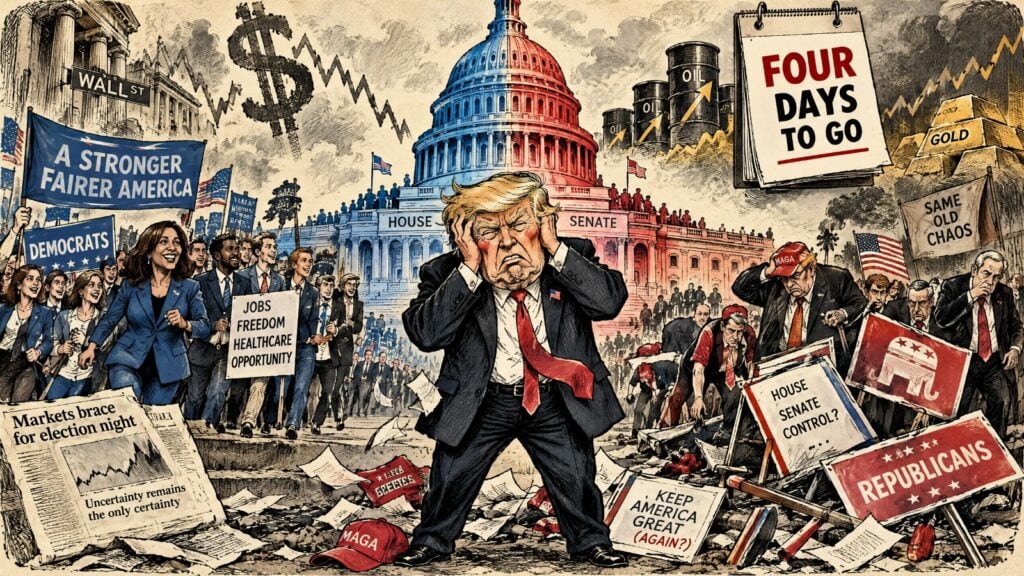
Start with the national picture. The latest Reuters/Ipsos polling has Trump's approval rating at 32%, fractionally above the 31% record low it hit the previous week. More importantly for Tuesday, registered voters preferred Democrats to Republicans for Congress by 47% to 36%. Once undecided voters were pushed to say which way they leaned, that became 50% to 41%, while likely voters broke 53% to 44% for the Democrats. CNN's poll-of-polls is in essentially the same territory, putting the generic congressional ballot at 52% Democrat and 43% Republican.
That is a significant national advantage. It is not, however, the same thing as saying Democrats are nine points ahead everywhere. America does not elect Congress through one enormous national vote. House seats are won district by district and Senate seats state by state, which means Democrats can pile up millions of votes in California and New York without those votes helping them by a single seat in Ohio or Texas. This is political match play rather than stroke play: winning one hole by eight shots still only wins one hole.
The broad picture remains that the House is the easier Democratic target. Republicans have only a tiny majority and Democrats require a small net gain to take control. History isn't particularly friendly to the White House either: the president's party normally loses House seats in a midterm. The interesting question this time is therefore less whether there is a national swing against Trump and more whether that swing lands efficiently enough in competitive districts to change control of Congress.
The Senate is where this gets properly exciting.
Democrats need a considerably harder collection of victories there, and the map has broadened beyond what Republicans would ideally have wanted. North Carolina is competitive. Michigan is competitive. Maine matters. Ohio matters. Iowa and Kansas have attracted attention. And then there is Texas, where the fact that Democrats are seriously contesting a Senate race at all tells you something about the political environment. None of this means Democrats are going to sweep those states. It means Republicans are spending the final days defending territory they would much rather not be worrying about.
Early voting isn't calming anybody down either. More than 13 million Americans had already voted by last week's count, with participation running substantially ahead of the equivalent stage in 2022 in several important states. That doesn't tell us who is winning. Early voting is not an exit poll, voting rules change and the partisan composition of early voters can shift dramatically between elections. What it does tell us is that Americans are paying attention.
The Democrats' closing argument has been fairly recognisable political campaigning. Barack Obama has been back on the stump, including in Georgia, while candidates across the battlegrounds are hammering affordability, healthcare, the Iran war, petrol prices and Trump's record in office. The central Democratic proposition is increasingly straightforward: whatever you think of Trump, give Congress the ability to put a brake on him.
It is hardly revolutionary campaign strategy, but it is at least recognisably campaign strategy.
Trump's closing campaign, meanwhile, has become increasingly bizarre. That isn't a diagnosis or an attempt at faux neutrality. It is simply my assessment after watching what has actually been happening at these rallies. The President of the United States has spent a remarkable amount of the final fortnight before a potentially presidency-defining election discussing people's bottoms, studying men's bodies, making strange noises and performing gestures that, stripped of their supposed context, would be difficult to broadcast before the watershed.
At multiple rallies Trump has become fascinated by Ohio Republican Senator Jon Husted's physique. The story apparently began after Trump learned that Husted had been a successful college football player. Trump explained that he started “studying his body”, including his legs, feet, hands and shoulders and, repeatedly, his backside. At one rally he explained that he had “never studied the body of a man before”, adding that it was “not my thing”. In Michigan he returned to the subject, saying he had looked at Husted's backside and had “never done that with a man before”, before helpfully clarifying: “Women yes, men no.”
Its essentially another Simpsons prediction where Homer can’t get “stupid sexy Flanders” out his head whilst dressed in a skin tight ski suit-it’s like Husted is wearing… nothing at all… nothing at all… nothing at all.
He then noticed Nicki Minaj in the audience and announced that he had also looked at hers, describing it as beautiful and “hard to miss”.
This has now been going on for several rallies. Trump has even suggested that his discussion of Husted's posterior helped improve Husted's polling and told another Republican candidate that he would compliment his backside as well if it guaranteed victory. American democracy has survived a civil war, Watergate and Richard Nixon talking to portraits of dead presidents. It can probably survive the Great Senatorial Arse Strategy of 2026.
Then came Texas.
Trump was attacking Democratic Senate candidate James Talarico, whom he has repeatedly claimed is a vegan despite Talarico saying that he isn't. Trump acted out his version of Talarico attempting to eat barbecue: “I love the meat. Ahhh! I love it, look!”, while repeatedly bringing his hand towards his open mouth and making a slurping noise. I shall leave you to find the video and decide precisely what it resembles. Joe Scarborough subsequently complained that Trump's rallies were becoming too “X-rated” for morning television.
Taken alongside the ongoing discussion of male backsides, the whole closing campaign has acquired an unexpectedly homoerotic subplot that I doubt featured prominently in Republican strategy meetings.
There was also the extraordinary guttural noise in the middle of a sentence at another rally, which circulated so widely that people initially assumed the clip had been manipulated. The original footage confirms that the noise happened. There is absolutely no basis for me to tell you why Trump made it, and I don't particularly care. People make strange noises. I frequently make them getting out of low chairs. I'm not President of the United States, admittedly, but nor was anyone filming me for C-SPAN.
The more relevant point is that the closing week of a US midterm campaign has reached the stage where journalists are having to authenticate presidential grunting.
And then there are the hecklers.
Trump has repeatedly claimed that protesters disrupting his rallies are being paid $250, sometimes blaming Democrats or “Soros people”, without publicly producing evidence establishing that the particular protesters are receiving $250. Nevertheless, the figure has now become part of the routine. Two hundred and fifty dollars appears to be the official presidential exchange rate for shouting something unpleasant during a speech.
One heckler, comedian Rob Potylo, managed to get himself into an unusually intimate Trump event in Ohio and began singing his “Epstein Plane” song before shouting “Butterscotch Shitler” and “Pumpkin Spice Paedo” as he was removed. These are not phrases I expected to type while covering the world's largest economy, but here we are.
Whatever your politics, American election heckling appears to have entered its Brass Eye phase.
And beneath all the absurdity, the interruptions matter. Trump's rallies have always been partly theatre. The fight with the protester, the pause while security removes somebody, the crowd turning around and booing, then Trump returning triumphantly to the microphone are all familiar features. But in the closing days of an election, when the purpose of every appearance is supposedly to deliver a disciplined message about why Republicans should control Congress, repeatedly spending time arguing about hecklers, bottoms and whether somebody has been given $250 to shout at you is not exactly textbook message control.
Perhaps the strangest piece of campaigning hasn't come from a rally at all. It arrived in supporters' inboxes.
One Trump fundraising email carried the subject line “Farewell President Trump” and featured an image of the President boarding a train and waving goodbye. “In just 1 week, we might have to say goodbye to each other forever,” supporters were told.
Then came the wonderfully needy: “Do not make me say goodbye.”
This is the President of the United States, not someone informing his university girlfriend that he's transferring to Leeds.
The email warned supporters that if Republicans lost Congress, Democrats would impeach Trump for a third time and have sufficient votes to “lock me out of the White House and throw away the key”. The problem is that this doesn't survive contact with arithmetic. A Democratic House could impeach Trump. Actually removing a president requires a two-thirds vote in the Senate, and nobody seriously expects Democrats to emerge from Tuesday night with anything remotely approaching 67 senators.
The message also warned: “If our people sit this one out, it is over. No second chance. No do-over.” Another fundraising message earlier in October reportedly warned: “This could be my final four weeks as President.”
Now, fundraising emails are deliberately hysterical. That's their job. Somewhere in Washington there is presumably a copywriter whose professional purpose is to make an 80-year-old billionaire sound as though he is typing personally to Doris in Wisconsin because her missing $47 will bring down Western civilisation. There is also no reason to assume Trump personally wrote it.
But campaigns choose the messages they send.
Taken alongside Trump's weak approval numbers, the polling disadvantage, the number of states Republicans are suddenly having to defend and an enthusiasm gap that has recently favoured Democrats, I think it is reasonable to conclude that the Republican operation looks worried. “Panicking” may be a headline writer's interpretation. Worried is what the evidence comfortably supports.
And the language is revealing in another way. The email isn't really framed around saving Republican congressmen or preserving the Senate. It is framed around saving Donald Trump.
That may be extremely effective. Fear is an extraordinarily powerful turnout operation, and Trump's ability to mobilise voters who do not behave like conventional Republicans has been underestimated before. But it also illustrates how thoroughly the Republican midterm campaign has become a referendum on a man who isn't actually standing for election.
There is another rather delicious campaign development.
Trump is actively encouraging Republicans to vote by post.
After years spent attacking mail voting, arguing that it was vulnerable to fraud and making postal ballots central to his objections to the 2020 presidential election, Trump is now telling supporters they can and should use it.
From a purely electoral perspective, this makes perfect sense. If your opponents enthusiastically use a perfectly legal method of voting while you spend years persuading your own supporters that using it is suspicious, you may eventually discover that you have invented an unusually elaborate form of electoral self-harm.
The shift is particularly interesting because Republicans have spent several election cycles trying to undo the disadvantage created by Democratic enthusiasm for early and postal voting. Election Day turnout remains enormously important, but a campaign would generally prefer its supporters to vote whenever they can rather than construct a political philosophy around everyone turning up during the same twelve-hour period and hoping nobody's car breaks down.
Pragmatism appears finally to have defeated principle.
As of Friday morning, the Democrats clearly have the stronger national polling position and appear better placed in the battle for the House. The Senate is much less certain.
That distinction matters enormously.
A sizeable national Democratic advantage can look overwhelming until you remember that Senate control may ultimately depend on whether one candidate wins Maine, North Carolina, Ohio or Texas by 0.8% rather than losing it by 0.8%. Prediction markets and polling models can tell us what outcomes currently look more probable, but probability is not prophecy. As anyone who has ever traded anything should understand, 70% is not another way of spelling 100%.
The final weekend therefore matters. So does turnout. So does candidate quality. So do local issues that barely register in national polling. And so does the possibility that a polling error of only two or three points in one direction changes several apparently close races at once.
That is why I'm not giving you my prediction today.
We'll do that on Monday, once the final weekend's polling is in, the campaigns have made their last moves and America has enjoyed another 72 hours in which to make everything even stranger.
This is where FX Axe earns its lunch.
The simplistic version would be: Republicans win, stocks and dollar up; Democrats win, stocks and dollar down. Please don't trade that. Markets are irritatingly unwilling to obey political memes.
If Republicans unexpectedly retain both chambers, the immediate interpretation would probably be continuity. Trump would retain fewer congressional obstacles to appointments, spending priorities and domestic legislation. Some equity sectors exposed favourably to his existing agenda could benefit, but investors would simultaneously have to think about deficits, tariffs and inflation. A Republican victory is not automatically bullish for bonds if markets conclude it means greater borrowing or more inflationary fiscal policy.
If Democrats take the House while Republicans retain the Senate, America gets the classic divided-government scenario. There would be investigations, subpoenas, hearings and an enormous amount of Washington theatre, but comparatively limited ability to enact sweeping new legislation. Markets have historically been perfectly capable of living with gridlock because politicians being unable to do anything also means they are unable to do anything stupid. Unfortunately, American politicians have developed the ingenious workaround of occasionally threatening not to pay the country's bills instead.
A Democratic sweep would be the more consequential political surprise. Trump's executive authority would remain substantial, particularly over foreign affairs and areas where Congress has delegated presidential powers, but a Democratic Senate would materially affect judicial and senior appointments, while Democratic control of both chambers would give the party considerably greater leverage over spending, investigations and the debt ceiling.
It would also immediately accelerate something else: 2028.
If Tuesday produces a significant repudiation of Republicans, markets will not spend two years politely waiting for the next presidential election before considering what comes afterwards. Investors will begin pricing changes in taxation, regulation, fiscal policy, trade and the likely post-Trump direction of both parties almost immediately.
For the dollar, there isn't a giant red or blue button either. FX will care about what the result means for growth, government borrowing, tariffs, inflation and therefore the Federal Reserve. A result interpreted as reducing future fiscal expansion could pull Treasury yields one way while greater political confrontation pulls risk sentiment another. Gold will care about uncertainty, real yields and the dollar. Equities are likely to split by sector rather than obediently marching together. We have many fine videos on this subject, please peruse with wild abandon.
And hanging over all of this is oil.
Brent has been trading above $110 a barrel as the market attempts to price the Iran war, the Strait of Hormuz, shipping disruption and the possibility of further escalation. That means Tuesday's election isn't taking place in a lovely sealed political laboratory. It is happening while America is involved in a war, energy prices are feeding into inflation and households are being reminded of those prices every time they stop at a petrol station.
A politically weakened Trump confronting an opposition Congress could behave differently from a Trump emerging from Tuesday with Republican control intact. Congress does not simply switch presidential foreign policy on and off, but congressional control affects funding, scrutiny and the political room available to the White House. Oil traders will therefore be watching Washington alongside everybody else.
So where are we?
Four days out, Democrats have the advantage nationally. The House looks increasingly difficult for Republicans. The Senate remains the battlefield capable of turning Tuesday night from an election into an absolute circus. Trump is unpopular nationally but still commands an intensely loyal base. Democrats appear more enthusiastic, but enthusiasm needs to become votes. Early turnout is substantial. Republicans are defending more territory than they would like.
Barack Obama is back on the stump. Trump has discovered postal voting. His campaign is emailing supporters to warn that they may have to say goodbye to him forever. Hecklers are singing about Epstein's plane. The President is insisting somebody paid them $250. He has spent an improbable amount of time discussing Jon Husted's backside, complimented Nicki Minaj's, performed a rather extraordinary piece of mime involving eating meat and made a noise that journalists subsequently had to establish was real.
Meanwhile oil is above $110, markets are trying to price congressional gridlock and the world's largest economy is four days away from an election that could completely change the final two years of Donald Trump's presidency.
So I'm not giving you a prediction today.
We'll do that on Monday, when the final polls are in.
Whatever happens, Tuesday is going to be one rocky ride.
Keep your Axe sharp, and Husted’s arse out of mind.
Join the FX Axe newsletter and stay one chop ahead.

