

I promise we do have other things to talk about.
There are some rather good blogs sitting in the FX Axe pipeline that have absolutely nothing to do with Donald Trump, the American midterms or the increasingly peculiar spectacle of modern American politics. We have businesses to discuss, markets to explore, fortunes to make and lose, and an entire world of financial absurdity that deserves our attention. Unfortunately, the United States has once again decided to do something rather important, and it would be a touch irresponsible to spend this morning discussing the price of tomatoes.
Because the results are in, and they are rather more dramatic than many expected.
The Democrats have won control of both the House of Representatives and the Senate, delivering a sweeping defeat to Republicans that reaches well beyond the usual collection of competitive seats. This wasn't simply a case of the opposition picking up a few marginal districts. Democrats won Senate races in places including Texas, Kansas, Iowa and South Carolina, states that Republicans would ordinarily expect to feature rather prominently in their victory calculations. Kansas has elected its first Democratic senator since the Great Depression. South Carolina, which Trump won by nearly 18 percentage points in 2024, has also turned blue in its Senate race.
The political equivalent of Manchester United losing to a pub team is one thing. Losing to several pub teams, including one that hasn't beaten you since the 1930s, suggests something rather more fundamental has gone wrong.
And now comes the really interesting bit: what happens next?
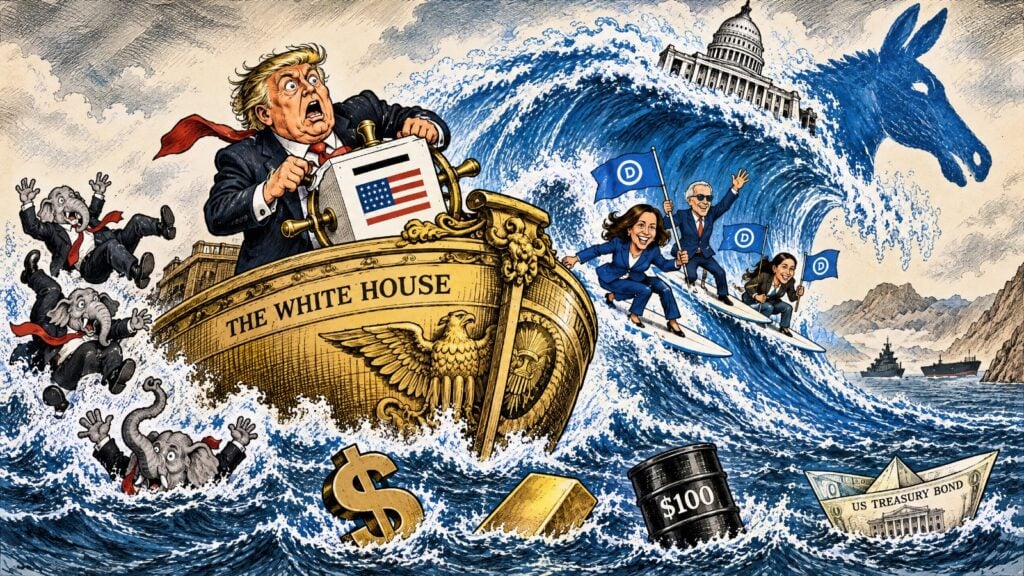
We have spent the past few weeks discussing the increasingly unusual closing stages of Trump's campaign. The rallies, the hecklers, the extraordinary fascination with people's bottoms, the fundraising emails warning supporters that they might never see him again, and the growing suggestion that the election was becoming less about Republican candidates and more about the President himself.
Well, the voters have now had their say.
There were two things I particularly expected to see if Republicans suffered a substantial defeat. The first was Trump insisting that the result had nothing to do with him. The second was a barrage of accusations about electoral fraud, stolen votes and the legitimacy of the outcome.
On the first, he has been reassuringly predictable. On the second, at least so far, I appear to have been wrong.
Trump's initial response was to announce that Republicans would have won in a landslide if he had been on the ballot. This is a slightly extraordinary position given that he spent much of the campaign explicitly telling supporters to vote as though he were on the ballot. Apparently they were supposed to pretend he was standing, but not pretend quite so convincingly.
And the landslide did arrive. Just not in the direction he had in mind. I was going to make a joke about the prospect of Trump appearing in a photograph with his shirt off, but having considered the image that would leave in everybody's minds, I think we have all suffered quite enough.
More interestingly, Trump's initial response to the defeat has been almost suspiciously civilised. He has indicated that he accepts the result and is willing to work with Democrats. There have been the predictable suggestions that Republicans would have performed considerably better had he personally been standing, but nothing resembling the immediate explosion of electoral fraud accusations that I had anticipated.
And I must admit, that has surprised me.
I had expected a much uglier immediate reaction. Instead, we have seen something approaching grown-up acceptance from a man whose political career has hardly been characterised by an enthusiasm for accepting defeat. Which leaves me with a rather uncomfortable question: what's around the corner?
Because when Donald Trump reacts to an enormous political setback with apparent composure, my instinct isn't necessarily to conclude that he has suddenly discovered the virtues of graciousness. It's to wonder what he is going to do next.
Perhaps this really is a change of approach. Perhaps the scale of the defeat has persuaded him that cooperation is preferable to confrontation. Or perhaps we are simply enjoying the unusually peaceful opening scene of what promises to be a very long and unpredictable final two years.
I don't know. And that, frankly, is what makes it so interesting.
For the moment, though, I am perfectly happy to acknowledge that my expectation of an immediate explosion was wrong. The result has been more dramatic than I anticipated, and Trump's response considerably less so.
The question now is whether that restraint survives the next news cycle.
The most important point about this election is that the defeat was geographically broad.
Republicans didn't merely lose in the places where Democrats were expected to do well. They lost in conservative states, in competitive suburbs and in races where their candidates should have enjoyed substantial structural advantages. Texas elected Democrat James Talarico to the Senate, while Sherrod Brown defeated Republican Jon Husted in Ohio. In North Carolina, Roy Cooper won a Republican-held Senate seat. Democrats also recorded historic victories in Kansas and South Carolina.
Those results matter because the Senate is not supposed to be easy for Democrats to capture on this particular electoral map. We discussed before the election how they needed to win several difficult contests simultaneously. They have now done precisely that.
The reasons are becoming clearer. Early voter surveys and reporting point towards the cost of living, dissatisfaction with the Iran war and frustration with the direction of the administration. Trump has spent much of his presidency talking about American strength, economic success and making extraordinary amounts of money. Unfortunately, the people actually buying groceries and filling their cars have not necessarily experienced quite the same financial renaissance.
That is an important distinction. A country can have profitable oil companies, a booming defence industry and a president announcing that America is making a fortune, while ordinary households find that their own expenses are becoming increasingly unpleasant.
And when that happens, voters tend to become rather less interested in how splendid the economy looks from the White House.
So what does a Democratic Congress actually mean?
First, Trump remains President. He retains the powers of the executive branch, including substantial authority over foreign affairs, military decisions and trade policy. Anyone expecting Tuesday's election to have magically cancelled every presidential tariff or brought American foreign policy to an immediate halt is going to be disappointed.
But the political environment has changed enormously.
Democrats will control congressional committees, giving them the ability to conduct investigations, summon witnesses, demand documents and scrutinise the administration's decisions. Legislation will become considerably harder for Trump to pass, particularly anything involving new spending commitments, taxation or significant changes to domestic policy. Senate control also matters for appointments, including judges and senior administration officials.
This is particularly interesting given how much of Trump's second presidency has involved the intersection of government power and private commercial interests. We have covered the family's cryptocurrency ventures, foreign business relationships and the broader questions surrounding conflicts of interest. A Democratic Congress now has far greater capacity to examine those relationships.
That does not mean every investigation will establish wrongdoing, nor does it mean Congress can simply remove Trump from office. Impeachment requires a House majority, but conviction and removal require two-thirds of the Senate. Democrats have won an extraordinary election, not abolished arithmetic.
And there is another important limitation: Trump still has the presidential veto. Democrats cannot simply pass whatever they like and expect it to become law. The result is divided government, with considerable potential for negotiation, obstruction and the occasional spectacular argument over the federal budget.
Think of it as two people being given control of the same car, one with the steering wheel and the other with the handbrake. It is possible they will cooperate beautifully. It is also possible we are about to discover what happens when both insist they are driving.
Financial markets wasted very little time reacting.
The dollar weakened as the results came through, falling as much as 0.6% against a basket of major currencies and touching a one-month low. The euro and Japanese yen strengthened, while US Treasury bonds rallied and yields fell. Gold also rose sharply, at one stage climbing to around $4,022 an ounce.
US equity futures initially suffered, particularly technology shares, as investors began considering what a Democratic Congress might mean for regulation, artificial intelligence, taxation and future government spending. Bitcoin also came under pressure, briefly falling towards $75,700 before recovering some ground.
None of this means Democrats are inherently bad for markets or Republicans inherently good. That would be a particularly foolish conclusion, and history provides plenty of evidence against it.
What markets are doing is repricing the political environment.
A Republican Congress could have continued supporting Trump's legislative agenda, including potential tax measures and spending commitments. A Democratic Congress makes many of those proposals more difficult, potentially reducing future government borrowing and fiscal stimulus. That helps explain why Treasury yields have fallen.
The dollar is more complicated. Lower yields can make dollar-denominated assets less attractive, while political uncertainty and changing expectations for economic growth influence currency flows. Gold, meanwhile, benefits from a combination of uncertainty, lower yields and a weaker dollar.
Technology companies face a different set of questions. A Democratic Congress may bring greater scrutiny of artificial intelligence, data centres and competition policy, although the precise regulatory consequences remain uncertain.
The crucial point is that this is not one enormous trade called “Democrats win”. It is a collection of smaller trades involving interest rates, borrowing, regulation, taxation and the expectations investors had already priced into markets.
And just as traders were beginning to digest all that, somebody decided to start shooting at Iran again.
Because apparently a historic American election wasn't quite enough news for one week.
The United States has carried out fresh strikes against Iranian targets on Qeshm Island, near the Strait of Hormuz. American officials have described the operation as limited and defensive, targeting surface-to-air missile threats against US forces and seeking to prevent attacks on commercial shipping.
Trump has simultaneously indicated that there are no immediate plans for further major strikes, while Iranian officials have warned that negotiations remain some distance from producing an agreement.
This is the rather extraordinary position in which the oil market now finds itself. Washington is carrying out military strikes while also suggesting that diplomacy is progressing. Tehran is warning that a deal remains distant. Qatar is attempting to mediate. And oil traders are left trying to decide whether the next major development will be a ceasefire or another missile.
There is a reason we have spent so much time discussing oil recently. It has become one of the clearest ways to measure the economic consequences of this conflict.
And the prices have moved substantially.
Earlier this morning Brent crude was trading around $103–104 a barrel, with US West Texas Intermediate around $95–97. That is a considerable retreat from the levels above $110 and $115 we were discussing only recently, although oil remains expensive by normal historical standards.
The distinction between the two benchmarks matters. When somebody says oil is at $95, they may be referring to American WTI rather than Brent, the international benchmark that matters particularly for global energy markets.
But why has oil fallen when America is still launching attacks?
Because markets are not simply pricing what happened yesterday. They are pricing what they think happens tomorrow.
Hopes of a negotiated settlement have increased, while the latest strikes appear limited rather than the beginning of a renewed large-scale offensive. Traders are weighing the possibility that the conflict might be contained, shipping restrictions eventually eased and supplies allowed to move more freely through the Strait of Hormuz.
That is a very different prospect from the escalation scenarios that drove oil sharply higher.
However, the risk has hardly disappeared. Hormuz remains one of the world's most important energy chokepoints, and the conflict continues to disrupt the movement of oil. A serious escalation, attacks on energy infrastructure or renewed restrictions on shipping could reverse the recent decline extremely quickly.
Conversely, a credible agreement that restored confidence in the safety of shipping could remove a substantial geopolitical premium from crude prices.
Oil is therefore sitting between two competing narratives: the possibility of peace and the continuing reality of war.
And neither side has yet won.
This is perhaps the most important question of all.
Before the election, there was considerable speculation about whether Trump might change his approach to Iran depending on the result. A Republican victory might have been interpreted as an endorsement of his policies, while a defeat could increase pressure to find a diplomatic solution and bring down energy prices.
But there is another possibility: that a politically weakened president becomes more reliant on the powers he can exercise without congressional cooperation.
Foreign policy is one of those areas.
Congress has important powers over funding, oversight and the authorisation of military action, but presidents retain substantial operational authority as commander-in-chief. A Democratic Congress can make sustained military operations more politically difficult and demand greater scrutiny, but it cannot simply flick a switch and end the conflict.
So the election does not tell us what Trump will do next. It changes the incentives and constraints surrounding his decisions.
One interpretation is that the scale of the Republican defeat strengthens the case for de-escalation. High energy prices have hurt households, the war has become unpopular, and a diplomatic agreement that brings down petrol prices could provide a political victory at a moment when Trump badly needs one.
Another is that confrontation with Iran becomes part of the continuing battle between the White House and Congress, creating new uncertainty over military spending, sanctions and foreign policy.
The markets will be watching both possibilities.
Personally, I would be extremely cautious about anyone confidently predicting Trump's next move. We have now spent the best part of a year discovering that attempting to forecast his behaviour using conventional political logic is rather like trying to predict the weather by interviewing a particularly angry pigeon.
Sometimes you get it right. Often you end up covered in something unpleasant.
There is a temptation after an election of this magnitude to declare that everything has changed overnight.
It hasn't.
Trump remains President. The Iran war continues. American debt remains enormous. Inflation has not disappeared. The Federal Reserve still has to make decisions based on the economy rather than election-night television coverage. And the constitutional balance between Congress and the presidency will continue to generate disputes.
But something important has changed.
For the first two years of Trump's second term, Republicans controlled Congress and the White House. From January, assuming the projected results hold, the President will face a Democratic legislature with both the political incentive and institutional power to challenge him.
That creates a very different landscape for fiscal policy, appointments, investigations and the approach to the 2028 presidential election.
It also makes the next two years potentially more volatile, rather than necessarily calmer. Gridlock can reassure markets when it prevents expensive or unpredictable legislation. It can also generate government shutdowns, debt-ceiling confrontations and prolonged battles over spending.
And, as we know, the President still has an extraordinary ability to move markets with a single statement.
Which brings us back to the beginning.
I had expected the Republicans to lose ground. I had also expected Trump to respond by attacking the legitimacy of the result. The scale of the defeat has been more dramatic than anticipated, but his immediate response has, surprisingly, been more restrained.
That is worth recognising.
Now the challenge begins. Can Trump work with a Democratic Congress? Will the two sides find common ground on spending and economic policy, or will Washington descend into two years of legislative trench warfare? Will the administration seek an agreement with Iran, or will the conflict escalate again? And can oil continue falling without another geopolitical shock sending it straight back up?
For traders, the important lesson is that an election result is not the end of uncertainty. It is often the beginning of a completely different sort.
Yesterday America voted. Today the dollar is weaker, gold is stronger, bonds have rallied, oil is hovering around $100 and the world's most powerful politician is discovering what it feels like when the electorate gives somebody else control of Congress.
He wanted a landslide.
He got one.
Just not the one he ordered.
Keep your Axe sharp. The election is over, but I suspect the fun is only just beginning.
Join the FX Axe newsletter and stay one chop ahead.

