

I am aware that Max’s Daily Chop is a relatively new blog and that, within its first week, I have now managed to write two articles about women who are famous, at least in part, for having internationally regarded breasts. I would like to reassure everyone that this is not an editorial theme.
The first was Dolly Parton. Today it is Katie Price. Statistically, I am confident the numbers will dilute over time, although I appreciate that after a sample size of about eight articles, my assurances may not yet carry the authority of the Office for National Statistics. For those of you who aren’t necessarily overwhelmed by such things, please bear with me. It is about the theme, not the carrier, and I think today’s carrier has stumbled into something genuinely interesting about money, crypto, AI, misinformation and the increasingly difficult question of how on earth we establish whether anything anybody tells us is actually true.
But first, Katie Price. Or, as she will probably always be known to men of roughly my age, Jordan.
I was a late teenager when Jordan was approaching the height of her fame as a Page Three girl, back when Page Three was still an extraordinarily successful part of Britain’s most popular newspaper and, to a teenage boy, one of its more entertaining sections. This was before anyone had invented the phrase “content creator”, although in retrospect Jordan was arguably rather ahead of the curve. The business model was certainly more straightforward.
I should also declare a peculiar personal interest. Through absolutely no reflection on either the company I keep or my own historical profligacy, I know several people who became entangled with Jordan in various ways during those years. These range from one schoolboy who, at the time, briefly achieved the social status normally reserved for astronauts returning from the Moon, to rather better-known people from the worlds of celebrity and sport. Interestingly, they’ve tended to say broadly the same thing about her: behind the Jordan caricature was somebody considerably more shrewd and canny than people assumed.
That shouldn’t really be surprising. Whatever you think of Katie Price, remaining famous for thirty years is not an accident. Jordan was the persona that got her through the door; Katie Price subsequently built the business. She emerged on Page Three in the 1990s and turned that initial fame into modelling, television, books, perfumes, clothing, reality shows, endorsements and an apparently inexhaustible market for being Katie Price. At one stage she was one of Britain’s bestselling authors: Being Jordan alone sold more than a million copies, while her empire expanded into everything from lingerie and perfume to make-up and bed linen. The Guardian — Katie Price and the business of being Jordan
She has also been bankrupt twice, so this isn’t going to become The Warren Buffett of Brighton. But there is plainly a commercial intelligence there. Katie Price realised extremely early that the valuable commodity wasn’t necessarily modelling, television or books. It was Katie Price.
And yes, having already acknowledged the mammaries in the room, Jordan’s breasts undoubtedly played an important part in establishing that commodity. But plenty of attractive Page Three models disappeared from public consciousness almost as quickly as they entered it. Katie took what Jordan had given her and built a multimillion-pound commercial career spanning three decades. There is a difference between having an asset and knowing how to monetise it, and Katie Price, whatever else you may think of her, understood that distinction remarkably well.
Which is what makes the extraordinary story of Mr. Lee Andrews so much more interesting.
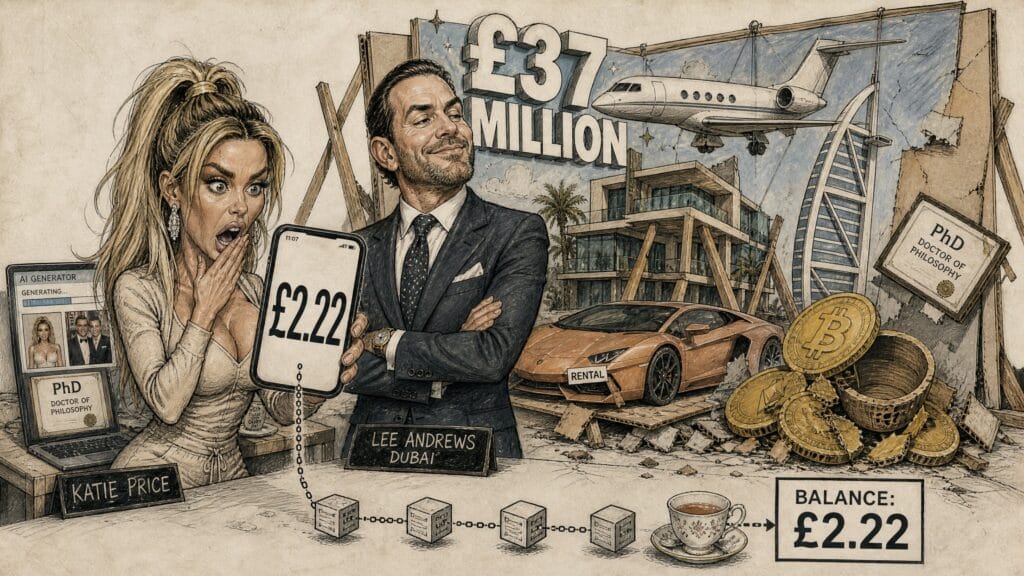
In January, Katie met a Dubai-based British businessman called Lee Andrews after they had connected online. Within days they were engaged and within about a week they were married in Dubai. Katie subsequently insisted that she knew what she was doing, describing Andrews as her “Richard Gere”.
Cupid’s bow, after all, does not consult a timetable, although Cupid might occasionally consider performing some basic due diligence.
The proposal took place at Dubai’s Burj Al Arab, with candles, rose petals and the words asking Katie to marry him arranged romantically around them. Unfortunately, reports soon emerged that only a few months earlier Andrews had allegedly proposed to another woman, fitness influencer Alana Percival, in an extraordinarily similar manner. Same city, same general rose-petal aesthetic, same basic proposition. The Standard — Lee Andrews reportedly proposed to another woman in almost the same way
Some men have a type. Lee apparently had a template.
Then people began looking at Andrews’ background, and this is where the story becomes magnificent.
His online profile presented an impressively accomplished man. Andrews described himself as “Dr Lee Andrews” and had reportedly claimed a PhD from Cambridge University’s Department of Chemical Engineering and Biotechnology. Cambridge said it had no record of him studying there; Katie later said his doctorate was actually from a university in Spain. He was reportedly a member of the Labour Party’s “Board of Advisors”. Labour pointed out that it doesn’t have one. He had reportedly been director of philanthropy at The King’s Trust. The charity said it had no record of working with him.
His LinkedIn profile also described him as founder and CEO of an electric-car venture called Aura, while records cited by The Independent showed the British Virgin Islands-registered company had been dissolved in 2024. Andrews disputed that, insisting Aura remained operational. He has also said some of the inflated CV material was the work of a former personal assistant. The Independent — Lee Andrews and his disputed CV
There were also glamorous photographs apparently placing him alongside people including Elon Musk and Kim Kardashian, which were subsequently questioned. At this point the CV begins to sound less like LinkedIn and more like the achievements section on The Sims.
There have also been clips and claims about Andrews’ extraordinary linguistic abilities. I haven’t found a sufficiently reliable primary source confirming the wonderful claim that he speaks literally every language in the world, so I’m not going to grant him that particular superpower as fact. But I desperately want it to be true, because I’d like to see Tagalog. Nothing against Tagalog; it just feels sufficiently far down Duolingo to separate the men from the boys.
Then, in May, Andrews was due to fly from Dubai to Britain to appear alongside Katie on Good Morning Britain.
He didn’t arrive.
Katie initially feared he had been kidnapped. The Foreign Office confirmed it was assisting the family of a British man in Dubai. Eventually she discovered that Andrews was alive and being held in Dubai’s Al Awir prison. Katie said he told her authorities believed he was a spy and had interrogated him. Andrews later gave his own rather more cinematic account, claiming that armed men had seized him near the UAE-Oman border, hooded and shackled him and taken him to a black site on suspicion of espionage. The Independent — What happened to Katie Price’s husband in Dubai?
Dubai authorities subsequently said the detention related to a private civil matter, not espionage, which is quite a downgrade: James Bond to unpaid invoice in approximately 48 hours.
Katie then said she had been asked for around £140,000 in connection with securing his release and, rather sensibly, declined to pay it. Remarkably, the marriage survived all of this.
Until the cryptocurrency.
According to reports this week, Andrews had told Katie that he held $50 million, around £37 million, in cryptocurrency. Eventually, after months of questions about his wealth, Katie reportedly demanded proof. Andrews supplied the recovery phrase needed to access a crypto wallet and a financial expert examined it.
It contained $3, or about £2.22. ITV News — Katie Price reportedly files for divorce after crypto claims unravel
There are financial collapses and then there is losing £36,999,997.78 simply by logging in.
According to reports, this was the final straw. Katie reportedly ended the relationship over WhatsApp and consulted a London divorce lawyer. Andrews has denied fraud allegations made against him, and Katie herself had not publicly commented on the reported divorce when ITV published its account.
So, eight months of marriage, one disputed doctorate, a possible espionage incident that apparently wasn’t espionage, £140,000 reportedly required for release and a £37 million crypto fortune worth roughly the same as a Tesco meal deal. Romance isn’t dead, but due diligence has certainly had a difficult year.
This is the bit I find interesting. It would be easy to laugh at Katie, and obviously I have just spent several hundred words doing precisely that, but she isn’t some extraordinarily sheltered person encountering a smooth-talking man for the first time.
This is Katie Price. Jordan may have been the character Britain first met, but Katie has spent thirty years in one of the most cynical industries on Earth. She has dealt with agents, managers, newspapers, television executives, publishers, sponsors, husbands, ex-husbands, lawyers, creditors and an enormous number of people whose income has at some point depended upon the commercial exploitation of Katie Price.
Indeed, the transition from Jordan to Katie was itself a rather clever exercise in brand management. A fascinating old Guardian profile describes 2004’s I’m a Celebrity as the point at which she effectively entered the jungle as Jordan and emerged as Katie, with her management deliberately broadening her appeal beyond the male audience that had made her famous. The Jordan and Katie brands even existed simultaneously for a while, aimed at different audiences. The Guardian — How Jordan became Katie Price
Her life has been so relentlessly public that Sky has now made a four-part documentary called Katie Price: Nothing to Hide. I haven’t watched it, largely because I regard reality television in approximately the same way I regard food poisoning: I understand other people experience it, but I see no reason to participate voluntarily. From the clips, Katie’s latest cosmetic incarnation is also becoming slightly Doctor Moreau for my tastes, but the broader point remains that she has survived an extraordinary amount and continues to find ways of making money from being famous. Sky — Katie Price: Nothing to Hide
And she apparently still got taken in.
That should make the rest of us slightly uncomfortable.
Because Lee Andrews is really only an unusually entertaining example of a much bigger problem. It has never been easier to manufacture credibility.
Twenty years ago, if you wanted to pretend to be enormously wealthy, you needed quite a lot of infrastructure. You needed the car, the watch, the house, the clothes, perhaps an office and ideally some actual rich friends.
Now you need Instagram.
The Lamborghini can be rented, the private jet can be a photograph taken inside a stationary studio set, the penthouse can belong to Airbnb, your 300,000 followers can be purchased, your photograph with Elon Musk can be generated and your doctorate can be typed into LinkedIn. Your £37 million cryptocurrency fortune can apparently remain entirely theoretical until somebody asks for the recovery phrase.
Dubai is almost purpose-built for this particular era. That isn’t an attack on Dubai, which contains an enormous amount of genuine wealth and serious business. It’s precisely because the place is so wealthy that it provides such an effective backdrop for people who want to look wealthy. Put on a decent shirt, stand beside a Lamborghini outside the Burj Al Arab and suddenly nobody on Instagram is asking to see the audited accounts.
This is about to become much worse. We’ve talked before about AI and investing, but the implications go far beyond asking ChatGPT whether Nvidia looks expensive. For most of human history, seeing was a reasonably useful component of believing. A photograph wasn’t perfect evidence, but it was evidence of something.
That relationship is breaking down remarkably quickly. We now live in a world where the President of the United States can publish AI-generated Canada geese with his hairstyle carrying assault rifles, and everyone has to spend half a second establishing whether the president really posted it.
He did. The geese, thankfully, remain innocent.
AI can manufacture photographs, voices, qualifications, documents and increasingly convincing video. Cryptocurrency can manufacture the appearance of enormous financial sophistication while remaining sufficiently opaque that most people have absolutely no idea what they’re looking at. Social media then gives the whole thing distribution.
We have accidentally constructed the finest bullshit delivery mechanism in human history.
And this is where the story does have something useful to say about markets. Every investment begins with a claim: this company will grow earnings 30%; this token is going to $10; this fund manager has discovered a unique strategy; this bloke in Dubai has £37 million in cryptocurrency.
The question isn’t whether the claim sounds plausible. The question is what evidence would prove it wrong?
That is one of the most useful habits you can develop as an investor, trader or frankly person attempting to function on the internet. Don’t ask only, why might this be true? Ask, what would I need to see to know whether it is? Audited accounts, blockchain records, company filings, independent reporting, regulatory registrations, actual transaction history or, in Katie’s case, apparently, the crypto wallet.
The beauty of the blockchain, incidentally, is that it was supposedly invented partly to create a world in which we wouldn’t need to trust people. Katie Price may just have discovered its killer application.
There is something almost poetically perfect about the number. If the wallet had contained £400,000, you could argue about missing funds. If it contained £10 million, perhaps the fortune had merely been exaggerated.
But £2.22? That’s not rounding. That’s a bus(t) fare.
And perhaps that is the strange lesson in the whole wonderful saga. Jordan created an image and used it to become famous. Katie Price then turned that fame into a career, built and lost fortunes, reinvented herself repeatedly and survived three decades of British celebrity culture. Lee Andrews constructed an online persona featuring doctorates, companies, glamorous connections, luxury Dubai and extraordinary wealth.
Eventually the entire edifice came down to somebody opening an account and looking at the number.
In an age of AI, crypto, social media, influencers, fake photographs, deepfakes and people confidently telling you they have discovered the investment opportunity of a lifetime, perhaps we need rather more of that.
Which is why, every morning, you can continue to rely on Max: independent, occasionally dishevelled, hair frequently askance, and with considerably less than £37 million in cryptocurrency.
But at least I can prove it.
Keep your Axe sharp. And always check the wallet.
Max
Want more of The Daily Chop?
Sharp market stories, trading takes and financial madness straight to your inbox.

