

We have talked about artificial intelligence quite a lot at FX Axe, both in these pages and in our videos, and I appreciate that saying “AI is going to change our lives” in 2026 now has roughly the revelatory power of announcing that Amazon might have an effect on the high street. It is already happening. In fact, for most of us, it has happened so quickly that we've barely noticed the point at which AI stopped being an interesting new technology and started becoming something we simply use.
I am, for example, dictating the opening of this article to my very handsome robot assistant, a description that will presumably come as music to his robotic ears. He will take my ramblings, turn them into something vaguely coherent, check whether I've remembered the numbers correctly and occasionally have the awkward responsibility of informing me that something I confidently remember happening didn't actually happen quite like that. I flatter him, he corrects me, and somehow the work gets done. It's a surprisingly functional relationship.
And that is increasingly how AI fits into ordinary life. People use it for work, research, translation, planning their weekly shop, analysing coursework, organising holidays and discovering why the washing machine is making that noise. Traders use it to interrogate markets, analyse data and test investment ideas. The interesting question is therefore no longer whether we are going to use AI. Increasingly, it is where on Earth we are going to put all the machinery required to run it.
Elon Musk's answer, rather wonderfully, appears to be: why Earth?
The Times — The data centre boom reaches the final frontier
One of the cleverest bits of marketing the technology industry ever pulled off was calling remote computing “the cloud”. It sounds wonderfully weightless: our photographs, emails and increasingly our artificial intelligence apparently floating around somewhere above us like digital cumulus.
Unfortunately, the cloud is actually an enormous industrial estate.
AI requires data centres filled with processors that consume enormous quantities of electricity and produce enormous quantities of heat. As models become larger and usage grows, the infrastructure behind them grows too, which means more chips, more servers, more electricity, more cooling, more grid capacity and more land. That has turned data centres from something most people barely thought about into an increasingly contentious political and environmental issue.
There is the electricity question: where does all this new power come from? Renewables? Nuclear? Gas? There is the physical space occupied by vast server campuses and the pressure they can place on local electricity grids. Then there is water, which has somehow become another front in America's seemingly inexhaustible ability to turn infrastructure into a culture war.
US Energy Secretary Chris Wright has been particularly bullish about the criticism. Visiting a proposed data centre in Iowa earlier this year, he pointed to its closed-loop cooling system and argued that its meaningful water consumption would essentially be limited to people washing their hands and flushing the toilets. He subsequently described broader concerns around data-centre water use as “overblown” and argued that there was probably “no higher value use of water” than using it to support data centres.
The difficulty is that water consumption isn't imaginary. Different data centres use radically different cooling technologies, and modern closed-loop or waterless systems can dramatically reduce demand, but large liquid-cooled facilities can still consume millions of litres depending on their design and location. Congress is now considering legislation specifically addressing who should pay for the additional water infrastructure required by data centres. So, irritatingly for anyone hoping for a neat political slogan, the truth appears to be somewhere between “AI is drinking the planet dry” and “the only water involved is Dave from accounts washing his hands”.
Either way, the underlying problem remains. AI requires an extraordinary amount of physical infrastructure, and the world is going to need considerably more of it.
Which brings us to space.
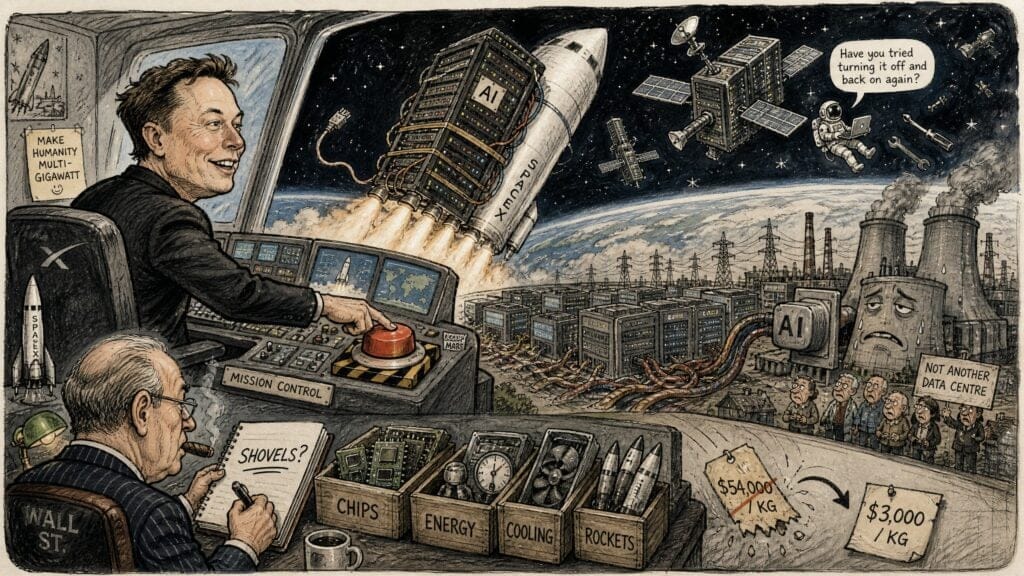
Musk and others are increasingly arguing that orbital data centres may eventually make considerably more economic sense than they initially appear to. Put computing infrastructure into orbit and several terrestrial constraints begin to disappear. You're no longer competing for enormous parcels of land near major cities, you're not placing the same burden on local electricity networks, and solar panels can potentially generate power for far longer without the rather inconvenient terrestrial interruptions of clouds and night.
There is also significantly less chance of somebody forming a residents' association because the new server farm is ruining the view from the conservatory.
The reason this has moved from science fiction towards something serious people are actually discussing is the extraordinary collapse in launch costs. According to The Times, putting one kilogram into orbit cost around $54,000 fifteen years ago. Reusable rockets, particularly those developed by SpaceX, have helped bring that figure down towards roughly $3,000 per kilogram, while projections suggest future launch systems could eventually push it towards $200.
At $54,000 a kilo, launching a data centre into space sounds like the sort of business plan you'd normally encounter immediately before somebody asks you to invest in their cryptocurrency. At $200, you start reaching for the calculator.
And this is where technological forecasting becomes so difficult. We have a habit of judging tomorrow's ideas using today's economics. The first commercial computers were ludicrously expensive. Early mobile phones were enormous bricks carried mainly by people who wanted everybody in the restaurant to know they owned a mobile phone. International telephone calls were once treated as events. Then costs collapsed, infrastructure improved and things that had seemed extravagant became ordinary.
Space-based computing could conceivably follow the same path.
There are, naturally, one or two technical difficulties.
The first is heat. Computers generate enormous quantities of it, and space is a surprisingly awkward place to get rid of heat because there is no surrounding air or water to carry it away. Orbital data centres therefore need large and sophisticated radiator systems capable of shedding heat through thermal radiation. Current technology can do this, but doing it economically at hyperscale is another matter entirely.
Then there is radiation itself, which electronics traditionally regard as something of a negative. There is orbital debris, communications latency, launch risk, cybersecurity and the awkward matter of what happens when something breaks. A terrestrial data centre develops a fault and you send an engineer with a laptop and a slightly weary expression. An orbital data centre develops a fault and suddenly Dave from IT requires six months of astronaut training and a working knowledge of docking procedures.
“Have you tried turning it off and back on again?” becomes a considerably more expensive support ticket when the server is 300 miles above Botswana.
These are serious objections, and plenty of people within the data-centre industry remain sceptical that the economics currently make sense. Cooling technology in particular is nowhere near the point where you could simply pick up one of today's hyperscale facilities and fire it into low-Earth orbit.
But the important word there is currently.
If launch costs really have moved from around $54,000 towards $3,000 per kilogram in fifteen years, and if they can eventually approach $200, almost every calculation surrounding orbital infrastructure changes with them. Boston Consulting Group estimates that space-based data centres could eventually become a market generating hundreds of billions of dollars in annual revenue by 2040. That doesn't mean Slough's industrial estates are about to be fired into the Sun, but it does suggest that particular types of computing workload could one day migrate into orbit while the jobs requiring easy maintenance, minimal latency or physical security remain firmly on Earth.
And, as ever, the most interesting opportunities may not belong solely to the companies actually running the data centres. If orbital computing becomes viable, somebody has to build the rockets, satellites, radiators, power systems, communications networks and specialised hardware that make it possible. AI stops being merely a software boom and becomes an infrastructure boom with a space programme attached.
If all these unresolved questions about electricity, water, cooling, infrastructure and whether we may eventually need to launch the internet into orbit have caused investors to become cautious about artificial intelligence, they are hiding it extremely well.
Which brings us to Wonderful.
Wonderful is a European-headquartered enterprise AI company founded only last year. It has just raised $550 million in a funding round led by Insight Partners, with Salesforce and existing investors including Index Ventures and Bessemer Venture Partners also participating. Its new valuation is $5 billion.
The Times — European AI firm Wonderful hits $5bn valuation in funding round
That is fairly impressive progress for a company younger than some things in my freezer.
Wonderful is developing enterprise AI agents designed to automate business workflows, and its growth has been extraordinary. According to reporting around the funding round, its annualised revenue has gone from roughly $1 million to around $70 million in about a year, while the company now operates across dozens of markets and is expanding rapidly.
You can argue about whether a company founded in 2025 should be worth $5 billion in 2026, and I suspect plenty of people will. There will inevitably be absurd valuations during this boom. There will be companies with the letters “AI” somewhere in their investor presentation that raise enormous amounts of money and subsequently disappear. There will be technological dead ends, disappointing products and, almost certainly, some spectacular frauds.
None of that necessarily changes the bigger story.
The dotcom boom produced some of the stupidest valuations in financial history. It also produced the infrastructure and companies that subsequently transformed the global economy. The fact that Pets.com was ridiculous did not mean the internet was ridiculous. It meant Pets.com was ridiculous.
AI will almost certainly produce its own Pets.com. Probably several of them. Some may even be valued at $5 billion first.
This is the part of the AI boom I find increasingly fascinating. Everyone naturally focuses on the models: ChatGPT, Claude, Gemini, Grok and whichever astonishingly expensive digital brain launches next Tuesday. But every gold rush creates an economy around the miners, and AI is becoming one of the largest infrastructure programmes in modern economic history.
It needs semiconductors and enormous quantities of electricity. It needs fibre, transformers, cooling equipment, backup generation and land. It needs nuclear plants, gas turbines and renewable generation. If terrestrial constraints eventually become too expensive, it may also need reusable rockets, satellites, enormous solar arrays and technologies capable of cooling computers in the vacuum of space.
Suddenly the AI investment story isn't simply about which chatbot writes the nicest email.
It's about energy, property, utilities, manufacturing, semiconductors and potentially the commercial space industry.
That doesn't mean Musk is necessarily right about orbital data centres. Elon Musk has an admirable willingness to suggest things that exist somewhere on the spectrum between “obviously the future” and “what the fuck is he talking about?”, and occasionally it takes a decade before we discover where on that spectrum the idea belonged. Reusable rockets once sounded improbable. Electric cars becoming mainstream sounded improbable. Colonising Mars still sounds fairly improbable. Putting thousands of GPUs into orbit currently sits somewhere in the middle.
The pressure pushing the idea forward, however, is very real.
And perhaps that is the larger point. Artificial intelligence is no longer something happening inside the technology industry. It is affecting power generation, water infrastructure, commercial property, semiconductor manufacturing, national security, education, employment, financial markets and now potentially the commercial space industry.
That is why the occasional wobble in AI shares, disappointing model release or failed startup doesn't necessarily alter the wider trajectory. Individual companies will fail spectacularly. Valuations will turn out to have been ridiculous. Billions of dollars will almost certainly be set on fire. That happened with the internet as well, and the internet still ate the world.
At FX Axe, we use AI. Of course we do. So increasingly does almost everyone else. People use it to write brilliantly thought-out and fascinating blog posts — although obviously not this one, which arrived fully formed from the author — as well as to organise their week, plan meals, research holidays, analyse coursework and interrogate financial information.
Traders increasingly use it too. Some will inevitably hand AI control of their entire trading strategy, which isn't something we'd advocate. As we discussed in an earlier Daily Chop about young investors increasingly trusting AI with their money, the far more useful approach is to treat it not as an oracle but as an extraordinarily capable second brain. Use it to analyse information faster, challenge assumptions, find weaknesses in an argument and test the case against your own position. Ask it what you've missed. Ask it why you might be wrong. Then make the decision yourself.
Because the extraordinary thing about AI isn't necessarily that it replaces human thought. Used properly, it increases the amount of thinking a human being can do.
And apparently, satisfying our appetite for that capability may eventually require us to put computers in space.
Gene Roddenberry imagined humanity exploring the galaxy in search of strange new worlds, new life and new civilisations. Elon Musk may get us there because ChatGPT needs more server capacity, which isn't quite the heroic future Star Trek promised us, but technological progress has always had a slightly disappointing relationship with poetry.
Space may indeed be the final frontier. It just turns out that the first people boldly going there may be the IT department.
Keep your Axe sharp, and perhaps your servers in orbit.
Max
Want more of The Daily Chop?
Sharp market stories, trading takes and financial madness straight to your inbox.

