

Isn't it extraordinary that we live in an age in which we have access to more information than at any other point in human history, and yet increasingly find ourselves struggling to establish what is actually true? We carry around devices that provide access to an astonishing proportion of everything humanity has ever written, recorded, discovered or thought important enough to preserve. Within seconds, we can read the philosophical observations of Marcus Aurelius, examine photographs of distant galaxies or listen to Barry from Wigan explaining that the moon is hollow.
You would have thought that this extraordinary democratisation of knowledge would have made us better informed, more rational and considerably less susceptible to nonsense. Instead, we appear to have created an environment in which every imaginable conspiracy theory can find an audience, complete with supporting video footage, an enthusiastic community of believers and, inevitably, some merchandise.
And with the advancement of artificial intelligence, even the things we see with our own eyes and hear with our own ears can no longer automatically be trusted. We have somehow managed to arrive at a point in human civilisation where the technology capable of answering almost every conceivable question is also capable of fabricating almost every conceivable answer.
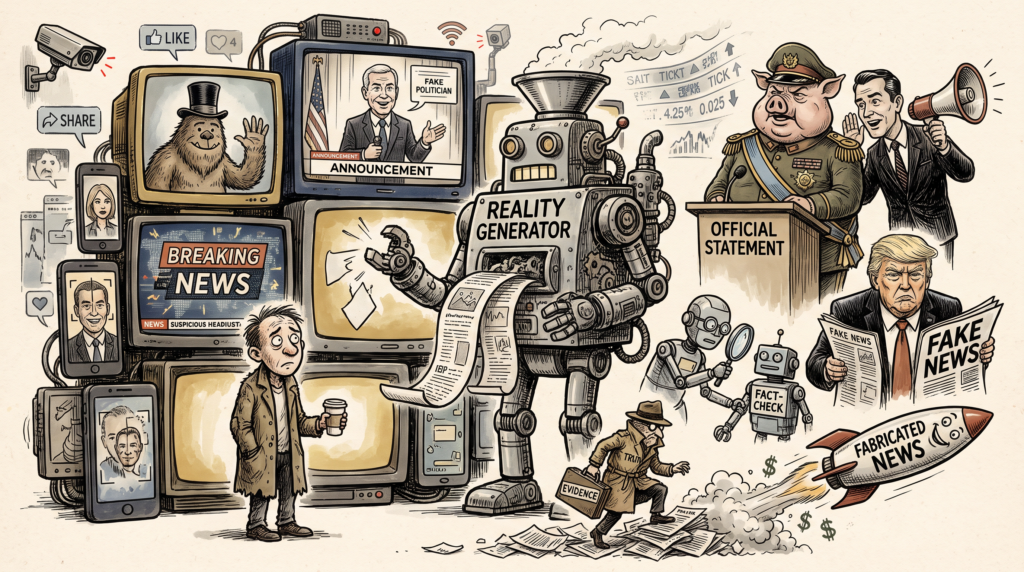
I occasionally find myself wondering about the poor souls who have dedicated their lives to finding Bigfoot. Imagine spending forty years wandering around the forests of North America, wearing camouflage trousers, enduring ridicule from your friends and family and spending a small fortune on increasingly sophisticated camera equipment. Then, one glorious morning, there he is. Seven feet tall, covered in hair and looking reasonably irritated that you've disturbed his breakfast. You capture the entire encounter in magnificent 4K resolution and upload it to the internet.
Within thirty seconds, somebody called Dave has commented: 'Obviously AI, mate.'
And what can you possibly do about it? Historically, the criticism of Bigfoot footage was that it was too blurry to establish anything meaningful. Today, the criticism would probably be that it was too clear. The poor creature could appear on Good Morning Britain, discuss his childhood and complain about the cost of woodland property, and half the audience would assume he was computer-generated.
The same applies to the endless collection of bizarre videos circulating on Instagram and TikTok. A lizard appears to transform its entire face, a shark leaps over a fishing boat, or somebody discovers an entirely new species of animal that looks suspiciously like a Labrador crossed with a medieval gargoyle. Some of these videos are real, some are edited, some are entirely generated and some are sufficiently convincing that I find myself spending five minutes trying to establish whether they are biologically possible.
And then there's the famous footage of Katy Perry appearing to lose control of one of her eyes during a performance in Las Vegas in 2022. Naturally, the internet concluded that Katy Perry was a malfunctioning robot requiring a software update. Perry subsequently explained that it was a deliberate party trick forming part of her performance, which was presumably rather disappointing for those who had already committed themselves to the theory that the entire entertainment industry was being operated by technologically advanced lizards.
The fascinating thing is that the footage itself was real. It was the interpretation that was nonsense. And that distinction is becoming increasingly important.
Of course, none of this is entirely new. Propaganda has shaped nations, destroyed civilisations, justified wars and influenced human behaviour for centuries. Governments, religious institutions and political movements have long understood that controlling what people believe can be every bit as powerful as controlling their armies or economies.
One of the most chilling historical examples is Nazi Germany. Following Hitler's rise to power in 1933, the Nazi regime systematically introduced its ideology into German schools. Textbooks were rewritten, teachers were pressured to conform, and children were taught the fraudulent racial theories that portrayed Jewish people as inferior and dangerous. Mathematics exercises, biology lessons and history textbooks became instruments of political indoctrination.
Imagine being a five-year-old German child in 1933. By the time the Second World War began, you were eleven, and much of your formal education had taken place under the Nazi regime. You encountered its ideology at school, through newspapers, on the radio and within organised youth movements. The objective was to produce a generation for whom the regime's abhorrent ideology appeared not as a controversial political opinion, but as an established feature of the world.
What makes our modern situation so fascinating is that we appear to have approached the problem of misinformation from almost entirely the opposite direction. Rather than restricting access to information, we have created such an abundance of it that individuals can construct remarkably elaborate versions of reality around whatever they already believe.
You don't necessarily need a government to impose an ideology upon you anymore. You can spend an afternoon on YouTube and have the algorithm assemble one specifically for your requirements, presumably with a discount code for some nutritional supplements at the end.
George Orwell understood the relationship between information and power remarkably well. In Animal Farm, Napoleon gradually consolidates his authority over the other animals, assisted by Squealer, whose principal responsibility is to explain why whatever happened yesterday was entirely consistent with whatever Napoleon happens to want today. The rules are quietly rewritten, historical events are reinterpreted and the animals are encouraged to question their own memories. Eventually, the revolution's founding principles culminate in that magnificent observation:
'All animals are equal, but some animals are more equal than others.'
But perhaps Orwell's most relevant observation comes from his other great novel, Nineteen Eighty-Four:
'The Party told you to reject the evidence of your eyes and ears. It was their final, most essential command.'
What an extraordinary sentence to consider in 2026. Orwell was writing about a political system in which people were instructed to disregard the evidence of their own senses in favour of an officially approved version of reality. Today, we find ourselves in a position where disregarding certain evidence presented to our eyes and ears might actually be a perfectly sensible precaution.
I could watch a video of the British prime minister announcing the nationalisation of Greggs, complete with convincing footage, accurate facial movements and an entirely plausible voice. The fact that I had seen and heard it would no longer establish that it had happened.
As an aside, the footage circulating of an influencer miming the words 'Bomboclaat pussywagon chicken nuggets' outside Number 10, following Andy Burnham's reported reception for social media influencers, looks like precisely the sort of thing artificial intelligence was invented to fabricate. Another influencer reportedly recreated Hugh Grant's dancing scene from Love Actually inside the building. Churchill presumably never considered the diplomatic potential of chicken nuggets, although admittedly he didn't have access to TikTok.
The particularly depressing thing is that had somebody shown me those videos a fortnight ago, I would probably have congratulated them on the quality of their AI-generated satire.
I give up.
Orwell imagined a Ministry of Truth responsible for systematically rewriting reality. We appear to have outsourced much of the operation to several billion people with smartphones, and nobody even needs to provide them with a pension.
Long before artificial intelligence became sufficiently sophisticated to generate convincing video footage, Donald Trump popularised a particularly effective political expression: 'fake news'. The phrase became a recurring response to unfavourable coverage, whether it concerned his personal affairs, his administration, his popularity or investigations into his conduct.
According to the Committee to Protect Journalists, Trump published nearly 1,900 tweets attacking the news media between the announcement of his presidential candidacy in 2015 and the end of 2019. Among his favourite expressions were 'fake news', 'enemy of the people', 'dishonest' and 'corrupt'.
What interests me about Trump's use of the expression is how it can dispense with the need to address the substance of an allegation. Rather than explaining why a particular story is inaccurate, a politician can simply attach a label to it. If supporters trust the politician more than the institution reporting the story, that label can become more persuasive than the evidence itself.
It's a magnificent arrangement for anyone in public office who dislikes being asked difficult questions. Imagine being caught doing something particularly embarrassing at work and simply announcing that your employer, the CCTV footage and the three people who witnessed the incident are all fake news.
Trump has also repeatedly made inaccurate or misleading public statements. Yet his attacks on the credibility of the press illustrate how a politician can attempt to determine which information their audience considers legitimate. His critics argue that this has helped create a political culture in which loyalty to an individual can override trust in independent institutions.
Napoleon had Squealer. Modern politicians have social media accounts, sympathetic broadcasters and an almost unlimited supply of people willing to reinterpret their previous statements on their behalf.
The broader danger is that once people begin selecting which sources are credible according to whether they agree with the conclusions, establishing a common set of facts becomes extraordinarily difficult. The internet has made it possible to have our existing opinions confirmed around the clock, with increasingly enthusiastic musical accompaniment.
Consider the extraordinary photograph of Donald Trump following the assassination attempt in Butler, Pennsylvania, in July 2024. Blood on his face, fist in the air, the American flag behind him. Whatever your political opinion of Trump, it is one of the most remarkable photographs in recent American political history.
The image is almost impossibly cinematic. If a Hollywood director had recreated the scene for a film about an American presidential candidate, somebody would probably have suggested toning it down a little.
It probably doesn't help Trump's cause that he subsequently appeared at the Republican National Convention with what looked like a small mattress strapped to the side of his head, only for his ear to appear remarkably unscathed in later photographs. Given the size of the original dressing, one might have expected something rather more dramatic. Instead, his ear appears to have enjoyed the regenerative capabilities of a starfish. Of course, a superficial injury can heal without leaving an obvious scar, but the visual contrast has provided an enormous amount of material for the conspiracy theorists.
Almost immediately, people began questioning whether aspects of the event had been staged. There are videos circulating online accompanied by commentary questioning the security response and the circumstances surrounding the photograph. There have also been comparisons with the footage surrounding the killing of Charlie Kirk.
What I find particularly fascinating is how readily the same footage can produce entirely different conclusions in the minds of different viewers. One person sees an extraordinary moment of political defiance, another sees a photograph that looks suspiciously well composed, and a third sees evidence of an elaborate conspiracy. All three are looking at essentially the same material.
The FBI confirmed that Trump was struck by a bullet or fragments from one, and the attack claimed the life of Corey Comperatore. The photograph was taken by Associated Press photographer Evan Vucci. Those are important pieces of evidence, but they don't independently establish the authenticity of every other video, caption or allegation subsequently circulated online.
Could convincing footage of an entirely fabricated event be produced today? Absolutely. Could authentic footage be accompanied by a completely fabricated explanation of what happened? Equally so. How is somebody scrolling through Instagram supposed to establish which is which?
The photograph from Butler is an extraordinarily powerful image, and precisely because it is so powerful, people have attached an enormous collection of political narratives to it. Establishing what a photograph actually demonstrates, rather than what we want it to demonstrate, is becoming one of the great challenges of our time.
We discussed Nvidia in our previous article, along with concerns about Western technology reaching countries subject to American export restrictions. There have been numerous reports of Western-manufactured electronic components being recovered from Russian military equipment, raising serious questions about the effectiveness of international sanctions.
But consider the claims circulating about Nvidia technology being discovered in Russian drones. How would you or I independently establish whether a particular photograph purporting to show such a discovery is authentic? It would be extraordinarily easy to photograph an Nvidia-branded circuit board next to the wreckage of a drone, attach a suitably inflammatory caption and distribute the image to several million people.
Equally, an authentic discovery might be dismissed by somebody who simply doesn't want to believe it. The company has a vested interest in its reputation, governments have political interests, journalists have commercial pressures and social media accounts have an incentive to generate engagement.
Meanwhile, Barry from Wigan has already conducted his investigation, identified three members of the Illuminati and put the kettle on.
Investigators can examine physical evidence, serial numbers, supply-chain records and independent corroboration. These are considerably more difficult things for somebody scrolling through their phone whilst eating a sandwich to establish.
And the implications extend well beyond Nvidia. A fabricated announcement about a company's involvement in military activity, an AI-generated recording of a chief executive or a false report concerning international sanctions could move financial markets before investors have had an opportunity to establish its authenticity.
For traders, misinformation isn't simply an intellectual inconvenience. It can be an extraordinarily expensive one.
One of the more amusing features of X is watching people enthusiastically publish information that is subsequently contradicted by Community Notes or challenged by Grok, the platform's own artificial intelligence assistant. A person confidently announces that a politician said something outrageous, only for somebody to ask Grok whether the quotation is authentic.
We have reached the magnificent stage of technological development where one machine can generate misinformation, an algorithm can distribute it, another machine can attempt to correct it and several thousand human beings can spend the afternoon arguing about which machine is lying.
And naturally, artificial intelligence systems can themselves produce inaccurate answers. Asking Grok whether something is true doesn't necessarily settle the matter any more than asking a particularly confident man in the pub. The answer is only as useful as the evidence supporting it.
There is also an economic problem. An outrageous allegation is often considerably more entertaining than its correction. A video claiming that the King has been replaced by an extraterrestrial will probably generate rather more engagement than a subsequent explanation confirming that His Majesty remains a relatively conventional mammal.
Researchers at MIT published a fascinating study in Science in 2018 examining the spread of information on Twitter. They found that false news travelled significantly further and faster than true news, with falsehoods approximately 70% more likely to be retweeted. Perhaps most interestingly, the researchers concluded that human behaviour, rather than automated accounts alone, was an important explanation for the difference.
And that was in 2018, before most of us had access to the extraordinary generative AI capabilities available today. We were perfectly capable of spreading nonsense without technological assistance. We've now industrialised the operation.
I don't think the answer is to become suspicious of absolutely everything. That would be exhausting, and it would arguably make us even more vulnerable to manipulation. If you convince somebody that nothing can be trusted, they may eventually abandon the search for reliable evidence altogether and simply choose whichever version of events they find most emotionally satisfying.
And perhaps the most uncomfortable question is how often we apply different standards of scrutiny depending on whether we want something to be true. How many times have you watched a video about somebody you dislike and immediately accepted its contents, only to spend twenty minutes investigating the authenticity of another video because it concerns somebody you admire?
I increasingly think the most valuable skill in the modern world will be the ability to change your mind. To encounter information that contradicts an existing belief, examine the evidence and occasionally accept the deeply uncomfortable possibility that you might have been wrong. It is not a particularly glamorous intellectual achievement, and it rarely attracts thousands of followers, but it might prove rather important.
There is an old saying that a lie can travel halfway around the world before the truth has had time to put its boots on. Versions of that sentiment have existed for centuries, long before radio, television, social media or artificial intelligence entered our lives.
But I wonder where that lie would be today.
By the time the truth has got out of bed, found its slippers and put the kettle on, the lie has probably circumnavigated the planet seventeen times, been translated into forty languages, acquired its own cryptocurrency and inspired a six-part Netflix documentary. It's probably several light years beyond the solar system by now, causing considerable political unrest on a planet we've yet to discover.
And somebody, somewhere, is still insisting that Katy Perry needs a software update.
Keep that Axe sharp. And if you do happen to find Bigfoot, for heaven's sake, bring him back with you.

Sources & References
Join the FX Axe newsletter and stay one chop ahead.

