

There is an extraordinary claim doing the rounds about Donald Trump this week. Michael Wolff, the journalist and Trump biographer, says people inside the White House believe the President has a fairly straightforward financial objective before he leaves office: he wants to be worth $20 billion. Wolff goes further, claiming Trump wants to put deals in place that will continue generating enormous sums for his family after he returns to Mar-a-Lago. The White House disputes Wolff's credibility, the sources are anonymous and there is no documentary evidence establishing that Trump has actually set himself a $20 billion target, so we should treat the claim accordingly. It is an allegation, not a fact.
The problem is that the number itself almost feels like the least interesting part of the story.
Because whether Trump's private target is $20 billion, $10 billion or simply MORE, something extraordinary has already happened to the American presidency. The most powerful public office in Western democracy has become intertwined with the private commercial interests of the man occupying it to a degree that would once have been almost unimaginable. Trump sells crypto. His family sells crypto. Trump-branded property projects are expanding overseas. His meme coin offered wealthy buyers access to the President. A Trump-linked stablecoin was selected for a $2 billion transaction involving an Abu Dhabi-backed investment company. His administration simultaneously makes policy governing the very industries from which his family is making enormous amounts of money. Trump insists there is nothing improper about this because his children and money managers handle his affairs. Perhaps every individual transaction can be defended. The cumulative picture is considerably harder to ignore.
And that is the bit I cannot quite get my head around. America has spent most of the post-war era telling the rest of us what liberal democracy is supposed to look like. Separation of powers. Institutions. Constitutional restraint. Public service. The rule of law. Checks and balances. America has invaded countries while explaining some of these concepts, occasionally before being entirely certain where those countries were. Yet here is an American president becoming vastly richer while in office and conducting private business alongside public power almost completely in the open.
It isn't really America First anymore. Increasingly, it looks like Trump First.
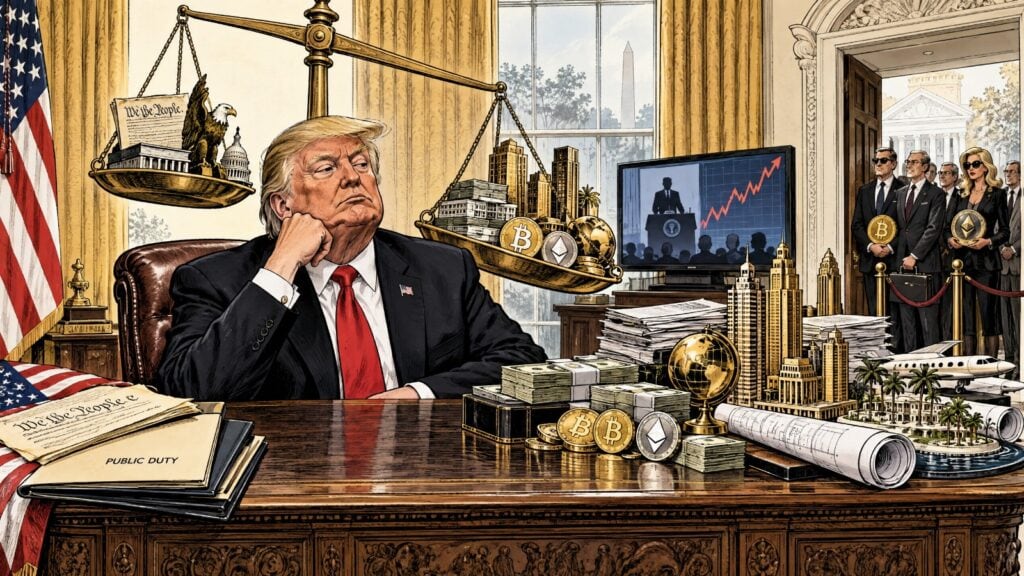
Let's start with something that isn't an anonymous-source allegation. Trump has become considerably richer since returning to power. His own 2025 financial disclosure showed more than $1.4 billion in income associated with family crypto ventures, while a New York Times analysis estimated that he pulled in at least $2.2 billion overall that year. Forbes subsequently estimated that by September 2026 Trump was approximately $2.7 billion richer than when he won the 2024 election, putting his fortune at roughly $7 billion. PolitiFact examined a Republican claim that being president had actually cost Trump money and concluded that the evidence showed precisely the opposite.
Presidents becoming rich isn't new. Bill Clinton and Barack Obama both became spectacularly wealthier, largely through books, speeches and other opportunities associated with having been president. But there is a fairly important distinction hidden inside that sentence: having been president. The traditional model was to serve, leave office and then charge Goldman Sachs an indecent amount of money to hear stories about the Situation Room.
Trump has improved the business model by removing the inconvenient waiting period.
Reuters examined four major Trump family crypto ventures and estimated that Trump and his sons had added at least $2.3 billion to the family fortune while the investors they attracted had collectively suffered roughly $2.3 billion in losses by the end of April 2026. Reuters found that the family had risked comparatively little of its own capital in the ventures. That doesn't make the businesses illegal, and investors in meme coins are presumably aware they have not purchased an ISA from Nationwide. But it is an extraordinary financial outcome for the family of a sitting president whose administration has simultaneously transformed federal policy towards cryptocurrency.
Trump's answer when questioned about conflicts is essentially that he doesn't personally manage the investments. “I don't get involved,” he said this summer. “We have funds that run my money.” He also argued that there was “nothing illegal” about knowing what was happening if he chose to. That distinction matters legally. Politically and ethically, it doesn't make the conflict disappear simply because Eric is holding the calculator.
The meme coin is where this crosses from merely unusual into something I struggle to imagine being accepted from any previous modern president.
In 2025 the promoters of $TRUMP announced that the top 220 holders of Trump's cryptocurrency would be invited to a gala dinner with the President at his private golf club. The top 25 received an even more exclusive reception. Buyers collectively spent an estimated $148 million competing for those places, according to crypto intelligence firm Inca Digital. Reuters reported that more than half of the attendees were believed to be based outside the United States. Trump-affiliated entities controlled most of the token supply and benefited financially from activity around the coin.
Just contemplate the structure of that for a moment. You aren't donating to Trump's campaign, where American campaign-finance laws apply. You aren't buying a ticket to a Republican fundraiser. You're buying an asset from which businesses connected to the President benefit financially, and the more of it you hold, the better your access to the President becomes.
That doesn't automatically prove bribery. It doesn't establish that anybody received a policy favour. But even Republican Senator Cynthia Lummis, one of Washington's strongest crypto supporters, expressed concern about the arrangement. The ethical problem is so obvious you could identify it from space: wealthy people, including foreigners, can put money into an asset benefiting the President's business interests and potentially obtain personal access to the President of the United States.
We used to have a word for this sort of thing in less sophisticated countries.
The Trump family's World Liberty Financial business makes the overlap still more extraordinary. In 2025, its USD1 stablecoin was selected to settle Abu Dhabi-backed MGX's $2 billion investment in Binance, the world's largest crypto exchange. That was not a tiny transaction accidentally passing through a Trump product; it was a $2 billion institutional deal involving an investment company backed by Abu Dhabi.
Then comes the sequence that makes eyebrows start climbing. Binance founder Changpeng Zhao had pleaded guilty to violating US anti-money-laundering requirements. Binance paid $4.3 billion to resolve the case. The Trump family was separately reported to have held business discussions involving Binance's US operation while Zhao was seeking a presidential pardon. In October 2025, Trump pardoned him. None of that establishes that the pardon was purchased or exchanged for business benefits, and the White House said Zhao had been unfairly prosecuted as part of the previous administration's hostility towards crypto. But it is difficult to invent a better illustration of why presidents traditionally try to keep their private financial interests some distance away from people seeking official presidential favours.
If President Biden's son had owned part of a financial venture doing major business with an organisation whose convicted founder was lobbying Joe Biden for a pardon, I have a sneaking suspicion Fox News might have mentioned it.
Possibly more than once.
Then there is property. Trump never fully divested himself of the Trump Organization, and his second-term ethics arrangement was looser on new private foreign business than the restrictions adopted during his first presidency. The watchdog Citizens for Responsibility and Ethics in Washington has tracked 23 Trump-branded foreign projects being planned, built or opened during his second term, across ten countries. Its analysis of Trump's financial disclosures says his overseas business revenue exceeded $117 million in 2025 alone. CREW is an ethics advocacy group and a longstanding Trump critic, so its conclusions should be understood in that context, but the underlying problem is not ideological: the President remains financially interested in a business whose fortunes can depend on overseas markets, partners, permissions and governments while he simultaneously conducts American foreign policy.
The Constitution actually anticipated this general problem. Its Foreign Emoluments Clause prevents federal officeholders from accepting gifts or benefits from foreign states without congressional consent. Lawyers disagree about how the clause applies to some of Trump's modern commercial arrangements, and first-term litigation against him ended without producing a definitive Supreme Court ruling on the merits. But the principle isn't especially mysterious: America's founders weren't enthusiastic about foreign powers finding financial routes into American officeholders.
They had apparently failed to anticipate meme coins.
The Qatari aircraft controversy captured the problem beautifully. Trump's administration was prepared to accept a Boeing 747-8 reportedly worth around $400 million from Qatar for government use, with plans for it eventually to go to Trump's presidential library. Constitutional scholars disagreed over aspects of the arrangement, while several experts argued congressional approval would be required under the Foreign Emoluments Clause. Trump responded that America would be “stupid” to reject a free aircraft. Perhaps. But when the gift offered to your administration is worth more than the lifetime earnings of several small towns, “free plane” becomes a slightly more complicated concept.
THIS IS A GREAT TIME TO BUY!!!
And then we reach the bit that, as somebody who talks about markets for a living, still makes my head hurt.
On April 9, 2025, Trump's tariff programme had helped send markets sharply lower. At 9:37 that morning the President posted on Truth Social: “THIS IS A GREAT TIME TO BUY!!! DJT.” Less than four hours later he announced a 90-day pause on most of the tariffs, and markets exploded higher. The S&P 500 gained 9.5 per cent that day. Democratic senators demanded an investigation into whether anybody with advance knowledge had traded around the announcement.
To be absolutely clear, there is no public evidence establishing that Trump personally traded on the information or tipped somebody privately to do so. Legal experts also noted significant obstacles to an insider-trading prosecution on the known facts. Calling Trump guilty of insider trading would therefore be wrong.
But just read the sequence again. The President of the United States knows that he possesses information capable of moving trillions of dollars of market value. He tells the public that it is a great time to buy. Hours later, he releases the information and the market rockets.
Even if nobody connected to him made a penny, why in God's name would a president create that question in the first place?
The information a president possesses isn't his personal commodity. He knows things because the American people temporarily entrusted him with an office. Market-sensitive policy, intelligence, diplomatic information and the machinery of the state are not a collection of Trump NFTs waiting to be monetised. The entire purpose of public-service ethics is to maintain a wall between what I know because I am President and what I can exploit because I am Donald Trump.
Under Trump, that wall increasingly looks like a bead curtain.
This is where the wider family matters too. It would be unfair to say that relatives of presidents have never benefited from their names. Billy Carter caused Jimmy Carter endless embarrassment. Hunter Biden's business activities quite rightly generated years of scrutiny. Presidential families have always attracted people hoping proximity to power might be useful.
The difference with Trump is scale and normalisation.
Forbes estimated in 2025 that the wider Trump family, including Jared Kushner, was worth around $10 billion, nearly double its estimated wealth around the 2024 election. Eric Trump and Donald Trump Jr. have become heavily involved in crypto and other ventures, while Kushner has remained an influential informal participant in Middle East diplomacy alongside his investment activities.
I wouldn't describe Kushner as an “unqualified ambassador”, because he isn't actually an ambassador and that becomes an easy factual distraction. The more interesting point is that Trump repeatedly blurs family, business and government in a way that most administrations spend enormous effort avoiding. The traditional fear is obvious: if the President's son, son-in-law, business partner or company is doing business with somebody today, what happens when that somebody needs something from the United States tomorrow?
The answer may be nothing. But democracies build ethics rules so citizens don't have to rely on may be nothing.
This is made stranger by Trump's legal history. He is the first person to serve as US president after being convicted of felonies: a New York jury found him guilty on 34 counts of falsifying business records, for which he later received an unconditional discharge. Separately, a federal civil jury found him liable for sexually abusing and defaming E. Jean Carroll; in 2026 Carroll collected the roughly $5.6 million judgment, including interest, from that first case. Trump continues to deny Carroll's allegations and has described the proceedings against him as politically motivated.
Those facts don't prove financial corruption in office. They belong here for another reason: they demonstrate just how completely Trump has rewritten the assumptions surrounding presidential conduct.
Things that once appeared politically disqualifying simply haven't disqualified him.
Felony conviction? President.
Civil finding of sexual abuse? President.
Business empire? Keep it.
Crypto empire? Expand it.
Foreign buyers purchasing a presidential meme coin? Dinner is at seven.
Family making fortunes in industries affected by administration policy? The children are handling it.
The extraordinary thing isn't simply that Trump pushes against ethical boundaries. Politicians have been doing that since somebody first discovered you could build a palace with public money. It is how little political cost many of these boundaries now appear to carry.
The contrast with Joe Biden is almost comical. Biden released annual financial disclosures reviewed by the Office of Government Ethics, and his administration required senior officials to divest conflicting assets in numerous cases. Biden himself historically avoided direct individual stock ownership; his finances were overwhelmingly boring by Trump standards. The Biden White House explicitly presented financial disclosure and conflict avoidance as part of maintaining public trust.
You can think Biden was a terrible president. You can think his son exploited the family name. You can criticise his administration on any number of grounds. That's not the point.
The point is that boring is good here.
You don't actually want the President of the United States to be an entrepreneurial genius while he is President. You don't want him spotting commercial opportunities created by diplomatic relationships. You don't want him discovering exciting new ways to monetise access. You don't want him launching financial products whose value might rise because people want proximity to American power.
You want him to run the fucking country.
And that brings us back to Wolff's alleged $20 billion target. I don't know whether Trump has ever said it. Neither does the journalist reporting it firsthand; he attributes it to people in the White House. The White House rejects his credibility. Until evidence emerges, that is where we should leave the claim.
But here is the remarkable thing: we don't need the $20 billion allegation to make the argument.
The disclosed numbers are extraordinary enough. At least $1.4 billion of reported crypto income in 2025. Reuters estimating $2.3 billion added to the family fortune from four major crypto ventures. Forbes estimating Trump himself $2.7 billion richer since the 2024 election. A meme coin offering access to its largest holders. Foreign property developments proliferating. A Trump stablecoin participating in a $2 billion Abu Dhabi-backed Binance transaction. A pardon later granted to Binance's convicted founder. A president publicly telling people to buy before his own tariff announcement sends markets soaring. None individually proves that Trump has illegally sold the presidency. Some may be entirely lawful. Several allegations surrounding them remain exactly that: allegations.
But democracy isn't supposed to operate on the standard “prove beyond reasonable doubt that the President literally sold something before we're allowed to worry about it.” Conflict-of-interest rules exist because public trust depends not only upon preventing corruption but upon preventing public officials from putting themselves in positions where their private interests and public duties become impossible to disentangle.
America is supposed to be government of the people, by the people, for the people. Trump built his second political movement around an even simpler proposition: America First.
Yet when you look at the money flowing around this presidency, it is becoming increasingly difficult to tell where America ends and Trump Incorporated begins.
Perhaps every deal has an innocent explanation. Perhaps every pardon was independently justified, every crypto transaction commercially legitimate, every foreign project properly separated, every market-moving announcement handled correctly and every presidential decision taken solely in the interests of the United States. Trump's defenders are entitled to make that case, and the absence of proof of a quid pro quo matters.
But there comes a point where the question itself becomes unavoidable. How much private enrichment by a sitting president are Americans comfortable with before they decide the presidency is not supposed to be a four-year commercial opportunity?
Because if Michael Wolff's $20 billion story is rubbish, fine. Throw it away.
What remains is arguably more extraordinary: Donald Trump doesn't need to have a secret plan to get rich from being President. He is already getting extraordinarily rich while being President, and much of it is happening in plain sight.
For a country that spent 250 years worrying about kings, that feels like a fairly important thing to notice.
Keep your Axe sharp. And never confuse America First with Trump First.
Max
Join the FX Axe newsletter and stay one chop ahead.

