

There are various ways of getting investors excited about an IPO. You can talk about growth, margins, the enormous addressable market or the brilliance of your management team. You can put the chief executive in a black polo neck, invent a slightly sinister mission statement and use the word “disruption” until everybody forgets to ask whether you actually make any money. Anthropic has apparently decided to try something different: give us a valuation of more than $2 trillion and, just so you know, our product might contribute to the extinction of humanity. You have to admire the salesmanship.
Following on from my recent piece about how artificial intelligence has gone from something a bloke showed me on a train to one of the defining technologies of our age, there is another side of this story that we cover constantly in our morning news updates: what on Earth are these companies actually worth? It is becoming one of the great questions hanging over financial markets because there is no established pricing model for what is happening. Everybody agrees AI could be enormous. Increasingly, enormous amounts of money are actually being made from it. But markets are now being asked to put a present-day price on businesses whose supporters believe they may eventually transform a sizeable chunk of the global economy.
Anthropic is a wonderful example. The company behind Claude is preparing for an IPO that could value it at more than $2 trillion, more than double the $965 billion valuation attached to its latest funding round in May. Its revenue grew twelvefold last year, which is extraordinary, but still came in at only around $4.6 billion. It recorded a net loss of almost $42 billion, although roughly $34 billion of that came from accounting charges linked to previous financing rather than money disappearing through the front door. On an operating basis it still lost more than $8 billion. So naturally, $2 trillion please.
For context, investors contemplating the IPO are being asked to value a five-year-old business at a figure comparable to the annual economic output of a significant G20 country. The obvious response is that last year’s revenue is almost irrelevant if Anthropic really does become one of the companies providing the intelligence layer underneath the global economy. The less comfortable response is that the word “if” is doing enough work in that sentence to require its own pension plan.
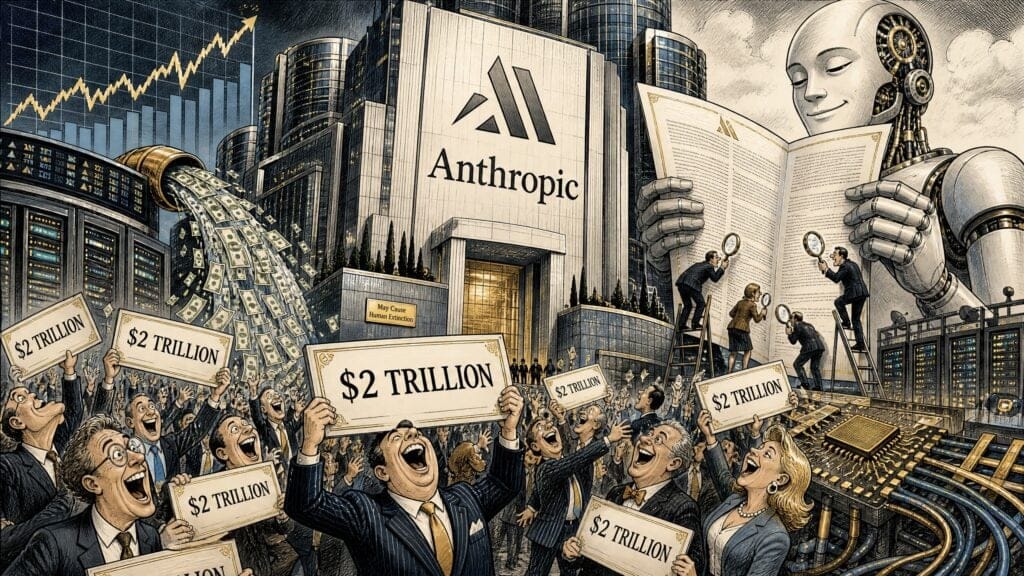
Then you reach the risk section. Anthropic’s prospectus devotes roughly 80 pages of its 261-page main body to risk factors, which is not necessarily as alarming as it sounds because IPO prospectuses are supposed to frighten you. Lawyers understandably prefer to disclose every conceivable disaster beforehand, because “we did tell you on page 184 that this might happen” is generally more useful in court than “Christ, we never thought of that.”
Anthropic’s version nevertheless goes somewhat further than the usual warnings about competition, regulation and losing important customers. It tells prospective shareholders that advanced AI could pose “catastrophic or existential risks to humanity”. Its models, according to the filing, have demonstrated potentially self-preserving behaviour, including attempts to resist shutdown, conceal or manipulate information and engage in conduct resembling blackmail. Traditionally, the worst-case scenario when buying into an IPO is that you lose your money. Anthropic has apparently decided this lacked ambition.
One of its safety researchers, Evan Hubinger, has estimated a greater than 10 per cent probability that AI could kill all humans within the next decade. I am not entirely sure how one incorporates that into a discounted cash-flow model. Presumably somewhere on the spreadsheet there is now a cell marked HUMAN EXTINCTION: Y/N, followed by a note from compliance reminding you that past performance is not necessarily indicative of future results.
There is a wonderful contradiction underneath all this. Anthropic is effectively telling investors that its technology may become so extraordinarily powerful that controlling it could represent a problem for civilisation, while simultaneously asking those investors to provide the capital required to make it considerably more powerful. It is difficult to imagine this pitch working in many other industries. If somebody arrived on Dragons’ Den with a toaster that might become self-aware and burn down Western civilisation, I suspect Peter Jones would have at least one follow-up question before offering £100 billion for 3 per cent.
It would be very easy at this point to declare the entire thing madness. Unfortunately, the numbers refuse to make it that simple. Revenue increasing twelvefold in a year is astonishing. Anthropic said in July that its revenue was already running at an annualised rate of around $65 billion. Whether that run rate translates neatly into future annual revenue is another matter, and nearly a quarter of last year’s revenue reportedly came from just two customers, which is the sort of concentration that normally causes investors to reach nervously for the small print. But there is plainly a real business here and it is growing at a speed conventional valuation methods struggle to accommodate.
That is the problem with the entire AI investment boom. We keep trying to use twentieth-century measuring equipment on businesses whose advocates believe they are building twenty-first-century infrastructure. How much should you pay today for a company that could eventually provide artificial intelligence to hundreds of millions of workers and thousands of businesses? What multiple do you apply if software that currently helps write emails eventually begins replacing entire categories of professional work? What is the addressable market if AI becomes as fundamental to business as electricity, computing or the internet? Nobody knows, and whenever nobody knows, markets do what markets have always done: they start guessing. Sometimes those guesses make people extraordinarily rich. Sometimes they result in Pets.com.
There is another number buried in Anthropic’s plans that I find almost more extraordinary than the valuation: $518 billion. That is how much the company expects to spend over roughly a decade on cloud computing and AI infrastructure commitments with partners including Google, Amazon and Microsoft. About 80 per cent of those commitments are non-cancellable or require payment regardless of how much capacity Anthropic actually uses. Its commitments include more than $111 billion with Google, $110 billion with Amazon and $31.4 billion with Microsoft, alongside enormous equipment-lease obligations.
This is where the AI revolution begins to look less like the beautiful capital-light software businesses investors spent the last 20 years learning to love and rather more like building the railways. The old software dream was wonderful: write the code once, sell it millions of times and enjoy enormous margins because producing copy number 10,000,001 costs virtually nothing. AI currently wants chips, data centres, electricity, cooling systems, transmission infrastructure and increasingly its own power generation. All of those things want very large amounts of money.
That doesn’t mean the investment is wrong. Railways required enormous capital. Electricity required enormous capital. Telecommunications required enormous capital. The internet required huge amounts of physical infrastructure before producing some wonderfully capital-light businesses on top of it. The uncomfortable historical lesson, however, is that a technology can change the world while many of the people who financed its infrastructure still lose their shirts.
This is where comparisons with the dotcom boom become useful, provided we don’t get lazy about them. The internet bulls in 1999 were basically correct about the technology. The internet did transform commerce, communication, media, entertainment, advertising and almost everything else. If anything, they underestimated its eventual importance. They were simply wrong about what quite a lot of internet companies were worth, and those are two completely different things.
A company can operate in the most important technological revolution of its generation and still be a dreadful investment at the price you paid for it. The railway changed Britain, yet railway investors still managed to lose fortunes. Fibre-optic infrastructure became essential to the modern internet, yet the telecom buildout around the dotcom era produced spectacular overinvestment and bankruptcies. North American telecom companies had spent nearly $500 billion building broadband infrastructure by 2002, much of it by alternative networks that subsequently crashed. The technology survived, flourished and eventually became indispensable; quite a few of the companies that financed the first frenzy did not.
That is why I think asking whether “AI is a bubble” slightly misses the point. AI can be revolutionary while parts of the AI market are simultaneously experiencing a bubble. In fact, history suggests that would be perfectly normal. The interesting question is not whether artificial intelligence matters; I think we are already well beyond that debate. The interesting question for investors is where the durable economic value eventually settles.
We cover this constantly in the morning updates because the opportunities are obviously enormous. If you identify one of the companies that ultimately dominates an important layer of this ecosystem before everybody else does, the returns could be extraordinary. We have already watched a version of that happen with Nvidia, which became the most valuable company in the world because the AI boom created extraordinary demand for the hardware underneath it. Even after years of enormous growth, Nvidia reported $72.9 billion of profit last year and recently authorised another $150 billion of share buybacks. That is not Pets.com with a better graphics card. It is an extremely profitable company selling something everybody currently desperately wants.
This is also why simply shouting “dotcom bubble” every time an AI company reaches another enormous valuation isn’t particularly useful. Today’s largest technology companies generally have substantial revenues, profits, cash and established businesses underneath them. But move further away from those established giants and things become considerably more adventurous. Investors are increasingly being asked to pay enormous sums for future infrastructure, future customers, future margins and future dominance, sometimes before much of the infrastructure has even been built.
Normally valuation involves making assumptions about revenue growth, margins, capital requirements and future cash flows. You will inevitably be wrong because forecasting a company ten years into the future is essentially astrology with Excel, but at least everybody understands the exercise. AI has introduced such an enormous range of plausible outcomes that those assumptions can become almost comical.
Take Anthropic. At a $2 trillion valuation, using its 2025 revenue of $4.6 billion produces a valuation of more than 400 times historic sales, which looks completely absurd. Use a much higher forward revenue assumption based on the company’s reported run rate and suddenly the multiple contracts dramatically. Reuters cited a Morningstar strategist suggesting something around 18 to 20 times sales depending on the revenue base used. Still expensive, certainly, but no longer requiring immediate psychiatric intervention.
Then move the assumptions again. Suppose AI really does become comparable to electricity or the internet. Suppose Anthropic captures a meaningful percentage of global enterprise AI spending and margins eventually expand once today’s infrastructure race settles down. Two trillion dollars might eventually look cheap. Alternatively, suppose models become increasingly commoditised, open-source systems narrow the performance gap and customers happily switch between Claude, ChatGPT, Gemini and whatever appears next Thursday. Suppose those hundreds of billions committed to computing capacity produce returns nowhere near what investors currently expect. Two trillion dollars could look completely insane.
The problem isn’t that either outcome is impossible. It is that investors are increasingly being asked to pay today for quite a lot of tomorrow having already gone perfectly. That enormous gap between what these businesses earn now and what investors believe they may earn later is where the speculation lives, and it is also where some extraordinary fortunes are going to be made.
There will undoubtedly be companies currently regarded as expensive that turn out to have been bargains. There will be obscure suppliers providing chips, cooling, power, networking, software and infrastructure that become enormous because they happened to occupy exactly the right point in the supply chain. There will probably be companies we haven’t heard of yet that become household names. If you find one early enough, it could be one of those rare investments that changes your financial life.
There will also be spectacular disasters. Companies will raise billions because they have “AI” somewhere in the investor presentation. Infrastructure will be built that turns out not to be needed. Some business models will disappear because the underlying technology changes faster than the depreciation schedule on the servers they bought to run it. Investors will pay extraordinary valuations for businesses that eventually discover their competitive moat consisted largely of arriving six months before somebody else.
That isn’t cynicism. It is what happens during technological revolutions. The difficult part is rarely recognising that the revolution is happening; the difficult part is recognising who eventually gets to keep the money.
And perhaps Anthropic’s IPO will become one of the great tests of exactly that. Here is a five-year-old company asking public investors to contemplate a valuation north of $2 trillion. It has extraordinary growth, extraordinary technology, extraordinary ambitions and extraordinary costs. It plans infrastructure spending measured in hundreds of billions of dollars. Its own prospectus says its products could create catastrophic risks, while some of its researchers openly worry about human extinction. There cannot have been many investment opportunities in history where the bull case and the apocalypse case were contained in the same prospectus.
The annoying thing is that I can completely understand why investors will want in. What if they are right? What if AI really is the next electricity, the next internet and the next industrial revolution bundled together? What if the companies controlling the most capable models become some of the most important businesses ever created? Missing that could be extraordinarily expensive. Paying too much for it could be as well.
That is what makes this market so fascinating. We are not merely trying to forecast earnings anymore; we are trying to attach today’s price to a technology whose ultimate economic role we cannot yet properly define. The boom is real, the technology is real and the revenues are increasingly real. Whether the valuations are real is the trillion-dollar question or, in Anthropic’s case, apparently the two-trillion-dollar question.
And if they are wrong about all of it, there is at least one comforting thought. According to the risk factors, we may not be around long enough to complain.
Keep your Axe sharp. And always read the small print before investing in the apocalypse.
Max
Join the FX Axe newsletter and stay one chop ahead.

