

Long-time readers of this relatively new blog — an admittedly contradictory description — and viewers of FX Axe will probably have worked out by now that I love history. Properly love it. I am one of those people who can lose an entirely unreasonable amount of time reading about an obscure medieval battle and emerge several hours later with strong opinions about the logistical capabilities of an army that ceased to exist nine hundred years ago.
So something genuinely exciting has happened this week. The Bayeux Tapestry has returned to England.
And I say “returned” deliberately, because despite spending the best part of a millennium in France and being named after a beautiful Norman town, the Bayeux Tapestry was almost certainly made in England. Most historians believe English embroiderers produced it, probably in Canterbury, sometime after the Norman Conquest. It is also, pedantically but importantly, not actually a tapestry at all. A tapestry is woven; this is an embroidery, with coloured wool stitched onto linen. But after roughly 950 years I think we're probably stuck with the branding.
For the first time since it was created, it is now back on English soil, on loan from France and at the British Museum. Reuters — King Charles and President Macron view the Bayeux Tapestry at the British Museum I would strongly recommend going to see it. This will surprise precisely nobody who has read the opening paragraph, but I am a member of the British Museum and think it is one of the greatest places on Earth. You can walk through several thousand years of human civilisation, realise how little we've fundamentally changed, have a coffee and then go and look at something somebody embroidered when William the Conqueror was still alive.
Mega.
The fact that we can see it at all is actually rather extraordinary, because over the intervening thousand years humanity has made several fairly determined attempts to destroy it. During the French Revolution in 1792, according to a long-established local account, the tapestry was taken to be used as a covering for military wagons and was apparently in danger of being cut up for the purpose. A local lawyer called Léonard Lambert-Leforestier intervened and saved it. Nearly a thousand years of history came remarkably close to ending because somebody needed a tarpaulin. Bayeux Museum — From the cathedral to the Louvre
Then came the Nazis. They were fascinated by the tapestry, although for rather less wholesome reasons than mine, seeing its Vikings, Normans and conquest narrative as potentially useful evidence for their theories about Germanic and supposedly Aryan history. The SS-linked Ahnenerbe sent scholars to study it during the occupation of France. As the Allies advanced after D-Day, German authorities had the tapestry transferred to the Louvre, and in August 1944 Heinrich Himmler ordered that it be removed from Paris to what he described as a “place of safety”, widely understood to mean Germany. An SS unit subsequently attempted to take possession of it, only to discover that the Louvre was already effectively back in French hands. Bayeux Museum — The Bayeux Tapestry during the Second World War
So this extraordinary strip of embroidered linen has survived medieval wars, revolutionaries wanting to turn it into military equipment, Napoleon using it as propaganda while contemplating his own invasion of Britain, Victorian restorers and finally the SS trying to spirit it away as Nazi Germany collapsed. The latest conservation survey records tens of thousands of stains and wrinkles, thousands of gaps and dozens of tears, alongside nail holes, old repairs and even wax stains left by the candles that once illuminated it inside Bayeux Cathedral. Bayeux Museum — Conservation study of the Bayeux Tapestry
And yet here it is. Nearly a thousand years old, seventy metres of wool and linen telling us a story that has survived almost everything Europe could throw at it.
Except, possibly, the truth.
Because the reason I want to talk about the Bayeux Tapestry today isn't simply because I have temporarily hijacked an FX website to indulge my medieval-history hobby. It is because the tapestry is one of the greatest surviving examples of something we still encounter every day: the story we remember isn't necessarily what happened.
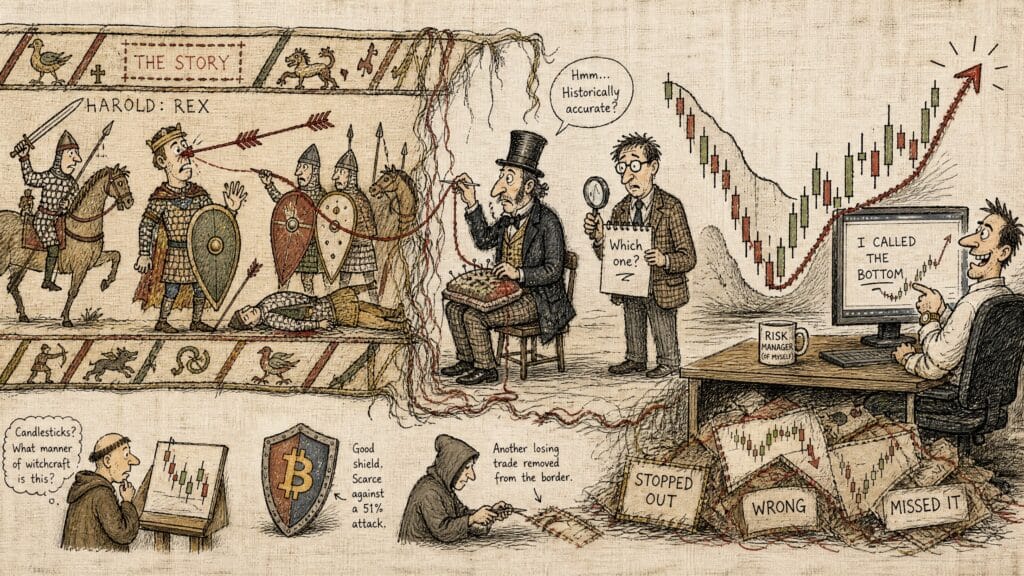
The Bayeux Tapestry is magnificent, but it isn't an impartial documentary. It tells the story of the Norman Conquest largely from the Norman perspective and helps legitimise William's claim to the English throne. Bishop Odo of Bayeux, William's half-brother and one of the great beneficiaries of the conquest, features prominently and is widely thought to have commissioned it.
Odo is worth a brief diversion because he is one of those wonderful medieval characters who sounds as though somebody has combined several different people by mistake. He was simultaneously Bishop of Bayeux, Earl of Kent, William's half-brother, an enormously wealthy landowner and a man perfectly comfortable accompanying an army into battle. Domesday records him holding land across hundreds of English settlements, and he became one of the richest and most powerful figures in post-Conquest England.
He was also closely associated with Bayeux's magnificent cathedral, whose Romanesque predecessor was consecrated in 1077. If you've never been to Bayeux, go. The cathedral is extraordinary, and there is something wonderfully medieval about an age in which being a bishop apparently didn't preclude you from turning up on a battlefield carrying a large club. Church and state were apparently less concerned about departmental overlap in 1066.
The tapestry Odo probably commissioned gives us the version of events that subsequently became familiar. Edward the Confessor dies. Harold Godwinson takes the throne. William believes the crown was promised to him. William crosses the Channel. Harold marches south. The two armies meet at Hastings. Harold gets an arrow in the eye. William wins and England changes forever.
Except 1066 was considerably messier than that.
Before William even arrived, England had another invasion to deal with, led by one of the most extraordinary warriors of the medieval period: Harald Hardrada.
Hardrada tends to get treated as a supporting character in the British version of 1066 because he lost, which rather proves today's point. Had things gone slightly differently, generations of British schoolchildren might have been learning about King Harald III of England while William the Bastard remained an interesting Norman duke who once had an unsuccessful boating holiday.
Hardrada was King of Norway and had spent much of his life fighting across Europe and beyond. He had served in the Varangian Guard of the Byzantine emperor, campaigned through the Mediterranean and built such a formidable reputation that his death is often used as a convenient marker for the end of the Viking Age. In September 1066 he invaded northern England alongside Harold Godwinson's estranged brother Tostig, defeated an English army at Fulford and appeared to have opened the road to York.
Harold Godwinson then did something extraordinary. He marched his army north at tremendous speed and surprised Hardrada at Stamford Bridge on 25 September. And, just to clarify for some of our international readers, Stamford Bridge in this story is in Yorkshire. Chelsea Football Club had yet to be founded and was therefore unable to affect the outcome.
Later Norse accounts tell us that Hardrada's army had been caught by surprise, with many of his men having left their armour behind because of the warm weather. As with so much medieval history, the colourful details come from sources written later and need to be treated carefully. What isn't in doubt is the result: Harold's English army won a crushing victory, Hardrada and Tostig were killed and the great Norwegian invasion effectively collapsed.
Harold had just destroyed one invading army when he received the rather unwelcome news that another one had landed in Sussex.
William had crossed the Channel while Harold was occupied in the north, his timing helped by the weather after his invasion fleet had spent weeks waiting for favourable winds. Harold now had to turn around and march south again with an army that had just fought one of the decisive battles of the century. On 14 October, less than three weeks after Stamford Bridge, he met William's forces near Hastings.
The battle lasted most of the day. The English occupied a formidable defensive position around Senlac Hill, fighting largely on foot behind their shield wall, while William attacked with infantry, archers and cavalry. At points rumours spread that William himself had been killed. Norman retreats — some possibly deliberate, others probably rather less so — helped draw sections of Harold's army away from the protection of the shield wall, and eventually the English position collapsed.
Harold died, William won and the entire political, linguistic and cultural trajectory of England changed. And this is where history does something fascinating, because almost everybody reading this already knows exactly how Harold died.
He got an arrow in the eye.
Except we don't actually know that.
The image is embedded in British historical memory: Harold looking upwards, an arrow protruding from his face. It's probably one of the few details about 1066 that almost every British schoolchild retains.
The problem is that the evidence is remarkably ambiguous. Near the end of the Bayeux Tapestry, the Latin inscription reads Hic Harold rex interfectus est — “Here King Harold has been killed”. Beneath it are two figures. One appears to be clutching something near his face, while immediately beside him another English warrior is being hacked down by a Norman horseman.
Which one is Harold? Possibly the first, possibly the second, or perhaps both figures represent different stages of the king's death. The British Museum's own curators emphasise that the tapestry simply doesn't allow us to say with certainty how Harold died. The Times — Did Harold really get an arrow in the eye?
Then it gets better, because the famous arrow itself may not even be what the original embroiderers stitched. Early drawings of the tapestry differ from what we see today, and the heavily restored final section underwent significant nineteenth-century work. Some scholars believe the object near the figure's face was reconstructed as an arrow because restorers were already familiar with the later tradition that Harold had been shot in the eye. The Bayeux Museum itself notes that colours in the nineteenth-century restorations have faded dramatically, particularly in these final scenes. Bayeux Museum — Tapestry or embroidery?
There are medieval written traditions connecting Harold's death with an arrow, so it would be equally misleading to announce that we've finally disproved the story. But the neat certainty most of us were taught — Harold, arrow, eye, dead — simply isn't supported by equally neat evidence.
And I absolutely love that, because somewhere along the way an uncertain possibility became a story, the story became an image and the image became a fact.
This isn't quite the Mandela Effect. It's something more interesting: narrative compounding.
Human beings like stories that make sense. William invades England, Harold stands against him, an arrow flies through the air, the king is struck in the eye, Harold falls and William conquers England. It's perfect storytelling. “Harold may have been the bloke next to the bloke who may or may not have been holding something that was subsequently restored as an arrow” doesn't have quite the same cinematic quality.
So the cleaner story wins, and once enough people repeat it, the distinction between “this may have happened” and “this happened” gradually disappears.
Spend enough time around traders and investors and you encounter exactly the same phenomenon. People remember their great trades beautifully: they knew Bitcoin was going higher, they called the bottom, they knew the Fed was going to pivot, they saw Nvidia coming years ago. And maybe they did. But human memory is an extraordinarily accommodating historian. We remember the winning trade and quietly forget the three previous attempts to call exactly the same bottom. We remember selling immediately before the crash but not the six occasions when we sold too early. We remember the enormous position that made 40 per cent and somehow neglect to mention that it represented 2 per cent of the portfolio.
By the time the story has been told often enough, the trade starts developing its own arrow in the eye.
Social media makes this considerably worse because you generally see the tapestry after the battle. Somebody posts the winning position, the chart, the percentage gain and the photograph of the watch. What you don't see are the discarded positions, failed strategies, sleepless nights, stop-losses and years of thoroughly unphotogenic work that came before it. History is written by the winners, and Instagram is written by whoever remembered to screenshot the winning trade.
That is perhaps what I like most about the Bayeux Tapestry itself. From a distance, it is history: kings, bishops, ships, cavalry, battles, conquest and the transformation of a country. Up close, it is stitches. Thousands upon thousands of them, made by people whose names we don't even know.
And that is a rather better analogy for trading, investing, building a business or almost anything else than the arrow in Harold's eye. The dramatic moments are what people remember, but they're rarely what everything is actually built from. The important bit is the repetitive stuff: managing risk, doing the research, following the system, accepting losses, reviewing mistakes and doing it again tomorrow.
Nobody particularly wants to put that on Instagram because “I followed my risk-management rules consistently for four years” doesn't have quite the same algorithmic appeal as “I TURNED £1,000 INTO £487,000”. But it is considerably more likely to be true, and considerably more likely to keep you in the game.
So when you see somebody online explaining that they knew exactly what was going to happen to gold, Bitcoin, sterling or Nvidia, remember Harold's arrow. Perhaps they did. Perhaps that's genuinely how they remember it. Or perhaps, somewhere over the years, a few stitches have been added.
Either way, if you're anywhere near London while the exhibition is on, go and see the Bayeux Tapestry. It has survived nearly a thousand years, revolution, war, Napoleon, the Nazis, questionable restoration and the peculiar human desire to turn complicated history into a much better story. The fact that it is back in the country where it was probably made for the first time since the eleventh century is genuinely extraordinary. British Museum — The Bayeux Tapestry
And while you're there, have a proper look at Harold. The arrow you've known about your entire life might not actually be an arrow, which is a useful thing to remember the next time somebody on the internet tells you they saw the whole thing coming.
Keep your Axe sharp, and check the stitching.
Max
Want more of The Daily Chop?
Sharp market stories, trading takes and financial madness straight to your inbox.

