

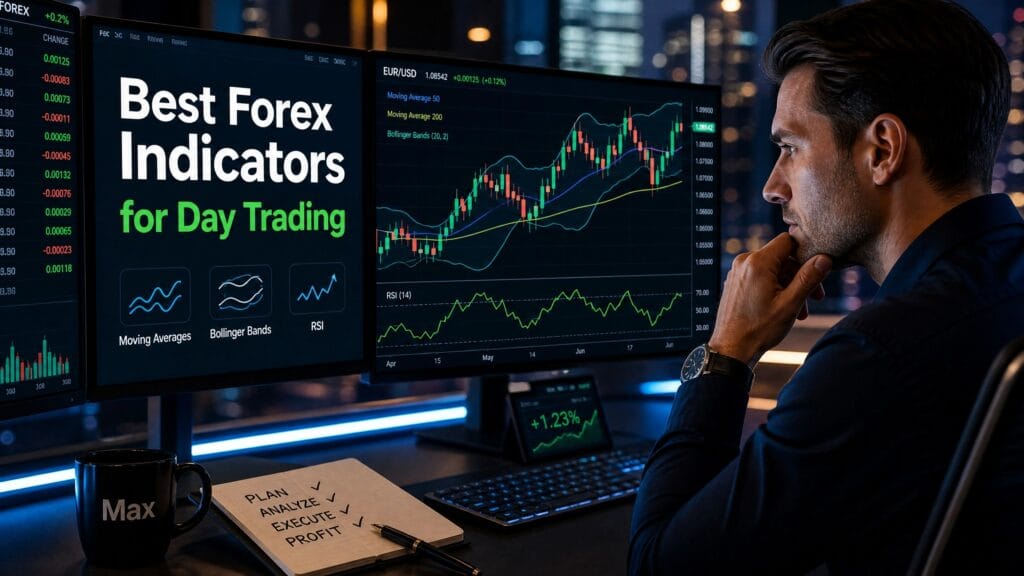
Day trading is one of the most popular trading styles in the forex market because it allows traders to capitalize on short-term price movements without holding positions overnight. However, making consistent trading decisions requires more than simply watching price charts. That's where the best forex indicators for day trading come into play.
Technical indicators help traders identify trends, measure momentum, confirm entry and exit points, and manage risk more effectively. While no indicator guarantees winning trades, combining the right tools can significantly improve your trading strategy.
In this guide, we'll explore the best forex indicators for day trading, explain how each one works, and discuss how beginners can use them to build a simple yet effective trading system.
Forex indicators are mathematical calculations based on historical price, volume, or volatility data. They help traders analyze market conditions and predict potential price movements.
Most trading platforms, such as MetaTrader 4, MetaTrader 5, and TradingView, include dozens of built-in indicators that traders can apply with just a few clicks.
The best forex indicators for day trading are designed to help traders answer key questions:
Using indicators alongside price action and proper risk management can improve trade confidence and reduce emotional decision-making.
Successful day traders rarely rely on a single indicator. Instead, they combine different types of indicators to confirm trading opportunities.
For example:
The goal is to build a strategy where multiple indicators support the same trading idea before entering a position.
The Relative Strength Index (RSI) is one of the best forex indicators for day trading because it measures momentum and identifies overbought or oversold market conditions.
RSI ranges between 0 and 100.
Many day traders use RSI to identify potential reversals, especially when combined with support and resistance levels.
Moving averages help traders identify the overall market trend by smoothing price fluctuations.
The 20 EMA and 50 EMA are commonly used by day traders.
When the 20 EMA crosses above the 50 EMA, it may signal a bullish trend. When it crosses below, it may indicate bearish momentum.
The EMA is considered one of the best forex indicators for day trading because it reacts faster to price changes than a simple moving average.
The MACD combines trend-following and momentum analysis into one indicator.
It consists of:
A bullish crossover occurs when the MACD line moves above the signal line, while a bearish crossover occurs when it moves below.
MACD works particularly well during trending markets and is often used to confirm EMA signals.
The Volume Weighted Average Price (VWAP) is widely used by professional traders and institutions.
VWAP shows the average price of an asset based on both price and trading volume throughout the trading session.
Although forex is a decentralized market, many traders still use VWAP through broker volume data to identify intraday trends and potential support or resistance zones.
For active traders, VWAP remains one of the best forex indicators for day trading.
Bollinger Bands measure market volatility using three bands:
When the bands expand, volatility increases.
When they contract, the market may be preparing for a breakout.
Many traders use Bollinger Bands to identify volatility squeezes and possible reversal opportunities.
Unlike other indicators, the Average True Range (ATR) does not predict market direction.
Instead, it measures volatility.
Higher ATR values indicate increased price movement, while lower values suggest quieter market conditions.
Many traders use ATR to determine realistic stop-loss and take-profit levels rather than guessing arbitrary distances.
The Stochastic Oscillator compares the current closing price with a recent trading range.
Like RSI, it helps identify overbought and oversold conditions.
Many day traders combine Stochastic with RSI for stronger confirmation before entering trades.
Instead of filling your chart with multiple indicators, keep your setup simple.
A beginner-friendly combination includes:
This combination provides trend direction, entry confirmation, and risk management without overwhelming new traders.
Even the best forex indicators for day trading can produce false signals if used incorrectly.
Avoid these common mistakes:
Remember, indicators should support your analysis—not replace it.
Choosing the best forex indicators for day trading depends on your trading style and experience. Indicators like RSI, EMA, MACD, VWAP, Bollinger Bands, ATR, and the Stochastic Oscillator have stood the test of time because they provide valuable insights into trend, momentum, and volatility.
However, no indicator is perfect on its own. The most successful day traders combine multiple indicators with solid risk management, patience, and disciplined execution. By practicing on a demo account and refining your strategy over time, you can learn how to use these tools effectively and improve your trading performance.
Whether you're just starting or looking to enhance your strategy, mastering the best forex indicators for day trading can help you make more informed decisions in today's fast-moving forex market.
Learn more:

