

Something rather strange has happened to the motor industry while the rest of us weren't looking. For most of my life, buying a Chinese car would have sounded approximately as sensible as buying a French victory flag from a bloke in a pub. China made lots of things, certainly, but the cars you actually wanted came from Germany, Britain, Japan, Italy or, if reliability was more important to you than arriving anywhere with a pulse, Sweden.
Then, almost without anybody noticing, Chinese cars started appearing everywhere.
BYD. Chery. Omoda. Jaecoo. Geely. GWM. Leapmotor. XPeng. Some of them still sound less like car manufacturers and more like passwords your internet provider has written on the back of the router, but the cars themselves are increasingly difficult to laugh at. In fact, the really uncomfortable bit for the established manufacturers is that quite a lot of them are extremely good.
This isn't just a feeling. Chinese-owned and Chinese-built brands have been tearing into the British market at remarkable speed. Depending on precisely which brands you include, they were already accounting for around 15 to 20 per cent of UK registrations during parts of this year, and industry estimates suggest their share could reach one car in four by the end of 2026. The official SMMT figures through August show just how quickly individual brands are moving: BYD registrations had almost doubled year on year to more than 48,000, while Chery went from essentially nowhere to more than 23,500. Omoda and Jaecoo together managed 6.6 per cent of the entire UK new-car market in August alone.
For context, Japanese manufacturers spent decades establishing themselves in Britain. The Koreans then followed with Hyundai and Kia, initially treated as cheap alternatives before gradually becoming cars people actively wanted. The Chinese appear to have looked at that 30-year journey and decided it seemed unnecessarily leisurely.
Ford chief executive Jim Farley was rather more blunt this week. Asked about the threat Chinese manufacturers pose to Western carmakers, he warned America to look at what has happened in Europe because, in his words, Europe is already “too late”. China is expected to export around 12 million cars this year, up from only about 3 million in 2022.
That is not market entry. That is an invasion with cup holders.
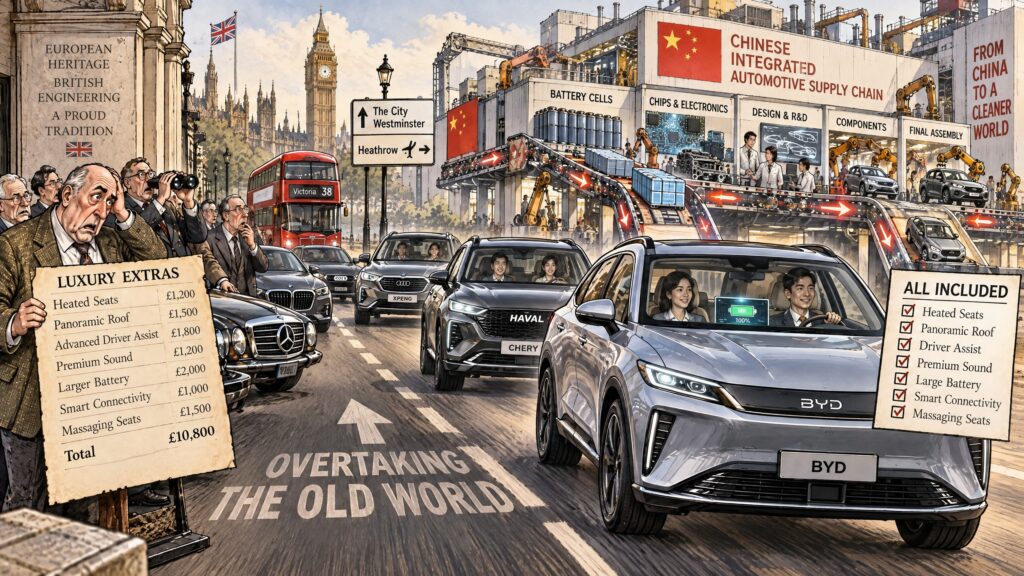
The first mistake established manufacturers made was assuming Chinese cars would compete principally because they were cheap. Cheap cars are relatively easy to dismiss. Make the interior out of something resembling a recycling bin, attach four wheels, offer a seven-year warranty and there will always be somebody prepared to buy it.
The problem is that Chinese manufacturers started offering cheap-ish cars containing surprisingly expensive things.
Sit inside many of them and there are enormous touchscreens, 360-degree cameras, adaptive cruise control, panoramic roofs, heated and ventilated seats, wireless charging, electrically adjustable everything and enough ambient lighting to make the interior resemble a reasonably discreet nightclub. Features that European manufacturers spent years carefully distributing between Sport, Premium, Executive, Luxury and Please Give Us Another £7,500 trim levels often just appear as standard.
This is where the Chinese proposition becomes rather awkward.
A customer walks into one showroom and is told that the car costs £35,000, but if they would like the nicer headlights, larger screen, heated seats and driver-assistance package it will actually be £43,000. They then wander down the road to a Chinese manufacturer who says, “Yes, it has all of those. Would you also like it to park itself?”
At some point brand loyalty meets a calculator.
The cars are also improving at an extraordinary rate because China's domestic market has become one of the most brutally competitive automotive environments in the world. There are still more than 100 manufacturers fighting for customers, margins have been crushed by price wars and unsuccessful models can disappear remarkably quickly. That sounds unpleasant if you happen to run one of those businesses, but from the customer's perspective it has created automotive Darwinism on an industrial scale. Build something mediocre and there are 20 companies waiting to eat your lunch.
Reuters reports that Chinese manufacturers can now develop some new vehicles in roughly 18 months, while traditional Western development cycles have historically been considerably longer. That matters enormously when the competitive battleground is software, batteries, charging speeds and consumer technology, because a three or four-year development cycle suddenly starts looking rather like turning up to an iPhone launch carrying a fax machine.
There is another reason the cars don't necessarily look like the cheap Chinese imports people remember from 15 years ago: China went shopping for talent.
The country's manufacturers realised that if they wanted to compete with BMW, Audi, Porsche and the rest, there was no particular reason to spend several generations slowly learning everything those companies knew. You could simply employ some of the people who already knew it.
BYD recruited Wolfgang Egger, whose CV includes Alfa Romeo and Audi, to lead its design operation. Geely's design transformation was heavily influenced by the late Peter Horbury, who had previously led design at Volvo and worked for Ford. Other Chinese groups have recruited extensively from European manufacturers, bringing in designers and engineers who understand what Western customers expect a car to look, feel and drive like.
It is a wonderfully simple piece of business logic. If you want to make something that looks European, employing the bloke who used to design European cars is probably a decent place to start.
The Chinese manufacturers are now going further than simply modifying domestic cars for export. Reuters reported earlier this year that companies including BYD, Chery and others are developing vehicles specifically around overseas tastes, particularly Europe's fondness for smaller cars and compact SUVs. Internally, some executives apparently refer to finding their “Yaris moment”: the point at which a foreign manufacturer stops merely exporting cars and begins understanding what local customers actually want.
That is important because successful international expansion rarely comes from telling customers they should learn to like what you already make. Toyota understood that. Hyundai and Kia understood it. The Chinese increasingly do too.
This is where the story becomes particularly interesting from a business perspective.
China has spent years constructing an extraordinary supply chain around electric vehicles and batteries. It has enormous scale in battery manufacturing, processing of critical materials, electronics and component production. BYD is particularly interesting because it is highly vertically integrated: rather than buying every important component from somebody else and accepting their margin, it produces major parts of the vehicle and battery ecosystem itself.
Scale then compounds the advantage.
If you produce a few thousand electric cars, batteries are expensive. If you produce millions of vehicles while also manufacturing batteries, electronics and components, your purchasing power and unit economics become completely different. BYD sold more than 463,000 vehicles in September alone, with overseas shipments approaching 180,000 for the month. Its exports were up more than 150 per cent year on year.
There is also an uncomfortable subject here that shouldn't simply be brushed aside: Chinese industrial policy. Beijing has spent years supporting strategically important sectors including electric vehicles and batteries through subsidies, incentives, cheap financing, infrastructure and broader industrial policy. The European Union has imposed additional tariffs on Chinese EVs after concluding that state support gave Chinese manufacturers an unfair competitive advantage. Britain has so far chosen not to follow the EU, meaning Chinese vehicles generally face the UK's normal 10 per cent car import tariff rather than the much higher additional duties imposed across the Channel.
So no, this is not simply a heartwarming story about some plucky entrepreneurs in Shenzhen discovering they are unusually good at making SUVs.
China made electric vehicles a strategic industry and threw enormous resources behind it.
But subsidies alone don't explain why customers actually want the products. Governments can help companies build factories. They cannot indefinitely force somebody in Birmingham to buy a Jaecoo instead of a Volkswagen.
Eventually the car has to be good.
And increasingly, it is.
This is the part I find most interesting because it goes beyond cars.
Chinese manufacturers appear to have spotted something that disruptors repeatedly discover in established industries: incumbents become accustomed to the economics of being incumbents.
Premium brands have spent decades learning exactly how much customers will pay for the badge, the optional extras, the finance package and the privilege of having slightly nicer stitching around the steering wheel. There is nothing inherently wrong with that. If people will pay £70,000 for something that costs substantially less to manufacture, congratulations, you have built an excellent business.
But large margins are also an invitation.
Somebody eventually looks at them and asks whether they can offer 90 per cent of the experience for 65 per cent of the price and still make perfectly decent money.
The Chinese have arrived in automotive markets at exactly the moment when cars are also becoming more like consumer electronics. Mechanical engineering still matters enormously, obviously, but increasingly customers care about screens, software, cameras, connectivity, driver assistance, battery performance and charging speed. Those happen to be areas in which China's electronics and battery industries are exceptionally strong.
The traditional manufacturer therefore finds itself defending a century of automotive heritage against a competitor whose argument is essentially: “That's lovely. Ours has massage seats.”
There is a beautiful brutality to it.
Western consumers have a habit of initially sneering at new automotive countries.
Japanese cars were once dismissed as cheap imports. Then Toyota, Honda and Nissan became global giants and Japan acquired a reputation for almost obsessive manufacturing quality.
The Koreans arrived later. Early Hyundai and Kia models were hardly objects people pinned to their bedroom walls. They competed on price and warranty, improved relentlessly and eventually reached the point where Kia could produce an EV6 and Hyundai an Ioniq 5 that reviewers compared seriously with expensive European alternatives.
China appears to be attempting the same journey at considerably higher speed.
The difference is that China arrives with a domestic market of enormous scale, one of the world's most sophisticated manufacturing ecosystems and a commanding position in batteries. It isn't trying to catch the internal-combustion industry at its peak. It has entered just as the entire industry is being forced through its biggest technological transition in a century.
Imagine challenging Manchester United in 1999 versus challenging them while they're rebuilding the stadium, changing the entire squad and arguing about who should be manager.
Timing matters.
And the established manufacturers know it. European carmakers are cutting costs, accelerating development programmes and increasingly forming partnerships with Chinese technology companies. Volkswagen has deepened its battery relationship with China's Gotion, while Ford is collaborating with Chinese companies in batteries and vehicle development. The fascinating question is slowly changing from “Can Chinese manufacturers catch Western carmakers?” to “How much Chinese technology will Western carmakers themselves eventually use?”
Before this starts sounding like promotional material from the Chinese Ministry of Commerce, there are perfectly legitimate reasons for caution.
Residual values remain uncertain for newer brands. Dealer and servicing networks need time to mature. Some manufacturers will inevitably disappear because China itself has too many car companies and consolidation is coming. Software and data security have become political issues, particularly because modern cars contain cameras, microphones, GPS systems and permanent internet connections. Governments are increasingly asking uncomfortable questions about what information connected vehicles collect and where it goes.
There is also a significant difference between making a compelling new car and supporting it for 10 or 15 years. European and Japanese manufacturers have enormous established parts networks, dealerships and institutional experience. Nobody buying an unfamiliar brand wants to discover in 2033 that replacing a wing mirror requires communicating with an abandoned WeChat account in Guangzhou.
Those concerns matter.
But they increasingly have to be weighed against what customers can actually see sitting in front of them: a lot of car for the money.
And customers appear to be making that calculation remarkably quickly.
I have spent most of my life regarding cars through the normal hierarchy. German cars were German cars. British cars had character, which is traditionally what British people say immediately before something electrical stops working. Japanese cars were dependable. Korean cars gradually became rather good. Chinese cars were simply not something I ever imagined buying.
Then I increased my personal breeding programme and started looking properly.
I drove some of them. I looked at the equipment. I looked at the technology. I looked at what equivalent European cars cost. I looked again at the Chinese one because I assumed I'd missed something.
And then I did something I genuinely never thought I would do.
Drumroll, please.
I've bought a Chinese car.
A Haval H6, to be precise. Super Luxury specification, which sounds pleasingly like somebody at Haval decided “Luxury” wasn't quite enough and simply added another adjective.
And do you know what finally got me? It wasn't that I suddenly developed an ideological commitment to Chinese manufacturing. It wasn't because somebody convinced me that the old European manufacturers had forgotten how to make cars.
It was much simpler.
The thing is really bloody good.
It is comfortable, beautifully equipped, packed with technology and, compared with what I would have had to spend to get a similar specification from several established manufacturers, extraordinarily good value.
Which, ultimately, may explain this entire story better than any chart about export volumes or battery supply chains.
Consumers aren't normally loyal to industrial history. They're loyal to getting something good for their money.
For decades, Western manufacturers possessed the technology, engineering expertise, distribution networks and brands, and they priced accordingly. China has looked at that market, studied where the margins sit, built enormous manufacturing scale, recruited international talent and arrived offering customers considerably more equipment for considerably less money.
The frightening thing for the established manufacturers isn't that Chinese cars are cheap.
It's that they're cheap and good.
Japan taught the motor industry that lesson once. Korea taught it again.
Apparently we needed a third reminder.
Keep your Axe sharp. And, apparently, your Haval in Super Luxury.
Max
Join the FX Axe newsletter and stay one chop ahead.

