


A CPI Volatility Strategy is a structured trading approach designed to take advantage of sharp price movements that occur during U.S. inflation data releases. CPI is one of the most influential economic reports in global markets, often causing immediate and aggressive volatility across gold, forex pairs, indices, and bonds.
Unlike normal market conditions, CPI events create fast, unpredictable moves where liquidity shifts within seconds. Because of this, traders who rely on prediction often struggle. Those who use a structured CPI Volatility Strategy focus instead on reaction, structure, and timing.
CPI stands for Consumer Price Index.
It is a monthly economic report that measures inflation by tracking changes in the price of goods and services across the U.S. economy.
It reflects the cost of living through items such as:
When prices rise faster than expected, inflation is considered strong. When price growth slows, inflation is cooling.
This matters because inflation directly influences how central banks manage interest rates.
CPI is released by the U.S. Bureau of Labor Statistics (BLS).
This timing is important because it aligns with one of the highest-volatility windows in global financial markets.
At this moment, liquidity is thin, algorithms react instantly, and price discovery becomes extremely fast, which is why CPI is a core event for any CPI Volatility Strategy.
Gold is one of the most sensitive assets during CPI releases because it reacts strongly to inflation and interest rate expectations.
CPI influences:
When inflation is higher than expected, markets may assume interest rates will remain elevated. This typically strengthens the dollar and can pressure gold.
When inflation is lower than expected, expectations shift toward easier monetary policy, which often supports gold.
This constant repricing is what creates volatility and opportunity.
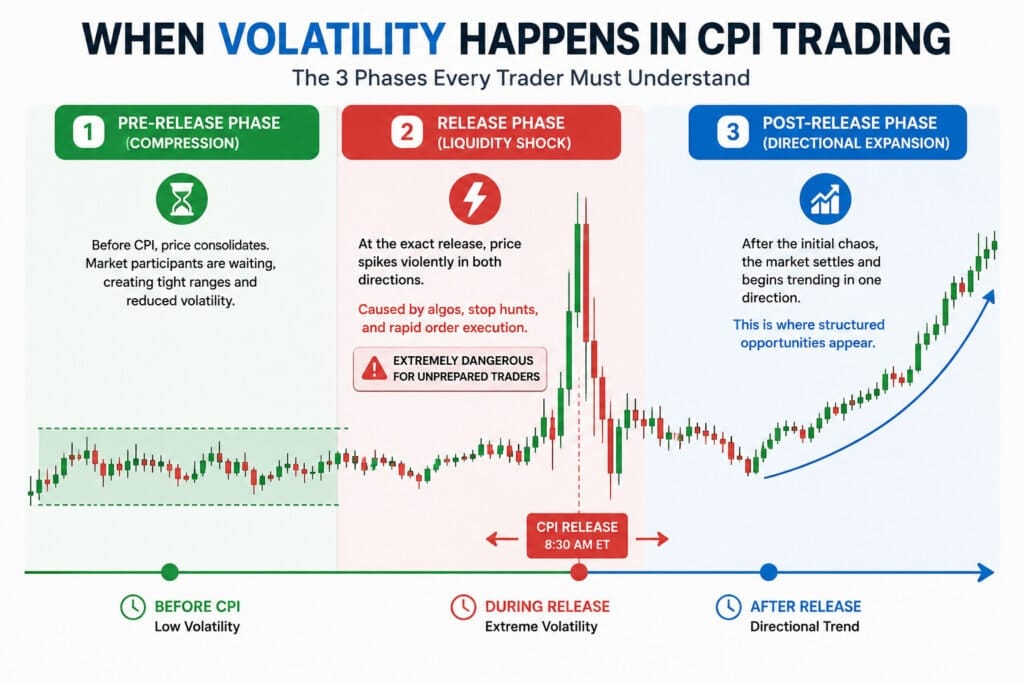
A professional CPI volatility strategy is built around understanding three distinct phases of market behavior:
Before CPI, price usually consolidates. Market participants are waiting, creating tight ranges and reduced volatility.
At the exact release, price often spikes violently in both directions. This is caused by algorithmic reactions, stop hunts, and rapid order execution.
This phase is extremely dangerous for unprepared traders.
After the initial chaos, the market settles and begins trending in one direction. This is where structured opportunities appear.
Most professional traders focus on this final phase.
Here's a visual presentation of when volatility happens in CPI trading:
Mark key levels such as highs, lows, and consolidation zones where liquidity is likely resting.
Markets react to the difference between forecast and actual CPI, not just the number itself.
The first movement is often a liquidity trap driven by algorithms.
Price often breaks key levels briefly to trigger stops before reversing or continuing.
Only trade once directional structure forms clearly after the spike.
Wait for price to reclaim or retest key levels before entering.
A strong CPI Volatility Strategy is based on interpreting price behavior, not guessing the outcome.
Volatility increases both opportunity and risk, position sizing must reflect that.
Gold often moves inversely with the dollar and reacts strongly to yield shifts.
CPI-driven trends can extend for hours or even into the next trading session.
Risk control is the foundation of consistent performance.
A disciplined CPI volatility strategy includes:
Even the best strategy fails without risk control.
CPI impacts multiple asset classes, but the most reactive include:
Among these, gold often provides the cleanest volatility structure due to its sensitivity to inflation expectations.
A profitable CPI Volatility Strategy is not about predicting inflation outcomes, it is about understanding how markets behave when new macroeconomic information enters the system.
The real edge lies in patience, structure, and disciplined execution.
Traders who consistently perform during CPI events are not the fastest, they are the most controlled. They wait for clarity, confirm direction, and manage risk without emotion.
In high-volatility environments like CPI:
The market does not reward prediction, it rewards reaction with discipline.
Read more:
Breaking: US CPI Inflation Rises To 3.8% In April, Beating Expectations
Top 3 Brokers For High Volatility Trading (2026 Guide)
Why Smart Gold Traders Are Watching The Middle East Again Aggressively In May 2026

