

There are very few people whose death can unite country music fans, Hollywood, feminists, conservative America, the LGBT community, small children learning to read and, for reasons we will get to later, genetic scientists in Edinburgh.
Dolly Parton, who died yesterday aged 80, somehow managed it.
Over a career spanning more than six decades, she sold more than 100 million records, wrote thousands of songs, conquered country music, crossed into pop, became an Oscar-nominated songwriter and film star, built a business empire, created one of America's most successful theme parks and gave away enormous amounts of money. She was also married to the same man, Carl Dean, from 1966 until his death last year, which means that somewhere along the way Dolly apparently discovered the secret to both showbusiness longevity and marriage and had the good manners not to become unbearable about either.
And beneath the rhinestones, wigs and jokes about her breasts was something that deserves particular attention from anyone interested in markets.
Dolly Parton was an absolutely formidable allocator of her own talent.
She knew what she owned. She understood its value. She knew when to take a risk, when to diversify and, crucially, when not to sell.
Which is why today's Chop is about Dolly.
Let's begin with one of the more absurd demonstrations of talent in popular music.
Dolly believed she wrote Jolene and I Will Always Love You on the same day.
Not the same year. Not during the same particularly productive creative period. Possibly the same bloody afternoon. She later said she had looked through old tapes and material and concluded that the two songs were probably written together.
Imagine doing that at work.
“What did you get done today?”
“Oh, not much. Two of the most recognisable songs of the twentieth century. Might knock off early.”
Jolene, incidentally, remains one of the strangest love songs ever written. Dolly isn't really angry with her husband. She spends most of the song telling Jolene how extraordinarily beautiful she is and begging her not to steal him.
And Jolene doesn't even appear particularly interested in the man.
She can just take him because she can.
What a bitch.
But beneath the joke is something useful. Parton was extraordinarily productive. Estimates vary depending on how compositions are counted, but her catalogue ran to more than 3,000 songs. She didn't build a career around producing one masterpiece and spending the next forty years telling everybody about it. She kept writing.
Traders should recognise the principle.
You don't build a career from one extraordinary trade.
You build it by turning up tomorrow.
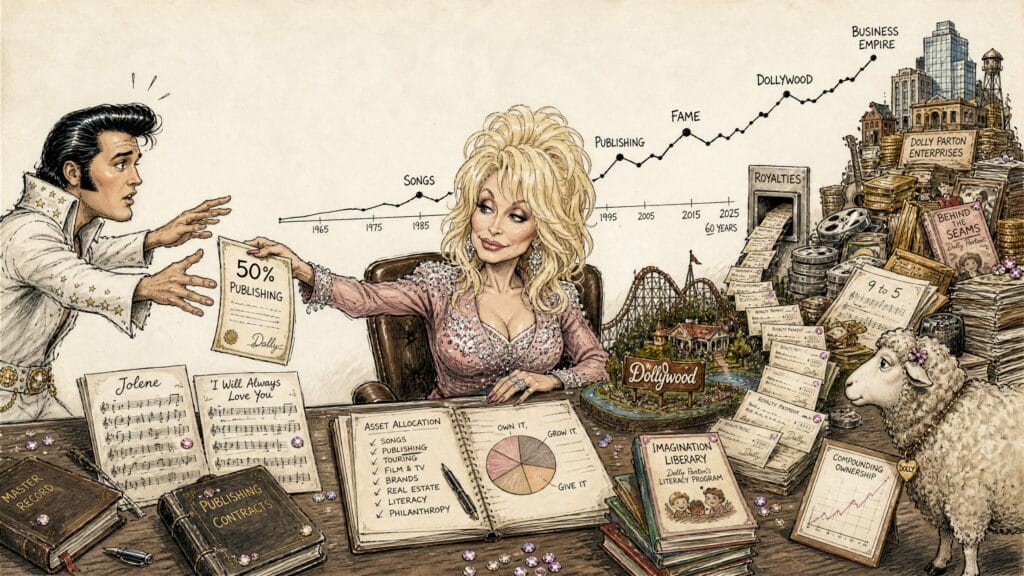
My favourite Dolly Parton business story involves Elvis Presley.
Elvis wanted to record I Will Always Love You. For a songwriter from Tennessee, having Elvis Presley sing your song was approximately the musical equivalent of being informed that Warren Buffett would like to invest in your lemonade stand.
There was a condition.
Elvis's manager, Colonel Tom Parker, wanted half the publishing rights.
Dolly said no.
She later admitted she cried all night. This wasn't an easy decision made with the benefit of knowing what happened afterwards. It was Elvis Presley. Saying no meant potentially walking away from an enormous opportunity.
But she understood what she owned.
Years later Whitney Houston recorded the song for The Bodyguard. It became one of the biggest-selling singles ever, and Dolly still owned her publishing rights. The US Library of Congress notes that Parton retained control of the underlying composition, while Forbes estimated her entire song catalogue at around $120 million by 2025.
That might be one of the best lessons in investing I've ever heard.
Price and value are not the same thing.
Elvis offered Dolly an enormous increase in profile. The price was half of an asset she believed would remain valuable.
She declined the trade.
And she was right.
There is an alternative universe in which Elvis records the song, Dolly gets a wonderful photograph with him and Colonel Parker spends the next fifty years collecting half the royalties.
Sometimes the best position you take is the one you refuse to enter.
Dolly also understood branding before personal branding became an industry populated by people posting photographs of themselves pretending to read business books on aeroplanes.
She deliberately constructed the Dolly Parton look: enormous blonde hair, rhinestones, impossible proportions and outfits visible from neighbouring states.
Her most famous line about it was that it took a lot of money to look this cheap.
That was the joke.
Dolly knew people underestimated her because of how she looked and was perfectly happy to let them. The Washington Post described the extraordinary journey from Appalachian poverty to becoming a musician, film star, philanthropist and feminist icon; Forbes put her fortune at around $450 million in 2025.
She wasn't accidentally Dolly Parton.
She was managing Dolly Parton.
And there is something very market-like about that distinction. Assets are constantly mispriced because people confuse appearance with fundamentals. Something looks boring, unfashionable or slightly ridiculous, so people assume there can't be anything particularly sophisticated underneath it.
Dolly spent sixty years dressed as though she'd been attacked by a Bedazzler while quietly retaining intellectual property and investing in businesses.
Don't judge the balance sheet by the rhinestones.
Music was the original asset.
It wasn't the whole portfolio.
In 1986, Parton became involved with a Tennessee theme park and attached her name to it. That became Dollywood, which expanded into hotels, a water park and one of Tennessee's major tourist attractions. Forbes concluded that the bulk of her estimated $450 million fortune ultimately came from her stake in the business rather than simply record sales.
That's another interesting distinction.
Parton didn't abandon the thing she was good at in order to chase the next opportunity. She used the original asset — songs, fame, reputation and a very distinctive brand — to create adjacent ones.
Music led to television. Television led to films. Celebrity supported Dollywood. Her songwriting catalogue kept generating value throughout.
That is diversification when it works properly.
Not abandoning your FX strategy because somebody on TikTok has just explained soybean futures.
At this point her cultural reach became so extensive that it escaped showbusiness altogether.
In 1996 scientists at the Roslin Institute in Scotland successfully cloned a sheep from an adult mammary-gland cell.
They called her Dolly.
Why?
Well, according to Ian Wilmut, one of the scientists involved, because the donor cell came from a mammary gland and they couldn't think of anyone with a more famous pair of mammary glands than Dolly Parton.
Science is magnificent.
Just think about the level of cultural penetration required for that to happen. Scientists make one of the most important breakthroughs in genetics in modern history, stare at the first mammal cloned from an adult cell and collectively decide:
Dolly Parton.
That isn't celebrity anymore.
That's infrastructure.
But I think the most interesting thing about Dolly Parton's career is its length.
Popular culture is absolutely brutal at disposing of people. Music careers flare spectacularly and disappear. Actors become unfashionable. Public personalities overexpose themselves, implode, become unpleasant, discover Twitter or all four.
Dolly remained Dolly.
She had huge successes and quieter periods. Country music changed. Popular music changed. Television changed. Hollywood changed. The internet arrived and completely transformed celebrity.
She stayed.
By the end of her life, younger generations who weren't born when Jolene was released knew her through films, television, Miley Cyrus, memes, philanthropy and the Imagination Library. She had somehow become one of those extraordinarily rare public figures who remained famous without requiring everybody to keep remembering why she was famous in the first place.
That's a lesson traders should probably think about more.
Survival is a strategy.
Markets are obsessed with maximum returns. Who made 80%? Who caught Bitcoin at the bottom? Who shorted the crash?
But the person who generates sensible returns for thirty years may ultimately do considerably better than the genius who makes 200% in twelve months and blows up in month thirteen.
You have to remain in the market long enough for compounding to matter.
Dolly did that with fame.
She also understood that accumulating capital wasn't necessarily the end of the exercise.
Her Imagination Library, inspired partly by her father's inability to read, grew into what Forbes describes as the world's largest early-childhood book-gifting programme and had distributed more than 300 million books by the time of her death. She donated $1 million towards research that contributed to Moderna's Covid vaccine, supported victims of Tennessee wildfires and funded numerous educational and medical causes.
Again, there is a financial lesson hiding in there.
At some stage, wealth is supposed to do something.
The number on the screen isn't the objective. It represents options: independence, security, time, opportunity and, if you're fortunate enough, the ability to improve somebody else's life.
Dolly accumulated enormously.
She also deployed.
Which brings me, inevitably, to David Brent.
For American readers, I should explain that I'm referring to the original British Office, rather than your later adaptation. The American version is very good. The British version is comedically superior by such an enormous distance that it enters a new dimension. And before anyone comments to the contrary, I want to make it very clear that I am perfectly willing to die on this hill, although preferably not the day after Dolly Parton because it would be extremely difficult to get any press coverage.
During one of David Brent's excruciating motivational speeches, he invokes Dolly Parton's observation that if you want the rainbow, you've got to put up with the rain.
Then comes the Brent philosophy.
People look at Dolly Parton, he says, and dismiss her as “just a big pair of tits”.
Except, of course, she wasn't.
That was the joke Dolly herself had spent an entire career making.
Behind the wigs was a songwriter who could apparently produce Jolene and I Will Always Love You in the same sitting. Behind the jokes was a businesswoman who told Elvis Presley he couldn't have half her publishing. Behind the rhinestones was an investor who turned a music career into a theme park, hotels, intellectual property and a fortune estimated at hundreds of millions of dollars.
And behind six decades of success was the decidedly unglamorous business of continuing to turn up.
That's probably the trading lesson worth keeping.
Talent matters. Timing matters. Knowing when to take the opportunity matters enormously. But knowing what you own, refusing to sell it too cheaply, diversifying intelligently and staying in the game for long enough may matter even more.
There will be bad years. Bad trades. Missed opportunities. Things you desperately wish you'd bought and things you wish you'd never touched.
Without the rain, you don't get the rainbow.
Who said that?
Dolly Parton.
And, as David Brent reminded us, people say she's just a pair of tits.
Turns out she was also a bloody good investor.
Rest in peace, Dolly.
Keep your Axe sharp.
Max
Want more of The Daily Chop?
Sharp market stories, trading takes and financial madness straight to your inbox.

