

We normally try to be reasonably balanced in these articles. Not necessarily polite, obviously, because that would rather defeat the purpose, but balanced. If Donald Trump does something clever, we say so. If somebody I broadly agree with does something idiotic, they don't receive diplomatic immunity simply because they're on the correct side of my own prejudices. Markets are particularly good at teaching you that lesson because reality has an irritating habit of refusing to care what you wanted to be true.
Today I'm going to do something slightly different. This article is deliberately going to make one side of an argument. Think of it as the prosecution case rather than the judge's summing-up. I will acknowledge the important evidence that cuts against it, because otherwise we're just doing propaganda, but I'm interested in seeing how strong the case looks when you assemble the evidence in one place.
And the question is one that has followed Donald Trump around for the better part of a decade: why does Donald Trump so consistently appear to behave like Vladimir Putin's bitch?
I don't mean that literally. I have no evidence that Vladimir Putin controls Donald Trump, that Trump takes instructions from Moscow or that the Kremlin possesses some secret lever which can make the President of the United States sit, roll over and waive sanctions. Those are enormous claims and the available public evidence does not establish them. Indeed, the bipartisan Senate Intelligence Committee's investigation found extensive Russian interference in the 2016 election, while its Republican leadership said it found no evidence that Trump or his campaign colluded with the Russian government. Right, that’s that bit done.
What we can examine is behaviour. And the behaviour is fucking weird.
Because if you were asked to design an American president whose foreign policy repeatedly produced outcomes Vladimir Putin would like, how different would he look from Donald Trump?
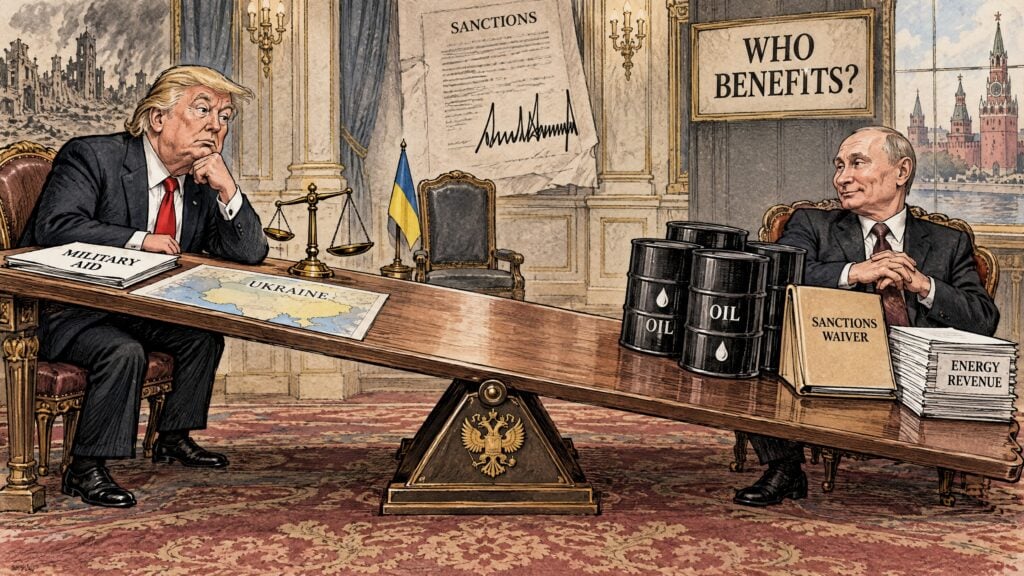
Last month Trump signed the Lindsey O. Graham Sanctioning Russia and Iran Act into law. The legislation contained potentially ferocious measures aimed at Russia and those helping finance its war, including tariffs and sanctions designed to squeeze Moscow's energy revenues. Then, on October 16th, Trump used the waiver provisions in the very law he had signed to suspend the application of a substantial number of those measures, declaring that doing so was in the “national interests” of the United States. That isn't somebody else's interpretation of the order. It is there in black and white in the White House order itself.
At the same time, Trump's administration has pursued a controversial arrangement involving Russian diesel, intended to get more fuel onto world markets as energy prices bite. There is a coherent defence for this. Global fuel markets are under severe pressure, Trump wants prices down, and his administration can argue that restoring some Russian supply creates both economic relief and an incentive for Moscow to negotiate.
Fine. That's the defence.
Now look at it from Moscow. Russia invades Ukraine. Russia continues attacking Ukrainian territory and energy infrastructure. America passes new legislation intended to increase the economic cost to Russia. Trump signs it. Putin keeps going. Trump subsequently waives many of its sanctions and tariff provisions while simultaneously easing restrictions around Russian diesel.
If you're Vladimir Putin, that's a fairly decent week.
It was sufficiently extraordinary that the reaction has not simply come from Democrats or the usual Trump critics. Republican voices have joined criticism of the change, and Mike Pence, Trump's own former vice-president, has now publicly demanded that Trump restore the sanctions, rescind the diesel deal and increase military support for Ukraine. Pence described Putin as a war criminal and argued that waiving the Graham Act sanctions “signals weakness”.
When Mike Pence is effectively asking why the Republican President is being too accommodating towards Vladimir Putin, we've travelled quite a long way from Ronald Reagan.
Then there is Volodymyr Zelensky.
Trump's relationship with the Ukrainian president has been peculiar almost from the beginning of his second term. Their February 2025 Oval Office meeting descended into an extraordinary public confrontation in which Trump and JD Vance berated Zelensky, accused him of insufficient gratitude and challenged his approach to ending the war. Trump told him he was “gambling with World War III”. The planned minerals agreement was left unsigned and Zelensky departed the White House early.
The extraordinary thing watching it was the direction of the anger. Ukraine had been invaded. Russia was the invading country. Yet the man receiving the public bollocking in the Oval Office was the leader of the country being invaded.
That pattern has never entirely disappeared. Trump has attacked Ukrainian strikes on Russian energy infrastructure while simultaneously trying to bring Russian fuel back onto global markets. There are perfectly rational economic arguments for wanting Ukrainian refinery attacks stopped when oil and diesel prices are already causing problems for American consumers. But Russia has itself repeatedly attacked Ukraine's energy system.
So look at the picture from Kyiv. Russia attacks Ukrainian infrastructure. Ukraine retaliates against Russian energy assets. Washington puts pressure on Ukraine over those attacks, Trump publicly condemns them, the United States reaches towards an arrangement beneficial to Russian diesel exports and then Trump waives sanctions Congress designed to increase pressure on Moscow.
Any one of those decisions can be defended individually. It is when you put them next to each other that the question becomes interesting.
There is another element of all this that I find increasingly fascinating, which is the gap between what Trump says America has given Ukraine and what the public record says actually happened.
During that extraordinary Oval Office confrontation with Zelensky in February 2025, Trump declared: “We gave you, through this stupid president, $350 billion.” JD Vance then joined the attack on Zelensky, demanding greater gratitude for American support.
There was only one fairly substantial problem with Trump's number: it wasn't true.
The US government's own Ukraine oversight accounting put total appropriations for the Ukraine response at roughly $183 billion by late 2024, while independent assessments of US commitments and assistance similarly came nowhere close to Trump's $350 billion claim. Different accounting methodologies produce somewhat different totals because some money is spent replenishing American stocks, some remains unspent and some supports wider US military activities in Europe, but $350 billion was vastly above the documented figure.
Then it gets stranger.
In October 2025, while discussing whether Ukraine should finally receive Tomahawk cruise missiles, Trump talked about Tomahawks alongside “a lot of other things that we're sending to Ukraine”, before referring to the difficulty of giving away “massive numbers of very powerful weapons”.
Sitting next to him was Zelensky, who rather inconveniently pointed out that Ukraine did not have Tomahawks.
Ukraine was asking for them. Indeed, that was one of the principal reasons they were having the bloody conversation.
That does not mean America has given Ukraine nothing under Trump. Far from it. His administration has at various points continued weapons and intelligence support, including air-defence assistance. That is probably the strongest evidence against the simplistic version of today's argument. If Trump were literally Putin's obedient servant, it would be rather odd to continue helping arm the country Putin is invading.
But the rhetoric matters because it helps construct a particular political story. America has supposedly given Ukraine almost unimaginable sums of money. America has emptied its armouries. America has supplied “massive numbers” of its most powerful weapons. Zelensky has accepted all of this and remains insufficiently grateful. Therefore Trump is perfectly justified in eventually telling Ukraine to get stuffed.
Except parts of that story simply aren't true.
Ukraine had not received Tomahawks. Trump's $350 billion figure substantially exceeded the documented US expenditure. And the fact that American stocks of Patriots, Javelins and other weapons have come under pressure does not magically mean every weapons system discussed in Washington has been shipped to Kyiv.
Now we move from fact into interpretation, and we should say explicitly that we're doing so. Is this confusion, exaggeration, political salesmanship or something more deliberate? I don't know. Well, I do.
But there is something fascinating about the political environment Trump and his movement have created around factual correction. If your most committed supporters already distrust the institutions that might contradict you, corrections lose much of their power. A newspaper says the number is wrong? Fake news. A government watchdog produces a different figure? Deep state. Zelensky himself says Ukraine doesn't possess the weapon you're discussing? Well, he's ungrateful anyway.
It creates an extraordinary advantage. You don't necessarily have to win an argument about reality if you've persuaded enough people that anyone correcting your version of reality is part of the conspiracy against you. The original claim travels around the world while the correction is still putting its trousers on.
And in the context of this article, the consequence is important. The exaggerated version makes Trump look extraordinarily generous towards Ukraine: hundreds upon hundreds of billions of dollars, enormous quantities of weapons, apparently even weapons Ukraine never actually received. His subsequent pivot towards pressuring Kyiv therefore looks less like withdrawing support from an invaded ally and more like a long-suffering benefactor finally losing patience with an insatiable dependent.
Perhaps that isn't deliberate. Perhaps Trump simply conflates weapons being discussed, produced, replenished and supplied. Perhaps $350 billion is Trumpian numerical inflation rather than a carefully designed information strategy. We cannot know his intention from the statements alone.
But we can say something much simpler: when the President tells the public that Ukraine has received substantially more American money than the documented total, and talks about weapons in a way that blurs what has actually been delivered, we should probably stop treating the rhetoric as a reliable ledger of what America has actually given Ukraine.
And once that fictional generosity becomes part of the political story, Putin benefits from that too.
The weirdness becomes more obvious when you compare Putin with almost everybody else Trump deals with. Trump likes confrontation. It is practically his resting state. He insults allies, threatens tariffs, attacks leaders personally, questions alliances and approaches international diplomacy rather like somebody negotiating the sale of a second-hand Range Rover on Facebook Marketplace.
Canada has experienced it. Europe has experienced it. Denmark has experienced it. NATO has experienced it. Zelensky has certainly experienced it.
Putin, however, has always seemed to occupy a special category.
Back in February 2022, as Putin recognised separatist-controlled regions of eastern Ukraine immediately before the full-scale invasion, Trump described Putin's manoeuvring as “genius” and “very savvy”. Those are Trump's words, not an opponent's characterisation of them.
And this is the bit I struggle with. Trump distrusts virtually everybody. He attacks American institutions, attacks the media constantly, has repeatedly fought with NATO allies, clashes with foreign leaders and has made suspicion of the Washington establishment part of his political identity.
Yet Vladimir Putin has repeatedly received a degree of personal warmth and benefit of the doubt that many American allies would presumably quite like to borrow for the weekend.
Why?
The moment that has always bothered me most happened in Helsinki in 2018.
American intelligence agencies concluded that Russia interfered in the 2016 presidential election, and the bipartisan Senate Intelligence Committee subsequently endorsed the intelligence community's central assessment. The committee found that Putin approved the influence campaign and that Moscow developed a preference for Trump while seeking to damage Hillary Clinton.
That is not the same thing as saying Trump colluded with Russia. The Senate committee's Republican leadership subsequently said it found no evidence that Trump or his campaign colluded with the Russian government. Both facts matter.
But then came Helsinki.
Trump stood beside Vladimir Putin at their 2018 summit and publicly cast doubt on his own intelligence agencies' conclusion while discussing Putin's denial of Russian interference. The optics were extraordinary because this wasn't Trump being charitable towards the leader of Luxembourg. This was the American president standing beside the man American intelligence said had approved an operation intended to influence an American election in Trump's favour.
Then Trump and Putin held an extended private meeting with interpreters and without the normal collection of senior American officials in the room.
Whatever explanation you prefer, that is fucking strange.
Which inevitably brings us to the thing everybody thinks about and nobody can responsibly present as established fact: kompromat.
For years there have been rumours that Russian intelligence possesses compromising material involving Trump from visits to Moscow. The most notorious allegations appeared in the Steele dossier and included claims surrounding Trump's stay at the Ritz-Carlton Moscow in 2013.
Those allegations became some of the most famous unverified claims in modern American politics. And the important word there is unverified. It is absolutely unverified that there is a film of Trump enjoying being pissed on and various other nighttime activities.
No public investigation has established that the notorious hotel episode occurred or that Vladimir Putin possesses a tape capable of blackmailing Donald Trump. The Senate Intelligence Committee examined the wider possibility of Russian kompromat but did not establish the existence of such material. Subsequent investigations also exposed serious problems with parts of the Steele dossier's sourcing.
So I'm not going to tell you there's a tape. I don't know, and neither do you. Nor that its about him being pissed on.
What we can fairly say is that allegations of compromising material have circulated for years and were sufficiently serious to be examined by investigators. Those investigators did not establish the central claim. That is where the factual statement should end.
The political question doesn't, because every time Trump does something inexplicably favourable to Putin, somebody inevitably asks about it again.
Perhaps the answer is absolutely nothing.
There are several perfectly rational explanations for Trump's behaviour that don't require Russian prostitutes, hidden cameras or Vladimir Putin sitting in the Kremlin with a VHS marked DONALD — DO NOT ERASE. Presumably the front cover is a smaller than average mushroom floating in an ocean of urine.
Trump may sincerely believe the war cannot be won on Ukraine's preferred terms. He may think maintaining a personal relationship with Putin is the quickest route towards ending it. He may believe Europe should shoulder far more of the financial and military burden. He may care more about reducing energy prices before the American midterms than maximising economic pressure on Moscow. And he may simply dislike Zelensky personally. Trump is a politician for whom personal relationships appear to matter enormously, and the chemistry between the two men has repeatedly been dreadful.
Those explanations don't require conspiracy.
But then you come back to the outcomes. Russia wants pressure on its energy exports reduced, and Trump reduces some of it. Russia wants Ukrainian attacks on its refineries stopped, and Trump publicly attacks Ukraine for conducting them. Russia wants the new Graham sanctions neutralised, and Trump invokes the waiver. Russia wants Western unity around Ukraine fractured, and the relationship between Washington and Kyiv is openly strained. Russia wants the war resolved through negotiation rather than Ukraine achieving its preferred military outcome, and Trump is explicitly pursuing negotiations.
At some point the question stops sounding entirely unreasonable.
There is an old Latin question used in investigations: cui bono? Who benefits?
It doesn't prove motive. It certainly doesn't prove conspiracy. But it's often a useful place to start.
And when you apply it to Trump's recent Russia policy, Vladimir Putin appears remarkably often in the answer.
That is why criticism from within Trump's own political world matters. This isn't simply Democrats shouting “Russia” because they hate Trump. Mike Pence is Trump's former vice-president. Republican senators have joined Democrats in objecting to recent Russia policy. Congress passed the Graham sanctions with the explicit intention of increasing pressure on Moscow, and Trump then used the legislation's own waiver mechanism to suspend substantial parts of it.
Perhaps Trump's defenders are right. Perhaps this is transactional diplomacy designed to get Putin talking. Perhaps increasing Russian diesel supply reduces energy prices, helps American consumers and creates enough mutual economic interest to facilitate a settlement. Perhaps Trump's willingness to talk to people other leaders consider beyond the pale is precisely why he occasionally opens negotiations conventional diplomacy cannot.
Those are legitimate arguments.
But they still leave one enormous question: why does the transaction so often seem to favour Putin?
So, is Donald Trump literally Vladimir Putin's bitch? I cannot prove that, and nobody responsibly can on the public evidence currently available. But if we're allowed one article to make the prosecution case, the case becomes considerably more interesting when you assemble the record rather than looking at each incident separately. And he is.
It isn't really about a piss tape. Forget the fucking piss tape, don’t even talk about it. It is about behaviour. It is Helsinki and the willingness to publicly question American intelligence beside Putin. It is calling Putin's opening manoeuvre against Ukraine “genius” and “very savvy”. It is the extraordinary hostility towards Zelensky. It is telling Americans that Ukraine received $350 billion when the documented figure was vastly lower. It is talking about enormous weapons transfers in language that can blur the distinction between weapons discussed and weapons actually delivered. It is the Tomahawk that Ukraine was supposedly receiving while Zelensky was sitting there explaining that he didn't fucking have one. It is pressure over Ukraine's refinery campaign. It is the Russian diesel arrangement. And now it is Donald Trump signing a sanctions law and then using the powers within that law to waive a substantial number of the measures it was supposed to impose.
Any one of those things can be explained. That is the important point. There is an explanation for Helsinki. There is an explanation for the rhetoric. There is an explanation for the weapons policy. There is an explanation for the diesel. There is an explanation for the sanctions waiver. There is an explanation for wanting Ukraine to negotiate. There may even be a perfectly innocent explanation for Trump's remarkable ability to remember US expenditure on Ukraine at roughly twice its actual size.
But eventually you're entitled to stop looking at each tree individually and notice the shape of the forest.
Maybe Trump believes this is how you make peace. Maybe he thinks flattering Putin gives him leverage. Maybe his overriding priority is cheaper energy and ending a war he believes America should no longer be financing. Maybe he simply likes Putin and dislikes Zelensky. None of those explanations requires a conspiracy.
Or maybe Vladimir Putin has somehow spent the better part of a decade consistently getting an extraordinary amount out of his relationship with the most powerful man in the world.
I don't know which explanation is correct, and that uncertainty matters. The evidence establishes a pattern of decisions and rhetoric; it does not establish that Trump is controlled or blackmailed by Russia, our lawyers have made me add.
But after this week, I think the question we're deliberately prosecuting in this article is a perfectly fair one: why does Donald Trump so often behave in ways that Vladimir Putin would presumably welcome?
And perhaps more intriguingly: what does Putin understand, or indeed know, about Donald Trump that the rest of us don't?
Keep your Axe sharp. And always ask who benefits.
Max
Join the FX Axe newsletter and stay one chop ahead.

