

I am conscious that Donald Trump appears in this blog rather a lot. I promise this isn't an obsession. In fact, I would quite like to stop writing about him occasionally. The problem is that he appears to regard a quiet news day as a personal failure.
This is, after all, the only American president to have been impeached twice, a man who has returned to the White House after criminal prosecution, whose business interests now stretch from property and golf to crypto, books, fragrances, trainers and guitars, and whose presidency seems capable of producing an entirely new controversy before you've finished reading about the previous one. Today, while America is dealing with a war in Iran, oil above $100, stubborn inflation, a Federal Reserve potentially about to raise rates and Congress trying to rewrite the rules governing cryptocurrency, I found myself watching the President of the United States promoting a bright red watch.
And I suddenly realised who he reminded me of.
Harry Wormwood.
For anyone whose childhood didn't involve Roald Dahl, Harry Wormwood is Matilda's father: the spectacularly dodgy second-hand car salesman played by Danny DeVito in the film, a man for whom absolutely everything represents an opportunity to make a few quid. I should stress that I am not suggesting Donald Trump is winding back the mileage on second-hand Buicks with an electric drill. It is the sheer inability to stop selling that feels familiar. There is always another product, another limited edition, another licence, another opportunity to turn towards the camera and explain that this extraordinary thing could be yours. And both, despite an appalling outward appearance, are too vain to be seen in public without an astonishingly shit wig on.
Similar in almost everything then-except Harry Wormwood never had nuclear weapons.
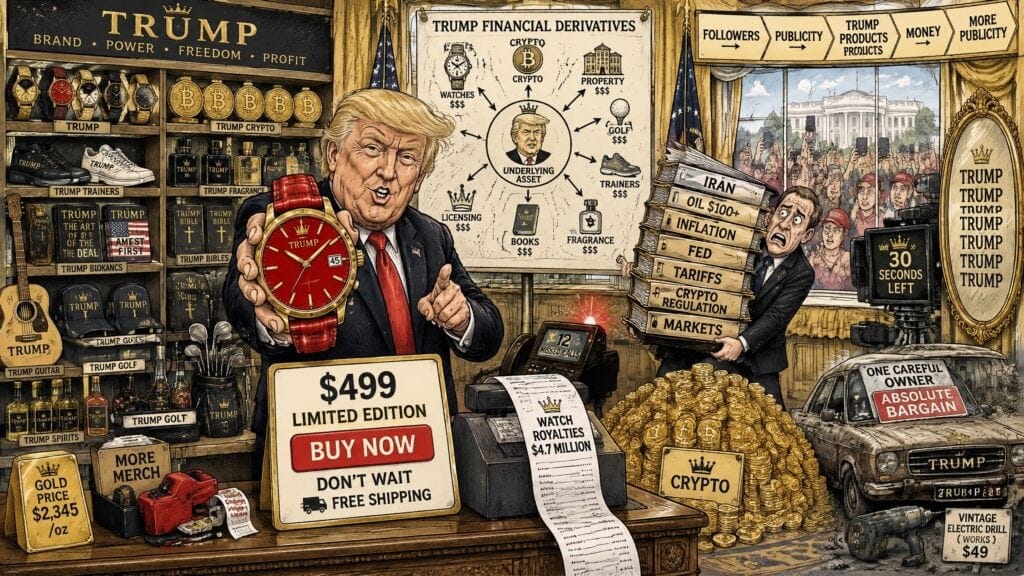
The watch in question is the Trump Fight Fight Fight watch. The range starts with models at $499, while Trump has previously promoted a $100,000 gold tourbillon containing more than 100 diamonds. In the original promotional video, Trump admired the expensive version and announced, with the understated refinement for which he has always been famous, that he loves gold and diamonds.
Axios — Trump watch collection launches with watches from $499 to $100,000
The whole thing has the unmistakable atmosphere of a late-night shopping channel. Limited availability. Collectors' item. Free shipping. Trump signature. Buy now. Don't wait. Only a certain number available. You half expect a telephone number to start flashing across the bottom of the screen while somebody shouts that Clive from Solihull has just bought two. Except this was on Fox News, a national “news” broadcaster. At this point the White House occasionally feels less like the executive branch of the world's most powerful democracy and more like QVC after somebody accidentally gave the presenter nuclear weapons.
And then you read the small print. The watches are not actually designed, manufactured, distributed or sold by Donald Trump or the Trump Organization. According to the Trump Watches website itself, a separate company uses Trump's name, image and likeness under a paid licensing agreement. The website also stresses that the watches are collectibles rather than investments and have nothing to do with any political campaign.
Which somehow makes the entire thing even more Trump. He doesn't need to make the watch, distribute the watch or post the watch to you. He doesn't even need to know terribly much about watches. He simply needs to be Donald Trump, and Donald Trump, it turns out, is an extremely valuable thing to licence.
But I don't think money entirely explains it. Increasingly, I think the other answer is much simpler: vanity.
Trump seems to derive an extraordinary satisfaction from seeing the word TRUMP on things, preferably in enormous gold letters. For decades he has put it on towers, casinos, golf courses, hotels, aeroplanes, helicopters, steaks, vodka, water, wine, universities and assorted other ventures of wildly varying distinction. Now we have watches, trainers, perfume, guitars, Bibles, NFTs, meme coins and crypto businesses. At some point you stop looking at it as a conventional licensing strategy and begin to wonder whether Donald Trump would put his name on a municipal wheelie bin if somebody offered him a royalty and promised the lettering would be gold.
And this is where the $499 watch starts making more sense. Four-point-seven million dollars is obviously worth having, even to a billionaire, but I suspect the psychological return is every bit as important as the financial one. Somewhere, thousands of people are walking around with TRUMP written on their wrists. They are wearing his trainers, spraying his fragrance, buying his books, waving his flags and trading a cryptocurrency bearing his name. For somebody whose entire adult life has been built around the cultivation of his own image, that must be an intoxicating form of validation. The businessman makes money every time the name appears; the vain man gets to see the name appear. Trump gets both.
The obvious response is: so what? Trump has been licensing his name for decades. Hotels, buildings, steaks, vodka, casinos and golf courses — the commercialisation of Donald Trump predates the political version by a very long way. But what fascinates me now is the scale at which this is happening compared with the relative triviality of some of the products.
Trump's latest financial disclosure says he earned $4.7 million in royalties from Trump Watches last year. Sneakers and fragrances generated additional income, as did guitars, books and other branded products.
CBS News — Trump's latest financial disclosure
In almost anybody else's life, earning $4.7 million from licensing your name onto watches would constitute an exceptionally successful year. For Donald Trump, it is practically the change drawer. His crypto ventures have transformed the scale of the family's commercial interests, while Forbes continues to put his fortune in the billions.
Forbes — Donald Trump net worth
And this is why I cannot stop thinking about the watch. Imagine being worth billions of dollars. You are President of the United States. Your family's crypto ventures are generating sums normally associated with sovereign infrastructure projects. You own golf courses, resorts and property interests around the world, and your name itself can apparently generate enormous licensing fees. Someone walks into the Oval Office and says: “Mr President, we've got another shit red watch.”
Most billionaires would presumably conclude they had enough going on.
Trump, it seems, asks about the grift.
There is actually a fascinating business model underneath the comedy. Donald Trump himself has effectively become the underlying asset, while the products are different financial instruments written against it. The watch monetises Trump. The trainers monetise Trump. The fragrance monetises Trump. The Bible monetises Trump. The guitar monetises Trump. Property developers licence Trump. Crypto monetises Trump. The common asset isn't gold, property, technology or intellectual property in the conventional sense. It's him. And I increasingly think that's important, because Trump doesn't merely own the brand. He appears to adore the brand.
There is something wonderfully unsubtle about it. Most enormously wealthy people eventually start removing their names from things. They create holding companies, family offices and discreet investment vehicles with names like Oak Tree Capital or Blue Harbour Partners. Trump appears to have spent his life going precisely the opposite way. Why call it a golf course when it can be TRUMP NATIONAL GOLF CLUB? Why own a tower when you can put TRUMP across the front in letters visible from a neighbouring postcode? Why sell a watch when you can put your signature across the dial? For most businesses, branding is a commercial tool. With Trump, branding sometimes feels closer to interior decoration.
That is why the licensing disclosure on the watch website is so revealing. Somebody else can manufacture the physical object. Trump's economic contribution is attaching TRUMP to it, and remarkably that can be worth millions. The economics therefore work perfectly with the vanity: somebody else deals with the boring business of actually making watches, while Trump gets paid to see his name appear on another object.
There is a wider markets point here because Trump may simply be the most extreme version of something happening throughout the modern economy. We've talked before about athletes, influencers and celebrities becoming businesses themselves. Social media has allowed individuals to build direct distribution networks containing tens or hundreds of millions of people. Once you own the audience, you can decide what to put through it.
Kendall Jenner can take equity in a drinks company and then use her enormous audience to help increase the value of the company in which she owns equity. Cristiano Ronaldo isn't simply a footballer; he possesses one of the largest direct marketing audiences on Earth. MrBeast can launch chocolate because the expensive bit - acquiring hundreds of millions of potential customers' attention - has already been done.
Trump has achieved something even more powerful because his audience isn't merely following him. A significant proportion identify with him. A MAGA hat isn't merely a hat; it communicates membership of a political tribe. The same can apply, to varying degrees, to the watch, trainers or $TRUMP token. Conventional products have customers. Political movements have believers. Combine the two and you have a rather extraordinary commercial proposition.
This is where the story becomes more serious, because Trump's commercial activities aren't limited to novelty merchandise. His investment accounts are also extraordinarily active for a sitting president. Disclosures covering the first three months of 2026 showed 2,346 purchases and 1,296 sales, involving between $212 million and $695 million because federal disclosure rules report transactions in value ranges.
CBS News — Trump's thousands of investment transactions
That is highly unusual historically. George W. Bush held assets through a blind trust. Barack Obama largely used Treasury securities and broadly diversified investments. Joe Biden did not own individual stocks. Trump, by contrast, has investment accounts holding securities across the American economy.
The important qualification is that Trump says he isn't making those trades himself. The Trump Organization and White House say the accounts are managed independently by third-party financial institutions using computer-based model portfolios, and that neither Trump nor his family directs the individual purchases and sales. That distinction matters. There is no basis for simply describing every transaction appearing in Trump's disclosure as a personal Trump trade, but it doesn't completely remove the extraordinary appearance of the situation.
His accounts have continued buying and selling oil and gas shares while Trump directs American policy in the war with Iran. Again, there is no evidence Trump personally ordered those trades, and his representatives say independent managers were responsible.
CBS News — Trump's oil and gas stock trades during the Iran war
But this is precisely why presidents traditionally tried to avoid the situation altogether. A blind trust is boring, and that is rather the point.
The internet version of this story often says previous presidents simply “sold all their stocks”, which isn't quite right. Different presidents used different arrangements. But the broad convention since Watergate was remarkably consistent: presidents tried to create distance between the decisions they made in office and investments that might benefit from those decisions.
| President | Broad financial approach while president |
| George H.W. Bush | Blind trust |
| Bill Clinton | Blind trust |
| George W. Bush | Blind trust / divested individual shares |
| Barack Obama | Treasuries and broadly diversified investments |
| Joe Biden | Did not own individual stocks |
| Donald Trump | Retains extensive business interests and independently managed investment accounts containing individual securities |
ProPublica — How presidents historically separated office and private wealth
Trump is also different because the presidency itself appears capable of increasing the value of his commercial ecosystem. That creates a situation America has simply never dealt with at this scale before. The President can affect regulation, tariffs, defence spending, cryptocurrency rules, international relations and markets while simultaneously remaining one of the most commercially active presidents in American history.
Which makes the fact that he is also selling watches almost beautifully absurd.
And this is why I keep returning to Matilda's father. Harry Wormwood's defining characteristic wasn't simply dishonesty. It was that he was always selling. Every interaction contained a deal, every object had a price and every customer was an opportunity. The salesman never switched off. And, as we've already established, both men appear to regard spectacularly shit fake hair not as something to be corrected but as an important component of the personal brand.
But there is one difference. Harry Wormwood primarily wanted the money. With Trump, I increasingly think the money and the vanity have become almost impossible to separate. Most people who accumulate billions eventually reach a point where the marginal utility of another few million becomes fairly theoretical. Trump doesn't appear to recognise that point. The $4.7 million watch royalty sits alongside billion-dollar crypto income; the trainers sit alongside international property developments; the fragrances sit alongside Mar-a-Lago. There is no obvious minimum transaction size below which Donald Trump concludes that monetisation would be undignified for a President of the United States.
Perhaps that's because every sale achieves two things simultaneously. It produces another dollar, but it also produces another Trump: another watch bearing the name, another pair of trainers, another bottle, another building, another photograph, another little piece of the world onto which Donald Trump has managed to stamp five enormous letters.
There is always another item on the shopping channel because there is always another surface that doesn't say TRUMP yet.
And perhaps that's also why the constant selling isn't merely about the money. It reinforces the character. Trump became famous as a businessman, then became a television version of a businessman, transformed that television celebrity into political power and then transformed political power back into an even more valuable commercial brand. The loop is almost perfect. Publicity creates political attention; political attention increases the value of the Trump name; the Trump name creates products; those products reinforce the identity; and the identity generates more publicity.
The shop never closes because, in a strange way, the shop is the product.
That is why I think the watch is actually more revealing than the billion-dollar crypto deals. I understand why somebody takes a billion-dollar opportunity. Virtually everyone does. If somebody presented me with a legal way of making a billion dollars tomorrow, I suspect Max's Daily Chop might be arriving slightly late. But $499 watches when you're worth billions? That isn't really about financial necessity. That's character.
It is the same reason Trump remains such an extraordinary political figure. There doesn't appear to be much separation between Donald Trump the man, Donald Trump the salesman, Donald Trump the television character, Donald Trump the billionaire and Donald Trump the President. The traits that built the business became the traits that built the celebrity; the traits that built the celebrity helped build the political movement; and the political movement has now made the original commercial brand vastly more valuable.
And perhaps vanity is the thing holding the whole loop together. The money is obviously important, but so is the extraordinary ubiquity of the name itself. Trump has spent most of his adult life building monuments to Trump. Becoming President of the United States hasn't diminished that instinct. If anything, it has provided him with the largest shop window on Earth.
That may be why it feels so strange compared with previous presidents. Barack Obama became extremely wealthy from books and media after establishing his political career. Bill Clinton made enormous sums from speeches after leaving office. Former presidents have monetised fame for generations.
Trump doesn't seem terribly interested in waiting until afterwards.
He has turned the presidency, the celebrity and the business into one enormous vertically integrated Donald Trump ecosystem. Somewhere in that ecosystem, while America worries about Iran, oil prices, inflation, interest rates, crypto regulation and the midterms, there is apparently still somebody checking how many red watches we've shifted this morning.
I keep saying I'd like to write fewer articles about Donald Trump. I would simply ask him to stop providing the material. Because after everything we've covered — the billions, crypto, foreign deals, active investment accounts, political power, wars, tariffs and extraordinary conflicts that come with all of it — I still find myself returning to the smallest question: why does the President of the United States still need to sell me a watch?
I don't think he does. And perhaps that's the answer. The $499 isn't really the point. The point is that it is another Trump watch. Another product carrying the name. Another opportunity to sell Donald Trump back to the enormous audience that already bought into Donald Trump in the first place.
Perhaps it's greed. Perhaps it's ego. Perhaps it's simply the salesman in him. But increasingly I think vanity explains more than any of them individually. Trump has spent most of his adult life building monuments to Trump, and the presidency hasn't diminished that instinct. If anything, becoming the most powerful man in the world appears to have given him an even larger shop window. Harry Wormwood wanted to sell you the car. Donald Trump wants to sell you Donald Trump, and apparently he'll put the name on absolutely anything.
Either way, I suspect the watch tells us rather more about Donald Trump than the time.
Keep your Axe sharp. And check the warranty.
Max
Join the FX Axe newsletter and stay one chop ahead.

