

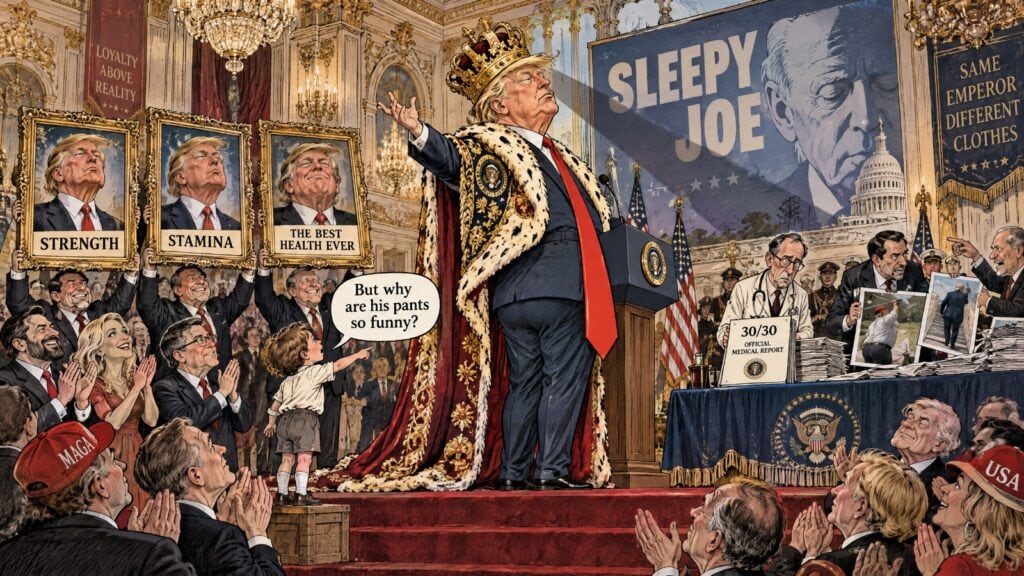
There is a children's story by Hans Christian Andersen about an emperor who is so vain that two conmen persuade him they can make clothes invisible to anybody who is stupid or unfit for office. The clothes don't actually exist, but nobody is prepared to admit they can't see them because doing so would expose themselves as an idiot. So the Emperor eventually parades through the streets completely naked while an entire population politely admires his magnificent outfit, until a child finally points out the fairly obvious problem.
Donald Trump has always struck me as somebody who would rather enjoy being the Emperor in that story. The gold, the pageantry, the insistence that everything bearing his name is the biggest, strongest and most magnificent anybody has ever seen. There is therefore something almost too perfect about the fact that, at the age of 80, one of the more persistent questions surrounding the President of the United States is not whether he is wearing the Emperor's new clothes, but what the hell is going on underneath his trousers.
I appreciate this sounds like I've finally exhausted all respectable subjects for Max's Daily Chop. I haven't. There are wars taking place, oil is above $100, America is heading towards another election and artificial intelligence may yet either revolutionise civilisation or turn us all into human batteries. Yet my phone keeps showing me photographs and videos of Donald Trump's backside, and after a certain number of them it becomes difficult not to notice that something looks rather odd.
There is, in genuine footage, a pronounced and sometimes remarkably square-looking bulge around the back of Trump's trousers or beneath his jacket. There are videos in which his gait looks stiff and unusual. There are photographs of his extraordinarily devoted aide Natalie Harp repeatedly following him carrying very large bags, including around his golf activities. And now, in a development so perfectly unfortunate that even Armando Iannucci might have rejected it as slightly unsubtle, menswear writer Derek Guy has identified one of Trump's recent suits as apparently belonging to the relatively inexpensive Jos. A. Bank Traveler range, which is marketed using technology designed to help resist odours.
Trump is a billionaire. He owns golf courses, aircraft and buildings with his surname written across them in enormous gold letters. This is a man who has launched watches costing tens of thousands of dollars and whose interior-design philosophy appears to be what would happen if Louis XIV won the Powerball. Yet he is apparently campaigning in a suit costing a few hundred dollars whose manufacturer advertises its ability to resist smells.
I am sorry, but at some point you are allowed to ask a question.
The internet's answer is that Donald Trump wears an adult nappy. That theory has existed for years. It has been fuelled by claims from former Apprentice staffer Noel Casler, by the visible shape underneath Trump's clothing, by his peculiar gait and by the enormous bags that accompany him. Harp has consequently acquired the charming online nickname “Diaper Nurse”, although there is no verified evidence that this is part of her actual job description and I suspect it is unlikely to appear on LinkedIn.
One widely circulated photograph supposedly showing Harp actually carrying nappies was manipulated, and that is worth removing from the evidence pile completely. The authentic photograph involved another Trump aide, Margo Martin, carrying the bag; the white objects inside were never identified. If we're going to ask people to believe their own eyes, we should probably start by making sure the photograph they're looking at is real.
But debunking one photograph doesn't make all the other photographs disappear. There really is unusual-looking footage of Trump's clothing. Harp really does follow him around carrying extremely large bags. Trump really does sometimes walk with a peculiar, stiff gait. And he really has recently appeared in a surprisingly cheap suit belonging to a range marketed partly around odour resistance. None of those facts individually tells us what is going on. Put together, however, they explain perfectly well why people keep asking the same question.
Could the bulge simply be tailoring? Yes. Could it be some sort of protective or medical equipment? Possibly. Could Trump wear an adult incontinence product? Of course he could. He's 80 years old, and millions of perfectly healthy and capable people use them. We don't know. What interests me is not pretending that we do know, but equally not pretending there is nothing there to discuss simply because the answer might be embarrassing.
And this is where I think the weight of evidence matters. Evidence does not always arrive as one photograph with a helpful label saying PRESIDENTIAL NAPPY: SIZE XXXXL. Sometimes it is accumulation that makes people start asking questions. One strange photograph is a strange photograph. One peculiar walk is a peculiar walk. One enormous bag carried by an aide is an enormous bag. One oddly shaped suit could simply mean the tailor was having a difficult morning. But when the same questions keep being prompted by different photographs and different appearances, alongside allegations that have circulated for years, it becomes perfectly reasonable to ask whether all these apparently unrelated things have a common explanation.
There is repeatedly something conspicuous beneath the back of Trump's clothing. There are repeated examples of the peculiar, stiff-looking gait. Natalie Harp, one of the people almost permanently around him, repeatedly carries an enormous bag. There have been allegations about incontinence going back years. Now we discover that this billionaire President, a man who sells spectacularly expensive watches and decorates things as though Versailles has recently suffered an explosion, appears at events wearing a roughly $250 suit from a range marketed partly around odour resistance. None of those things on its own answers the question. Collectively, they make the question rather harder to dismiss as something invented by a bored person on Twitter.
And that is where the Emperor's new clothes come in.
Donald Trump hasn't built a political brand around sober administrative competence. He has built it around strength. Everything about the Trump character is designed to project it: the enormous rallies, the fist in the air, the golf, the long red tie, the aeroplane, the aggressive handshakes and the constant language of winning and domination. Supporters have spent years circulating pictures of his head Photoshopped onto Rocky Balboa and various other improbably muscular bodies. Trump himself has enthusiastically shared some of them.
It is political theatre, and extremely effective political theatre at that. Trump understands something about branding that plenty of much cleverer politicians never grasp: people remember a picture far more easily than they remember a policy document.
The problem is that Trump also made physical weakness a legitimate political weapon. Joe Biden was not merely President Biden; he was Sleepy Joe. Trump mocked his gait, his mistakes, his stumbles, his apparent tiredness and his age. Biden's physical presentation was repeatedly offered as evidence that he lacked the capacity to be president. Some of those concerns ultimately became very serious indeed and contributed to the pressure that ended Biden's attempt to seek another term.
Fair enough. If the physical and cognitive condition of an elderly president is relevant, then it is relevant. But Donald Trump is now 80, and political weapons have an annoying habit of remaining loaded after you've finished firing them.
That makes the growing collection of photographs and footage showing Trump himself sitting at public events with his eyes closed rather awkward. No single photograph proves anything particularly interesting. People blink, people close their eyes while listening and, having attended enough interminable corporate meetings myself, I would strongly resist any rule under which being photographed with your eyes shut for three seconds constitutes a medical diagnosis. But once again, it is the weight of evidence and recurrence of the same observation that makes the question legitimate. There have now been repeated occasions on which Trump has appeared to be asleep or at least extremely drowsy at public events, and the pictures keep coming.
Perhaps Trump has simply discovered in his eighties that everything is more comfortable with his eyes closed and his face completely at rest. If so, I sympathise enormously. But he created the standard. “Sleepy Joe” wasn't an incidental insult; it was part of Trump's wider argument that physical presentation tells us something about a president's fitness and stamina. You cannot spend years telling everybody that an elderly president looking sleepy is evidence of declining capacity and then demand an entirely different interpretation when exactly the same photographs start being taken of you.
Trump is now the oldest person ever to serve as US president. He has repeatedly highlighted his cognitive-test results when responding to questions about his age and stamina, including again this summer when he boasted about achieving perfect scores. The supposedly inexhaustible strongman increasingly appearing with his eyes closed therefore has an irony that really doesn't require much assistance from me.
Again, this is why I keep coming back to the cumulative picture rather than any single image. The strange bulge at the back of the trousers doesn't establish what is underneath it. Natalie Harp carrying an enormous bag doesn't establish what is inside it. The stiff-looking gait doesn't establish its cause. A billionaire choosing a roughly $250 suit marketed partly for odour resistance doesn't establish why he chose it. Trump repeatedly appearing with his eyes closed doesn't, by itself, establish that he was asleep. But there comes a point where an accumulation of observable things becomes interesting in its own right. You don't have to pretend you know precisely what each one means in order to notice that they're there.
There is, however, an important piece of evidence on Trump's side, because his own doctors say he is fine.
Trump underwent his latest annual examination at Walter Reed in May. According to the official memorandum from the Physician to the President, the examination incorporated diagnostic testing from the preceding year and consultations with 22 specialist providers from multiple academic institutions. His neurological examination recorded normal mental status, motor strength, sensation, reflexes, gait and balance, while screening for depression and anxiety was also normal. Most importantly for the argument about cognitive decline, Trump scored 30 out of 30 on the Montreal Cognitive Assessment, or MoCA. His physician concluded that he remained in excellent health and fully fit to perform the duties of President and Commander-in-Chief.
That deserves to be taken seriously. These are the clinicians who have actually examined him rather than people watching clips on Twitter, and a perfect score is plainly better than failing the thing.
Trump, however, has occasionally presented his performance as though he has successfully completed the entrance examination for Mensa. He has described his results as evidence of his “extreme intelligence”. That isn't really what the MoCA establishes. It is a screening test designed to detect cognitive impairment, not an intelligence test.
And some of the questions are not exactly University Challenge.
The MoCA asks patients to perform tasks involving memory, attention, language, visuospatial ability and orientation. Among them is identifying pictures of animals. The patient is shown drawings of a lion, rhinoceros and camel and asked to name them. There are also tasks involving drawing a clock, remembering five words, repeating sentences, subtracting sevens and identifying the date and location.
I'm not belittling the test. It has an important clinical purpose. A person struggling with tasks that should ordinarily be straightforward can provide clinicians with useful evidence of possible cognitive impairment. But passing it perfectly establishes that you performed normally on a cognitive screening test. It doesn't establish that you're Einstein.
So when Trump effectively says, “I got 30 out of 30, therefore I possess extreme intelligence,” it is worth remembering that three of the available points involved successfully recognising a lion, a rhinoceros and a camel.
Congratulations, Mr President. That is indeed an elephant.
The serious point beneath the joke is that Trump's perfect result is evidence in his favour, but it has limits. It tells us that the clinicians administering the MoCA did not identify cognitive impairment through that screening tool. It cannot tell us everything about judgement, temperament, concentration over long periods, decision-making under pressure or whether somebody's cognitive performance has changed subtly over time. Screening tests aren't designed to answer every conceivable question about presidential capacity.
There is also an unavoidable institutional point. These results come from the President's official medical team. That doesn't make them false or politically compromised; Walter Reed and the specialists involved are serious medical professionals, and the examination included far more than one White House doctor taking Trump's blood pressure between meetings. But the information the public receives is nevertheless released through the White House medical system, with Trump authorising what is published. That is worth remembering when assessing presidential health disclosures generally, whether the president happens to be Trump, Biden or anybody else.
For balance, there is another body of medical opinion that shouldn't simply be ignored because it points in the opposite direction.
In May, 30 senior US psychiatrists and other doctors specialising in mental health signed a statement declaring Trump mentally unfit to serve as president. Their concerns included what they described as marked deterioration in cognitive functioning, episodes of apparent somnolence during important public proceedings, impaired judgement and impulse control, and significant loss of self-control. They argued that the pattern they believed they could observe in Trump's public behaviour had become serious enough to constitute a danger. The statement and the debate surrounding it were reported in the BMJ.
These aren't thirty blokes from Twitter who watched Trump mispronounce something and changed their profile pictures to stethoscopes. The group included psychiatrists, neurologists and other professionals with experience in cognitive disorders and assessing dangerousness. Their concerns therefore deserve acknowledgement.
But there is an equally important qualification on their evidence: they have not conducted Trump's official clinical examination. They are drawing conclusions from his publicly observable behaviour. That has generated a serious ethical argument within medicine itself. A consultant psychiatrist subsequently writing in the BMJ argued that assigning a psychiatric diagnosis without a clinical examination, medical history, collateral evidence, investigations and detailed capacity assessment is inappropriate.
And actually, that disagreement rather neatly captures the entire point of this article.
Trump's own doctors have examined him and say he is cognitively normal and fit for office. A substantial group of highly qualified outside medical professionals have looked at his public behaviour and reached a profoundly different conclusion. One group has direct clinical access but operates within the presidential medical system. The other has independence but does not have direct clinical access.
You should know both.
Then look at the evidence yourself.
Which brings us, after that brief excursion into cognitive medicine, back to Natalie Harp's bag. I admit I have become fascinated by it, not because I know what's in it but precisely because I don't.
Harp is one of Trump's closest aides, sometimes described as his “human printer” because of her habit of feeding him printed articles and information. She has been photographed repeatedly around him carrying a remarkably substantial bag, including while accompanying Trump around his golf activities. It may contain papers. It may contain clothes. It may contain chargers, medication, golf equipment or enough McDonald's to survive a nuclear winter. Presidential aides presumably carry all manner of strange things.
But when the President simultaneously has a conspicuous unexplained bulge beneath his clothing, and an existing theory says he uses incontinence products, the aide permanently carrying the enormous bag is inevitably going to become part of the story.
The interesting question isn't “can I prove what's inside Natalie Harp's bag?” I can't. It's why everybody feels slightly ridiculous for asking.
Hans Christian Andersen would recognise that part.
There is something sitting there in plain sight. Nobody can say with certainty what it is. The White House could presumably end a substantial amount of speculation with a mundane explanation if there is one, but instead the internet fills the vacuum, as the internet invariably does. And Trump is unusually vulnerable to that because his political persona leaves almost no room for ordinary human frailty.
Which brings us back, regrettably, to the suit.
Trump's recent Jos. A. Bank suit became a story partly because the visible label allowed menswear observers to identify what appeared to be the Traveler range. That is amusing enough by itself. But the identification also drew attention to the range's wrinkle-resistant and odour-control properties.
Now, obviously, there are several million reasons why somebody might buy a suit designed not to smell. Politicians spend hours under lights, travel constantly and shake hundreds of hands. I would quite happily wear one myself if somebody wants to send it over. Odour-resistant fabric is not evidence of incontinence.
But Christ, it doesn't help.
If the internet already believes you may be wearing an adult nappy, discovering that your inexplicably inexpensive suit has been marketed for its ability to resist odour is the sartorial equivalent of being accused of arson and arriving at court smelling of petrol. It proves absolutely nothing by itself. It is simply an almost magnificently unfortunate addition to the pile.
And the pile is why the story survives: the strange silhouette, the stiff-looking walk, the enormous bag, the longstanding allegations, the odour-resistant suit and now the growing gallery of the man who invented “Sleepy Joe” sitting at events looking remarkably sleepy himself. Any individual piece has an innocent possible explanation. Taken together, they create a visual mystery around a president who has built his identity around the idea that physical weakness happens exclusively to other people.
If Donald Trump were simply an 80-year-old retired property developer in Florida, none of this would matter in the slightest. If he needed an adult nappy, good luck to him. Incontinence is common, medical and not remotely a moral failing. Franklin Roosevelt could not walk unaided and managed to lead America through most of the Second World War. Physical frailty tells us remarkably little about somebody's intelligence or judgement.
But Trump isn't a retired property developer. He is President of the United States, commander-in-chief of the world's most powerful military and perhaps the single individual whose unscripted comments most consistently move global financial markets.
His remarks can move oil. His tariff announcements move currencies and equities. His comments about the Federal Reserve move expectations for interest rates. His decisions on Iran, China, Russia and Europe affect wars, trade routes, energy prices and hundreds of billions of dollars of capital. When one individual possesses that degree of influence, questions about whether he remains capable of absorbing enormous quantities of information, maintaining concentration and making decisions under extraordinary pressure are plainly legitimate.
That doesn't mean bladder control has anything whatsoever to do with presidential capacity. It doesn't. If Trump does wear an incontinence product, that tells us essentially nothing about whether he can make a rational decision on Iran. Physical disability and intellectual capacity are not the same thing, which is why the trousers themselves are ultimately less important than the extraordinary mythology surrounding them.
The wider question is transparency. America has just lived through an enormous argument about how much the public was entitled to know about the health and ageing of Joe Biden. Trump himself helped establish the standard that voters should watch an elderly president, observe his behaviour and ask whether what they were seeing matched what they were being told. Fine. Then that rule cannot simply expire because Donald Trump is now the elderly president.
If he repeatedly appears exhausted, people are entitled to notice. If his movements change, people are entitled to ask why. If there is repeatedly a conspicuous unexplained object beneath his clothing, people are entitled to wonder what it is. If the White House has completely mundane explanations for any of those things, wonderful. Give them.
Because Trump's age isn't merely a personal matter when Trump himself made age and stamina a political test.
Which finally brings us back to Andersen.
The genius of The Emperor's New Clothes isn't really that the Emperor is naked. It is that everybody can see the same thing and social pressure prevents them from saying it. That feels strangely appropriate to modern American politics.
Trump's most devoted supporters sometimes seem required to believe not merely that he is the best political choice, but that every aspect of the man confirms the mythology. He isn't merely an 80-year-old politician; he's stronger than people decades younger. His verbal tangents aren't tangents; they're “the weave”. His age isn't relevant despite Biden's age having been treated as overwhelmingly relevant. Every visible vulnerability has to be either fake, irrelevant or evidence of some conspiracy against him.
The other side can be equally ridiculous, turning every photograph into proof of dementia and every crease in a suit into a medical diagnosis. That isn't evidence either. If you're looking hard enough for something to confirm what you already believe about Donald Trump, the internet will provide it before breakfast.
But between those two camps sits a much simpler position. Look at the pictures. Look at the footage. There is something unusual visible beneath the back of Trump's clothing. There are recurring questions about his gait. One of his closest aides carries an enormous bag around with him. There have been longstanding allegations about incontinence. Somebody has now identified his cheap suit as belonging to a range promoted partly for odour resistance. And the man who spent years calling his predecessor “Sleepy Joe” is increasingly producing photographs in which he looks rather sleepy himself.
Against all of that, Trump's doctors have actually examined him and say he is fit for office. He scored perfectly on a recognised cognitive screening test. Twenty-two specialist providers contributed to his latest medical assessment. Those aren't facts we should discard merely because they interfere with a good joke about his trousers.
Equally, a group of senior medical professionals with expertise in mental health and cognitive disorders has publicly reached the opposite conclusion from observing his behaviour. They haven't clinically examined him, which matters enormously, but their qualifications don't disappear merely because their conclusion is inconvenient either.
So what does it all mean?
I haven't got a fucking clue.
Perhaps one day the White House explains the whole thing and it turns out Donald Trump simply has the worst tailor in America. Perhaps the bag contains paperwork, the bulge is something completely mundane and the President has simply discovered, as many men eventually do, that meetings are considerably more enjoyable with your eyes closed.
Or perhaps the internet has correctly guessed at something extremely ordinary about an 80-year-old man that is embarrassing only because that particular 80-year-old man has spent a decade constructing a political character who isn't allowed to be old.
That is the real point. The Emperor's problem was never that he was naked. It was that everybody could see him. You don't have to diagnose Donald Trump from any of this, but neither should you have to pretend you cannot see a recurring pattern simply because acknowledging it conflicts with the brand.
Because whether Donald Trump is wearing a $250 odour-resistant suit is funny. Whether the most powerful man in the world remains capable of doing the job is important. And if you build your entire political identity around being the strongest man in the room, you probably shouldn't be surprised when eventually everybody starts looking rather closely at your trousers.
Keep your Axe sharp. And never build a brand that your own trousers can destroy.
Max
Join the FX Axe newsletter and stay one chop ahead.

