

The EUR/USD pair remained under pressure during Tuesday's European session on July 28, trading close to the 1.1350 level as the US Dollar continued to attract buyers ahead of this week's Federal Reserve policy announcement. The market has entered a wait-and-see mode, with traders avoiding large positions before the outcome of the two-day Federal Open Market Committee (FOMC) meeting.
The euro slipped as the US Dollar strengthened across the board, helped by rising US Treasury yields and expectations that the Federal Reserve will keep interest rates unchanged while maintaining a cautious stance on inflation. With no major surprises expected from policymakers, investors are instead focused on the tone of the Fed's statement and Chair Kevin Warsh's press conference for clues about future rate decisions.
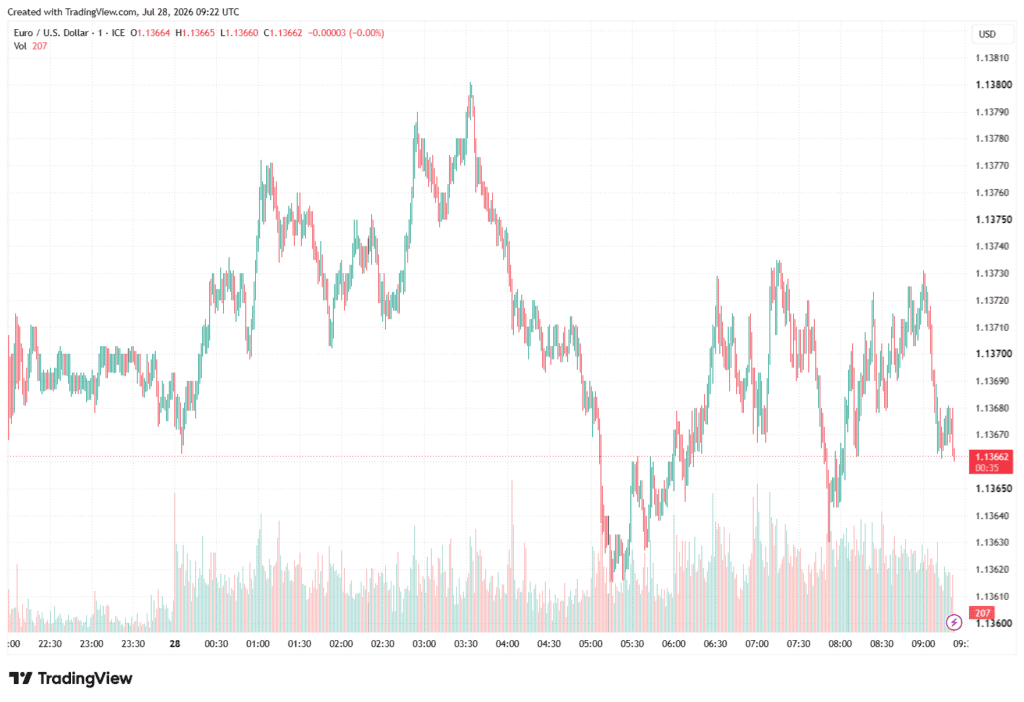
The recent weakness in EUR/USD is mainly driven by renewed demand for the US Dollar. While easing geopolitical tensions in the Middle East have reduced demand for traditional safe-haven assets like gold, the Dollar has continued to benefit from higher Treasury yields and expectations that US interest rates could stay elevated for longer.
On Tuesday morning, the US Dollar Index (DXY) climbed to around 101.5, its highest level in about a month, while the euro hovered near 1.1360 after touching fresh monthly lows earlier in the session. The stronger Dollar has limited buying interest in the common currency, keeping EUR/USD close to its weakest levels seen in July.
The biggest market event this week is Wednesday's Federal Reserve interest rate decision. Markets widely expect policymakers to leave the benchmark interest rate unchanged. However, investors will closely examine every word of the policy statement for hints about whether another rate increase remains possible later this year.
This uncertainty explains why EUR/USD has struggled to recover despite limited selling pressure during Tuesday's session.
If the Federal Reserve signals that inflation remains a concern and that further tightening cannot be ruled out, the US Dollar could strengthen even more. In that scenario, EUR/USD may face another wave of selling.
On the other hand, if the Fed adopts a softer tone and indicates that inflation is moving closer to its target, traders could reduce Dollar positions, allowing EUR/USD to rebound.
The Federal Reserve meeting is only one part of a busy week for financial markets.
Investors are also preparing for the release of second-quarter US GDP figures and the Core Personal Consumption Expenditures (Core PCE) Price Index, the Fed's preferred inflation measure. These reports could significantly influence expectations for future monetary policy.
Stronger-than-expected data would reinforce the view that the US economy remains resilient despite higher borrowing costs. That outcome would likely support the Dollar and keep EUR/USD under pressure.
Conversely, weaker economic figures could reduce expectations of additional tightening and provide support for EUR/USD later this week.
From a technical perspective, EUR/USD remains in a short-term consolidation after failing to sustain gains above the 1.1400 mark earlier this month.
Immediate support is located around 1.1350, a level that has attracted buyers several times during July. If sellers manage to break below this area, the next important support could emerge near 1.1300.
Meanwhile, resistance remains around 1.1400. A sustained move above that level would improve the short-term outlook for EUR/USD, although traders are unlikely to commit to larger positions before the Federal Reserve announcement.
Trading volumes have also been relatively light, reflecting the cautious mood across global currency markets.

Several major events could determine the next move in EUR/USD over the coming days:
Together, these events are expected to increase volatility across the forex market and could determine whether EUR/USD extends its recent decline or begins a recovery.
For now, EUR/USD remains trapped near monthly lows as traders wait for fresh direction from the Federal Reserve. The stronger US Dollar, firm Treasury yields, and uncertainty surrounding future interest rate policy continue to weigh on the pair.
The next 48 hours could prove decisive for EUR/USD, with both the Fed's communication and upcoming US economic data likely to shape market sentiment through the rest of the week. Rather than trying to predict the outcome, traders should stay focused on risk management and wait for confirmation before reacting to any post-meeting moves.
If you're looking to stay updated on the latest forex news, market analysis, broker reviews, and educational trading content, subscribe to the FX Axe YouTube channel for regular updates.
Learn more:

