

There are probably ten Warren Buffett quotations that get recycled so frequently in investing that they should come printed on the side of Bloomberg terminals. “Price is what you pay, value is what you get.” “Our favourite holding period is forever.” “Never invest in a business you cannot understand.” “It’s far better to buy a wonderful company at a fair price than a fair company at a wonderful price.” All excellent principles, although inevitably rather easier to recite while drinking coffee on a Tuesday morning than to follow when your portfolio has fallen 30% and every financial news channel appears to be announcing the end of capitalism.
But the Buffett line I keep coming back to today is perhaps the most famous of all: “Be fearful when others are greedy, and be greedy when others are fearful.” Buffett wrote those words in October 2008, when being greedy required considerably more nerve than it does printed underneath a photograph of him on Instagram. Lehman Brothers had collapsed, banks were failing, credit markets were freezing and the Dow was being thrown around like a shopping trolley with one broken wheel. Buffett wrote an article called Buy American. I Am. and announced that he was moving his personal wealth from US government bonds into American equities. Crucially, he didn’t claim to know where shares would be next week, next month or even next year. His argument was simpler: fear had become so widespread that good businesses were being sold alongside bad ones, and eventually the price you pay for a good business matters.
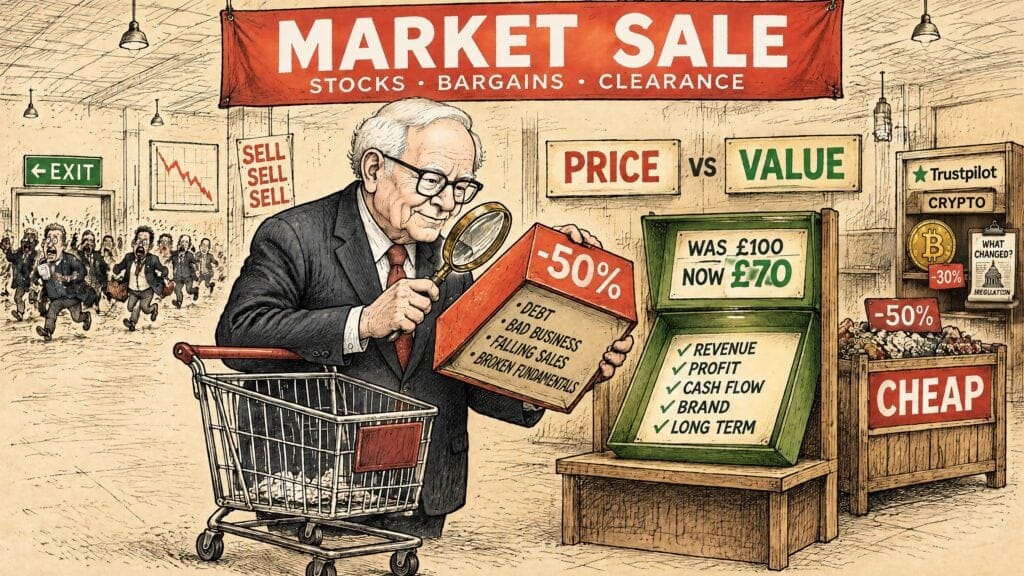
That distinction between price and value may be one of the most important ideas in investing, and today provides a rather interesting little laboratory in which to look at it.
Trustpilot had a fairly horrible day yesterday. The online reviews company announced half-year revenue growth of 19% to $151.4 million, adjusted earnings rose 46% to $26.3 million, and new business sign-ups increased 41%. Those aren’t normally numbers that cause investors to run screaming towards the exits. Unfortunately, the same announcement contained some considerably less attractive details. The company had incorrectly handled share buybacks because it lacked sufficient distributable reserves, discovered it hadn’t collected sales tax correctly in some US states and took an $800,000 charge relating to that problem. It has also been fined €4 million by the Italian competition regulator. On top of that, investors had apparently been hoping for an upgrade to guidance, which didn’t arrive.
The result was brutal: Trustpilot shares fell 18.6% in a single day.
The Times — Book-keeping blunders take shine off Trustpilot’s revenue growth
Before anyone reaches for their trading account, this is absolutely not a Trustpilot share tip. I am not a financial adviser, I don’t know where Trustpilot’s shares will be tomorrow and I’m deliberately using the company because I happened to read the headline and thought it illustrated something interesting about markets. There may be risks the market understands better than I do, and accounting or governance problems should never simply be waved away because the revenue number looks nice.
But as an intellectual exercise, it is fascinating. Trustpilot shares reached 299.8p in August and yesterday closed at 213p. That’s roughly 29% below the recent high, not the 50% figure I had heard suggested elsewhere, but it is still a fairly dramatic repricing of a company whose underlying revenue has just grown 19%. So the question for an investor isn’t simply whether the price has fallen, but what has actually changed. If the company’s long-term economics have deteriorated dramatically, a falling share price may simply be the market correctly adjusting to worse information. But if the underlying business remains sound and the problem is temporary, administrative or repairable, then eventually you arrive at the question Buffett has spent a lifetime asking: has the price fallen by more than the value?
That is where investing becomes interesting, because a cheap price and a cheap asset are very different things.
The great frustration with investment opportunities is that they rarely arrive accompanied by a small brass band and a note saying THIS IS THE BOTTOM. When Buffett began buying American equities in October 2008, the crash wasn’t finished. The S&P 500 continued falling and didn’t reach its eventual bottom until March 2009. Somebody following Buffett into the market could therefore have bought what looked like an extraordinary bargain and promptly watched it become an even bigger bargain. Sometimes you buy the dip and discover it was merely the first floor of a multi-storey car park.
But consider the opposite extreme. Suppose you had managed the almost impressively unfortunate feat of investing in the S&P 500 immediately before the financial crisis and then simply refused to touch it. In 2008 your investment would have fallen about 37%, including dividends. Horrendous. Then came 2009 at roughly +26.5%, 2010 at +15.1%, 2011 at +2.1%, 2012 at +16% and 2013 at more than +32%. The recovery continued, with interruptions, through the decade.
Across the ten calendar years from 2008 through 2017, even that disastrously timed investment still produced roughly 8.5% a year compounded, assuming dividends were reinvested. In other words, you could have been almost comically wrong about the timing and still eventually been right about the asset. This doesn’t mean equities always recover within ten years, nor that every market behaves like the S&P 500 did during that particular period. It means that volatility and permanent loss are not the same thing, and confusing the two is one of the easiest mistakes investors make.
This is the bit that tends to disappear from the motivational posters. Buffett doesn’t simply buy things because they’ve gone down. Berkshire began buying Coca-Cola heavily in 1988, eventually spending more than $1 billion building the position. Buffett wasn’t buying a distressed company on the verge of extinction. He saw an extraordinary brand, enormous distribution, attractive economics and a business he believed could compound for decades. The opportunity wasn’t merely that Coca-Cola shares were available at a particular price; it was that Buffett believed the value of the business was greater than the price the market was asking.
Berkshire Hathaway — Buffett’s 1988 shareholder letter
That is the missing half of “greedy when others are fearful”. Fear creates the price; fundamentals justify the purchase. Buffett’s principles, stripped of the mythology, are remarkably consistent: understand what you’re buying, distinguish price from value, prefer excellent businesses, don’t become obsessed with short-term market movements, maintain enough financial strength that you’re never forced to sell, and when everybody else panics, look more closely rather than automatically running away with them. That isn’t contrarian investing simply for the sake of being difficult. It’s emotional discipline.
If I had to reduce decades of Buffett into ten principles rather than ten quotations for Instagram, mine would be these:
For me, number five is the interesting one today: fear creates opportunities, but only when the fundamentals survive it.
Crypto provides another useful test of exactly the same principle. The failure of the US Senate to advance the CLARITY Act has added another dose of regulatory uncertainty to a market that wasn’t exactly famous for being calm in the first place. Bitcoin and the wider crypto complex have been under pressure, which inevitably produces the same question whenever an asset falls sharply: is this the moment to buy?
There is no responsible universal answer to that. But the framework for asking the question is exactly the same as it is with Trustpilot. If you believed Bitcoin was worth owning because of its scarcity, network, adoption, institutional demand and possible long-term role as a digital asset, has a setback in Washington destroyed that thesis, or has it merely delayed regulatory clarity while making the asset cheaper? Conversely, if your investment thesis depended heavily on favourable legislation passing immediately, then something fundamental has changed and buying simply because the price has fallen would be a completely different proposition.
That is what makes crypto particularly interesting because, unlike a company, Bitcoin doesn’t produce earnings, pay a dividend or publish a set of accounts from which we can calculate conventional intrinsic value. Its price therefore has an unusually elastic relationship with sentiment, liquidity, regulation and expectations. That can create enormous opportunities, but it can also create the seductive illusion that something must be cheap simply because it used to cost more.
A share falling from £10 to £5 is not necessarily half price. It may simply have been twice as expensive as it deserved to be in the first place.
Markets can move astonishingly quickly because markets price new information almost instantaneously. A company can lose 20% of its market capitalisation between breakfast and lunch without its offices changing, its customers disappearing or its employees becoming 20% less productive. A currency can move sharply because a central banker changes three words in a speech. Bitcoin can lose billions of dollars of market value because politicians fail to pass legislation traders had expected.
Sometimes those moves are entirely rational. New information matters, and occasionally a 20% fall isn’t nearly enough because the underlying problem is catastrophic. Sometimes a 5% fall is excessive because traders have panicked about something comparatively minor. But price is highly responsive to emotion and new information, while fundamental value usually moves more slowly, and the gap between the two is where investment opportunities can exist. Unfortunately, it is also where people lose spectacular amounts of money convincing themselves that every collapsing asset is “oversold”.
The skill is not identifying things that have fallen. Any idiot with a percentage column can do that. The skill is deciding whether the thing that has fallen is actually worth more than its new price.
Currencies provide an even cleaner version of the argument because there isn’t a company underneath them. You’re effectively comparing two enormous economic systems against one another. Interest rates change, inflation surprises, governments alter fiscal policy, wars begin, elections change expectations, central banks adjust language and capital moves accordingly.
Interest rates are particularly important. If markets expect the Federal Reserve to keep rates higher, or raise them further, US assets can become relatively more attractive because investors are being paid more to hold dollars. That can strengthen the dollar while simultaneously putting pressure on equities, crypto and other risk assets whose valuations benefited from cheaper money. But if the dollar jumps sharply on a single piece of news, the interesting question is once again not merely what moved, but why did it move and does that reason alter the longer-term picture?
A short-term trader may look at a violent currency move and see momentum. Another may see an overshoot and trade the reversal. A long-term investor may conclude that absolutely nothing has happened that requires action. All three can be rational because they are operating over different time horizons. This is why having a framework matters so much: without one, volatility simply becomes a succession of flashing green and red numbers inviting you to do something.
The annoying thing about good investment opportunities is that they often feel terrible at the time. If everybody is relaxed, optimistic and convinced something is going higher, that confidence is normally already reflected in the price. Discounts tend to appear when something has gone wrong, people are frightened and nobody particularly wants to explain at dinner that they’ve just bought the thing everyone else is desperately selling.
That doesn’t mean running around buying every disaster. Sometimes the crowd is frightened because the building really is on fire. The skill is working out whether the fire has destroyed the building or merely set off the alarm, and Trustpilot is an interesting example today precisely because the numbers force you to ask that question. Revenue up 19%. Adjusted earnings up 46%. New business up 41%. Accounting and administrative mistakes emerge, guidance disappoints and the shares fall almost 19% in a session. Is the market correctly repricing a company whose risks were underestimated, or has a growing business been marked down more heavily than the underlying facts justify?
I don’t know, and again, I am emphatically not recommending Trustpilot shares. What makes it useful is that we now have a live experiment. Yesterday’s closing price of 213p gives us a marker. We can come back to it in the morning news over the next few days and see what happens. If further problems emerge and the shares continue falling, the market may have been recognising something deeper. If no significant deterioration appears and the shares begin recovering, that tells a different story. Either way, we learn more by watching what happens next than by pretending today that we know the answer.
And I know which question interests me more. It isn’t simply, “Why did Trustpilot fall 18.6%?” It is, “Did Trustpilot’s underlying value fall 18.6% yesterday as well?” The same question applies to Bitcoin after a regulatory setback, to the dollar around a Fed decision and to American equities during a market panic. Prices move every second. Value is much harder to establish.
Buffett wasn’t successful because he possessed some magical ability to identify the exact bottom of every market. He didn’t. In October 2008 he openly admitted that he had no idea where shares would be in a month or a year. What he understood was rather more useful: when everybody else is frightened, prices can become interesting, and when prices become interesting, that is when you should probably start doing your homework.
Being greedy when others are fearful doesn’t mean buying whatever everybody else is selling.
It means having the nerve to look.
Keep your Axe sharp. Especially when everybody else is dropping theirs.
Max
Join the FX Axe newsletter and stay one chop ahead.

