

There is a phrase used rather too liberally in financial journalism: “a crucial week for markets”. Rather like “historic”, “unprecedented” and “breaking news”, it has suffered somewhat from inflation of its own. If every week is crucial, eventually none of them are. This one, however, has a reasonable claim, because between today, 10 September, and next Friday, 18 September, we have American producer inflation, American consumer inflation, a potentially pivotal vote on cryptocurrency regulation, a Federal Reserve interest-rate decision and a Bank of Japan meeting that could have enormous consequences for the yen. And, because apparently that wasn’t enough, the European Central Bank is expected to raise rates today as well.
All of this is happening against a fairly extraordinary backdrop. Brent crude is above $100 a barrel, US bond yields are elevated, the Iran conflict continues to make energy markets nervous and central bankers are once again discovering the irritating problem with inflation: you can spend months persuading it towards the door, only for oil to invite it back in through the kitchen window.
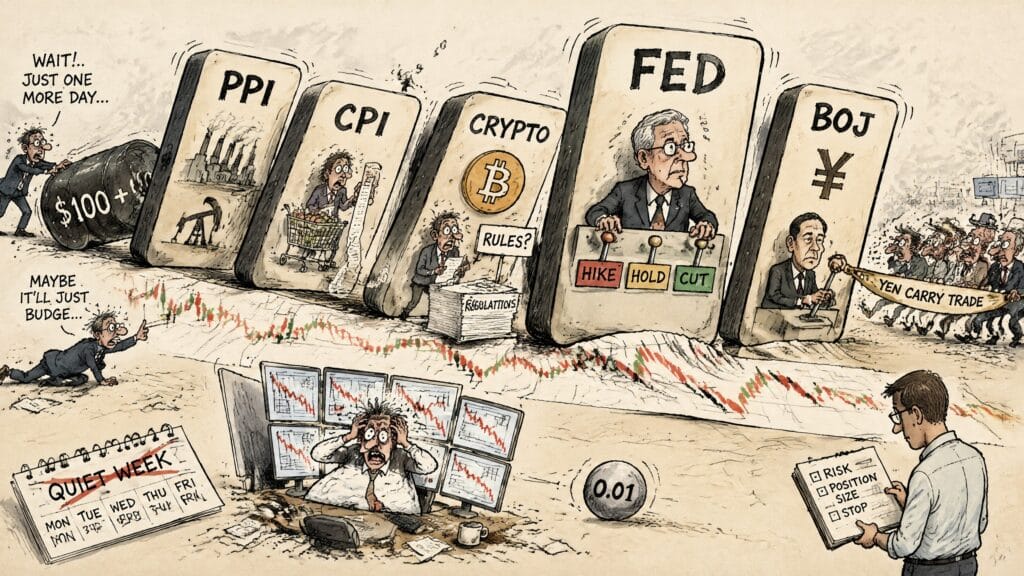
So rather than pretending anyone can tell you precisely what markets will do over the next eight days — they can’t — I thought it might be more useful to look at the five events that could determine where they go. Because the interesting thing about this particular run isn’t simply that there are five large catalysts sitting almost on top of each other. It’s that each one feeds into the next.
The first number arrives today with the US Producer Price Index, or PPI. For anyone understandably unmoved by the prospect of spending Thursday morning discussing wholesale inflation, PPI essentially measures how prices are changing further up the economic food chain, before many of those costs reach consumers. If manufacturers are suddenly paying substantially more for energy, materials, transport and everything else required to make things, there is a reasonable chance somebody eventually passes that bill onwards.
Today’s number is particularly interesting because economists expect producer inflation to remain hot. Consensus is around 0.4% month-on-month for headline PPI, with the annual rate expected at approximately 5.3%. Core PPI is expected at roughly 0.3% monthly and 4.6% annually. Those aren’t numbers the Federal Reserve can simply look at, stroke its collective chin and wander off for lunch.
The Fed is currently sitting in one of those deeply uncomfortable positions where virtually every option can be made to look wrong. Raise rates and you risk squeezing an economy in which consumers are already becoming more worried about employment and their personal finances. Leave rates alone while inflation accelerates and you risk allowing the problem to become embedded. Cut them — which President Trump would very much like — and at the moment you would need to explain why pouring additional petrol onto an inflationary fire constituted monetary prudence.
PPI therefore gives us our first proper clue about what happens next. Unfortunately for anyone hoping to digest that information at leisure, we only have to wait until tomorrow for the much bigger one.
Friday brings US CPI, the inflation figure that gets substantially more attention because it tells us what is happening to prices being paid by consumers. Headline inflation is expected to remain around 3.4% year-on-year, and the timing could hardly be more important because the Federal Reserve meets next week. The CPI print is therefore landing almost directly on the doorstep of the decision.
The problem for markets is that the Fed’s next move is far from settled. Policymakers have been signalling that the incoming inflation data matter enormously, while investors and economists don’t entirely agree about what happens next. Markets have recently attached a meaningful probability to another increase in rates, while a Reuters survey of economists has leaned towards the Fed remaining on hold. That disagreement is precisely what makes tomorrow dangerous.
Markets tend to become particularly lively not simply when the data surprise, but when large numbers of people have positioned themselves for different outcomes. A softer CPI figure could push rate expectations down, drag Treasury yields lower, weaken the dollar and give risk assets some breathing room. A nasty upside surprise could do almost exactly the reverse. For anyone trading EUR/USD, GBP/USD, USD/JPY, gold, US equities or the dollar generally, tomorrow is therefore less a day for making a confident prediction and more a day for knowing precisely where your risk is.
This is also where the sequence starts becoming important. Today’s PPI changes how people approach tomorrow’s CPI; tomorrow’s CPI changes how people approach next Wednesday’s Fed. We aren’t looking at five separate news stories. We’re watching one rather elaborate financial Rube Goldberg machine.
Then, after a weekend in which everyone can confidently explain what the Fed is going to do based on whichever inflation number best supports the position they already held, attention moves to Washington. On 15 September, the US Senate is scheduled for a key procedural vote connected to the Digital Asset Market CLARITY Act, legislation intended to establish a clearer regulatory structure for cryptocurrencies and determine which regulators oversee different parts of the digital-asset market.
That may sound considerably less exciting than Bitcoin suddenly moving 10%, but for the longer-term crypto story it potentially matters far more. Crypto has spent much of its existence in a slightly peculiar regulatory purgatory where trillions of dollars of value can move through an asset class while governments, courts and regulators continue arguing over precisely what many of those assets actually are.
The industry wants clarity, while traditional banks are considerably less enthusiastic about some elements of the proposals, particularly where stablecoins might compete more directly with conventional deposits. That has produced a substantial lobbying battle ahead of the vote, made more urgent by November’s midterm elections and the possibility that the political arithmetic in Washington changes afterwards.
For Bitcoin and the broader crypto market, the interesting point is that regulation isn’t necessarily the enemy it once appeared to be. The original crypto dream may have involved removing central institutions from finance altogether, but large institutional investors tend to have an irritating preference for knowing what the rules are before arriving with several billion dollars. Regulation can constrain an industry, certainly, but regulatory certainty can also legitimise it.
Sometimes boring legislation is extremely exciting for markets.
By Wednesday, the Fed will have seen both PPI and CPI, traders will have spent several days interpreting every decimal place, and the Federal Open Market Committee will finally have to do something with all of it.
The Federal Reserve announces its rate decision on 16 September, and this is unquestionably the centrepiece of the sequence. The current federal funds target range is 3.50%–3.75%, but the committee has already shown signs of disagreement over whether rates need to move higher. At the July meeting, three policymakers preferred an immediate quarter-point increase while the majority opted to hold.
Chairman Kevin Warsh is dealing with a particularly unpleasant mixture: inflation remains above target, oil is above $100, geopolitical risk remains elevated, parts of the American economy are proving resilient and the White House would like considerably cheaper money. Meanwhile, the bond market has been applying pressure of its own, with US 10-year yields around levels not seen since 2023.
That is why the next two inflation reports matter so much. If PPI and CPI both surprise upwards, the argument for tighter policy becomes considerably stronger. If they soften, the Fed gets more room to wait. And because markets are not fully committed to either outcome, the reaction could be considerably larger than it would be if everybody already knew what was coming.
For FX traders, this is where the dollar becomes particularly interesting. A more hawkish Fed should, all else being equal, support US yields and the dollar; a softer stance could push both in the opposite direction. Gold, equities and crypto will all be listening as well, because the price of money in the world’s largest economy has an annoying habit of turning up in almost every other asset class eventually.
Then, after America has had its turn, attention moves to Tokyo. The Bank of Japan meets on 17–18 September, and if you’ve been following the FX Axe shorts this week, you’ll know why this one interests me particularly.
The yen has strengthened significantly as traders increasingly contemplate further Japanese tightening. That matters because Japan has spent decades occupying a rather unusual position in global finance. Extremely low Japanese interest rates helped create the enormous yen carry trade, where investors borrowed cheaply in yen and deployed the money into higher-yielding assets elsewhere. It was one of those trades that could look wonderfully clever for years at a time, right up until the assumptions underpinning it began changing.
If Japanese rates rise while the yen strengthens, suddenly borrowing in yen becomes more expensive and repaying that borrowing becomes more painful. Imagine taking out an exceptionally cheap mortgage and then discovering that the currency in which you borrowed the money has risen sharply against the currency in which you earn it. The word “cheap” begins doing rather less work in that sentence.
This is why a hawkish Bank of Japan can matter well beyond USD/JPY. Carry trades can fund positions across bonds, equities and other risk assets around the world. If enough investors decide simultaneously that they would rather not be on the wrong side of a strengthening yen, those positions can unwind quickly.
It also creates a fascinating contrast with the United States. If the Fed sounds softer while Japan sounds tougher, the interest-rate differential that helped support USD/JPY narrows from both directions. If America remains hawkish and Japan disappoints those expecting tightening, the equation changes again. For a currency pair, it is a remarkably good demonstration of why FX is never simply about one country.
So that is the calendar: PPI today, CPI tomorrow, crypto regulation on Monday, the Fed on Wednesday and the Bank of Japan on Friday. And technically I’ve cheated, because there is a sixth major event sitting amongst them: the ECB today, with economists expecting another quarter-point increase in European rates as policymakers contend with renewed inflation pressure from the energy shock.
What makes the whole thing fascinating is that none of these events exists in isolation. Oil above $100 feeds inflation. Inflation affects PPI and CPI. Those numbers affect the Fed. Fed expectations move Treasury yields and the dollar. The dollar interacts with the yen. Japanese rates affect the carry trade. Changes in global liquidity filter into equities and crypto. Meanwhile, Washington is simultaneously trying to decide what the future regulatory architecture of digital assets should actually look like.
It is less an economic calendar than a particularly aggressive game of dominoes.
And that, ultimately, is the useful trading lesson from the next eight days. You can have a strong view, analyse every data point available and decide with absolute confidence what you think the Fed should do. But when markets face this many genuinely consequential events in quick succession, conviction and certainty are very different things. The skill isn’t necessarily predicting five outcomes correctly. If you can reliably do that, congratulations: you’ve cracked financial markets and can probably stop reading this blog.
For everybody else, it is about understanding where the risks sit, knowing what each result changes and making sure one unexpected decimal point in Washington doesn’t remove you from the game before Tokyo gets its turn. Because over the next eight days there are going to be quite a few decimal points.
And some of them could be expensive.
Keep your Axe sharp.
Max
Join the FX Axe newsletter and stay one chop ahead.

