EURUSD Bid: --
USDJPY Bid: --
GBPUSD Bid: --
USDCHF Bid: --
AUDUSD Bid: --
USDCAD Bid: --
NZDUSD Bid: --
EURGBP Bid: --
GBPJPY Bid: --
WTI Bid: --
BRENT Bid: --
XAUUSD Bid: --
XAGUSD Bid: --
SPX500 Bid: --
DAX40 Bid: --
US30 Bid: --
JPN225 Bid: --
NAS100 Bid: --
UK100 Bid: --
BTCUSD Bid: --
ETHUSD Bid: --
LTCUSD Bid: --
XRPUSD Bid: --
EURUSD Bid: --
USDJPY Bid: --
GBPUSD Bid: --
USDCHF Bid: --
AUDUSD Bid: --
USDCAD Bid: --
NZDUSD Bid: --
EURGBP Bid: --
GBPJPY Bid: --
WTI Bid: --
BRENT Bid: --
XAUUSD Bid: --
XAGUSD Bid: --
SPX500 Bid: --
DAX40 Bid: --
US30 Bid: --
JPN225 Bid: --
NAS100 Bid: --
UK100 Bid: --
BTCUSD Bid: --
ETHUSD Bid: --
LTCUSD Bid: --
XRPUSD Bid: --

Forex Market Volatility Surges as Tariff Uncertainty and BoJ Shifts Shake Global Markets

Posted: 25th Feb 2026

Forex Market Volatility is accelerating as global investors react to tariff uncertainty, shifting central bank expectations, and a major policy signal from Japan. Currency traders are navigating risk repricing across FX, equities, and commodities as macroeconomic uncertainty deepens.

From USD weakness to safe-haven flows and yen volatility, markets are clearly repositioning.
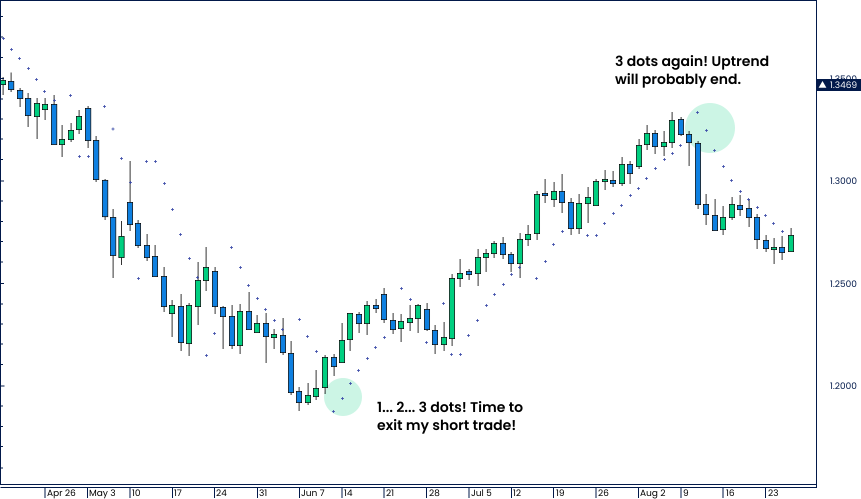
Global Markets React to Tariff Uncertainty

https://blueberrymarkets.com/media/soujg05v/top-forex-volatility-indicators-graphic-05.svg

The latest wave of Forex Market Volatility stems from uncertainty around global trade policies and tariff negotiations. Traders are pricing in risk as governments signal possible changes in trade frameworks.

Asian equity markets surged, particularly technology stocks, reflecting optimism around regional growth prospects. However, currency markets remain far less stable. FX traders are balancing:

  • Trade-policy uncertainty
  • Diverging monetary policy expectations
  • Inflation signals from commodities

While equities gained, the U.S. dollar softened against several major currencies. When tariff risk increases, investors often trim USD exposure and diversify into alternative assets.

For broader policy context, traders monitor updates from the World Trade Organization and global economic projections from the International Monetary Fund.

Safe Havens Rise as USD Weakens

As Forex Market Volatility rises, safe-haven demand typically strengthens.

Gold and oil prices climbed, reflecting both inflation hedging and geopolitical risk positioning. Gold, in particular, tends to benefit when:

  • Real yields soften
  • USD weakens
  • Risk sentiment deteriorates

Safe-haven currencies such as the Japanese yen and Swiss franc often attract flows during uncertainty. However, this time the yen’s reaction has been more complex due to domestic policy developments.

This dynamic creates mixed signals across G10 FX pairs, increasing short-term volatility and widening intraday trading ranges.

For traders looking to understand how volatility affects position sizing, review risk management strategies here.

Yen Weakens Sharply After Bank of Japan Appointments

Forex Market Volatility

A second major driver of Forex Market Volatility emerged after Japan’s Prime Minister appointed two dovish economists to the policy board of the Bank of Japan.

This move undermined expectations that Japan would continue tightening monetary policy. As markets reassessed rate differentials, the yen weakened sharply against the U.S. dollar.

Lower expected Japanese rates relative to other major central banks reduce the currency’s carry appeal. When interest rate expectations shift unexpectedly toward dovish territory, the result is often:

  • Momentum-driven yen selling
  • Rising USD/JPY
  • Increased volatility across Asian FX

Traders closely track policy commentary from institutions like the Federal Reserve to compare global rate trajectories.

When rate differentials widen in favor of the U.S., USD/JPY typically climbs. This repricing amplifies Forex Market Volatility, particularly in risk-sensitive crosses.

Why Dovish Surprises Matter in FX

Currency markets are highly sensitive to interest rate expectations. Even small policy shifts can trigger large capital flows.

A dovish pivot:

  • Reduces yield advantage
  • Weakens the domestic currency
  • Encourages carry trade unwinding
  • Boosts trend-following strategies

In this case, the Bank of Japan’s perceived softer stance altered forward rate expectations. As a result, FX momentum accelerated.

If you're comparing how different brokers handle volatility spikes, explore: How FX AXE Evaluates Brokers

What Traders Should Watch Now

With Forex Market Volatility elevated, traders should monitor:

  1. Updates on global tariff negotiations
  2. Central bank communication shifts
  3. Inflation data releases
  4. U.S.–Japan rate differential changes
  5. Commodity price momentum

Expect wider spreads, faster intraday swings, and stronger momentum flows in USD pairs.

Short-term opportunities often increase during volatility phases, but so does risk. Strategic position sizing becomes critical.

Final Thoughts: Forex Market Volatility Remains Elevated

Forex Market Volatility is being driven by two powerful forces: global tariff uncertainty and a dovish shift at the Bank of Japan. The combination has weakened the USD broadly while creating sharp moves in USD/JPY and other risk-sensitive pairs.

Asian equities may be resilient, but currency markets are signaling caution.

Until trade clarity improves and central bank guidance stabilizes, volatility is likely to remain a defining feature of the FX landscape.

For continued updates and deeper market insights, monitor official releases from:

  • International Monetary Fund
  • World Trade Organization
  • Bank of Japan

Staying informed is the first step in navigating Forex Market Volatility successfully.

Follow us on
Website Managed by BuiltByGo
Disclaimer: The information provided on FX Axe is for educational and informational purposes only and should not be construed as financial advice. Trading Foreign Exchange (FX), Contracts for Difference (CFDs), and other leveraged financial products involves a high level of risk and may not be suitable for all investors. Leverage can work both to your advantage and disadvantage, and as a result, you may lose more than your initial investment. Before deciding to trade FX, CFDs, or any other financial instrument, you should carefully consider your investment objectives, level of experience, and risk tolerance. You should not invest money that you cannot afford to lose. It is strongly advised that you seek independent financial advice if you have any doubts. FX Axe does not provide investment, tax, legal, or financial advice of any kind. We may receive compensation from brokers and partners featured on this website, but such relationships do not influence our reviews or recommendations. All reviews are based on our own opinions and research and should not be interpreted as endorsements or guarantees of any service. Past performance is not indicative of future results. The trading of FX and CFDs carries a significant risk of loss. By using this website, you acknowledge that FX Axe bears no responsibility for any losses you may incur from your trading activities or reliance on information provided here.

Affiliate Disclosure: Some of the links and references on FX Axe may relate to third-party brokers or service providers. In certain cases, we may receive compensation if you choose to engage with these providers through our website. This helps support the ongoing operation of the site and allows us to continue publishing content at no direct cost to our readers. Our content is created with the aim of being informative and useful. While commercial relationships may exist, we strive to ensure that the information presented remains objective and based on our own research and perspective.
cross