

Most people reading this probably trade currencies in one form or another. We spend our days talking about the dollar strengthening, sterling weakening, the yen being cheap, central banks cutting rates and whether EUR/USD is going through 1.20. We draw lines on charts representing the relative value of two currencies and then risk actual money predicting which direction that relationship will move.
But occasionally it is worth asking a much more basic question: what the hell is money?
Because if you actually stop and think about it, money is one of the strangest things human beings have ever invented. I can walk into a shop, hand somebody a brightly coloured piece of polymer with King Charles’s face on it and leave carrying a bottle of wine. The shopkeeper accepts this arrangement because he knows somebody else will accept the same piece of plastic from him tomorrow. Increasingly, of course, I don’t even give him the plastic. I tap my phone against another machine and some numbers move between computers. Nothing physical has actually changed hands at all, yet everybody involved agrees that payment has occurred.
That agreement is basically the entire trick. And it took humanity several thousand years to arrive here.
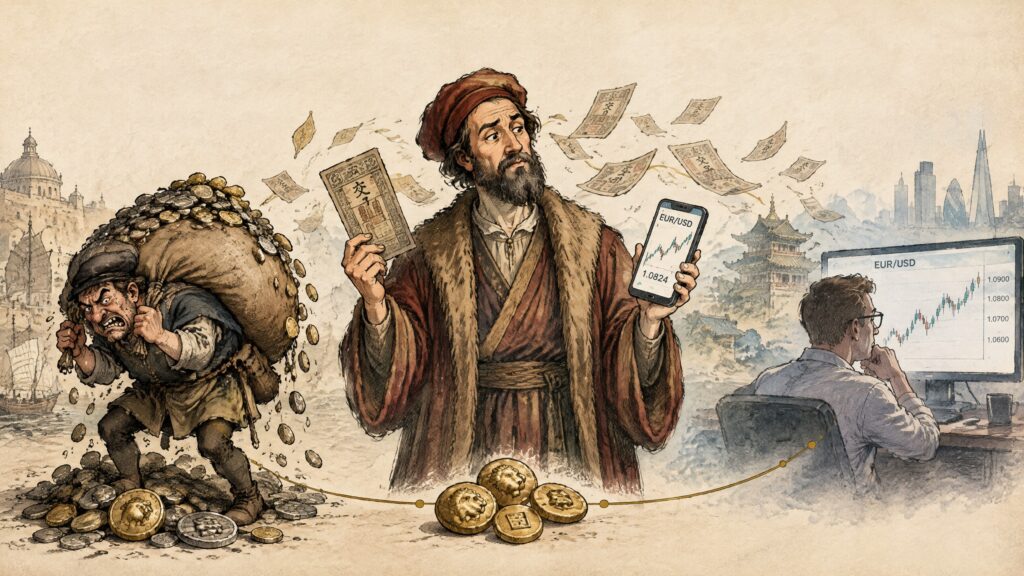
The traditional story begins with barter. Og has a chicken but wants some grain. Ug has grain but doesn’t particularly need a chicken, so Og has to find somebody who wants his chicken and owns something Ug wants. This is what economists call the “double coincidence of wants”, and it makes running an economy extremely inconvenient, particularly once somebody starts trying to purchase a house using 14,000 chickens.
Reality was probably more complicated than the schoolbook progression of barter, then money, then banks. Ancient societies also relied heavily on credit, obligations and systems of account. Long before everyone carried coins around, people were recording who owed what to whom. Money didn’t suddenly appear because one particularly irritated Mesopotamian got fed up with swapping goats.
What humans gradually discovered was that trade becomes much easier when everybody agrees on some common measure of value. Different societies used cattle, shells, grain, precious metals and all manner of objects for that purpose. Eventually metals became particularly useful because they were durable, divisible, portable and difficult to produce in unlimited quantities.
Then somebody had the rather clever idea of stamping them.
Some of the earliest recognisable coins appeared in Lydia, in what is now Turkey, around 650 BC. They were made from electrum, a naturally occurring mixture of gold and silver, and produced according to standard weights. Suddenly you didn’t need to weigh and test a lump of metal every time somebody wanted to buy something. The stamp effectively said: someone with authority guarantees what this is. The British Museum describes the Lydian electrum coins from around 650 BC as among the earliest coins in the world.
And that is an enormously important development, because it introduces something that will follow money for the next 2,500 years: trust.
The metal matters. But the stamp matters too.
Fast-forward more than a thousand years and China had a very practical problem. Trade was expanding enormously, but paying for things with metal was cumbersome. In parts of China, merchants were dealing with heavy coins, so moving large sums around could involve transporting ridiculous quantities of metal. Money is supposed to make trade more convenient. Once you need a small donkey to carry your wallet, something has probably gone wrong.
This reminds me of a conversation I had in New York when I was about 23 or 24, which is now sufficiently long ago that I’m not going to calculate the exact year. I was in a bar talking to two very attractive American girls and, as we’d been there for a while and buying drinks, the conversation somehow turned to British money. They were particularly fascinated by the fact that our currency was called the pound.
One of them eventually asked what happened if I wanted to go on a big shopping trip and spend, say, £300 or £500. How did I carry it all? I initially didn’t understand the question. I explained that you could obviously carry £500 in your wallet, although even then you’d probably just use a card. This seemed only to confuse matters further. After a little more questioning, I finally realised what they thought was happening in Britain.
They thought a pound was an actual pound of money. Not metaphorically. Not historically. They genuinely seemed to believe that somewhere in the United Kingdom we were wandering around with little lumps of currency that presumably weighed a pound each. Even better, they believed we carried these around in little leather purses, which in my mind immediately became the sort of drawstring pouch Robin Hood might attach to his belt before heading into Nottingham to buy six pints of mead.
By this logic, a £500 shopping trip would require you to arrive at Selfridges dragging nearly a quarter of a tonne of currency behind you.
Now, as I mentioned, they were both extremely attractive, so I wasn’t in any particular hurry to bring this anthropological exchange to an end. I may even have allowed the idea of Britain as a medieval barter economy to survive slightly longer than was strictly necessary. Presumably they went home believing that British men still settled their bar tabs by dropping small ingots onto the counter before galloping back to their castles.
But their wonderfully mistaken version of British monetary life actually illustrates a real problem rather well. Money has weight. Or at least, for most of human history, it did. If the value of your money depends upon the physical commodity itself, then greater wealth means carrying more of the bloody stuff around.
China encountered exactly this problem on a rather more serious scale. Forms of paper money appeared there remarkably early. The Bank of England notes that China was using paper money from as early as the seventh century, centuries before banknotes appeared in Europe. Surviving later Chinese notes were even made from paper produced using mulberry-tree bark.
Over the following centuries the concept became increasingly sophisticated. Instead of carrying all the underlying metal around, you could carry paper representing value. It is difficult to overstate how clever that conceptual jump was. The Chinese had effectively solved the problem my friends in New York thought Britain was still struggling with more than a thousand years later. You no longer needed £500 worth of little Robin Hood money lumps in your purse. You could carry a promise that represented them.
And this is where one of my favourite characters in history arrives: Marco Polo.
Polo reached the court of Kublai Khan in the thirteenth century and encountered a monetary system that must have looked completely insane to a European merchant. He described the Khan’s paper currency in remarkable detail, including its connection to mulberry bark and the authority that made people accept it.
Imagine seeing this through the eyes of a medieval Venetian merchant. You come from a world where wealth means silver and gold, and you arrive in China to discover that the most powerful ruler on Earth has essentially announced that bits of tree are money.
And everybody has gone along with it.
There is a wonderful myth that Marco Polo then brought paper money back to Europe. He didn’t. He described it to Europeans, which was remarkable enough, but Europe’s development of banknotes came through its own later banking systems.
There is another famous Marco Polo story worth killing while we’re here: he didn’t bring pasta to Italy from China either. Italians were eating pasta before Marco went anywhere near Kublai Khan. The story remains remarkably persistent, but the historical evidence for pasta in Italy predates his return from Asia.
So Marco Polo returned from China having invented neither European money nor spaghetti.
Still a decent trip.
Paper money represents one of the most important psychological leaps in financial history because the thing being exchanged increasingly stopped having much intrinsic value itself. A gold coin contains gold. Even if the government disappears tomorrow, you still own some gold. A piece of mulberry bark is considerably less reassuring.
For paper money to work, therefore, you need confidence. Perhaps the note can be exchanged for precious metal. Perhaps the issuing bank promises to honour it. Perhaps the government says it is legal tender. Whatever the mechanism, you are no longer simply trusting the object. You are trusting the system behind the object.
This eventually became the foundation of modern currencies. European banks began issuing notes redeemable for metal. Governments became increasingly involved. Central banks developed. National currencies became standardised. By the nineteenth century, much of the world’s international monetary system increasingly revolved around gold, and this gave currencies something wonderfully reassuring: an anchor.
Under the classical gold standard, participating countries defined their currencies in terms of a particular quantity of gold. If both sterling and dollars are ultimately claims on fixed quantities of the same metal, the exchange rate between them isn’t free to wander wherever it likes. Their gold definitions effectively establish the relationship.
This helped international trade because exchange rates were relatively predictable. Businesses trading across borders didn’t have to worry quite as much about currencies suddenly moving 20 per cent against them. But there was a price. If your currency is tied to gold, you can’t simply create unlimited money whenever the economy gets into trouble. Monetary policy is constrained by your gold reserves and the need to maintain convertibility.
This becomes particularly awkward when governments discover wars.
World War I placed enormous pressure on the system. Governments needed staggering amounts of money to fight, gold convertibility was suspended in various countries and attempts to reconstruct the pre-war monetary order afterwards proved increasingly difficult. The Great Depression then demonstrated how painful rigid monetary arrangements could become when economies desperately needed room to adjust.
By World War II, the world needed another plan.
In July 1944, while the war was still being fought, representatives from 44 countries met at Bretton Woods in New Hampshire to design the post-war international monetary system.
The arrangement they eventually created was ingenious. Instead of every currency being directly convertible into gold in the old way, participating currencies would maintain fixed but adjustable exchange rates against the US dollar. The dollar, in turn, would be convertible into gold for foreign monetary authorities at $35 an ounce.
In effect, the world built a pyramid. Gold sat underneath the dollar, and the dollar sat underneath much of the rest of the international monetary system. The IMF and what became the World Bank emerged from the same conference. Federal Reserve History records that the agreement fixed participating currencies to the dollar, within permitted adjustment bands, while the dollar itself was fixed to gold at $35 an ounce.
Initially it worked rather well. America emerged from World War II with an enormous share of the world’s monetary gold reserves and extraordinary economic power. Europe and Japan needed rebuilding. The world needed dollars.
But there was a rather obvious problem hiding inside the system. The global economy needed more dollars as international trade expanded, so America needed to supply those dollars to the world. Yet the more dollars accumulated outside America, the more governments could theoretically ask America to exchange those dollars for gold. Eventually foreign-held dollars exceeded the US gold stock, undermining confidence that America could honour every claim at the official price.
You can probably see where this is going.
By the late 1960s and early 1970s, confidence in the arrangement was deteriorating. Foreign governments and market participants increasingly questioned whether the United States could really continue converting dollars into gold at $35 an ounce.
On 15 August 1971, Richard Nixon went on television and announced that the United States was suspending dollar convertibility into gold. The gold window was closed.
It was initially presented as a temporary measure.
It has now been temporarily closed for more than half a century.
Attempts were made to patch the system together afterwards, but the fixed-exchange-rate system ultimately unravelled and major currencies moved towards floating against one another. Bretton Woods, as originally designed, was finished.
And this is essentially where the modern foreign-exchange world begins.
The pound doesn’t have to equal a fixed quantity of dollars. The dollar doesn’t represent a particular quantity of gold. The yen can strengthen or weaken depending on interest rates, capital flows, economic performance, trade, inflation, government policy, risk appetite and what several million traders collectively think might happen next.
Currency itself became a market.
This is where things become beautifully strange again. Modern major currencies are fiat money. Their value isn’t guaranteed by the promise that you can march into the Bank of England with £100 and demand the appropriate quantity of gold.
The pound has value because Britain has an economy, a government, a tax system, institutions and a central bank; because debts and taxes can be settled in sterling; because businesses price things in sterling; and, ultimately, because millions of other people believe sterling will continue to be accepted tomorrow.
We’re back to trust. Only now it operates at the scale of entire countries.
And this is why currencies have different values against one another. If investors expect interest rates in Britain to be higher relative to those elsewhere, sterling assets may become more attractive. If confidence in Britain’s economic prospects deteriorates, money may leave. Inflation matters because it erodes purchasing power. Trade matters because countries need foreign currencies to buy one another’s goods. Political stability matters. Debt matters. Central-bank credibility matters.
Ultimately, an FX price is an enormous, continuously updating argument about the relative credibility and prospects of two monetary systems. EUR/USD isn’t merely a squiggly line. It’s the market constantly answering the question: how much trust should we place in one currency relative to the other?
Which brings us to Hungary.
People often use Weimar Germany as the definitive example of hyperinflation, and understandably so. The images are extraordinary: wheelbarrows of banknotes, wages being spent immediately because prices might rise before lunchtime, money becoming worth less than the paper it was printed on.
But Germany doesn’t hold the record.
Hungary does.
Following World War II, Hungary experienced what is generally regarded as the most extreme hyperinflation ever recorded. Its currency was the pengő, and in July 1946 its peak monthly inflation rate reached approximately 41.9 quadrillion per cent. The equivalent daily inflation rate was around 207 per cent.
That number is almost meaningless to the human brain, so here is a much better way of understanding it: at the peak, prices were doubling roughly every 15 hours. Forget checking the price of your shopping next week. It could meaningfully change between breakfast and dinner.
The denominations became absurd. Hungary introduced the milpengő, meaning one million pengő, and then the b.-pengő, representing a trillion pengő. Notes reached numbers so enormous that ordinary monetary language effectively surrendered.
This is what happens when the central idea behind fiat currency collapses. The paper hasn’t changed. The ink hasn’t changed. The number printed on the front may actually have acquired several extra zeroes. What has disappeared is belief.
If everybody expects money to be worth dramatically less tomorrow, they try to get rid of it today. That increases the speed with which money is spent, prices rise further, confidence deteriorates again and the process can become self-reinforcing. In August 1946, Hungary finally replaced the pengő with the forint. The old currency had become effectively unusable.
The most important thing that disappeared wasn’t the pengő. It was trust in the pengő.
And perhaps this is why the history matters to anyone trading currencies today. We tend to think of FX as a modern technological market: screens, algorithms, economic calendars, central-bank press conferences, instant execution and trillions of dollars moving around the world.
But underneath all of it sits an argument humanity has been having for thousands of years: what is this thing worth?
A Lydian merchant asked it about a stamped piece of electrum. A Chinese trader asked it about a paper certificate. Marco Polo asked it when Kublai Khan showed him currency made from mulberry bark. Nineteenth-century bankers asked it about gold convertibility. The delegates at Bretton Woods asked it about dollars. Hungarian families asked it rather desperately about pengő. And today an FX trader asks exactly the same question about sterling, dollars, euros or yen.
The technology has changed. The question hasn’t.
Perhaps the most extraordinary thing about money is that almost every stage of its development has involved replacing something tangible with something increasingly abstract. We went from commodities to metal, from metal to stamped coins, from coins to claims on coins, from paper claims on gold to paper backed by governments, and eventually from paper to numbers in databases.
Today, most money isn’t even physical. It’s information.
Yet the entire global economy functions because billions of people wake up every morning and collectively continue believing that those numbers mean something. And normally they do, until they don’t.
That is why central-bank credibility matters. It is why inflation matters. It is why political institutions matter. It is why governments cannot simply print their way to prosperity indefinitely. And it is why currencies move against one another every second of every trading day.
Foreign exchange isn’t really the market for pieces of paper. It’s the market for relative trust.
Which makes Marco Polo’s astonishment at Kublai Khan’s mulberry-bark money rather wonderful in hindsight. He was looking at people accepting essentially worthless pieces of material because an enormous political and economic system stood behind them and everybody agreed they represented value.
Eight hundred years later, we’ve improved the technology considerably.
We’ve got rid of the mulberry bark.
Keep your Axe sharp. And remember: money only works while everyone agrees it does.
Max
Join the FX Axe newsletter and stay one chop ahead.

