

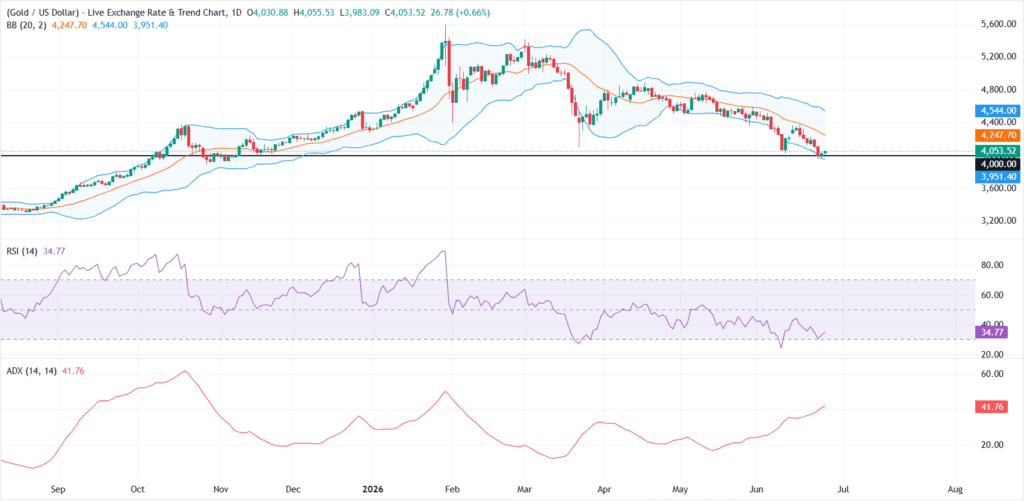
Gold stays above the $4,000 mark on Friday as markets react to softer U.S. inflation data. This data eases near-term Federal Reserve rate-hike expectations. The move stabilizes sentiment across the global financial market, after recent volatility driven by dollar strength and rising yields.
At the time of writing, gold (XAU/USD) stays supported as traders reassess macro conditions in real time. Price action reflects shifting expectations for inflation and monetary policy.
While the latest data brings short-term relief, uncertainty remains. Market prices are still sensitive to new economic reports. They also react quickly to signals from central banks.
From a technical view, gold keeps a bearish to neutral bias.
It stays below key resistance on the price chart.
Gold is still a key asset in the global commodity market. It trades alongside crude oil, natural gas, and other major raw materials.
In the long term, gold is driven by supply and demand. It is also driven by inflation hedging. Central banks also accumulate physical commodities.
In the short term, prices move based on liquidity, rate expectations, and stock market mood.
These factors strongly drive money flows across the broader financial market.
Several key factors support current stabilization:
These forces help prevent deeper downside pressure in market prices.
The latest U.S. PCE inflation report shows:
Following this release, traders lowered expectations for a near-term Fed rate hike.
Market pricing shows the September probability fell from 70% to 61%.
Despite this cooling, inflation is still above target. So, the central bank will likely keep a restrictive stance in the medium term.
Geopolitical uncertainty usually supports demand for physical commodities, especially gold.
However, when markets focus more on monetary policy and interest rates, geopolitical support weakens.
At present, sentiment in the commodity trading environment is dominated by macroeconomic expectations rather than risk-driven flows.
Gold remains sensitive to currency pair movements, especially USD strength.
The U.S. Dollar Index (DXY) trades near 101.20, after recently touching highs near 101.80, showing mild intraday weakness.
This softer dollar supports gold by making it more affordable for global buyers in real time. It also influences flows across the commodity market.
Gold trades closely with the broader financial market and behaves like a currency pair (XAU/USD).
It reacts to:
This makes gold a key macro indicator for commodity futures positioning and global risk sentiment.
Even with short-term dollar softness, elevated yields continue to limit strong upside.
Higher yields increase returns on bonds, reducing demand for non-yielding raw materials like gold.
This keeps the broader trend capped unless macro conditions shift more aggressively.
Gold remains closely linked with major currency pair movements:
These correlations help traders confirm momentum in commodity trading strategies.
Successful commodity trading requires combining macro and technical analysis.
Traders focus on:
Understanding how trading works across global cycles improves timing and execution.
Short-term traders focus on real time volatility driven by news and economic releases.
Long-term investors watch big cycles like inflation, supply and demand, and central bank buying of physical commodities.
Both approaches require strict risk management using stop losses.
Timing plays a key role in the commodity market.
Major moves often occur during:
These events create sharp shifts in market prices across stock markets and commodities.
Gold remains in a bearish-to-neutral technical structure, but downside pressure stabilizes after the PCE release.
A break above resistance could extend recovery momentum, while a drop below $4,000 may revive bearish pressure.
Traders rely on technical tools such as:
They combine signals with macro drivers in commodity futures markets for better accuracy.
Gold trades nearly 24 hours across global sessions.
Liquidity peaks during the London–New York overlap, where institutional commodity trading is strongest.
This is where real time volatility and directional moves are most active.
Volatility increases during high-impact news events, affecting gold, crude oil, natural gas, and other commodities simultaneously.
Traders manage risk using stop losses and controlled position sizing, especially in leveraged commodity futures exposure.
Gold holds above $4,000 as US PCE data cools near-term Fed rate-hike bets, easing pressure from yields and the U.S. dollar.
In the long term, gold remains supported by global supply and demand, inflation hedging, and demand for physical commodities. In the short term, however, commodity trading flows, macro data, and shifting market prices continue to define direction.
Traders should closely monitor real time data, price chart structure, and central bank signals to anticipate the next move in gold.
FX Axe Insight: Stay updated with our daily market updates, forex education, and broker reviews to understand how global financial markets move in real time.

