

I appreciate that anyone who has been reading Max’s Daily Chop for a while may have started to identify certain recurring themes. Markets obviously feature fairly heavily. History has a habit of appearing whether invited or not. Sport comes up probably more often than it should, and family occasionally wanders into proceedings too. These are, broadly speaking, the things that occupy most of my time, although I would like it formally recorded that I do have other interests and am capable of holding a conversation without mentioning Warren Buffett, Harold Godwinson or the Springboks.
Golf, however, deserves its own category.
I play it, I watch it and, like most golfers, I periodically convince myself that I understand it. This normally lasts until approximately the third hole of my next round.
And the more golf I watch, the more I think it may be one of the most interesting demonstrations anywhere in sport of the difference between probability and outcome. Because before a golf tournament begins, we now have an extraordinary amount of information. We know how far every player hits the ball, their accuracy from different distances, how frequently they find fairways, how many strokes they gain approaching the green, their putting performance, scrambling statistics, previous results on the course, current form and even how they perform on particular types of grass.
Then we can add the course itself. Is it long? Narrow? Firm? Soft? Links? Parkland? Does it reward enormous drives or punish them? Are the greens fast? Is the rough thick? Which side of the fairway gives the best angle into particular pins?
Then comes the weather. Wind direction. Rain. Temperature. Morning tee time versus afternoon tee time. On a links course particularly, somebody teeing off at 8am can occasionally appear to be playing a completely different sport from somebody beginning four hours later.
Put all of that into a model and theoretically we should be getting quite good at predicting who is going to win.
And then Ben Curtis turns up.
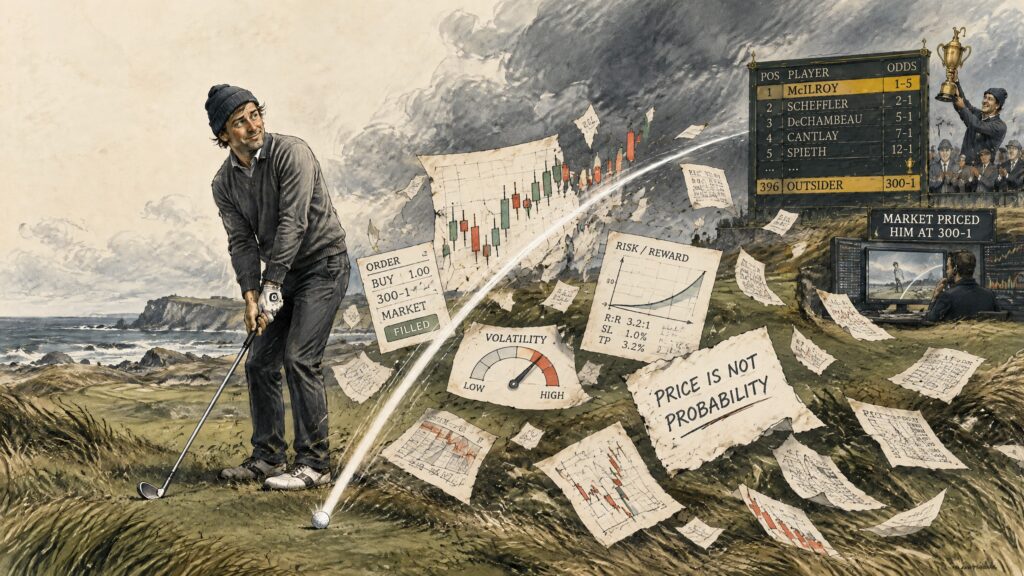
The 2003 Open Championship was held at Royal St George’s in Kent. Tiger Woods was there. Vijay Singh was there. Davis Love III was there. Thomas Bjørn was playing beautifully.
And then there was Ben Curtis.
Curtis was 26, in his rookie season on the PGA Tour and ranked 396th in the world. He had never played in The Open. In fact, he had never played links golf at all. He only qualified because of his finish at the Western Open the week before.
He arrived as a 300–1 outsider.
Four days later he was Champion Golfer of the Year.
The Open — the extraordinary story of Ben Curtis winning in 2003
This wasn't because every great golfer had inexplicably stayed at home. Woods finished fourth. Singh finished second. Bjørn looked for a while as though he was going to win before taking three attempts to escape a bunker at the 16th during the final round. Curtis simply survived Royal St George’s better than everyone else and finished as the only player under par.
Think about what a predictive model would have made of him on Thursday morning. World ranking: terrible compared with the field. Major experience: none. Open experience: none. Links experience: none. Course experience: none.
Result: winner.
That doesn't mean the model was useless. Quite the opposite. The model would have been entirely correct to conclude that Curtis was extremely unlikely to win.
But extremely unlikely is not the same thing as impossible.
And that distinction is where golf becomes fascinating.
Danny Willett provides another lovely example, although in a slightly different way.
Going into the final round of the 2016 Masters, Jordan Spieth was defending champion and appeared to be taking control again. By the time he reached the 10th tee on Sunday, he had built a five-shot lead.
You could have looked at Spieth’s game, his Augusta record, his putting, his experience and the leaderboard and concluded perfectly reasonably that he was about to win another green jacket.
Then came the 12th.
Spieth put two balls into Rae’s Creek, made a quadruple-bogey seven and suddenly a tournament that appeared largely settled wasn't settled at all. Willett, playing ahead, produced a superb bogey-free 67 and became Masters champion.
That wasn't Willett accidentally finding a green jacket in the locker room. He was a world-class golfer who played magnificent golf when the opportunity appeared. But the opportunity itself emerged because one of the best golfers in the world made a catastrophic mistake on one hole.
That's golf.
Four days of extraordinary skill can pivot on approximately ten minutes.
You can pick the right golfer and still lose
This is what I find particularly interesting when people talk about golf predictions. You can make what I would consider an extremely good selection and still be completely wrong.
Suppose we're playing a long course after heavy rain. The fairways are soft, there's almost no run and the rough is thick. Logically, I want somebody who carries the ball enormous distances because shorter hitters are going to be approaching greens with long irons while the bombers are coming in with wedges.
Perfectly sensible.
Then the enormous hitter arrives on Thursday morning and can't find a fairway.
Or perhaps we've chosen an exceptional links player because the forecast says 35mph winds all weekend. He tees off early on Thursday in atrocious conditions, shoots 75, and four hours later the wind disappears. Half the field plays the same course in relative tranquillity.
Our analysis wasn't necessarily wrong. The weather forecast wasn't necessarily wrong. The player selection wasn't stupid.
Reality simply didn't cooperate.
This is why golf is such an extraordinary sport to watch. In football, rugby or cricket, individual randomness can usually be absorbed to some extent by the rest of the team. Your fly-half has a poor ten minutes and somebody then successfully kicks at goal. Your opening batsman gets a first-ball duck and ten other people still have an opportunity to bat.
Golf leaves you standing alone with the consequences.
Nobody can hit the next shot for you.
Perhaps the most extraordinary example came at the 2009 PGA Championship.
Tiger Woods entered the final round leading by two shots. At that point in his career, Woods had been 14 for 14 when leading a major after 54 holes. Nobody had ever come from behind on Sunday to beat him in that situation.
Then Y.E. Yang did.
Yang chipped in for eagle at the 14th and produced one of the great pressure shots on the 18th, hitting a hybrid over a tree to around ten feet before holing the putt to beat Woods.
PGA Tour — how Y.E. Yang became the first player to overhaul Tiger Woods from a 54-hole major lead
Imagine building the model before that final round. Tiger Woods. Major championship. Two-shot lead. Fourteen previous occasions in precisely this situation. Fourteen victories.
You would pick Woods.
And you would have been wrong.
Not stupid. Wrong.
Those are different things.
I promise I wasn't trying to turn this into another trading analogy. I was quite happily writing about golf. Unfortunately, this is Max’s Daily Chop, and apparently my brain is now incapable of leaving anything alone.
Because the same distinction matters enormously in markets.
You can make a very sensible trade that loses money. You can also make an absolutely idiotic trade that makes money. We touched on this in the school article: judging the quality of a decision purely from the eventual outcome is dangerous because the outcome contains randomness that wasn't available when the decision was made.
Imagine a trader believes sterling will strengthen because UK inflation has surprised higher, markets are repricing interest-rate expectations and the economic data supports a more hawkish Bank of England. That's a coherent thesis.
Then, twenty minutes later, something completely unexpected happens politically and sterling collapses.
Was the analysis wrong?
Not necessarily.
The equivalent is choosing Tiger Woods when he has a two-shot lead on Sunday at a major after winning the previous fourteen times he had been in that position. You made the decision using the information available.
Y.E. Yang simply hit the shot.
There is an important warning here because “anything can happen” is also a wonderfully convenient excuse for people who repeatedly make terrible decisions.
Ben Curtis winning The Open doesn't mean golf is random. Scottie Scheffler being more likely to win a major than the world No. 396 remains an entirely sensible conclusion. If they played the tournament ten thousand times, you would expect the best players to win far more frequently.
Similarly, one terrible trade succeeding doesn't make it a good strategy.
If I close my eyes, select a currency pair at random and put my entire account on it going up, there is a perfectly reasonable chance that I will make money. That does not make me George Soros. It makes me an idiot who happened to win.
This is the part I think gets lost whenever people talk about probabilities. A good process does not guarantee a good outcome. It improves the distribution of outcomes over time.
Golf works exactly the same way.
Tiger Woods didn't win fifteen majors because golf is predictable. He won fifteen majors because over thousands upon thousands of shots, his ability shifted the probabilities enormously in his favour.
Ben Curtis didn't prove world rankings were meaningless. He proved that probability still leaves room for Ben Curtis.
Just to prove that Curtis wasn't some isolated statistical hallucination, The Open did something rather wonderful the following year.
In 2004 it went to Royal Troon. Ernie Els was world No. 2 and already a three-time major champion. Phil Mickelson had just won the Masters. Tiger Woods, Vijay Singh, Retief Goosen and a collection of the world's best golfers were all in the field.
Todd Hamilton won.
Hamilton was 38 and had spent much of his career playing in Japan. He wasn't remotely as obscure as Curtis — he was ranked 56th in the world and had already won on the PGA Tour that year — but very few people were picking him to beat that field. He eventually defeated Els in a play-off, using a hybrid from around the greens in a way that became one of the defining features of his week.
The Open — Todd Hamilton’s remarkable 2004 victory at Royal Troon
So The Open gave us Ben Curtis and Todd Hamilton in consecutive years.
Good luck with your model.
Perhaps this is why links golf is my favourite version of the sport. It exposes the limits of control more brutally than almost anything else.
You can prepare perfectly and wake up to find the wind blowing from the opposite direction. A hole you played with a wedge yesterday suddenly requires a three-iron. A drive that landed safely on Thursday bounces another thirty yards on Friday and disappears into a bunker. Somebody on the other side of the draw gets sunshine while you spend five hours wondering whether Gore-Tex trousers can actually develop trench foot.
And yet the best players adapt.
That, more than prediction, is probably the interesting lesson.
The objective isn't to build a model that perfectly predicts what happens next because such a model doesn't exist. The objective is to make sensible decisions based on probabilities and then remain capable of adapting when reality inevitably deviates from them.
A golfer can't control the weather, the bounce or what somebody three groups ahead is doing. They can control the next shot.
A trader can't control the Fed, an election result, an unexpected inflation print or somebody firing a missile somewhere inconvenient. They can control position size, entry, exit and risk.
You play the course you actually find yourself standing on, not the one you modelled on Wednesday evening.
And perhaps this is the real reason golf remains so compelling despite being, on paper, one of the least sensible spectator sports ever invented. It takes four days, the players spend much of the time walking and occasionally the television coverage consists of watching somebody stare at a patch of grass for forty seconds before deciding the wind has changed.
Yet millions of us watch because we know the spreadsheet eventually has to meet the first tee.
We know Scottie Scheffler can arrive as favourite and miss a six-footer. Rory McIlroy can hit a drive nobody else in the field can hit and then discover a bunker nobody else knew existed. Somebody ranked 396th in the world can turn up having never played links golf and leave holding the Claret Jug.
The statistics matter. Form matters. Course suitability matters. Weather matters. Experience matters. Research matters.
And after you've considered all of it, somebody still has to hit the bloody golf ball.
That's the bit no model can do for you.
So I'll continue looking at course form, weather forecasts, driving distance, strokes gained and whatever other increasingly sophisticated statistics golf manages to invent. I'll convince myself that I've identified exactly the player whose game perfectly suits that week's challenge.
And occasionally I'll even be right.
Just don't ask me to explain Ben Curtis.
Keep your Axe sharp. And play the course you get.
Max
Join the FX Axe newsletter and stay one chop ahead.

