

Donald Trump has been talking about Greenland for so long that it has gradually moved from one of those things you assumed he’d eventually forget about to an actual feature of American foreign policy. He has talked about buying it, controlling it and refused to rule out military force to acquire it. There have been the extraordinary maps presenting Greenland as part of an expanded America, diplomatic rows with Denmark and Greenland, and enough rhetoric to make you wonder whether somebody in the White House has simply left an old game of Risk running for too long.
Then there was the Nobel Peace Prize episode. Trump linked his increasingly aggressive approach to Greenland with his failure to receive the prize, complaining to Norway’s prime minister that he no longer felt obliged to think purely of peace. There is a fairly important administrative detail here: the Norwegian government doesn’t award the Nobel Peace Prize. The independent Norwegian Nobel Committee does. Denmark certainly doesn’t award it either. So whatever your view of Trump’s claim to deserve one, holding Scandinavian governments responsible for the decision is a little like shouting at Sweden because IKEA didn’t give you a Michelin star.
We could probably spend the entire article on that, but we’ve already written enough about Trump recently and Greenland itself is much more interesting. Because underneath all the bluster, maps and threats sits an awkward truth: America has perfectly sensible reasons to be extremely interested in Greenland.
It just doesn’t need to own it.
Look at Greenland on an ordinary world map and it appears to be an enormous frozen thing somewhere near the top left that cartographers have accidentally drawn roughly the size of Africa. In reality Africa is about fourteen times larger, but Greenland is still enormous: the world’s largest island, sitting in an extraordinary position between North America, Europe and the Arctic.
Militarily, that matters enormously. The shortest routes for certain missiles travelling between Russia and North America cross the Arctic, which makes Greenland extremely useful for early-warning radar, missile tracking and space surveillance. America already operates Pituffik Space Base, formerly Thule Air Base, in north-west Greenland, and the island fits naturally into Washington’s plans for expanded missile and space defence. Reuters has a useful breakdown of the military assets and strategic importance of the Arctic here
Russia is another part of the calculation. It controls roughly half of the Arctic coastline and has spent years developing its military infrastructure across the region, including important nuclear and submarine facilities. China, meanwhile, has long-term interests in Arctic shipping, infrastructure and minerals. From Washington’s perspective, having a friendly territory sitting across the northern approaches to North America is therefore rather useful.
And underneath all that ice is another reason everybody is interested: stuff.
Greenland has substantial deposits of rare earths and other critical minerals, precisely the materials becoming increasingly important for electronics, renewable-energy technology, aerospace and advanced weapons systems. That matters particularly because China remains dominant in the processing and supply of many rare-earth materials. The United States has consequently been trying to secure alternative sources, including interest in Greenland’s enormous Tanbreez rare-earth project. Reuters reported on Washington’s interest in taking a direct stake in the Greenland project here
So Trump isn’t wrong that Greenland matters.
Where things become slightly more complicated is the suggestion that America therefore needs to own it.
Trump has now announced an agreement with Denmark and Greenland that significantly strengthens America’s military position on the island. The arrangement gives the United States permanent access, basing and overflight rights, while preventing hostile non-NATO powers from establishing military bases or making certain sensitive investments there. Denmark and Greenland have stressed that sovereignty remains unchanged and that Greenland retains its right to self-determination. Reuters — US and Denmark close in on Greenland agreement
Strategically, that’s important.
Historically, however, it comes with quite a substantial asterisk.
America and Denmark signed the Defence of Greenland Agreement on 27 April 1951. Under that agreement, the United States was already able, alongside Denmark, to establish and operate defence areas in Greenland, construct military facilities, station personnel, move forces through Greenland and operate American military aircraft there. It was subsequently updated as Greenland’s constitutional position changed.
Indeed, the new agreement is explicitly an extension of that existing defence framework rather than America suddenly gaining access to Greenland for the first time. The original 1951 Defence of Greenland Agreement can be read here via Yale Law School’s Avalon Project
In other words, after months of threats, maps, diplomatic rows and discussion about acquiring an island whose population repeatedly said they didn’t particularly fancy becoming Americans, the eventual solution is broadly an expansion and strengthening of a military relationship that has existed for 75 years.
There is something wonderfully Trumpian about spending months threatening to buy the restaurant and eventually announcing that you’ve secured a very good table.
But while America has been thinking about Greenland since the Cold War, Europeans have been arguing, settling and occasionally murdering one another over this corner of the North Atlantic for more than a thousand years. And that is where the story becomes much more fun.
Meet Erik the Red.
Erik was a Norse explorer born around AD 950, and the nickname apparently came from his red hair and beard, although given the rest of his biography it could equally have referred to the amount of other people’s blood he had a habit of getting on himself. His father was exiled from Norway following killings, so the family moved to Iceland. Erik then managed to repeat the family tradition and was himself exiled after another violent dispute.
Rather than reconsidering his interpersonal skills, Erik sailed west.
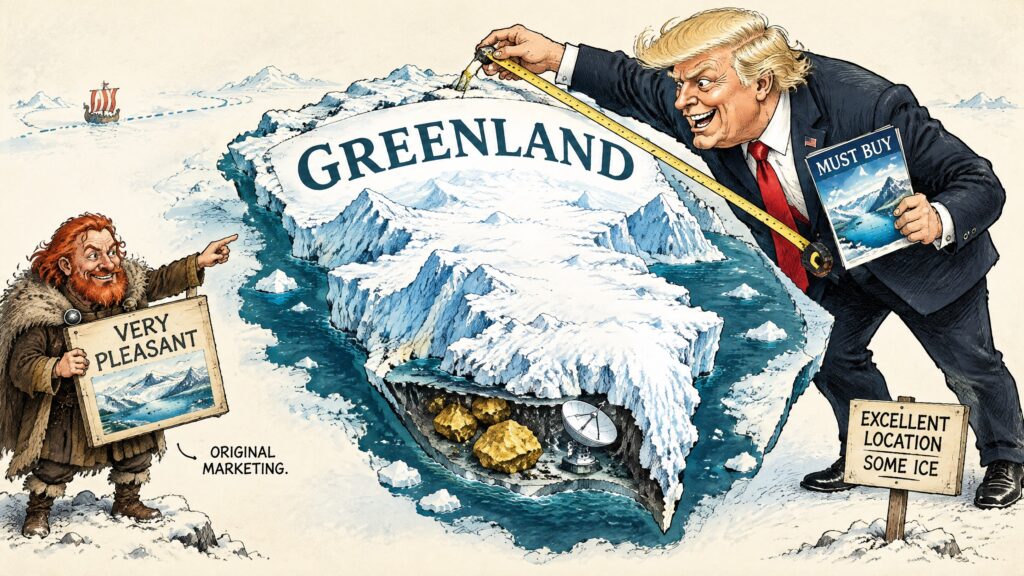
He reached Greenland, explored its south-western fjords and eventually returned looking for settlers. This presented a fairly obvious marketing problem. “Come with me to the enormous frozen island where I ended up after being thrown out for killing people” isn’t perhaps the strongest opening line for a property brochure.
So Erik called it Greenland.
According to the medieval sagas, he reasoned that people would be more inclined to settle somewhere if it had a favourable name. It worked. He returned with settlers and established the Norse colonies in Greenland.
And people say estate agents exaggerating the garden started recently.
To be fair to Erik, southern Greenland wasn’t entirely the frozen wasteland the name now suggests. The climate during parts of the medieval period was milder, and the sheltered south-western fjords contained grassland capable of supporting livestock. Norse communities survived there for centuries. But calling the entire island Greenland was still rather like discovering one pleasant beer garden in Manchester and renaming the city Costa del Sol. National Geographic — the real story behind the names Iceland and Greenland
This brings us to one of my favourite pieces of Viking trivia, partly because the popular version is almost right and therefore much more dangerous than something completely made up.
You’ve probably heard that Iceland and Greenland were deliberately given opposite names. Iceland was supposedly lush and beautiful, so the Vikings gave it an unpleasant name to discourage outsiders. Greenland was frozen and horrible, so Erik gave it a pleasant name to lure settlers.
Unfortunately, only the second half appears to be true.
According to the sagas, Iceland’s name is associated with an early Norse explorer called Hrafna-Flóki, who climbed a mountain, looked across a fjord filled with drift ice and called the place Ísland. There was no clever plan to discourage other Europeans from turning up. In fact, another member of his expedition apparently went home telling everyone the place was so fertile that butter dripped from every blade of grass, which sounds considerably closer to the Greenland school of Viking estate agency. National Geographic explains the wonderfully complicated naming story here
So there wasn’t an elaborate Viking conspiracy to switch the labels. There was just one extremely enterprising ginger murderer with a gift for branding.
Donald Trump might have liked him.
While we’re here, I would like everyone to perform a quick exercise. Stop for a second and picture a Viking. Longship. Beard. Axe. Round shield. Helmet.
Horns?
No.
Viking warriors did not, as far as the archaeological evidence shows, routinely wander into battle wearing horned helmets. The familiar image developed much later through art, theatre and costume design. Which makes sense because attaching two enormous handles to your head before somebody tries to hit you with an axe would be a curious tactical decision.
The Vikings themselves, however, were extraordinary. They weren’t merely raiders charging out of boats and ruining an English monk’s afternoon. They were traders, settlers, mercenaries and explorers whose networks stretched from North America through Britain and Ireland, across Russia and down towards Constantinople and the Middle East.
We’ve already met one of my favourites in the Daily Chop piece about the Bayeux Tapestry: Harald Hardrada, the magnificent Norwegian king whose failed invasion of England in 1066 helped set up Harold Godwinson’s subsequent sprint south to Hastings. If you haven’t read that one, go and have a look. It involves an arrow, an eye and one of history’s more inconveniently timed invasions.
But Erik the Red’s family managed something even more remarkable.
There is one important correction to the way this story is sometimes told. Erik the Red didn’t reach North America. His son Leif Erikson did.
Around AD 1000, Leif and other Norse explorers reached North America. Archaeology eventually confirmed a Norse presence at L’Anse aux Meadows in Newfoundland, meaning Europeans had crossed the Atlantic and reached North America roughly five centuries before Columbus sailed in 1492. Smithsonian — Viking settlement and exploration in North America
That doesn’t mean Leif Erikson “discovered America”, of course, because there were already millions of Indigenous people living across the Americas. But if we’re talking specifically about the conventional European exploration story, Columbus was very, very late to the party.
Which makes Columbus Day rather interesting. The holiday has become increasingly controversial in the United States because Columbus’s voyages opened an era of European conquest, enslavement and catastrophic population loss among Indigenous Americans. Many American communities now mark Indigenous Peoples’ Day instead.
But if America desperately wants an explorer-based celebration, there is another candidate.
Leif Erikson Day.
Even better, America already has one. It falls on 9 October, although it has never acquired anything approaching the cultural prominence of Columbus Day.
And there is something particularly relevant about Leif’s journey to our story because the Norse route west ran through Greenland. Erik established the Greenland colony; his son then used that Norse Atlantic world to push farther west. Smithsonian — the Vikings’ remarkable journey to North America
There is a rather lovely historical irony in all this. Trump has spent years presenting Greenland as something America suddenly needs to secure, yet the island has been sitting at the centre of North Atlantic strategy, exploration and trade for more than a millennium. The Norse understood its geographical importance. Cold War strategists understood it. The Americans and Danes certainly understood it when they signed their defence agreement in 1951.
And the latest agreement confirms the underlying strategic logic. America wants Greenland firmly inside the Western security architecture. It wants the ability to expand its military presence, wants Russia and China kept away from strategically sensitive infrastructure and wants reliable access to an Arctic region whose minerals and shipping routes are becoming increasingly important.
Those are serious strategic objectives. And Washington appears able to achieve them without Greenland becoming part of the United States. Denmark and Greenland have explicitly said that the agreement does not surrender sovereignty, despite Trump’s description of America obtaining “permanent control” over security. Reuters — Greenland and Denmark say the US agreement does not cede sovereignty
Which makes the preceding drama rather extraordinary. After threats of military action, sovereignty disputes, extraordinary maps and months of discussion about acquiring Greenland, the final answer looks remarkably similar to the answer America already had: work with Denmark and Greenland, use the island for collective defence and expand the military facilities when required.
Seventy-five years of existing policy, now with considerably more Trump bluster on top.
But perhaps the funniest part is that Donald Trump, a man whose career has been built around putting his name on things, has become obsessed with a country whose very name may be one of the greatest pieces of branding in history.
Erik the Red found an enormous Arctic island, called it Greenland because it sounded better and persuaded people to buy into the idea.
A thousand years later, Donald Trump looked at exactly the same island and decided he wanted to buy it.
Maybe he simply respects the salesman.
Keep your Axe sharp. And never trust the brochure.
Max
Join the FX Axe newsletter and stay one chop ahead.

