

Something struck me last week when one of the answers to Wordle was KARAT. Hopefully, that's no longer a spoiler. And yes, I do still play Wordle every morning.
Sorry.
Naturally, this initially sent me down the path of one of my particular bugbears: simplified American English versus actual English. Carat, of course, should be spelt with a C, but our American cousins decided that differentiating between the weight of a diamond and the purity of gold required the introduction of an entirely different spelling. This is presumably part of the same cultural movement that saw the unnecessary removal of the letter U from colour, humour and flavour, and the enthusiastic deployment of the letter Z wherever an perfectly serviceable S might otherwise have been employed.
Although, somewhat ironically, they retained the U in unnecessary.
Anyway, I could go on, but I won't. What actually got me thinking was that carat is a rather peculiar name for a unit of measurement, particularly one associated with something as historically important as gold. Where did the word come from? Why is pure gold measured in twenty-four carats rather than ten, a hundred or any other number? And why do we use the same word to measure the weight of a diamond, when it means something completely different when applied to gold?
So, following on from our little history lesson on salt last week, today's instalment takes us back to the ancient Mediterranean, the Roman Empire and a rather unassuming tree that has quietly influenced the way humanity measures wealth for thousands of years.
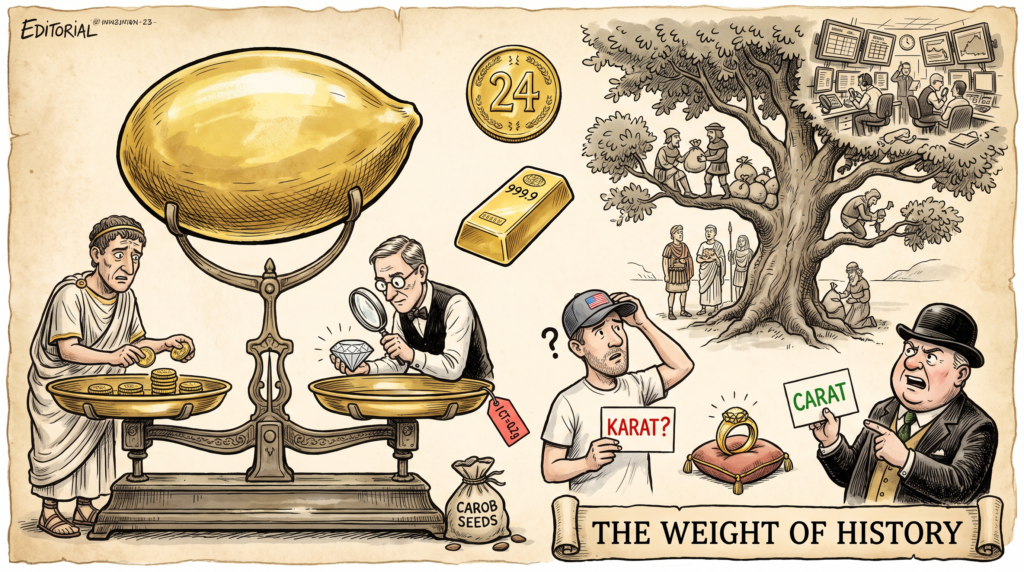
The carob tree, or Ceratonia siliqua for those of you who like to make ordering something at a garden centre unnecessarily complicated, is an evergreen tree associated with the Mediterranean and parts of Western Asia. It produces long, dark brown pods containing a sweet pulp and several small, hard seeds. You might recognise carob as the substance occasionally marketed as a healthy alternative to chocolate, an entirely unnecessary development which has presumably disappointed generations of children with particularly enthusiastic parents.
The interesting part of the carob tree, however, at least from a financial perspective, is its seeds. Ancient merchants needed reliable units of measurement for small quantities of valuable commodities, particularly precious metals and gemstones. Without electronic scales, internationally recognised standards or a government department responsible for issuing unnecessarily complicated guidance on weights and measures, traders had to find something relatively consistent, portable and readily available.
The carob seed provided a solution. Weighing roughly a fifth of a gram on average, the seeds became associated with small units of weight throughout the ancient Mediterranean. A merchant could carry a collection of carefully selected seeds and use a simple balance to weigh valuable materials against them.
Think about how extraordinary that is. Before sophisticated financial institutions, central banks and international commodity exchanges, some of the world's most valuable substances were being measured against something that had fallen out of a tree.
Although, given the occasional performance of modern financial institutions, perhaps the tree had something going for it.
The ancient Greeks used the word keration, meaning a little horn, in reference to the shape of the carob pod. The term subsequently became associated with a small unit of weight. It travelled through languages and trading cultures, becoming qirat in Arabic, carato in Italian and eventually carat in English.
It's a rather wonderful example of how commerce has shaped language. Long before international trade agreements, container ships and currency exchanges, merchants were exchanging not only goods but also words, mathematical concepts and systems of measurement. As goods travelled between civilisations, so too did the conventions surrounding their trade.
The carat survived the rise and fall of empires, the development of international banking, industrialisation and the emergence of modern financial markets. The word had already been used in English for centuries before the American spelling variant, karat, appeared in the nineteenth century.
And having survived all of that, it finally encountered the formidable intellectual challenge of an American crossword puzzle.
Perhaps the most interesting part of this particular history lesson is why we measure the purity of gold in twenty-four parts. We live in a world where most of our measurements are based on multiples of ten, unless, of course, you're discussing British distances, American temperatures or the entirely incomprehensible relationship between the various sizes of women's clothing.
So why twenty-four?
The answer takes us back to the Roman Emperor Constantine the Great in the early fourth century. Constantine introduced a gold coin known as the solidus, which became an enormously important currency throughout the Roman and subsequently Byzantine world.
The coin was produced according to a monetary system in which seventy-two solidi made up a Roman pound. Each solidus weighed approximately 4.5 grams, equivalent to twenty-four smaller units known as siliquae, themselves associated with the carob seed.
Over time, this relationship between gold and twenty-four units evolved into the convention for expressing its purity. Pure gold represented the full twenty-four parts, whilst gold containing other metals was expressed as a proportion of those twenty-four parts.
And that is essentially the system we still use today. Eighteen-carat gold contains eighteen parts gold and six parts other metals, making it 75% pure. Fourteen-carat gold contains approximately 58.3% gold, whilst nine-carat gold contains just 37.5%.
Twenty-four-carat gold represents essentially pure gold, although in commercial reality even exceptionally refined gold is generally expressed as something like 99.99% pure.
So, the next time somebody proudly informs you that their wedding ring is eighteen-carat gold, you can explain that its purity is being expressed using a system derived from the monetary reforms of a Roman emperor who died in AD 337.
Whether they'll invite you to another dinner party is an entirely separate matter.
One of the peculiarities of the word is that it means something entirely different when discussing diamonds.
A carat of gold describes purity, not weight. You could have an enormous twenty-four-carat gold statue of yourself, should you possess sufficient money and an unfortunate personality, or a tiny twenty-four-carat gold ring. Both would have essentially the same level of purity, despite their vastly different weights.
A diamond, on the other hand, is measured by its mass. One metric carat is exactly 0.2 grams, meaning a five-carat diamond weighs precisely one gram. It tells you nothing directly about the diamond's clarity, colour or quality of cut, all of which contribute to determining its value.
A beautifully cut, exceptionally clear one-carat diamond can therefore be considerably more valuable than a larger diamond of inferior quality. Although explaining this to somebody who has specifically requested a two-carat engagement ring might require a level of diplomatic skill ordinarily reserved for international peace negotiations.
Gold presents another interesting complication. Pure gold is relatively soft, which makes it less practical for certain types of everyday jewellery. Adding metals such as copper or silver can improve durability, whilst other alloys can alter its colour. Rose gold, for example, owes its reddish appearance to its copper content.
Consequently, an eighteen-carat wedding ring may actually be more practical than a twenty-four-carat version, despite containing less gold. Rather like many things in life, the more expensive and ostensibly superior option isn't necessarily the most sensible one.
Now, this is where my research into this particular subject took an unexpected turn. The conventional explanation for the historical use of carob seeds is that they are remarkably consistent in weight, making them an ideal natural measuring instrument.
For centuries, this has been repeated as an interesting little historical fact. There is, however, one slight problem.
They aren't.
In 2006, researchers published a study in the Royal Society's journal Biology Letters, examining the variability of carob seeds collected from trees in Mallorca. They compared them with seeds from dozens of other plant species and discovered that carob seeds were not particularly unusual in the consistency of their weight.
What they did discover, however, was that human observers were surprisingly good at visually identifying differences between individual seeds. People could distinguish weight differences of approximately 5% simply by examining them. The researchers therefore suggested that the historical consistency attributed to carob seeds may have resulted from merchants deliberately selecting similar specimens, rather than the tree producing naturally uniform seeds.
In other words, human beings had spent centuries congratulating a tree on its extraordinary quality control when the tree itself was exercising no such discipline whatsoever.
There is also something rather amusing about the idea that ancient merchants may have been walking around with bags of carefully selected seeds. One imagines that a particularly unscrupulous gold trader might have possessed two bags, one for buying and one for selling, with an entirely coincidental difference in the average weight of their contents.
The financial services industry has certainly developed more sophisticated methods of extracting a margin in the intervening centuries, but the underlying commercial temptation remains remarkably familiar.
As international trade expanded, the limitations of relying upon local systems of measurement became increasingly apparent. A merchant dealing in gemstones across several countries could encounter different definitions of the carat, with differences that might appear insignificant when discussing individual stones but become considerably more important when settling expensive commercial transactions.
In 1907, the metric carat was adopted internationally as a standard of 200 milligrams. A unit of measurement associated with something growing on a Mediterranean tree had finally been given a precise scientific definition.
The purity of gold, meanwhile, retained its ancient twenty-four-part system, although modern bullion markets commonly express purity in thousandths. A gold bar marked 999.9, for example, contains 99.99% gold.
And the modern gold market has its own slightly peculiar unit of weight: the troy ounce, equivalent to approximately 31.1 grams, rather than the ordinary ounce of approximately 28.35 grams. So, having spent centuries establishing sophisticated international systems of measurement, the precious metals industry still requires you to establish precisely which variety of ounce somebody is referring to.
The troy ounce is a history lesson in itself, traditionally associated with the medieval trading fairs of Troyes in France. But we'll save that for another morning, ideally after Wordle has presented me with something less intellectually distracting.
What interests me about all of these historical conventions is how much of our modern financial infrastructure remains influenced by decisions made hundreds or thousands of years ago. We now trade gold electronically, use derivatives to hedge exposure to it, invest in exchange-traded funds and employ algorithms capable of executing transactions in fractions of a second. Yet the language and measurements surrounding the underlying commodity remain partly rooted in the ancient world.
Technology has radically transformed the way we trade. It hasn't necessarily transformed what humanity considers valuable, or entirely replaced the conventions we inherited from previous generations.
Last week, when we discussed salt, we looked at how a seemingly mundane commodity helped shape trade, taxation, wealth and the development of civilisations. The carob provides another fascinating example of something entirely ordinary leaving an extraordinary mark on economic history.
The tree itself isn't particularly valuable compared with the commodities it helped measure. Nobody is sitting in a dealing room in Canary Wharf frantically monitoring the international carob futures market. Central banks aren't stockpiling its seeds in underground vaults, and I have yet to encounter a financial adviser recommending that nervous investors allocate 10% of their portfolios to Mediterranean legumes.
Yet every time a jeweller discusses the purity of gold or weighs a diamond, they are using terminology that can be traced back to this rather unassuming plant. Its legacy has survived the Roman Empire, medieval trade routes, the gold standard and the development of the modern global financial system.
There is something wonderfully humbling about that. We like to think of modern finance as an extraordinarily sophisticated creation, populated by exceptionally intelligent people armed with complex mathematical models and computers capable of processing millions of transactions. And yet some of its most enduring foundations were established by people who looked at a tree, examined its seeds and thought: that'll do nicely.
All of which I discovered because Wordle decided that carat should begin with a K.
Perhaps I should be slightly more grateful to the Americans after all.
I am of course joking. Let's not get carried away.
Keep that Axe sharp. Not everything that glitters is gold, and apparently some of the most enduring principles of measuring it grow on trees.

Sources & References
Join the FX Axe newsletter and stay one chop ahead.

