

I have spent a fairly significant proportion of my adult life looking at investments. Professionally, personally and, increasingly, simply because I find markets fascinating. And having watched several investment booms, busts, supposedly revolutionary new asset classes and the occasional complete load of bollocks come and go, this might be one of the most interesting periods in history to be an investor.
Not necessarily the best, incidentally. That is a very different claim, and anyone promising you that everything available today represents a wonderful investment opportunity should probably be asked to leave your house. But in terms of the sheer breadth, weirdness and accessibility of things you can now put your money into, there has surely never been anything quite like it.
Think about what investing traditionally meant. For centuries, if you had sufficient money, you could own land, lend to governments, finance businesses or buy shares in companies. Markets gradually became more sophisticated and more accessible. Bonds developed, stock exchanges expanded, commodities became financialised, derivatives proliferated and eventually online brokers allowed ordinary investors to participate directly in markets that had previously required a chap in a coloured jacket shouting at another chap in a different coloured jacket across a trading floor.
There have always been fashionable investment crazes too. We have covered several of them here before, from tulips to the South Sea Bubble, through the railway mania of Victorian Britain, the Wall Street boom of the 1920s, the dotcom explosion and, much more recently, cannabis stocks, crypto, NFTs and meme shares. Human beings have never required much encouragement to conclude that something going up in price will continue going up in price forever.
What feels different today is not our behaviour, which remains reassuringly unchanged. It is the menu.
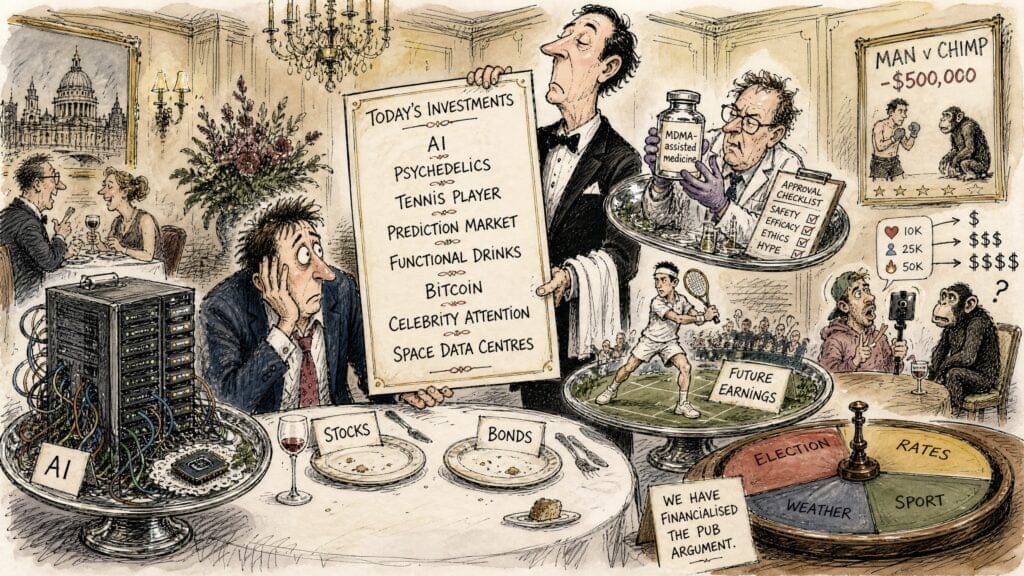
This week, The Wall Street Journal, republished by The Times, reported on something that would have sounded like a fairly niche investment thesis not terribly long ago: members of Elon Musk’s inner circle are pouring millions of dollars into bringing psychedelic drugs into mainstream medicine.
The Times/WSJ — Elon Musk’s inner circle is pouring cash into making psychedelics mainstream
The important distinction here is that this isn’t a group of billionaires sitting around taking mushrooms and deciding they had a particularly good weekend. There is serious money moving into clinical research intended to establish whether substances that spent decades almost exclusively associated with illegal recreational use can become regulated medicines.
Antonio Gracias, a longtime Musk associate and Tesla investor, has put $25 million into rescuing the former Lykos Therapeutics, now renamed Resilient Pharmaceuticals, which is pursuing FDA approval for MDMA-assisted treatment for post-traumatic stress disorder. Gracias has also donated millions towards psychedelic research at Harvard. Venture capitalist Steve Jurvetson and his wife have backed the field, while Musk’s brother Kimbal has funded related research.
There are still enormous clinical and regulatory hurdles. The FDA previously rejected Lykos’s MDMA application after concerns about trial design and adverse effects, and psychedelics present some uniquely difficult problems when you’re trying to run a blinded clinical trial. It is, after all, rather difficult to give somebody MDMA without them developing at least a suspicion that they may not have received the placebo.
But that is almost beside my point. The investment opportunity exists because an entire category that was essentially commercially untouchable could potentially become a legitimate branch of medicine. You aren’t merely investing in a pharmaceutical company. You’re effectively investing in the possibility that society’s relationship with a previously prohibited substance changes.
That is an extraordinary thing to be able to price.
At almost precisely the same time, Kendall Jenner has bought a minority stake in British drinks company Trip and become its global ambassador.
The Times — Kendall Jenner buys stake in UK drinks and supplements brand Trip
Trip began life in 2019 selling CBD-infused drinks but has subsequently broadened into the rapidly expanding “functional drinks” market. Its products now contain things such as magnesium, chamomile, L-theanine and lion’s mane and are marketed around relaxation and wellbeing. The business was valued at more than $300 million after a $40 million funding round, generated £50.9 million of revenue last year and says it is heading towards roughly $200 million of annual revenue this year. It is already stocked in about 70,000 shops worldwide.
Jenner isn’t simply being paid to hold a can in an advert, either. She has taken equity.
There is something fascinating about that investment chain. A celebrity with hundreds of millions of Instagram followers invests in a drinks company whose commercial proposition sits somewhere between soft drink, supplement and alcohol alternative; her fame potentially increases sales; increased sales raise the value of the company; and the increased value of the company raises the value of her own investment.
Celebrity used to sell products. Now celebrity can own the upside it creates.
The cult of celebrity is obviously nothing new. Human beings have always been fascinated by famous people, and famous people have generally been equally fascinated by the commercial possibilities of everybody being fascinated by them. Actors advertised cigarettes, footballers sold boots, George Foreman put his name on a grill and Elizabeth Taylor built a perfume empire. Celebrity has been commercially valuable for as long as somebody realised that putting a recognisable face next to a product made other people more likely to buy it.
What has changed is both the scale and the barrier to entry. Historically, becoming internationally famous generally required you to be exceptionally good at something, exceptionally beautiful, exceptionally well-connected or, ideally, some commercially useful combination of all three. You became a great actor, footballer, musician or model and then monetised the fame that followed. Today, the fame itself can be the product.
You can make objectively fairly rubbish videos on YouTube, discover that several million people inexplicably enjoy watching them and build a business worth hundreds of millions of dollars around the audience. You can become famous on TikTok without ever having possessed what previous generations would recognise as a conventional talent. You can monetise your personal life through Instagram, your opinions through podcasts, your appearance through OnlyFans, your ability to annoy people through X and, increasingly, the mere fact that people are prepared to spend thirty seconds looking at you. Or even simply by saying “Hawk Tuah, spit on that thang” into a microphone.
I don’t actually mean that entirely dismissively, because some of the people who have mastered this are exceptionally sophisticated business operators. MrBeast essentially took YouTube videos and built an enormous consumer and media business around the attention they generated. The Kardashians turned being famous into something resembling an industrial conglomerate. Logan Paul went from making internet videos to businesses spanning drinks, wrestling, boxing and crypto. The product is no longer necessarily the original thing that made you famous. The product is access to the people paying attention to you.
Once you look at it like that, Kendall Jenner buying into Trip makes perfect sense. She isn’t merely an investor who happens to be famous. Her enormous social-media following is part of the investment thesis. She can put capital into a company, expose that company to an audience larger than the population of almost every country on Earth and then potentially participate in the increase in value that her own attention helps create. Celebrity has gone from endorsement fee to equity stake.
The logical conclusion of an economy built around attention, however, is that eventually somebody asks just how far you can push it.
Which brings us, inevitably, to the man who says he is going to fight a chimpanzee.
Cole “Wavy” Johnson, a New Zealand MMA fighter, recently posted a video claiming that he could beat a chimpanzee in a fight. According to Johnson, it began as a joke. Then people started offering him money. He claims one offer reached $500,000, and a promotional website subsequently appeared advertising a pay-per-view fight for 11 September.
Now, before anybody clears the evening and orders snacks, there is a fairly substantial caveat. There is no confirmed venue, no identified sanctioning body, no reputable promoter and, perhaps most importantly in an event advertised as Man v Chimp, no independently confirmed chimpanzee. The supposed fight is said to be taking place in an unnamed country, presumably one whose sporting regulator has taken a particularly relaxed approach to the traditional distinction between combat sports and the primate enclosure at London Zoo. Current reporting therefore treats the whole thing as an unverified claim and quite possibly an elaborate exercise in viral marketing.
But that is almost more interesting.
Because the fight doesn’t necessarily need to happen for Johnson to have demonstrated the modern attention economy perfectly. He made an absurd claim on the internet. Millions of people discussed it. News organisations wrote about it. Social-media accounts shared it. A promotional website appeared. People began arguing about whether they would pay to watch. Johnson went from being an MMA fighter almost nobody had heard of to a man being discussed internationally because he said he could beat up a chimpanzee.
In another era, you needed the event to create the publicity. Now the suggestion of the event can be the publicity. If it turns out that there never was a chimpanzee, that might be an even more perfect representation of where we have arrived. We have built an economy in which attention has become so directly monetisable that the underlying product can occasionally become almost incidental. You don’t necessarily need to sell millions of records, score international goals or win an Oscar. You need people to stop scrolling.
That changes investing too, because increasingly when you look at businesses associated with influencers, athletes and celebrities, you’re not simply valuing the underlying product. You’re valuing an audience. How loyal is it? How engaged is it? Can it be transferred from YouTube into an energy drink, from Instagram into cosmetics, from a podcast into supplements or from an MMA TikTok account into, apparently, the possibility of paying to watch a man make an extremely poor career decision involving a great ape?
And if celebrity itself can become an asset, why not the future performance of the person?
Platforms are emerging that allow investors to finance athletes in exchange for exposure to their future earnings. Fantium, for example, allows investors to back professional tennis players and receive a share of future prize money once specified conditions are met. It says athletes have raised hundreds of thousands of dollars through its platform and investors have already received payouts.
Think about how strange and yet completely logical that is. For years, football supporters have sat in pubs confidently explaining that a 17-year-old academy player is going to be worth £100 million one day. Until relatively recently, the only financial beneficiary of being correct was the club that owned his registration and perhaps whichever friend became bored of hearing about him first.
Now somebody is trying to turn that knowledge into an asset class.
If you are obsessive about tennis, baseball or football and genuinely believe you can identify talent before everybody else, why shouldn’t there theoretically be a financial market allowing you to express that view? There are obviously substantial ethical, regulatory and liquidity questions surrounding these models, but as a concept it demonstrates just how dramatically the boundary between having an opinion and being able to trade that opinion is disappearing.
Prediction markets take that idea even further. Instead of buying a company because you think its earnings will rise, you buy a contract because you believe an event will or won’t happen. Elections, interest-rate decisions, sporting results, weather, entertainment and increasingly obscure cultural events can all become tradable outcomes.
We have essentially financialised the pub argument.
Twenty years ago, two friends could spend an evening disagreeing about whether a politician would win an election. Today there is a market price representing the collective probability, and either of them can put money behind their conviction. The principle can extend from genuinely important economic questions all the way down to the sort of thing that should probably never have required a Bloomberg terminal: celebrity relationships, television outcomes and whether somebody will say a particular word.
That development is both incredibly useful and slightly terrifying. Markets are extraordinary information-processing machines precisely because they force people to attach money to opinions. Saying “I’m absolutely certain” costs nothing. Putting £10,000 behind it tends to introduce a little intellectual humility.
But once everything becomes a market, we should probably ask whether every question benefits from having a price attached to it.
All of this would already make the current investment landscape remarkable, and then artificial intelligence turned up and started throwing petrol onto virtually every part of it.
AI has created an entirely new set of companies to invest in, from model developers and semiconductor manufacturers to data centres, power infrastructure, cooling systems and even, as we discussed recently, the possibility of putting data centres in space.
But that is only the obvious AI trade. The more interesting second-order question is what AI does to existing industries. Which pharmaceutical companies use it to discover drugs faster? Which insurers price risk better? Which logistics companies optimise their networks? Which retailers understand customers better? Which professions become dramatically more productive and which discover, rather less pleasantly, that software can now do 80 per cent of what they previously charged somebody £500 an hour to do?
That creates an enormous investment puzzle because AI isn’t simply an industry. It is a technology that potentially changes the economics of almost every other industry.
Then there is what it does to us as investors. Fifteen years ago, a private investor trying to analyse a company had access to information, certainly, but the process was laborious. You could read annual reports, research competitors, follow financial journalism, build spreadsheets and perhaps pay for specialist research. Today you can put years of filings, earnings calls, industry data and competitor information in front of an AI system and begin interrogating it in minutes, giving it its own persona should you wish. It is certainly easier to be angry at “Madame Chow” than it is to question your own righteous desire to make money. You can ask it to argue against your thesis, identify risks you haven’t considered, model scenarios, compare valuations or explain an obscure accounting note without spending Thursday evening discovering why deferred tax assets are less exciting than their name suggests.
That does not mean you should hand your brokerage account to ChatGPT and tell it to surprise you. We’ve covered that before, and I remain firmly in favour of retaining some human responsibility for the moment. But it does mean that the ordinary investor now has analytical capabilities that would have required an entire research team remarkably recently.
This is why I think the present moment is so fascinating. Isaac Newton invested in the South Sea Company because one of the great speculative opportunities of his age was a company supposedly offering exposure to international trade. Victorian investors piled into railways because railways were transforming the physical economy. Investors in the 1920s bought automobiles, electricity and radio. The late 1990s gave us the internet. The 2000s brought enormous commodity and property booms. Then came smartphones, social media, cannabis, crypto, NFTs, meme stocks and AI.
Every generation thinks it is living through unprecedented financial change, and usually it is right in some respects and spectacularly wrong in others. But the difference today is that all these markets are beginning to overlap.
You can own conventional equities and government bonds while simultaneously holding Bitcoin, backing an AI start-up, financing an athlete’s future prize money, buying a contract on an election outcome and investing in a company trying to turn MDMA into an FDA-approved treatment.
Your portfolio could theoretically contain Microsoft, gold, a Norwegian tennis player and medically supervised ecstasy.
Try explaining that to your bank manager in 1996.
There is also a common thread running through many of these supposedly unrelated markets. Psychedelic medicine monetises a change in social attitudes. Athlete markets monetise sporting potential. Prediction markets monetise opinions. AI monetises information and processing power. Influencer businesses monetise attention.
Modern markets are increasingly finding a price for things that previously didn’t have one.
There is, however, an important catch. An enormous increase in the number of things you can invest in does not produce an enormous increase in the number of things you should invest in. If anything, the opposite may be true.
Every new market creates opportunities, but it also creates new forms of nonsense. The dotcom boom gave us Amazon and also hundreds of companies whose entire business strategy appeared to consist of putting “.com” after an ordinary noun. Crypto created genuinely interesting financial technology and also coins named after dogs. NFTs demonstrated interesting concepts around digital ownership and briefly persuaded people to pay millions for pictures of apes. And if the chimpanzee fight actually happens, we will have reached the pleasingly circular point where the ape itself has become the asset.
The ability to invest in almost anything therefore makes discipline more important, not less. The underlying questions haven’t changed in several hundred years. What exactly am I buying? Why should it become more valuable? What could make me wrong? How liquid is it? Who regulates it? How much can I afford to lose?
Technology changes the assets. It doesn’t change arithmetic.
And perhaps that is the wonderfully strange thing about investing in 2026. We have more information than any investors in history, more analytical power, more direct market access and a range of investable ideas that would have been incomprehensible to almost every previous generation.
We can use artificial intelligence to analyse a pharmaceutical company attempting to commercialise psychedelics, buy exposure to an athlete’s future earnings and then trade the probability of an election result from the same telephone on which we order dinner. Meanwhile, somebody can become internationally famous without a record deal, film contract or professional sporting career, turn that attention into a consumer brand, take equity in other businesses and theoretically become vastly wealthier because millions of people enjoy watching them do something that would have left our grandparents utterly bewildered.
And somewhere, apparently, a man may or may not be preparing to fight a chimpanzee for half a million dollars.
What a time to be alive.
More importantly, what a time to have a trading account.
Keep your Axe sharp.
Max
Join the FX Axe newsletter and stay one chop ahead.

