

Investing in space sounds fucking cool. There really isn't a more sophisticated way of putting it. You can tell somebody you've invested in a European corporate bond fund and watch the light slowly disappear from their eyes, or you can casually mention over dinner that you've invested in the commercial exploitation of outer space. One sounds like something your accountant recommended. The other sounds as though you should be wearing a silver jumpsuit.
I've always liked science fiction, although I wouldn't describe myself as one of its great obsessive enthusiasts. I love Douglas Adams and H.G. Wells. Back to the Future fascinates me, although technically most of it involves travelling through time rather than space, and Firefly is excellent. As I've got older, I've actually become much more interested in the real science behind it all too: quantum physics, the scale of the universe, what might exist beyond what we can observe and that almost impossible question of whether we're actually alone in all of it.
Space occupies this extraordinary position in the human imagination because it is simultaneously science and fantasy. We know it exists. We can see it. We've been into it. We've walked on the Moon — and if you question that I will personally ask Buzz Aldrin to punch you in the face — we've put robots on Mars and sent spacecraft beyond the outer planets, yet almost everything beyond our tiny immediate neighbourhood remains essentially unknown. Depending on exactly how you define space, only around 750 people in the entire history of humanity have actually been there. More people can fit inside Wembley Stadium than have left the planet on which every human being who has ever lived was born.
And yet, somehow, we already have a space economy. That is the bit that makes this interesting as an investor rather than merely somebody wondering whether Marvin the Paranoid Android was onto something.
The wonderful thing about looking backwards at science fiction is discovering how much of it eventually stops looking fictional. H.G. Wells wrote about atomic weapons decades before they existed. Arthur C. Clarke imagined satellites and global communications. Douglas Adams gave his characters something resembling an electronic guide containing information about almost everything, which sounded fantastical until humanity invented smartphones and Wikipedia and then used them primarily to argue with strangers.
Science fiction repeatedly starts with a ridiculous question and waits for engineers to make it less ridiculous. Can humans fly? Can we reach the Moon? Can we talk instantly to somebody on another continent? Can a computer fit inside your pocket? Can a private company build a reusable rocket, land the bloody thing vertically and then launch it again? Every one of those questions would once have sounded absurd, which is why space is so seductive from an investment perspective. The potential market isn't merely a new product or even a new industry. It is, quite literally, somewhere else.
For most of human history, economic activity has taken place on approximately 510 million square kilometres of planet Earth. Space rather improves the available floorplan. Of course, this is also precisely the sort of sentence that should make investors extremely nervous, because whenever somebody tells you that the addressable market is effectively infinite, it is worth checking whether the revenue is.
The real investment case for space therefore begins with something much less romantic than aliens or colonies on Mars: getting there has become dramatically cheaper. Historically, space was overwhelmingly the preserve of governments because launching anything required enormous rockets, enormous budgets and a fairly relaxed attitude towards occasionally blowing several hundred million dollars into very small pieces. Reusable launch systems changed that equation. SpaceX's Falcon 9 demonstrated that one of the most expensive parts of a launch vehicle did not necessarily have to be thrown away after every flight. Boosters could return, land and fly again. Explain that to somebody watching Apollo 11 in 1969 — that private companies would one day routinely fire rockets into orbit and then have the bottom half reverse back down and stand itself upright on a boat — and they would quite reasonably assume you'd been drinking.
That fall in launch costs has helped create a much larger commercial ecosystem around satellites, communications, Earth observation, defence, navigation and data. Private investment in space companies reached roughly $23 billion in the year to June 2026, more than double the previous comparable period, with investors increasingly putting money into businesses with actual operations and revenue rather than simply somebody standing in front of a PowerPoint slide of Mars containing the words “total addressable market”.
This is where investing in space gets more interesting, because rockets are the bit everybody sees but they may not ultimately be where most of the money is made. Rockets are spectacular, noisy and excellent television, but economically they are delivery vans. The much more important question is what they're delivering and what businesses can be built once getting things into orbit becomes routine.
At the moment, much of the answer is satellites. Communications satellites provide broadband and connectivity. Earth-observation satellites photograph the planet and produce information used by agriculture, logistics, insurance, energy companies, governments and militaries. Navigation satellites underpin systems we use constantly without thinking about them. Weather satellites improve forecasting. Defence applications are expanding as governments have rediscovered, rather inconveniently, that geopolitical peace was not a permanent feature of the twenty-first century. A satellite monitoring crops from orbit sounds wonderfully futuristic until you realise its customer may simply be a farmer deciding which field needs water. A satellite monitoring shipping sounds like espionage until you realise a commodity trader would quite like to know how many oil tankers are sitting outside a particular port.
Space is becoming infrastructure, and infrastructure is normally where an exciting technological idea starts turning into an investable industry. That creates several ways to approach it. At one end you have the pure or near-pure space companies: SpaceX, now publicly traded, Rocket Lab, Planet Labs and Firefly Aerospace, where the potential upside can be enormous but so can the execution risk. Rocket Lab, for example, isn't simply trying to launch rockets; it is increasingly attempting to provide spacecraft, components and launch services across a much broader space ecosystem. These are the businesses that feel most like investing in “space”, but they're also the businesses where a delayed launch, failed technology or loss of a major contract can make your portfolio look rather more like the aftermath of a launchpad explosion.
At the other end sit enormous aerospace and defence groups such as Lockheed Martin, Northrop Grumman and RTX. You are obviously not buying a pure space business with these companies, but you are buying businesses already embedded in government procurement, defence, satellites, aerospace systems and some of the infrastructure likely to benefit as spending beyond Earth's atmosphere grows. They are less Millennium Falcon and more sensible Volvo estate, but sensible Volvo estates do have the useful characteristic of generally arriving at their destination.
Then there are funds. The Times piece that prompted this article mentions the iShares Space Technologies ETF, which limits the weighting of individual holdings and spreads exposure across businesses enabling space technology as well as the more obvious rocket and satellite companies. For somebody who believes the space economy will grow but hasn't the faintest idea whether Rocket Lab, Planet Labs, Firefly or a company that doesn't yet exist will ultimately dominate it, that diversification has an obvious appeal. A more adventurous option such as the Global X Space Tech ETF pushes further towards smaller, more speculative companies. One is essentially saying, “I think this industry will grow.” The other is saying, “Punch it, Chewie.”
That distinction is really the investment argument. You can be completely right about space and completely wrong about a space company. Railways transformed civilisation while bankrupting plenty of railway investors. The internet transformed almost everything about modern life while simultaneously producing one of the greatest stock-market bubbles in history. AI may transform the global economy while some of today's wonderfully valued AI businesses eventually turn out to have been wonderfully valued mistakes. The technology can win while the shareholder loses.
SpaceX itself is the enormous elephant floating around the room. It has transformed launch economics, built Starlink into an enormous communications network and become strategically important to governments as well as consumers. But even there, investors have to distinguish an extraordinary company from an extraordinary investment at any price. SpaceX went public in June and, by the end of September, its shares were around 6 per cent below their initial trading price of $165. That doesn't remotely invalidate the company or the space thesis. It simply demonstrates something markets repeatedly teach us and investors repeatedly forget: everybody knowing a company is brilliant can already be reflected in what you are being asked to pay for it.
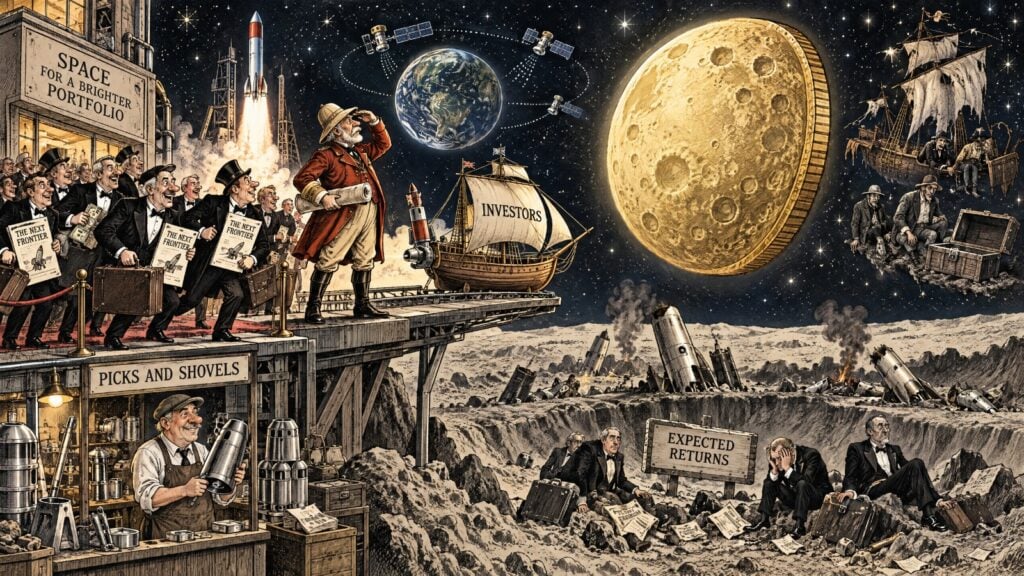
This is also why the “picks and shovels” approach appeals to me. During a gold rush, it is sometimes better to own the business selling equipment to prospectors than to bet everything on which prospector discovers gold. Space has its own shovels: components, semiconductors, communications systems, launch infrastructure, software, sensors, defence technology, satellite manufacturing and data processing. The company eventually making fortunes from the space economy might not own a rocket at all.
This is where we move from investable reality into the part I find considerably more entertaining, because the next question is what happens after space becomes economically accessible. Space tourism already exists, albeit in the same way transatlantic air travel existed in its infancy: technically available, provided you are extremely wealthy and don't mind accepting risks that would make Ryanair's legal department physically ill. Virgin Galactic has advertised tickets at $750,000, while orbital trips can cost millions. Optimists believe suborbital prices could eventually fall below $50,000. That is still an absurdly expensive holiday, but there are quite a lot of absurdly rich people.
Commercial space stations are being developed. In-orbit manufacturing is attracting investment because microgravity may allow materials, pharmaceuticals and industrial processes that are difficult or impossible to reproduce on Earth. Then there is lunar infrastructure. If humanity establishes any sustained presence on the Moon, somebody has to provide communications, energy, transport, construction, equipment, food and supplies. If humans eventually travel to Mars, multiply the logistical problem by several million.
And then capitalism inevitably arrives. One of my favourite recurring science-fiction ideas is advertising in space. I had half-remembered the idea as Demolition Man, but Arthur C. Clarke was playing with it back in 1956 in Watch This Space, where a scientific experiment involving sodium vapour is manipulated to produce an enormous soft-drink advertisement against the Moon. Coca-Cola itself appears repeatedly in futuristic cinema; Ridley Scott deliberately put its neon branding into Blade Runner on the wonderfully bleak assumption that even if civilisation became a rain-soaked dystopian nightmare, Coke would presumably still have the advertising budget.
That feels about right. Humanity could make first contact with an advanced extraterrestrial civilisation and within six months somebody would be negotiating the official soft-drink partnership. Give it slightly longer and we'll have naming rights for lunar bases, hotels overlooking the Sea of Tranquillity, advertising on spacecraft, broadcasting rights, low-gravity sporting events, mining, manufacturing and insurance. Imagine the first golf tournament on the Moon. Bryson DeChambeau would presumably hit a drive about nine miles and LIV would offer $4 billion for the broadcast rights.
The absurdity is precisely the point. We don't know which of these businesses will become viable because we are standing so early in the industry's development. In 1903, asking somebody what industries would eventually emerge from powered flight would have produced equally ridiculous answers. The Wright brothers weren't building Ryanair, Heathrow Airport, DHL, Boeing, Airbnb holidays to Majorca and a global air-freight industry. They were trying to keep a machine in the air for 12 seconds. Transformative technologies create businesses that nobody initially knows to ask for.
The frontier problem
There is another way of thinking about all this, and it requires looking backwards rather than forwards. Space isn't humanity's first economic frontier. Europeans once looked across the Atlantic in much the same way that we now look beyond Earth: somewhere enormously distant, difficult and dangerous, containing possibilities nobody properly understood.
The earliest voyages of the Age of Discovery were largely financed by monarchies, particularly Spain and Portugal, but private money followed remarkably quickly. Wealthy merchant families, including the Medicis, helped finance expeditions as Europeans realised that new trade routes and territories could generate fortunes. Gold, silver, spices, tobacco and entirely new markets appeared on the other side of the Atlantic. From Europe, it must have looked rather like the greatest investment opportunity in history.
And in aggregate, it was.
For many of the people actually investing in individual voyages, it was an absolute disaster.
The Times article cites research into the early Spanish private voyages known as the viajes andaluces. Of around 30 ships involved, roughly half made losses, several were destroyed, another dozen or so produced little or no profit and only around five generated the sort of returns investors had imagined. The frontier created extraordinary wealth, but knowing that the frontier would become valuable was not the same thing as knowing which boat to back.
The human numbers were considerably worse. Early Atlantic exploration was catastrophically dangerous. When Ferdinand Magellan's expedition left Spain in 1519 attempting to reach the Spice Islands by sailing west, roughly 270 men departed aboard five ships. Magellan himself never completed the journey. He was killed in the Philippines in 1521 during the Battle of Mactan. When the Victoria finally returned to Spain in September 1522, completing the first circumnavigation of the Earth, just 18 members of the original expedition were aboard.
Imagine the investor presentation for the next voyage.
“Excellent news. We proved the Earth can be circumnavigated.”
“How did the management team perform?”
“Dead.”
“And the staff?”
“Mostly also dead.”
“Return on capital?”
“It's complicated.”
Yet nobody looking back today would conclude that global exploration was economically irrelevant because the early voyages were catastrophically risky. Quite the opposite. The opening of global trade routes eventually created some of the most powerful commercial enterprises in history.
The East India Company is perhaps the most extraordinary example. It began as a trading company chartered in 1600 and ultimately became something almost unimaginable to a modern investor: a private corporation that collected taxes, administered territory and maintained an army larger than that of many countries. At its height it became one of the most powerful commercial organisations on Earth.
There is an interesting echo there with SpaceX. I am obviously not suggesting Elon Musk is about to assemble a private Martian army and start collecting taxes on Olympus Mons, although with Musk one hesitates slightly before ruling anything out. The similarity is structural. A private company builds infrastructure in a new frontier, that infrastructure becomes strategically important and governments gradually discover that they depend upon it.
That can be enormously valuable. It can also become uncomfortable. Governments tend not to remain relaxed indefinitely about strategically essential infrastructure being controlled entirely by private interests. The East India Company acquired extraordinary power partly through its relationship with the British state and ultimately lost that power to the British state. SpaceX is not the East India Company, Washington isn't about to nationalise Starlink and Mars is not eighteenth-century Bengal. The point is simply that strategic importance can create political risk as well as commercial power.
Which brings us back to investing.
I believe enormous fortunes will probably be made in space. They may be made by SpaceX. They may be made by Rocket Lab or satellite operators or defence contractors. They may be made by companies supplying components to all of them. They may be made in space tourism, manufacturing, data, communications, mining or some industry that currently sounds as ridiculous as commercial aviation would have sounded to the Wright brothers.
But history's frontiers teach us something useful. Knowing where the world is going is not the same as knowing who will make money getting us there.
The Americas became extraordinarily economically important. Most of Magellan's crew still didn't come home. Global trade created immense fortunes. Plenty of individual voyages lost everything. The East India Company became one of the most powerful corporations ever created, while countless competitors and expeditions disappeared almost completely from history.
Space will almost certainly produce the same mixture of extraordinary success and spectacular failure.
That is why, if I wanted exposure to it, I would be much more comfortable owning a little of several parts of the ecosystem than betting the entire farm on one rocket company. A diversified fund may be less exciting than telling somebody at dinner that you've backed the company that is going to colonise Mars, but there is something to be said for still having money when dessert arrives.
The final frontier may indeed become one of the great investment opportunities of our lifetime.
Just remember what happened to quite a lot of the people who invested in the previous ones.
Keep your Axe sharp. And never put the whole portfolio on one ship.
Max
Join the FX Axe newsletter and stay one chop ahead.

