

If you have been watching our morning news updates over the past few months, you may have noticed that I have spent an unreasonable amount of my life talking about oil. Brent crude has now received more airtime from me than several members of my extended family. Iran does something, oil goes up. Trump says something, oil goes up. Somebody mentions the Strait of Hormuz and oil goes up before they've finished saying “Hormuz”. Then peace briefly breaks out, crude collapses, everyone congratulates themselves on having survived another crisis and, approximately six minutes later, somebody starts firing missiles again. And the Epstein files lose some more headline space.
There is a reason we have been banging on about it. When the war first erupted, we did a video looking at how fundamentally it could change markets because the Strait of Hormuz isn't just an inconveniently narrow bit of water next to Iran. It is one of the great plumbing fixtures of the world economy. A vast quantity of the planet's oil and gas passes through it, and interfering with it is rather like putting your thumb over the end of the garden hose, except the garden is the global economy and everyone starts shouting about inflation.
For a while, however, it looked as though the world might have got away with it. Oil surged, markets panicked, economists produced charts with increasingly alarming red lines on them, and then the global economy did that irritating thing economies occasionally do to forecasters and refused to collapse. Supplies adjusted, inventories helped, alternative routes were found and people gradually started behaving as though the worst had passed.
Unfortunately, the latest evidence suggests the bastard may simply have been hiding round the corner.
A new Oxford Economics Global Risk Survey, reported by The Times, found that more than a quarter of businesses now expect traffic through the Strait of Hormuz to remain below pre-war levels until 2028 or later. Businesses have also sharply increased their medium-term inflation expectations, while Oxford Economics expects global inflation to rise to a little over 5 per cent towards the end of this year before gradually easing during 2027.
That is a very different problem from oil becoming expensive for a few weeks because somebody blew up a tanker. Markets are quite good at absorbing shocks. What they like considerably less is when the shock moves in, puts its feet on the coffee table and starts having post delivered.
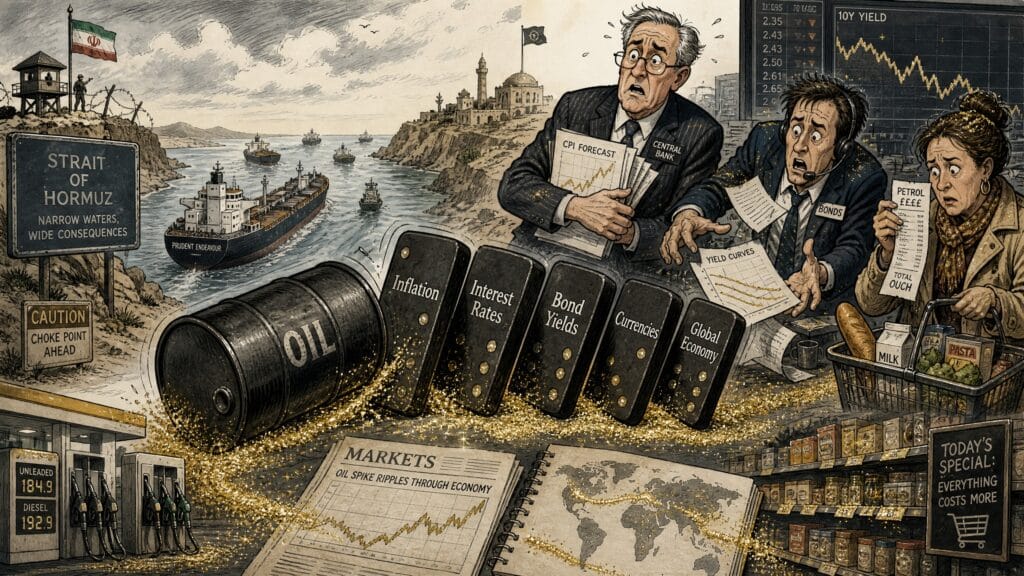
It is tempting to think of oil as something that matters principally when you pull into a petrol station and discover that filling the car now requires either a small personal loan or the sale of a minor organ. In reality, oil gets absolutely everywhere.
It goes into transport, aviation, agriculture, plastics, chemicals and manufacturing. Energy prices affect factories, warehouses and data centres. Diesel moves the lorries that move the goods that fill the shops. Farmers use fuel, airlines use enormous quantities of it and ships rather inconveniently cannot yet be persuaded to cross oceans on positive thinking.
This is why an energy shock behaves rather like glitter at a children's birthday party. Initially it appears to be concentrated in one manageable location. Six months later you're still finding the bloody stuff in the curtains.
Higher energy costs feed into transport costs, which feed into production costs, which feed into prices. Businesses can absorb some of that for a while, but eventually somebody has to pay. Normally that somebody is you, standing in Tesco wondering why a packet of something you could swear cost £2 last year now requires a discussion with your mortgage adviser.
Earlier in the conflict, Oxford Economics modelled what would happen if Brent averaged roughly $140 a barrel for two months. Parts of the global economy could have slipped into mild recession and global inflation could have approached 6 per cent. That sustained $140 nightmare didn't happen, and for a while there was a perfectly reasonable hope that oil might settle back down and the whole episode would become another frightening chart we could file away under Things That Nearly Ruined Everything.
Instead, Brent is back above $100 and Oxford Economics now expects it to remain there for roughly another six months under its latest assessment. More importantly, businesses themselves are beginning to plan around disruption lasting considerably longer.
And that changes everything, because there is an enormous economic difference between expensive oil and permanently annoying oil.
I appreciate that yield curves are not necessarily what most people dream about while staring wistfully out of the window. I have never heard anyone say, “Wonderful news, darling, the children are at your mother's this weekend, shall we open some wine and discuss the two-year/ten-year Treasury spread?”
But this is precisely why we cover these things in the FX Axe education videos.
If you want to understand why currencies move, you eventually have to understand interest rates. If you want to understand interest rates, you need to understand inflation. If you want to understand the dollar, you need at least a passing acquaintance with Treasury yields. If you want to understand gold, you need to know what the dollar and real yields are doing. And if you want to understand why all of those things are suddenly behaving strangely, at the moment you keep finding yourself back at oil.
One of the more interesting developments recently has been the relationship between crude prices and US government bond yields. The correlation between West Texas Intermediate and the ten-year Treasury yield reportedly reached 65 per cent in September, the strongest relationship since 1990 and close to levels last seen around the Gulf War.
That sounds spectacularly boring until you understand what it means.
Bond markets are essentially asking what inflation and interest rates will look like years into the future. If investors become convinced inflation will remain higher, they demand more compensation for lending money for long periods. Bond prices fall and yields rise. Those yields then influence mortgages, company borrowing, asset valuations and government finances. They also affect currencies because international capital is constantly looking around the world asking where it can receive the best return without accidentally investing in somewhere run by lunatics.
So when oil rises because of Iran, the effect doesn't remain conveniently contained on an oil trader's Bloomberg terminal. It crawls into inflation expectations, appears in the Treasury market, wanders into the Federal Reserve's interest-rate calculations and eventually turns up in the dollar.
This is macroeconomics' great party trick. Everything eventually ends up in somebody else's drink.
This is where the whole chain becomes fascinating.
The conflict disrupts energy supplies. Oil becomes more expensive. Higher energy costs increase inflationary pressure. Higher inflation changes expectations about what central banks will do with interest rates. Those expectations move government bond yields. Higher yields change the relative attractiveness of holding different currencies and assets, and suddenly the dollar is moving because of something that happened thousands of miles away.
September has provided a rather good live demonstration. As oil prices and Treasury yields have risen, the dollar has strengthened while sterling and the euro have weakened, with markets reconsidering how quickly the Federal Reserve will be able to loosen policy.
There is something wonderfully absurd about the journey. Somewhere near the Persian Gulf, a ship changes course because somebody is worried about a missile. The oil market responds, an economist in New York changes an inflation forecast, a bond trader adjusts his position, Treasury yields move and eventually a bloke sitting in Croydon staring at EUR/USD wonders why his technical setup has just gone completely to shit.
This is why fundamentals matter.
Charts are extremely useful, but occasionally the chart is moving because an oil tanker has just decided it would rather not be blown up.
Then we get to gold, another subject we cover extensively because gold has a slightly peculiar personality. Everybody learns the basic rule that geopolitical trouble is good for gold because frightened investors like safe havens. Fine. Unfortunately, markets have never been considerate enough to restrict themselves to one rule at a time.
War can support gold because people are nervous. Higher inflation can support gold because investors worry about the purchasing power of money. But the same oil shock can push US interest-rate expectations and Treasury yields higher. Gold pays no interest, so when government bonds suddenly offer more attractive returns, a lump of metal sitting in a vault has more competition. If higher yields also strengthen the dollar, that can create another headwind for gold.
So you can have war, inflation and geopolitical panic screaming BUY GOLD, while yields and the dollar are standing on the other side of the room shouting NOT SO FAST.
This is why “war equals gold up” is not an investment strategy. It is a fridge magnet.
Markets are collections of competing forces, and understanding which one is dominant at any particular moment is the interesting bit.
Eventually, unfortunately, we arrive at the word stagflation, which sounds like something that should be treated with antibiotics but is actually considerably less pleasant.
Central banks normally prefer their economic problems one at a time. If growth is booming and inflation is too high, raise interest rates. If the economy is collapsing and unemployment is rising, cut them. Everyone knows their lines, the economists go on television and the central bankers can look reassuringly serious while saying “data dependent” every seven minutes.
An oil shock has the unpleasant habit of giving them both problems simultaneously.
Higher energy prices squeeze households and businesses, weakening economic growth. At precisely the same time, those higher costs push inflation upwards. The economy therefore arrives at the doctor's surgery saying it feels faint and has high blood pressure, while the central bank discovers that the conventional treatments for one condition make the other worse.
Oxford Economics' more adverse scenario now envisages prolonged elevated energy prices, stubborn inflation and global growth of only around 2 per cent. That isn't necessarily a global recession, but it would be an unpleasant environment, particularly because governments are already carrying enormous debts accumulated during the glorious years when money was cheap and apparently nobody had considered that interest rates might one day go back up.
Higher bond yields make refinancing those debts more expensive. Governments then have less money available for everything else and less room to respond when the next crisis inevitably turns up demanding several hundred billion dollars.
Oil, in other words, starts at the petrol pump and somehow ends up in the Chancellor's Budget.
As I said: glitter.
When the Iran conflict began, markets understandably became obsessed with how high oil might go. Would Brent hit $100? $120? $140? Could the Strait of Hormuz effectively close? Every television interview required an increasingly frightening number because “it might remain rather expensive for quite a long time” doesn't make particularly exciting breaking-news graphics.
But I increasingly think we were asking the wrong question.
The important number may not be the peak oil price. It may be the number of months or years the disruption lasts.
A business can survive a temporary increase in shipping costs. It becomes a different calculation when management starts budgeting for those costs through 2028. Households can absorb an expensive month at the petrol station. It becomes much more painful when energy costs gradually work their way into food, travel, utilities and other goods for years.
Central banks can also “look through” a temporary inflation shock, which is economist-speak for acknowledging that something horrible is happening while hoping it goes away before they have to do anything. They have a much harder time doing that when higher prices start influencing wages and people's expectations about future inflation.
That is what makes the latest Oxford Economics survey interesting. It isn't another prediction that oil might spike if the war gets worse. It is evidence that businesses are beginning to change their assumptions about what normal looks like.
And once businesses change their assumptions, they change their behaviour.
The global economy has been remarkably resilient. That deserves saying. We have had wars, tariffs, enormous government debts, political upheaval, an extraordinary AI investment boom and energy prices behaving like a Labrador that has discovered an open gate, yet the entire system has continued moving.
There is therefore no need to start building a bunker.
But there is an equally large mistake in assuming that because the first economic shock wasn't catastrophic, the story is over. The consequences of energy disruption don't arrive simultaneously. Some appear immediately in the oil price. Others take months to work through transport, production, inflation, wages, interest rates, currencies and government finances.
That is why the education videos on yield curves, the dollar, gold and the fundamentals behind FX matter rather more at moments like this. They aren't separate academic subjects. They are different parts of the same machine, and right now somebody has thrown a rather large Middle Eastern spanner into it.
A few months ago, the Iran war looked principally like a geopolitical crisis with an oil problem attached. Increasingly, it looks like an oil problem with an inflation problem attached, which has an interest-rate problem attached, which has a bond-market problem attached, which has a currency problem attached, which eventually arrives in almost everybody's pocket.
That doesn't mean the world is about to fall apart. It does mean the world may have changed rather more than markets initially assumed.
The first explosion gets the television coverage. The economic aftershock tends to arrive quietly, wearing a suit and carrying a spreadsheet.
Unfortunately, it can hang around for much longer.
Keep your Axe sharp. And never underestimate how far one expensive barrel of oil can travel.
Max
Join the FX Axe newsletter and stay one chop ahead.

