

If I hadn't already written recently about rugby teams, red wine and the importance of blending the right ingredients together, this would probably be the point where I made an elaborate comparison between building a golf game and building an investment portfolio. Driver for growth, putter for defensive assets, seven iron for bonds and lob wedge for whatever deranged cryptocurrency you bought after three glasses of wine because somebody on X had a Lamborghini in his profile picture. There is definitely an article in there somewhere, so I shall push that one into next week and we won't tell anyone. Instead, I want to talk about professional golf itself, because one of the most fascinating sporting and business experiments of the past decade appears to be reaching a rather extraordinary conclusion. It turns out you can buy golfers. Buying golf is considerably harder.
LIV Golf was launched in 2022 with a fairly uncomplicated strategy. Saudi Arabia's Public Investment Fund had enormous quantities of money and professional golf contained quite a lot of people who could be persuaded to accept enormous quantities of money. Phil Mickelson went. Dustin Johnson went. Brooks Koepka went. Bryson DeChambeau went. Cameron Smith went. Sergio García went. Some were approaching the latter stages of their careers, others were very much in their prime, and the quality of the players meant LIV could never simply be dismissed as an expensive retirement home with nicer catering. Cameron Smith joined shortly after winning the Open Championship. Koepka subsequently won another major while playing on LIV. DeChambeau became one of the most popular golfers in the world. Then, in December 2023, LIV landed perhaps its most important signing of all: Jon Rahm, reigning Masters champion, former world number one and one of the greatest golfers of his generation.
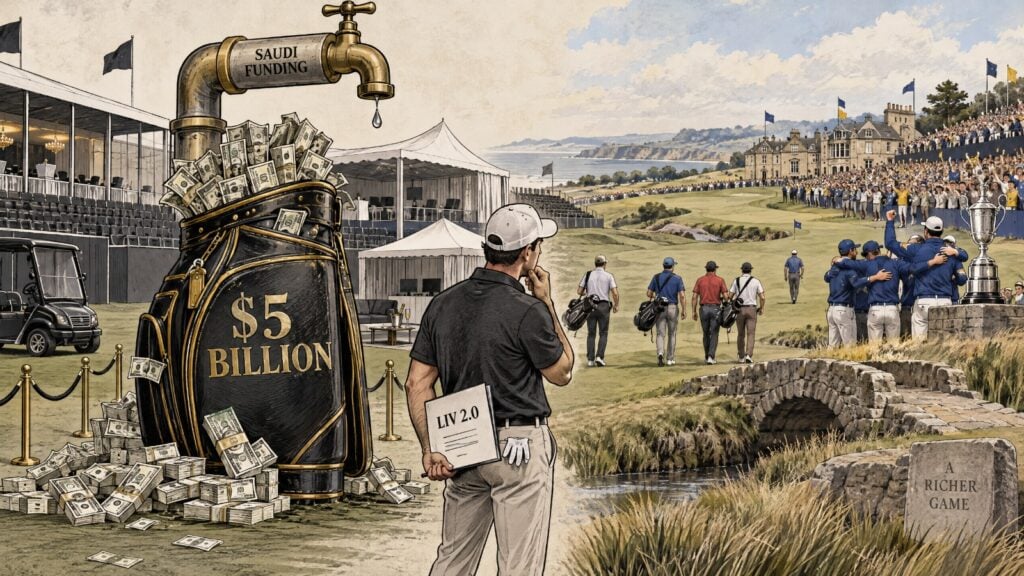
Reports put Rahm's deal at hundreds of millions of dollars. Whatever the precise figure, nobody was under the impression that he had suddenly developed a lifelong fascination with shotgun starts. Rahm's arrival mattered because it seemed to prove that LIV could attract almost anybody, including players at the absolute peak of the sport who already had extraordinary wealth and many years of competitive golf ahead of them. Three years later, however, Rahm is leaving. His lawyer has told a US bankruptcy court that he reviewed the proposed terms of the restructured “LIV 2.0” and found them unacceptable. LIV itself is in Chapter 11 proceedings after the Saudi PIF withdrew financial support, having reportedly poured more than $5 billion into the venture over four years. For something that was once going to revolutionise professional golf, this is not an ideal leaderboard.
I have written about LIV before because, politics and sportswashing arguments aside, it has always fascinated me as a pure business experiment. At its heart LIV posed a wonderfully simple question: if you have enough money, can you manufacture a major sporting competition? Normally leagues and tournaments acquire value incredibly slowly. They develop traditions, rivalries, records, heroes, villains and moments that are passed between generations. Wimbledon matters partly because people remember Borg, McEnroe, Navratilova, Federer and Serena Williams. Augusta matters because every April the world's best golfers walk across the same bridges, play the same holes and chase the same green jacket that generations chased before them. Sport accumulates meaning, and meaning is one of the few commodities that even sovereign wealth funds cannot order for immediate delivery.
LIV tried to accelerate the process. Instead of waiting 100 years for history, it bought stars, and initially the numbers were so enormous that the strategy appeared almost irresistible. Asking why somebody accepts $100 million, $200 million or $500 million to play golf somewhere else is not a particularly difficult psychological puzzle. Professional sporting careers are short, injury can end them and form can disappear without warning. If somebody offered me $500 million to write Max's Daily Chop exclusively for another website, I would like to think my principles would survive intact for at least four or five minutes.
The much more interesting question is what happens after you've paid them. There is an enormous difference between somebody who joins an organisation because he believes in what it is building and somebody who joins because you've multiplied his salary by ten. The second person may still be completely professional and exceptionally good at his job. Rahm certainly was. He won LIV's individual season championship in all three seasons he played there and his Legion XIII team won successive team championships. LIV paid for an outstanding golfer and received outstanding golf in return. But when the extraordinary guaranteed financial incentive disappears, you finally discover what else was holding the relationship together.
That is precisely the question LIV is now being forced to answer. Adrian Meronk has also indicated that he doesn't want to compete in the proposed LIV 2.0, while Sergio García has made his Ryder Cup ambitions increasingly important as he considers what comes next. The first version of LIV could essentially say, “Here is a frankly ridiculous amount of guaranteed money. Would you like to play golf with us?” The new version has to ask, “Would you still like to play golf with us?” Those sound like similar questions, but in business they are almost opposites.
Rahm's relationship with the Ryder Cup illustrates the difference beautifully. For anyone who doesn't follow golf particularly closely, the Ryder Cup is a wonderfully peculiar event in which golfers who spend almost their entire professional lives playing for themselves suddenly spend three days every two years behaving as though Europe or America faces an existential threat that can only be resolved by holing a twelve-foot putt. There is no normal tournament prize fund driving it, yet players care about it enormously because the reward is something money struggles to reproduce: history, identity, teammates, legacy and the possibility of becoming one of the names people remember when they talk about great Ryder Cup moments decades later.
Rahm clearly cares about that. His move to LIV created complications around his DP World Tour membership and therefore his Ryder Cup eligibility, and this year he eventually paid roughly £2.2 million in fines while accepting arrangements designed to preserve his eligibility. Think about the strange economics of that for a moment. A man who moved to LIV for an enormous financial package subsequently paid millions of pounds in penalties partly to preserve his route towards an event where the attraction is not an enormous cheque. That tells you something important about sport. Not everything has a price, or perhaps more accurately, not everything's price is denominated in money.
This is where I think some criticism of LIV has occasionally missed the point. The golf itself wasn't necessarily terrible. The shotgun starts were different, the team names were occasionally ridiculous and the attempt to make professional golf louder, quicker and younger sometimes felt as though somebody's father had been asked to design a nightclub, but there were very good golfers playing very good golf. Rahm, DeChambeau, Koepka, Smith, García, Johnson and Hatton are serious players. LIV events could produce excellent shots and close finishes. The problem was never whether the people on the course could play. The problem was getting enough people sitting at home to care who won.
That is a completely different commercial challenge, and it touches something we discussed recently when looking at sport following money around the world. Money can buy athletes, but it cannot necessarily buy an audience. LIV now adds another layer to the argument: money can buy participation, but it cannot necessarily buy attachment. Nobody grew up supporting Crushers GC. There isn't a 74-year-old man in Surrey who remembers his father taking him to watch Fireballs GC in 1963, and children haven't inherited a passionate allegiance to RangeGoats from their grandparents. Those things sound flippant, but they are where an enormous amount of sporting value actually lives.
Sport isn't simply an entertainment product; it is accumulated memory. Manchester United remains Manchester United after a terrible season because generations of people have invested emotion in the club. People travel across continents to watch the Ashes because what happens today is connected to what happened a century ago. Augusta matters because the Masters has accumulated stories on the same piece of land year after year. You can create a tournament surprisingly quickly if you have enough money. Creating meaning takes longer.
LIV attempted to manufacture some of that meaning through its teams, and conceptually I can understand why. Team identities theoretically create something for supporters to follow beyond the individual golfer, and ownership stakes can give players a reason to build those franchises. But you cannot simply announce tradition into existence. Calling something a franchise does not automatically make anybody care about it, any more than opening a pub on Monday and putting “Est. 1784” above the door gives it 240 years of history.
And now the financial experiment has reached its most revealing stage. PIF reportedly spent more than $5 billion supporting LIV before withdrawing its backing. The organisation subsequently entered Chapter 11 proceedings and is attempting to raise fresh financing for a restructured competition. Rahm is listed among LIV's significant player creditors, while reports suggest substantial sums associated with his original agreement may remain unpaid. The proposed LIV 2.0 model appears to depend much more heavily on players becoming equity owners rather than simply receiving the enormous guaranteed contracts associated with the first incarnation.
Conceptually, player equity isn't necessarily a bad idea. In fact, it might have been a rather good idea from the beginning. If players own meaningful stakes in the enterprise, their incentives change. They aren't simply extremely expensive employees turning up to collect prize money; they have a direct interest in television audiences, sponsorship, team values and the long-term success of the competition. The slight problem is that equity becomes most attractive when everybody believes the thing you own is going to become more valuable. Offering Jon Rahm equity after spending years offering Jon Rahm cash is a little like feeding somebody steak every evening for three years and then announcing that dinner will henceforth consist of shares in the cow. He has apparently decided he'd rather eat elsewhere.
There is a business and investment lesson here, and it is slightly subtler than the usual “you can't just throw money at things” argument, because obviously money works. Companies offering better salaries attract better employees. Football clubs paying larger transfer fees generally sign better players. Businesses with access to more capital can hire faster, advertise more aggressively and survive for longer. LIV's money unquestionably changed professional golf. It forced established tours to respond, increased player power, contributed to prize money rising and challenged assumptions about how professional golfers should be compensated. Even if LIV disappeared completely tomorrow, it would have left fingerprints all over the sport.
The mistake is believing capital automatically purchases all the other things a successful organisation requires. It doesn't buy culture, history or loyalty, and crucially it doesn't guarantee that the people you paid extraordinary sums to join will remain when somebody stops writing extraordinary cheques. Businesses discover this all the time. A company decides it can solve a cultural problem through compensation, hires expensive people from competitors, gives everyone impressive titles and assumes talent will somehow assemble itself into an organisation. Sometimes that works brilliantly. Sometimes you've simply rented some very clever people.
Markets have their own version of the same problem. Capital can sustain a business for years without proving that its underlying economics actually work. As long as somebody keeps providing money, growth can masquerade as viability. Customers can be subsidised, employees can be overpaid relative to revenue, market share can be purchased and losses can be described as investment in the future. None of those things necessarily means the business is bad; plenty of extraordinary companies lost fortunes while establishing themselves. But eventually every heavily funded enterprise encounters the same unpleasant question: does this thing work when the subsidy disappears?
That is what makes LIV such an interesting experiment. The Saudi money allowed it to test whether elite professional golf could be disrupted by brute financial force, and in one sense the answer was emphatically yes. LIV signed major champions, forced the PGA Tour to react and changed the economics of the sport. What it did not establish was whether the resulting product could generate enough independent commercial value and emotional attachment to survive once the extraordinary subsidy was withdrawn.
This is why I wouldn't write LIV's obituary quite yet. A restructured version may emerge, fresh investors may appear and there are still important players whose futures remain unresolved. Bryson DeChambeau in particular has built an enormous audience beyond traditional golf and remains an exceptional commercial asset. Disruption also doesn't have to replace an incumbent to change an industry permanently. Napster didn't become Spotify, but it still helped destroy the old economics of music. LIV may ultimately occupy a similar place in golf: not the new establishment it once threatened to become, but the disruptive force that made the old establishment change.
If, however, the objective was to build a self-sustaining global golf league capable of permanently competing with the PGA Tour, the evidence currently looks rather less flattering. Five billion dollars is an extraordinary amount of money to spend discovering that professional golfers rather enjoy playing in the Masters and the Ryder Cup.
And that is why Jon Rahm feels like such an appropriate ending to the first LIV era. He was the signing that seemed to prove the project had arrived. Here was a golfer in his prime, a Masters champion, former world number one and one of the biggest names in the sport. He wasn't somebody collecting one final pension cheque before disappearing into retirement. LIV got him, he spent three seasons winning there and, by any reasonable sporting measure, he delivered what it had paid for. Yet throughout that period he continued working to preserve his relationship with European golf, absorbed millions in fines to maintain his Ryder Cup pathway and, when the guaranteed-money model finally broke and he was asked whether he wanted to join the next version, decided that he didn't.
That doesn't make Rahm a villain or a hero, and it doesn't mean he has suddenly repudiated everything about LIV. He has spoken positively about elements of the format and his experience there, while the breakdown of the original financial arrangements obviously matters enormously. This isn't a morality play about somebody seeing the light. It is something far more interesting for anyone who follows markets: a price-discovery exercise. LIV discovered the price required to persuade some of the world's greatest golfers to leave established tours. It is now discovering the price required to persuade them to stay. Those are not necessarily the same number.
Perhaps that is the great lesson of the entire experiment. Saudi money demonstrated that almost anybody has a price, but paying that price does not necessarily make them love what they have been bought to join. You can buy the golfer, the team, the tournament, the prize fund, the hospitality suites and enough fireworks to make a three-foot putt look like the opening ceremony of the Olympics. What you cannot do is wire $500 million into a bank account marked tradition, manufacture somebody's childhood memory of watching the Ryder Cup with their father, or guarantee loyalty by paying for it. In fact, the moment the payment stops may be the first moment you discover what the loyalty was actually worth.
For Jon Rahm and LIV Golf, we may just have found out.
Keep your Axe sharp. And remember: renting something is not the same as owning it.
Max
Join the FX Axe newsletter and stay one chop ahead.

