

I should probably start with a confession that will immediately upset a sizeable percentage of the people reading this: I think football is a fairly ridiculous sport. I appreciate that billions of people disagree with me and, statistically speaking, that probably makes me the problem, but there we are. I like cricket, rugby and golf. Proper sports. The prospect of spending 90 minutes watching a collection of long-haired metrosexuals fall over whenever somebody brushes against them has never seemed particularly appealing, although I accept that I am very much in the minority on this one.
That said, when I was younger I did watch quite a lot of football. Manchester United were Manchester United, Arsenal had Wenger, Liverpool were perpetually discussing whether this might finally be their year and Manchester City were, well, Manchester City. They were obviously a proper old English football club, but they weren’t Manchester United. Then I grew out of football, discovered other ways of wasting entire weekends and largely stopped paying attention. Unfortunately, while I was away, football went completely fucking mad.
The sport I came back to was almost unrecognisable. Football had become a gigantic global entertainment industry involving sovereign wealth, private equity, American billionaires, £100 million players, £300,000-a-week salaries and television contracts worth billions. Supporters might complain endlessly about the cost of living and then spend £90 on a polyester shirt advertising an online betting company. Clubs had become international brands, players had become corporations in their own right and governments had realised that owning a successful football club could provide the sort of global recognition previously requiring either an empire or a particularly successful airline.
Nowhere is that transformation more extraordinary than Manchester City. In September 2008, Sheikh Mansour’s Abu Dhabi United Group bought the club for roughly £200 million. What followed was one of the most dramatic transformations in sporting history. Money poured into players, facilities, the academy and the wider organisation, and City went from perennial supporting act to one of the dominant football clubs in the world. They won league titles, cups and eventually the Champions League, while the City Football Group expanded internationally into a network of clubs around the world.
That is all interesting, but it isn’t actually the story anymore. The question hanging over Manchester City today isn’t how successfully Abu Dhabi spent its money. It is whether, for years, the club behaved as though the financial rules governing everybody else were an inconvenience that could be engineered around and, if so, what happens now that an independent commission has concluded that serious breaches took place.
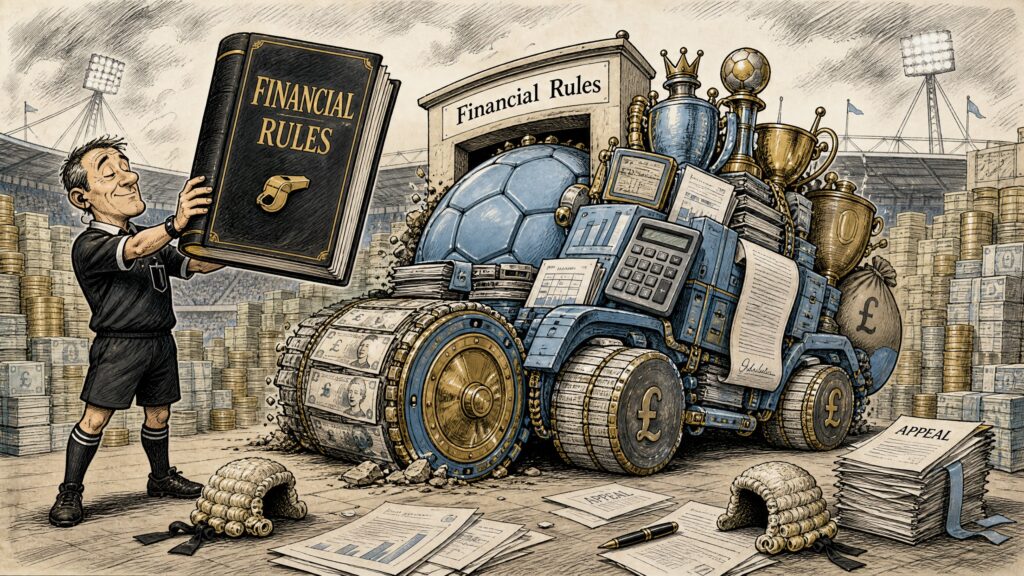
This week, an independent Premier League commission found Manchester City guilty of serious breaches of the league’s financial rules over a nine-season period. According to the findings, schemes involving commercial arrangements were used to inflate City’s revenues and reduce its reported costs by more than £900 million, helping the club appear to comply with financial regulations. The commission also found breaches relating to City’s cooperation with the subsequent investigation. City vehemently rejects those findings, maintains that the commission made serious factual and legal errors and intends to appeal.
That distinction matters. An appeal is part of the process and City is entitled to pursue it. Given the money, lawyers and complexity involved, this thing may not be finished for quite some time. Chief executive Ferran Soriano has attacked the case and indicated that the battle could continue for years. But the conversation has nevertheless fundamentally changed. For years this was about allegations; now there is an independent commission finding that serious rules were breached. City can challenge that conclusion, but unless it succeeds, English football eventually has to answer a rather uncomfortable question: what the hell do you do about it?
If a normal company breaks financial regulations, there are reasonably obvious mechanisms available. Fine the company, punish the directors, restrict its activities or allow shareholders to take the hit. Football is much stranger because sporting punishments inevitably land on people who had nothing to do with the original conduct. Take points away from Manchester City today and you punish current players and supporters over financial submissions made years ago. Relegate them and you affect broadcasters, sponsors, employees, local businesses, rival clubs and whichever unfortunate Championship centre-half suddenly discovers Erling Haaland bearing down on him on a wet Tuesday night.
A fine creates another problem. How large does a financial penalty have to be before it matters to an organisation with resources on this scale? More importantly, if the alleged benefit of breaching financial rules was a sporting advantage, does handing over some money years later actually correct anything? If the rewards of ignoring the rules substantially exceed the eventual punishment, then the punishment ceases to be a deterrent and simply becomes another cost of doing business.
That is where this stops being merely a Manchester City story. Financial regulation only works if the clubs that obey it believe there is some benefit to doing so. If one club can circumvent the restrictions, spend enormously, collect trophies and then fight the regulator for years afterwards, everybody else has a perfectly legitimate reason to ask why they bothered complying in the first place.
Manchester City’s ownership arrived with almost unimaginable financial resources and spent heavily, intelligently and successfully. City didn’t merely assemble an expensive team; it built an extraordinarily sophisticated football organisation around it. Whatever ultimately survives the appeals process, pretending the club simply threw money at a wall and accidentally won the Champions League would be nonsense. The infrastructure, recruitment, management and development behind the transformation have clearly been extremely effective.
Money, however, buys something else: the ability to fight. It buys exceptional lawyers, expert witnesses and almost unlimited time. It allows you to challenge regulators, contest interpretations and pursue appeals without worrying that the legal bill itself might destroy you. City has been involved in disputes over financial regulation for more than a decade. In 2014 it was sanctioned by UEFA under financial fair play rules, and in 2020 UEFA imposed a two-year European ban. City successfully overturned that ban at the Court of Arbitration for Sport, although a fine for failing to cooperate with UEFA’s investigation remained.
From City’s perspective, therefore, continuing to fight is hardly irrational. They have fought before and won. But from the Premier League’s perspective, there comes a point where the underlying question is no longer whether Manchester City can afford another lawyer. Of course it can. The question is whether a sporting competition can afford a regulatory system in which one of its largest members can spend years contesting enforcement without the process ever reaching a meaningful consequence.
Otherwise financial fair play starts becoming a rather peculiar concept: here are the rules, please follow them, and if you don’t, we’ll reconvene with the barristers sometime around the next World Cup.
This is where things become fascinating, because nobody yet knows what the final sanction will be. City will appeal and the legal process has to run its course, but the range of possible consequences being discussed is no longer limited to a fine and a stern letter. Points deductions are possible. Relegation and even expulsion from the Premier League have been discussed, while there is also an argument over whether historic titles should be stripped if the findings ultimately survive appeal.
The titles question is particularly messy because football has a habit of turning apparently simple punishments into philosophical arguments. Wayne Rooney, for example, has argued against stripping City’s historic titles even though doing so could theoretically benefit the Manchester United side he played for. His argument is that the players won those matches on the pitch and shouldn’t retrospectively lose their achievements because of decisions taken above them. He has nevertheless argued that, if the findings survive appeal, serious consequences such as relegation and spending restrictions would be justified.
Then there is the ownership itself. There is now public debate about whether findings of this seriousness should prompt the Independent Football Regulator to examine whether Manchester City’s ownership remains suitable under the new regulatory regime. That is importantly not the same thing as saying Sheikh Mansour is currently being ordered to sell Manchester City. He isn’t. It is an argument about what the regulator might eventually be asked to examine if the findings stand, and it demonstrates just how far the conversation has moved.
A few years ago the discussion was about whether City might receive a fine. We are now discussing points deductions, relegation, expulsion, historic titles and questions about the future regulatory status of the ownership. This has stopped being an accounting dispute and become a much bigger question about what Manchester City looks like if the final outcome actually bites.
This is the bit that even somebody like me, who would generally rather spend five days watching a Test match than 90 minutes watching football, has to admit is fascinating. Imagine Manchester City being relegated, not because Haaland stopped scoring or because the manager turned out to be useless, but because the organisation itself had been punished for what happened in the boardroom.
Suddenly the questions multiply. What happens to the players and their contracts? What happens to sponsorship income and broadcasting revenue? What happens to the value of the club? What happens to the City Football Group, with Manchester City sitting at the centre of an international network of clubs? Would players worth £100 million remain to play outside the Premier League? Would sponsors pay the same money for a club no longer appearing every week in the most watched domestic football competition on Earth?
There is precedent elsewhere in football for brutal punishment. Juventus were relegated to Serie B in 2006 during the Calciopoli scandal and stripped of titles. But Manchester City today isn’t merely a football team. It is the centrepiece of a global sporting organisation with enormous commercial relationships, international supporters and economic value. That creates the wonderfully absurd possibility that one of the wealthiest sporting organisations on the planet could end up playing considerably less glamorous opposition because somebody finally decided that the spreadsheet mattered.
I might actually start watching football again.
The biggest issue, however, may not be what happens if the punishment is severe. It may be what happens if it isn’t.
Everton and Nottingham Forest have already received points deductions for financial-rule breaches of a vastly different scale. Other clubs have constrained spending, sold players or changed their plans specifically because they believed the regulations had to be obeyed. Mauricio Pochettino has pointed to his time at Tottenham, when the club endured an 18-month period without signing players while financing its new stadium, as an example of accepting financial limitations rather than simply spending regardless.
That is where the integrity problem becomes unavoidable. Imagine entering a golf tournament where everybody is told they can carry 14 clubs. One player arrives with 27. When challenged, he employs six barristers, spends eight years arguing about the legal definition of a golf club and continues playing throughout the proceedings. Eventually the question isn’t whether he is a very good golfer; it is why everybody else bothered counting their clubs.
That, rather than whether Manchester City was a clever £200 million investment, is the point of this story. The takeover matters because it marks the beginning of the experiment: what happens when almost unlimited capital enters a football club operating inside a system specifically designed to place limits around capital?
For nearly two decades we have watched the answer unfold. City became spectacularly successful. It built infrastructure, recruited brilliantly, employed outstanding managers and, I am reliably informed by people who enjoy football, played some extraordinary stuff. Nobody can seriously argue that success was produced by money alone. But the commission’s findings now add a far more serious question to the story: whether financial information was manipulated during part of that rise to make the club appear compliant with rules intended to restrain precisely the sort of spending that was transforming it. City rejects that conclusion and will appeal, but if the findings stand, the Premier League has to decide what enforcement actually means.
A £20 million fine would plainly be absorbed. Even £100 million begins to look suspiciously like an invoice when set against the economic scale of elite football. For regulation to deter behaviour, the downside has to be meaningful enough that breaking the rules isn't simply an economically rational gamble. Yet the moment a punishment becomes genuinely meaningful, it spreads far beyond the people who made the decisions. Current players suffer, supporters suffer, employees suffer, sponsors suffer, broadcasters are affected and rival clubs suddenly find themselves competing in a different landscape.
That is why the Premier League has landed itself with such a horrible problem. Punish City too lightly and financial fair play risks looking ridiculous. Punish them severely and you potentially reshape one of the biggest football clubs in the world.
That is what interests me. I don’t particularly care whether Pep should have played a false nine, a real nine or seven midfielders standing on one another’s shoulders. I want to know what happens to the business if the punishment survives appeal and is serious enough to matter. What is Manchester City worth outside the Premier League? What happens under severe spending restrictions? What happens to sponsors, players and the wider City Football Group? What happens if historic titles become part of the argument? And what happens if the Independent Football Regulator is eventually asked whether findings of this seriousness have implications for the ownership itself?
Nobody knows yet, and City may succeed on appeal. That caveat matters. But English football has reached the point where somebody eventually has to answer a remarkably simple question: are the financial rules actually rules, or are they merely a price that sufficiently wealthy clubs can choose to pay?
I grew out of football years ago. I still prefer cricket, rugby and golf, and spending Sunday afternoon watching a long-haired metrosexual rolling around clutching his shin remains somewhere below reorganising the garage on my list of preferred leisure activities. But the Manchester City case has become something much more interesting than football. It is a test of what happens when enormous private wealth meets a regulatory system that depends on everybody accepting the same limits.
For years Manchester City has had enough money to buy almost everything football could offer: extraordinary players, elite managers, world-class infrastructure, international expansion and, when necessary, the time and legal firepower to fight its battles. The fascinating question now is what happens if the commission’s findings survive and the one thing City needs is something that money may finally not be able to purchase: a way out.
Keep your Axe sharp. The final whistle on this one could be a very long way away.
Max
Join the FX Axe newsletter and stay one chop ahead.

