

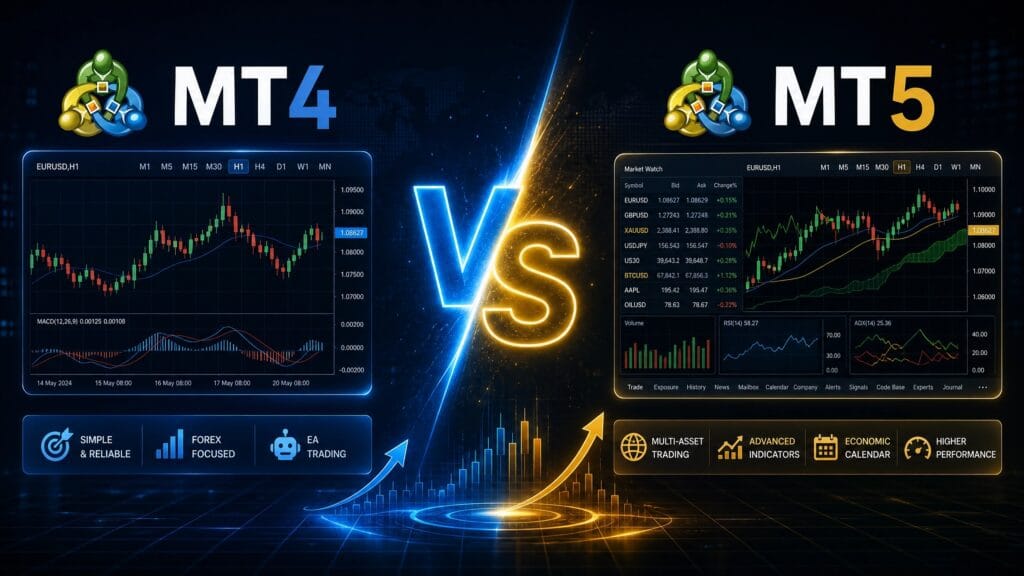
If you're starting your trading journey, one of the first decisions you'll face is choosing between MetaTrader 4 (MT4) and MetaTrader 5 (MT5). Both platforms are developed by MetaQuotes and are trusted by millions of traders worldwide, but they aren't identical.
While MT4 remains a favorite among forex traders for its simplicity, MT5 offers more advanced tools, additional asset classes, and faster performance. So, which one is right for you?
In this guide, we'll compare MT4 vs MT5 in detail, covering their features, key differences, advantages, and which platform suits different trading styles.
For the latest platform features and official updates, you can also visit the MetaTrader official website, where MetaQuotes provides detailed information about both MT4 and MT5.
MetaTrader 4 (MT4) was launched in 2005 and quickly became the world's most popular forex trading platform.
Its success comes from its intuitive interface, reliable execution, customizable charts, and support for automated trading through Expert Advisors (EAs).
MT4 is primarily designed for:
Even after two decades, many professional traders still use MT4 because of its stability and the enormous community that has built indicators, scripts, and trading robots around it.
MetaTrader 5 (MT5) was released in 2010 as the successor to MT4.
Rather than replacing MT4 completely, MT5 expands on its capabilities by offering access to multiple financial markets beyond forex.
MT5 supports trading in:
It also introduces more timeframes, more technical indicators, a faster strategy tester, and improved order management.
Here's a side-by-side comparison.
| Feature | MT4 | MT5 |
|---|---|---|
| Release Year | 2005 | 2010 |
| Markets | Forex & CFDs | Forex, Stocks, ETFs, Futures, CFDs |
| Timeframes | 9 | 21 |
| Pending Orders | 4 | 6 |
| Technical Indicators | 30 Built-in | 38 Built-in |
| Graphical Objects | 31 | 44 |
| Economic Calendar | No | Yes |
| Market Depth (DOM) | No | Yes |
| Strategy Tester | Single-thread | Multi-thread & Multi-currency |
| Programming Language | MQL4 | MQL5 |
| Hedging | Yes | Yes |
| Netting | No | Yes |
The biggest difference between MT4 vs. MT5 is the range of assets available.
MT4 focuses mainly on forex and CFDs.
MT5 was designed to support multiple asset classes, making it suitable for traders who want to diversify their portfolio.
If you only trade currencies, MT4 may be all you need.
If you plan to trade stocks, futures, or ETFs, MT5 is the better choice.
Both platforms provide excellent charting capabilities, but MT5 offers more flexibility.
More timeframes allow traders to analyze the market with greater precision.
MT4 includes:
MT5 adds:
These additional order types provide greater flexibility for advanced trading strategies.
One major advantage of MT5 is the built-in economic calendar.
Instead of switching between websites, traders can monitor major economic events directly within the platform.
This is especially useful for news traders.
MT5 includes Depth of Market (DOM), allowing traders to view available liquidity and pending orders.
This feature is useful for:
MT4 does not offer full market depth.
Both platforms support Expert Advisors (EAs).
However, there is one important difference.
Uses MQL4 programming language.
Ideal if you're already using older trading robots and indicators.
Uses the newer MQL5 language.
Benefits include:
Keep in mind that MT4 EAs do not work on MT5 without conversion.
This is where MT5 has a significant advantage.
MT4:
MT5:
Algorithmic traders generally prefer MT5 because backtesting large strategies takes considerably less time.
Many beginners wonder which platform is easier to learn.
If your goal is simply learning forex trading, MT4 offers a clean, straightforward interface with fewer distractions.
However, if you're planning to trade multiple asset classes or want access to newer features from the beginning, MT5 is worth learning.
The interface is very similar, so moving from one platform to the other is relatively easy.
As you compare MT4 and MT5, remember that the platform is only one part of the decision. Your broker determines important factors like spreads, execution speed, available markets, and account features.
Before opening an account, explore our Broker Reviews to compare trusted brokers that support MT4 and MT5, helping you choose a platform and broker that match your trading goals.
Professional traders often choose based on their strategy.
Choose MT4 if you:
Choose MT5 if you:
Many traders ask whether MT4 is disappearing.
The answer is not entirely.
MetaQuotes has shifted its development focus toward MT5, and most new features are introduced there. While many brokers still support MT4, an increasing number now encourage new clients to use MT5 due to its broader functionality and ongoing updates.
If you're starting from scratch today, learning MT5 may better prepare you for the future. However, MT4 remains widely available and continues to be a dependable choice for forex traders.
There isn't a universal winner.
The better platform depends on your trading goals.
When comparing MT4 vs MT5, both platforms remain excellent choices.
MT4 continues to dominate among traditional forex traders thanks to its simplicity, reliability, and extensive ecosystem of custom tools. MT5, on the other hand, is the more powerful platform for traders seeking advanced analytics, faster backtesting, and access to a wider range of financial markets.
If you're just beginning, either platform can help you develop your trading skills. The best choice ultimately depends on your trading style, preferred markets, and long-term goals.
Before choosing between MT4 and MT5, make sure you also choose a trusted broker. Platform features matter, but your broker plays an equally important role in execution quality, spreads, fees, and regulation.
Explore FX Axe's Broker Reviews to compare regulated brokers that support both MT4 and MT5, helping you find the platform and the broker that best fits your trading needs.
If you'd like to see the platforms in action, watch our step-by-step video guide covering the key differences between MT4 vs MT5, including charting tools, order types, and trading features.
MT5 offers more advanced features, additional asset classes, and improved performance. However, MT4 remains an excellent option for traders who focus exclusively on forex.
Many brokers support both platforms, though availability depends on the broker. Always check which platforms are offered before opening an account.
No. MT4 indicators and Expert Advisors are built using MQL4, while MT5 uses MQL5. They are not directly compatible.
MT5 is generally better because it offers multi-threaded strategy testing, faster optimization, and a more advanced programming language.
If you're only interested in forex, MT4 is easier to start with. If you want access to more markets and advanced tools, learning MT5 from the beginning is a smart long-term choice.

