

Who is old enough to remember going to a video shop?
And I don't actually mean Blockbuster. Before Blockbuster became the great international temple of VHS, popcorn and inexplicably expensive late fees, we had a lovely little independent video shop in the village where I grew up in leafy Buckinghamshire. As a young man, going in there was genuinely exciting. You wandered around the shelves looking through Action, Comedy, Horror and whatever slightly mysterious category had been placed behind the counter, picking up boxes, reading the backs and eventually making the enormous commitment of choosing the film you were going to watch that evening.
There was something rather wonderful about it because choice required effort. You couldn't watch a trailer. You couldn't check Rotten Tomatoes. There wasn't an algorithm informing you that because you once watched Jaws, you might enjoy a Bulgarian documentary about a depressed fisherman. You looked at the cover, read three sentences on the back and took a punt. Sometimes you discovered The Shawshank Redemption. Sometimes you spent £3.50 and two hours discovering why the film had gone straight to video.
Then the internet arrived and somebody decided even walking to the video shop was unnecessarily strenuous.
That somebody, eventually, was Netflix.
Netflix was founded in 1997 and launched its website in 1998 as a DVD rental business. You chose films online and they arrived through the post. In 1999 it introduced the subscription model, eventually allowing customers to keep receiving DVDs without the traditional video-shop experience of suddenly discovering that Die Hard With a Vengeance had been sitting underneath the passenger seat of your car for three weeks and you now owed Blockbuster approximately the GDP of Belgium.
The first DVD Netflix ever posted was Beetlejuice. By 2005 it was offering around 35,000 different films and shipping roughly one million DVDs every day. Then, in 2007, it did something much more important: it started streaming them.
Think about how absurdly quickly everything changed after that.
Within little more than a decade, an activity that had required leaving your house, travelling to a shop, physically choosing a plastic cassette or disc, paying somebody and returning the thing afterwards became pressing one button on the television. Thousands of films and programmes appeared instantly in your sitting room. No journey, no disc, no late fee and no awkward conversation with the 17-year-old behind the counter about why you'd rented Basic Instinct twice that week. Oh and Species. You know what I’m talking about.
Netflix didn't merely improve the video shop, it made the video shop unnecessary.
The really clever bit came afterwards.
Streaming other people's films was one thing. Netflix eventually realised that if it was going to build a global entertainment business, it couldn't remain permanently dependent upon Disney, Warner, Paramount and everyone else agreeing to license their best material.
So it started making its own.
Lilyhammer arrived in 2012 as its first original series, followed by House of Cards, Orange Is the New Black, Narcos, Stranger Things, The Crown and eventually a torrent of films, documentaries and series from almost everywhere on Earth. Netflix went from being the digital equivalent of the video shop to becoming the studio making the things sitting on the shelves.
And in doing so it helped dismantle one of Hollywood's great class systems.
There used to be a very obvious hierarchy. Proper film stars made films. Television actors did television. A film went to the cinema first because that was where serious films went, then eventually appeared on DVD and television. “Straight to video” was practically an insult. It meant somebody had made a film, watched it and concluded that asking the public to leave their houses for it might constitute fraud.
Netflix helped turn that completely upside down.
Suddenly major actors were appearing in lavish television series. Major directors were making projects for streaming. Films costing hundreds of millions could arrive directly on somebody's television. The distinction between film star and television star became increasingly meaningless, while the distinction between cinema and television became increasingly about the size of the screen on which you happened to be watching.
There is now nothing remotely strange about Ben Affleck making a Netflix film, or Florence Pugh starring in a Netflix series, or Martin Scorsese making The Irishman for a streaming platform. Netflix didn't single-handedly cause all of this, obviously, but it was one of the forces that made the old Hollywood hierarchy look increasingly ridiculous. Academic work on the industry's transformation has described Netflix as operating under a fundamentally different institutional logic from the traditional studio model, where opening weekends and theatrical releases had historically dictated enormous parts of the business.
The astonishing thing is that this revolution is barely old enough to buy a drink.
This is where Netflix becomes particularly interesting to me, because its great innovation wasn't simply understanding what people wanted to watch.
It was understanding how people actually watch things.
There is a difference.
Cinema demands attention. You have bought a ticket, travelled somewhere, sat in the dark and surrendered two hours of your life. If you start scrolling through your phone halfway through, somebody three rows behind will quite reasonably consider murdering you.
Netflix lives in a completely different environment. People watch while eating. They watch while ironing. They watch with children climbing over them. They watch while answering messages and pretending they aren't answering messages. Quite a lot of television is now being consumed by people who are simultaneously doing something else.
That changes what “good” means.
Netflix has made some exceptional films and television. It has also produced a quite heroic quantity of absolute crap. There are Netflix films whose plot appears to have been generated by asking somebody in a lift what they vaguely remember happening in another film. There are Christmas films in which attractive people return to picturesque small towns and discover that their true and childhood love has been running a bakery opposite the family home for 15 years without anybody thinking to mention it. There are horror films that I, as somebody who loves horror, have watched with increasing disbelief that anybody involved read the script all the way to the end.
And yet people watch them. Millions of people watch them.
Because sometimes a film doesn't need to be The Godfather. Sometimes it needs to be sufficiently entertaining that you can look at your phone for four minutes, look back at the television and immediately understand that the attractive woman is still trying to save the Christmas-tree farm.
That is a completely different product.
A very good friend of mine has taken this concept considerably further.
He flies a lot for business and has apparently decided that humanity has already produced all the films he will ever require. His personal canon consists, roughly in order, of Top Gun: Maverick, The Greatest Showman and Batman Begins.
That is essentially it.
To be fair, Batman Begins is excellent. I also absolutely love Maverick, although obviously the original Top Gun is infinitely better because I am not a barbarian. The Greatest Showman I will leave to history.
My friend, however, has probably watched each of these films about 300 times. He gets on a plane, examines an entertainment system containing perhaps 800 films and apparently thinks: “Excellent. Maverick again.”
He knows the dialogue. He knows what happens. With The Greatest Showman, he knows every bloody song. He can fall asleep, wake up 40 minutes later and know precisely where everybody is emotionally and geographically.
And I increasingly think this tells us something important about streaming.
We talk endlessly about consumers demanding new content, but people also love familiarity. They rewatch Friends. They rewatch The Office. The proper one I hope. Children watch the same film until their parents begin fantasising about destroying the television. My daughter at the moment keeps demanding to watch Miss Rachel-the purple one, which is code for the one with Elmo in, who is very clearly red. Anyway. Sometimes entertainment isn't about being surprised. It is about putting something on that you already know you enjoy.
Netflix understands this extremely well. Its interface isn't simply a library. It is an enormous machine designed to remove the friction between you and pressing play.
Perhaps the greatest demonstration of Netflix's power came from Squid Game.
There is a slight correction to one part of the story as it is sometimes told. Squid Game wasn't some Korean flop that Netflix accidentally discovered after local audiences rejected it. It was created by Korean filmmaker Hwang Dong-hyuk and released globally by Netflix in September 2021, including in Korea. It became number one in 94 countries, including South Korea, and its first season went on to become Netflix's biggest television launch at the time.
But the important part of the story remains extraordinary.
A Korean-language drama about heavily indebted people playing murderous children's games became one of the biggest television programmes on Earth.
Twenty years earlier, somebody trying to sell that internationally would have faced a rather difficult meeting. Foreign language. Subtitles. Unknown cast in most Western markets. Peculiar concept. Lots of tracksuits.
Netflix's distribution model made those barriers dramatically less important.
Once Squid Game started working, it could spread everywhere simultaneously. There was no need to persuade hundreds of individual broadcasters to schedule it. Netflix already owned the shop window.
The first season eventually became the service's most popular show ever, and the first two seasons together accumulated nearly 600 million views before the third arrived.
That may be Netflix's greatest achievement. It didn't just globalise American entertainment, which is of course, shallow, sanguine and trivial.
It globalised everybody else's, which is almost exclusively better. (This is Max’s opinion the editor has told me to add. It’s right though).
This is where today's Netflix story becomes much more interesting.
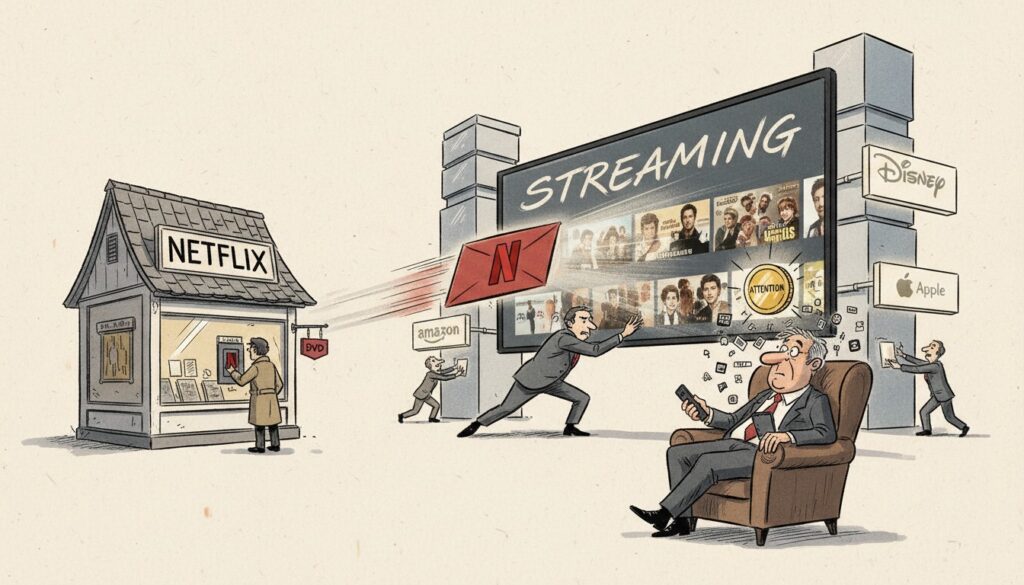
Netflix spent years being the bloke who had spotted the future while everyone else was still arguing about DVD sales. Then Disney noticed. Amazon noticed. Apple noticed. Warner noticed. Paramount noticed. HBO noticed. YouTube grew into something enormous and slightly different but competing for exactly the same finite human resource: time.
Suddenly everyone had a streaming service.
And once everybody has invented Netflix, being Netflix becomes rather harder.
The latest numbers illustrate the problem. Netflix's business is still growing. Second-quarter 2026 revenue rose 13 per cent to $12.56 billion, operating income reached $4.19 billion and quarterly net income was $3.4 billion. Across the first six months of the year, Netflix made nearly $8.7 billion in net profit. So one misconception is worth killing immediately: Netflix absolutely does make money, and rather a lot of it. In 2025 alone it generated $45.2 billion of revenue and more than $13.3 billion of operating profit.
The problem is expectations.
Netflix was valued at roughly $550 billion at its peak. Since then its valuation has almost halved, with more than $130 billion wiped from its market value as investors have worried about slowing engagement, competition and whether its next generation of programmes can reproduce the extraordinary hits of the past. Its shares are down sharply this year and by more than a third from their spring highs.
That is the peculiar punishment for changing an industry.
Eventually investors stop asking whether your invention works and start asking what you're going to invent next.
Netflix also recently tried to buy a substantial part of Warner Bros Discovery, offering about $83 billion before ultimately declining to raise its bid. Paramount Skydance won instead, creating a giant containing Warner Bros, HBO, Paramount, CBS, CNN and an extraordinary catalogue of franchises and intellectual property.
Think about how extraordinary that is historically.
Netflix began by putting DVDs belonging to companies like Warner through people's letterboxes. It then streamed their films. Then it started competing with their films. Then it became large enough to attempt to buy the studio itself.
That is like the bloke delivering your pizza eventually making an offer for Domino's.
The failure of the Warner bid leaves Netflix facing an increasingly consolidated group of competitors with enormous libraries of intellectual property. Disney has Marvel, Star Wars, Pixar and its vast back catalogue. The newly enlarged Skydance has HBO, Warner Bros, Paramount, Harry Potter, Batman, Friends, Top Gun (with some very elevated viewing figures from airline services) and Star Trek. Amazon has effectively unlimited financial resources and MGM. Apple can finance entertainment using money it found down the back of the iPhone sofa.
Netflix, meanwhile, has had to build much more of its cultural property from scratch.
It has done that brilliantly in places. Stranger Things became a global franchise. Bridgerton became enormous. Money Heist travelled around the world. Squid Game became a cultural phenomenon.
But producing the next Squid Game on demand is rather like asking a record label to schedule the next Bohemian Rhapsody for Q3.
Hits don't work like that.
And this brings us to what I think is the most interesting part of Netflix's problem.
It has given us more choice than any generation of television viewers has ever possessed, and yet I regularly spend 20 minutes scrolling through Netflix before concluding there is absolutely nothing to watch.
This should be impossible.
My childhood video shop in Buckinghamshire probably contained a few thousand films at most. Netflix can place an extraordinary proportion of the world's entertainment in front of me without requiring me to move six feet from the sofa, and somehow I can still end up watching Peep Show again.
My friend has access to the collected cinematic output of human civilisation at 35,000 feet and watches Maverick for the 301st time.
Perhaps abundance changes us.
When choosing a film involved physically leaving the house, you committed to the decision. Now, if a Netflix film hasn't interested you after seven minutes, there are another 10,000 sitting behind the Back button. Entertainment has become disposable precisely because access to it has become effortless.
That may explain why Netflix increasingly values engagement so highly. The important question isn't merely whether you subscribe. It is whether Netflix remains the place you instinctively open when you want to watch something.
And that battle is becoming ferocious.
YouTube doesn't even need to make Stranger Things. It can give you a 14-minute video about restoring a rusty lawnmower, followed by a podcast, followed by somebody falling off a boat. TikTok competes in minutes rather than episodes. Live sport commands attention in a way scripted entertainment often cannot, which helps explain Netflix's increasing experiments with live events and sport. Advertising creates another source of revenue, while price rises extract more from existing customers. Netflix is even reported to have discussed the possibility of a free advertising-supported service internally, although there is no current plan to launch one.
The company that once had one revolutionary idea is now having to find lots of smaller ones.
I don't think the Netflix story is one of failure. Quite the opposite.
This company has already won.
It helped kill the video shop. It helped make streaming normal. It changed the relationship between film and television. It helped turn binge-watching into a verb. It demonstrated that Korean, Spanish and other non-English-language programmes could become enormous global hits. It changed how Hollywood thinks about distribution and helped make it perfectly respectable for some of the biggest actors and directors in the world to make something principally intended for your television.
And it became enormously profitable while doing it.
The question facing Netflix now is harder because it is no longer competing against an industry that doesn't understand what Netflix is doing.
Everyone understands.
The advantage of being a pioneer is that you get to run onto an empty field. The disadvantage is that, if you are successful enough, everybody eventually follows you onto it.
Netflix now faces Disney, Amazon, Apple, YouTube and a newly enlarged Skydance containing much of old Hollywood under one roof. Its shares have been punished because investors aren't merely asking whether Netflix will continue making billions of dollars. They are asking whether it can continue growing quickly enough to justify the enormous valuation they once gave it.
That is a much more difficult question.
But I wouldn't dismiss the company that has already reinvented itself twice. Netflix began by posting Beetlejuice to somebody in an envelope. It then became a streaming company, then a studio, then a global content machine, and now increasingly an advertising, live entertainment and sports platform.
Perhaps its greatest product was never Stranger Things, Squid Game or The Crown.
Perhaps it was convenience.
Netflix understood before almost everybody else that the winner in entertainment would increasingly be the company that made watching something easiest. Not necessarily the greatest film ever made. Not necessarily the most expensive. Sometimes simply something sufficiently entertaining, immediately available and easy enough to follow while you're simultaneously buggering about on your phone.
My childhood video shop offered scarcity. Netflix offered infinity.
And perhaps Netflix's problem now is that everybody else has learnt how to offer infinity as well.
The pioneer has finally arrived at the awkward part of being a pioneer: working out what to do after everyone copies you.
My friend, meanwhile, remains entirely unconcerned by the streaming wars. He'll be somewhere over Dubai watching Maverick again.
And, irritatingly, he may have understood entertainment better than all of us.
Keep your Axe sharp. And if in doubt, apparently just put Top Gun on again.
Max
Join the FX Axe newsletter and stay one chop ahead.

