

Apparently, we are finally getting somewhere. After five years without a James Bond, final screen tests for the next 007 are reportedly taking place, and two names appear to have moved towards the front of the queue: Jack Lowden, the Scottish actor from Slow Horses, and Callum Turner, the British actor from Masters of the Air and Fantastic Beasts. Reports differ slightly on exactly how final the final shortlist actually is. Lowden and Turner are firmly in the mix, Josh O'Connor has also reportedly been offered a test, and there may be another unidentified candidate lurking somewhere behind a casino curtain. Amazon MGM, naturally, is saying nothing. But we are finally approaching the point where somebody is going to be handed the Walther PPK, the Aston Martin keys and arguably the most famous fictional job in Britain.
Turner, incidentally, also married Dua Lipa this year, which frankly I think should rule him out on the basis that no single man should be allowed to have those two things happen to him in the same year. You've married Dua Lipa, Callum. Congratulations. You've won. Now give somebody else a go.
This is quite a big decision. Not in the grand scheme of human civilisation, obviously. Interest rates will not move when Bond is announced and I doubt Jerome Powell is building the casting decision into the Fed's dot plot. But culturally, James Bond matters. This is one of the biggest film franchises ever created, a character who has existed on cinema screens since Sean Connery walked into a casino in Dr. No in 1962 and said those three words. People who don't particularly like Bond still know Bond. They know the Aston Martin, the Walther PPK, the tuxedo, the martini, M, Q, Moneypenny and the music. Everybody has an opinion about who the best Bond was, and more importantly everybody believes everybody else's opinion is wrong. Which is why Amazon had better not get this wrong.
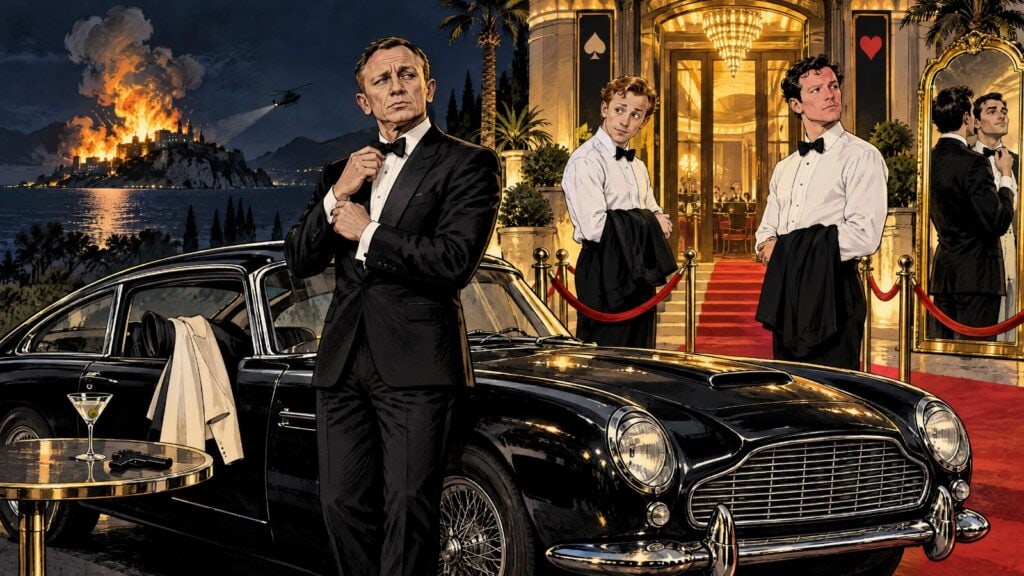
Before we get to Lowden and Turner, I need to address the elephant underneath several tonnes of explosives on a Mediterranean island. James Bond does not die. Spoiler alert, obviously, although No Time to Die came out five years ago, so if this has ruined it for you I would gently suggest that you may not have been enormously committed to seeing it.
Daniel Craig's Bond died at the end of No Time to Die. Not ambiguously. Not “perhaps he escaped through a secret hatch”. They fired missiles at him and blew him to pieces. It was all terribly emotional and beautifully filmed and Daniel Craig acted it extremely well, and I hated it, because Bond doesn't die. That's the bloody point. Bond is escapism. He has survived being shot, stabbed, poisoned, tortured, drowned, dropped from aeroplanes, thrown off trains, buried in avalanches, chased by helicopters and strapped to a table while Goldfinger points an industrial laser at his bollocks. You don't watch a Bond film wondering whether he'll make it. You watch because you know he will, and you want to see how.
Worse still, No Time to Die arrived in 2021 after the world had spent the previous eighteen months dealing with Covid. People had been locked inside their houses, separated from families, frightened about their health, watching businesses collapse and generally experiencing one of the bleakest periods of normal civilian life in generations. Eventually cinemas reopened and Bond returned, the character who had been safely escaping certain death since 1962, and the producers apparently decided what everybody needed was to watch him get obliterated by a missile strike. Cheers. I wanted an Aston Martin, a volcano lair and a man with metal teeth. I already had existential despair at home.
I should probably declare my position on Daniel Craig's Bond films generally, because it will upset people. Casino Royale is a very good film. It is not, in my view, a very good Bond film. There. I've said it. And in the immortal words of Alan Partridge: stop getting Bond wrong.
I understand why Casino Royale is so admired. Daniel Craig is excellent, Eva Green is excellent, Mads Mikkelsen is excellent, the opening chase is superb and the poker sequence is fantastic. As an action thriller, it is one of the best films in the entire franchise. But Bond had changed. Craig's Bond was bruised, emotional, vulnerable and increasingly miserable. He fell in love, got betrayed, questioned himself and developed emotional baggage. By the end of his run he had a child and was discussing his feelings before being vaporised. Roger Moore would have raised an eyebrow, shagged the nearest countess and escaped the island in a Union Jack hot-air balloon.
That, to me, is Bond. The brilliance of the character was never realism. Bond is absurd. He's a sociopathic, alcoholic, womanising government assassin who introduces himself using his surname twice, drives conspicuously expensive cars despite being a secret agent, gambles enormous sums of money, drinks before operating firearms and somehow remains irresistible to virtually every woman he meets. None of this survives even modest scrutiny, and it isn't supposed to. The Craig era sometimes seemed embarrassed by the absurdity, as though Bond needed to become Jason Bourne to justify his continued existence. I don't want Bond endlessly deconstructed. Give him the tuxedo, the ridiculous villain, the gadgets and a car with something hidden behind the headlights. Let him deliver a terrible pun after somebody falls into a shark tank. We have enough gritty realism elsewhere.
There's another moment in Casino Royale that has always bothered me disproportionately: Bond drinks a Heineken. I know Fleming's Bond drank all sorts of things and that the films have never actually confined him exclusively to vodka martinis, but visually it feels wrong. It's like seeing Batman order a WKD Blue. There was, naturally, a commercial reason for it. Heineken had a huge promotional relationship with the Craig-era Bond films, and Bond generally has been an absolute tart for product placement for decades: Aston Martin, BMW, Omega, Rolex, Smirnoff, Sony, Ford, Bollinger and countless others have all enjoyed the services of the most sophisticated salesman in cinema history. From a business perspective, that's also part of why the casting matters. Bond isn't merely a character in a film; he's the centre of an enormous global luxury ecosystem. Cars, watches, alcohol, clothes, tourism, games and merchandise all attach themselves to 007. Casting Bond is somewhere between casting a movie star and appointing the chief executive of a luxury conglomerate who occasionally shoots people.
Jack Lowden is suddenly one of the men to beat. He's 36, Scottish, an excellent actor and already has a rather useful qualification on his CV: he plays a spy. Lowden is River Cartwright in Slow Horses, the excellent Apple TV series about MI5 rejects banished to Slough House under Gary Oldman's spectacularly revolting Jackson Lamb. Lowden has been part of the Bond rumour mill for some time, but speculation intensified after Oldman appeared to suggest that his co-star had made the shortlist. Lowden's wife, Saoirse Ronan, has subsequently been asked about it and says it isn't really something they're discussing at home.
The amusing transition, of course, would be watching Lowden go directly from playing River Cartwright to James Bond. Cartwright isn't an idiot and he's actually a capable agent, but he does have a remarkable ability to charge enthusiastically into situations before discovering that the situation has become considerably worse. That's part of what makes Slow Horses so good. So can Lowden translate from a slightly bumbling spy into the world's greatest fictional spy? I rather hope so. If anything, the contrast might help because we haven't already watched him spend ten years effectively auditioning for Bond.
And there is something rather satisfying about another Scottish 007. Sean Connery established the cinematic Bond and remains, for many people, the definitive version. Returning the role to another Scot more than sixty years later has a pleasing symmetry. Lowden also has the other quality the producers traditionally seem to look for: he's famous, but not so famous that Jack Lowden arrives on screen before James Bond does. The question is whether he can produce that almost indefinable thing Bond requires: presence. Bond shouldn't merely be handsome. There are thousands of handsome actors. He needs to walk into a room and somehow make everybody else in it look like supporting cast.
Then there's Callum Turner, who arguably looks more immediately like my idea of James Bond. He's also 36, tall, British, conventionally handsome and has the sort of face you can imagine above a dinner jacket without requiring a particularly energetic imagination. He has appeared in the Fantastic Beasts films, The Boys in the Boat and Masters of the Air, and has gradually become one of Britain's most recognisable actors without yet becoming so enormous that casting him would feel like stunt casting. He is now also Mr Dua Lipa, but as discussed, nobody's life should be going this well.
That level of fame actually matters because Bond has rarely been handed to the biggest movie star available. Bond traditionally makes the movie star. Sean Connery wasn't an international superstar when Dr. No arrived. George Lazenby was effectively an unknown model. Roger Moore was well known from television, particularly The Saint, but Bond elevated him into another category. Timothy Dalton was respected but hardly Tom Cruise. Pierce Brosnan was famous from television and had previously nearly got the role, but Bond made him globally synonymous with 007. Daniel Craig was an established and respected actor, but he wasn't one of Hollywood's handful of untouchable megastars.
That is part of the formula. Bond needs to swallow the actor rather than the actor swallowing Bond, and this is where Turner makes enormous sense. He's known, but he isn't yet burdened by an enormous pre-existing screen identity. You can still look at him and imagine James Bond rather than immediately seeing Superman, Sherlock Holmes or somebody else who got there first.
Which brings us inevitably to Henry Cavill. On appearance alone, Cavill looks like somebody grew James Bond in a laboratory. He's British, absurdly handsome, physically imposing, comfortable in action films and looks as though he probably wakes up wearing a dinner jacket. He also has history with the role: Cavill auditioned for Casino Royale when he was only in his early twenties and reached the final stages before Daniel Craig got the job. More than twenty years later, his name still appears almost automatically whenever Bond becomes vacant.
But now I wonder whether he's simply too famous. He's Superman. He's been The Witcher. He was the extremely Bond-adjacent Napoleon Solo in The Man from U.N.C.L.E. He's been in Mission: Impossible. He has already played so many variations of handsome, extraordinarily capable action man that putting him in a tuxedo and handing him a Walther might almost feel like cosplay. Bond has usually worked best when the actor arrives with enough reputation to reassure the studio but enough blank canvas for the audience to believe that he simply is James Bond.
That is probably the strongest argument for Lowden or Turner. You're not buying an established global superstar and fitting him into Bond. You're potentially creating one.
And while we're here, can we deal with the argument that periodically resurfaces about making James Bond a woman? I don't think it works, and not because women can't lead spy films. Obviously they can. If anything, taking James Bond and simply turning him into Jane Bond feels strangely unimaginative and, to me, not particularly feminist. Create an extraordinary female spy. Give her her own name, flaws, history, mythology, enemies and franchise. Make her brilliant enough that in sixty years' time people are arguing about whether a man should play her.
But James Bond is a specific fictional character, and his flaws are part of that character. He's male, an orphan, a Royal Navy commander, emotionally damaged, promiscuous, arrogant, violent, alcoholic, charming and frequently appalling. Fleming created him that way. You can update the world around Bond, as every incarnation has done, without changing the fundamental character until the name becomes the only thing left. You don't make Sherlock Holmes progressive by turning him into Miss Marple. You write another great character.
There is another reason this casting decision feels particularly important: this is the first Bond of a new era. Amazon MGM now has creative control of the franchise after the Broccoli family relinquished its long-held control. Denis Villeneuve, the director behind Dune, Arrival and Blade Runner 2049, is directing, Steven Knight, creator of Peaky Blinders, is writing, and casting director Nina Gold is overseeing the search. Current reporting says final screen tests are taking place now, with the next Bond expected to be chosen before the end of the year and the film unlikely to arrive before 2028.
That combination could be fantastic. Villeneuve can make spectacle and understands scale, atmosphere and menace. Steven Knight can certainly write damaged, charismatic British men operating somewhere between charm and psychopathy, which is essentially the job description. But Amazon also makes me slightly nervous because Bond survived for more than sixty years partly because the Broccoli family treated him less like intellectual property and more like inherited crown jewels. Amazon owns an enormous streaming platform that would presumably quite enjoy a Bond universe, and I really don't want one. I don't need Young Moneypenny, Q: Origins or an eight-part series explaining Blofeld's difficult childhood. I don't need The Felix Leiter Files followed by a Christmas special in which Jaws discovers the true meaning of friendship. I want James Bond, preferably once every few years, for approximately two hours, defeating a lunatic who owns an unnecessarily complicated secret base.
At the moment, Lowden appears to have momentum, although the final field is not quite as simple as a two-horse race. Current reporting has Lowden, Turner and Josh O'Connor among the small group receiving final screen tests, with reports differing on whether there are three, four or perhaps five candidates in total. The tests themselves are reportedly assessing stunts, dialogue and camera presence, which sounds reassuringly Bond-like, although I hope there is also a fourth category entitled Can Order Martini Without Looking Like Estate Agent at Christmas Party.
My instinct is that Turner looks more immediately like the conventional Bond, while Lowden is potentially the more interesting choice. Another Scottish Bond, an excellent actor, famous enough that you've seen him but not so famous that you're really watching somebody else, and already believable within the world of espionage while playing a character sufficiently different from Bond that the transformation would actually mean something. Watching River Cartwright go from slightly bumbling MI5 operative to the most sophisticated secret agent in fiction would be rather fun. Turner, meanwhile, looks as though someone could put him in the tuxedo tomorrow morning and half the job would already be done. Unfortunately, as previously established, he has just married Dua Lipa and therefore must surely have exceeded his annual allocation of good fortune.
Whichever one gets it, the challenge is much bigger than whether he can throw a punch or look convincing ordering a martini. He has to inherit more than sixty years of cultural baggage without looking as though he's impersonating the men who came before him. He has to retain Connery's danger, Moore's wit, Dalton's steel, Brosnan's polish and some of Craig's physicality, while becoming his own version of a character invented in the 1950s. More importantly, the producers have to modernise Bond without becoming embarrassed by Bond. The character should evolve because the world around him has evolved, but if you remove the arrogance, danger, humour, absurdity, sex, glamour and escapism, eventually you're simply making another expensive action film about a man called James.
So give him the tuxedo. Give him the Aston Martin, the martini, the gadgets, the charm, the menace and an absolutely ridiculous villain. Let him be suave, let him be funny and let him occasionally be a bastard. Let him escape something no human being could possibly survive and straighten his bow tie afterwards. We've spent the Craig era exploring whether James Bond is traumatised, emotionally available and capable of maintaining a healthy relationship. Fine. Experiment concluded.
Now can we please have James Bond back?
And, for fuck’s sake, don't kill him again. “James Bond will return” isn't just something you put at the end of the credits. That's the entire bloody point.
Keep your Axe sharp. And stop getting Bond wrong.
Max
Join the FX Axe newsletter and stay one chop ahead.

