

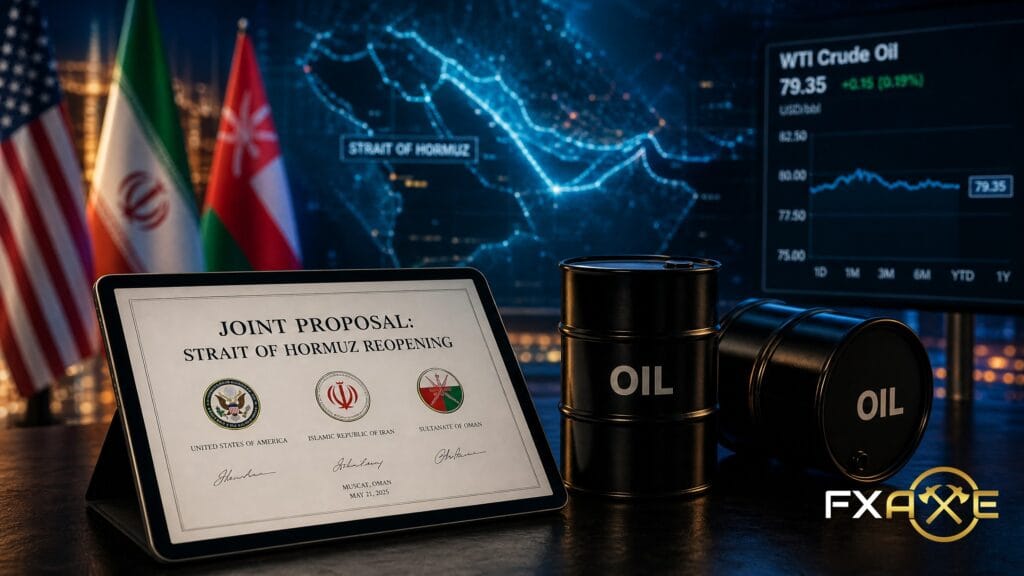
Oil Prices Hold Below $80 as traders assess the latest developments surrounding an Iran-Oman proposal that has increased optimism over potential improvements in Middle East shipping conditions.
Brent crude remained below the key $80 per barrel level, while West Texas Intermediate (WTI) traded near $75 per barrel, as investors balanced improving diplomatic expectations with continued uncertainty surrounding regional risks.
The latest market movement reflects changing sentiment rather than a major shift in global oil supply fundamentals. While the proposal has encouraged hopes that tensions around the Strait of Hormuz could ease, traders remain cautious because negotiations are still developing.
The Strait of Hormuz remains one of the world's most important energy routes, with a significant portion of global oil shipments passing through the area. Any disruption risk typically pushes crude prices higher, while signs of stability can remove some of the risk premium from energy markets.
Oil Prices Hold Below $80 because investors are reassessing the possibility of reduced geopolitical pressure in the Middle East.
The Iran-Oman proposal has improved market sentiment by creating expectations that shipping activity through the Strait of Hormuz could become more stable. However, traders are avoiding aggressive moves because there is still uncertainty over whether diplomatic progress will lead to a lasting agreement.
Oil markets often react quickly to geopolitical headlines. When tensions rise, traders usually price in possible supply disruptions, causing crude prices to increase. When risks appear to decrease, some of those gains can reverse.
This latest move shows how important geopolitical developments remain for energy markets.
Oil Prices Hold Below $80 as Brent crude trades under the psychologically important level watched by traders worldwide.
Brent crude, the international benchmark, remained near $79.50 per barrel, while WTI hovered around $75.30 per barrel.
The decline from previous highs came as markets reduced some of the risk premium linked to possible disruptions in Middle East oil flows.
However, prices remain supported by several factors, including global demand expectations, OPEC+ production policies, and ongoing geopolitical uncertainty.
A move below $80 does not necessarily indicate a long-term bearish trend. Instead, it reflects traders adjusting positions based on new information and changing expectations.
Oil Prices Hold Below $80 because the market is reacting to improving sentiment around potential diplomatic progress.
The proposal involving Iran and Oman has drawn attention because Oman has historically played a role in regional diplomatic efforts. Investors are watching whether these discussions can help reduce tensions and improve confidence around energy transportation.
The biggest concern for oil traders has been the possibility of disruption in the Strait of Hormuz. Any restrictions or security concerns in this area could quickly impact global oil supplies and cause price volatility.
For now, the market is taking a wait-and-see approach.
Oil Prices Hold Below $80 also influence currency markets, especially commodity-linked currencies.
The Canadian dollar is closely connected to crude oil because Canada is one of the world's major energy exporters. Lower oil prices can sometimes pressure CAD as investors adjust expectations for export revenues.
Meanwhile, the U.S. dollar continues to be influenced by Federal Reserve expectations, inflation trends, and upcoming economic data.
Lower oil prices could also affect inflation expectations because energy costs influence transportation, manufacturing, and consumer prices. If oil remains lower, markets may expect less inflation pressure, which could influence central bank decisions.
Forex traders should continue monitoring both energy developments and broader economic indicators.
Oil Prices Hold Below $80 while investors focus on several upcoming market drivers:
Although current sentiment has improved, oil markets remain highly sensitive to geopolitical headlines.
A sudden change in diplomatic conditions could quickly reverse the recent price action.
Oil Prices Hold Below $80 as traders carefully evaluate the impact of the Iran-Oman proposal and its potential influence on Middle East supply risks.
Brent crude staying below $80 per barrel and WTI near $75 per barrel shows that investors are currently pricing in reduced fears of immediate supply disruption. However, uncertainty remains, and energy markets could react quickly to any new developments.
For traders, understanding the relationship between geopolitical events, commodities, inflation, and currencies is essential. Oil remains one of the most influential assets in global financial markets, and today's move highlights how quickly sentiment can change.
Stay updated with the latest forex, commodities, and market analysis from FX Axe.
Follow us on FX Axe YouTube Channel to get real-time insights, broker reviews and trading education videos.

