


Oil prices near $100 again and it is dominating the financial headlines as renewed Middle East tensions force traders to reassess the risk of supply disruptions after weeks of optimism that the conflict could begin moving toward a diplomatic resolution.
On June 3, Brent crude traded just below the $100-per-barrel mark while West Texas Intermediate (WTI) crude approached the mid-$90s, extending gains after fresh military developments increased concerns about energy security in one of the world's most important oil-producing regions.
However, today's rally is different from previous spikes.
After spending weeks retreating from earlier highs, crude oil has surged back toward the psychologically important $100-per-barrel level as traders reassess geopolitical risks in the Middle East. While the latest rally may appear sudden, the reality is that the market has been building toward this move for weeks.
The key question is not why oil is rising today.
The key question is why oil prices near $100 again after markets had already started pricing in a lower-risk scenario.
The latest move behind why oil prices near $100 again was triggered by renewed escalation in geopolitical tensions in the Middle East, which forced traders to reassess the probability of supply disruptions.
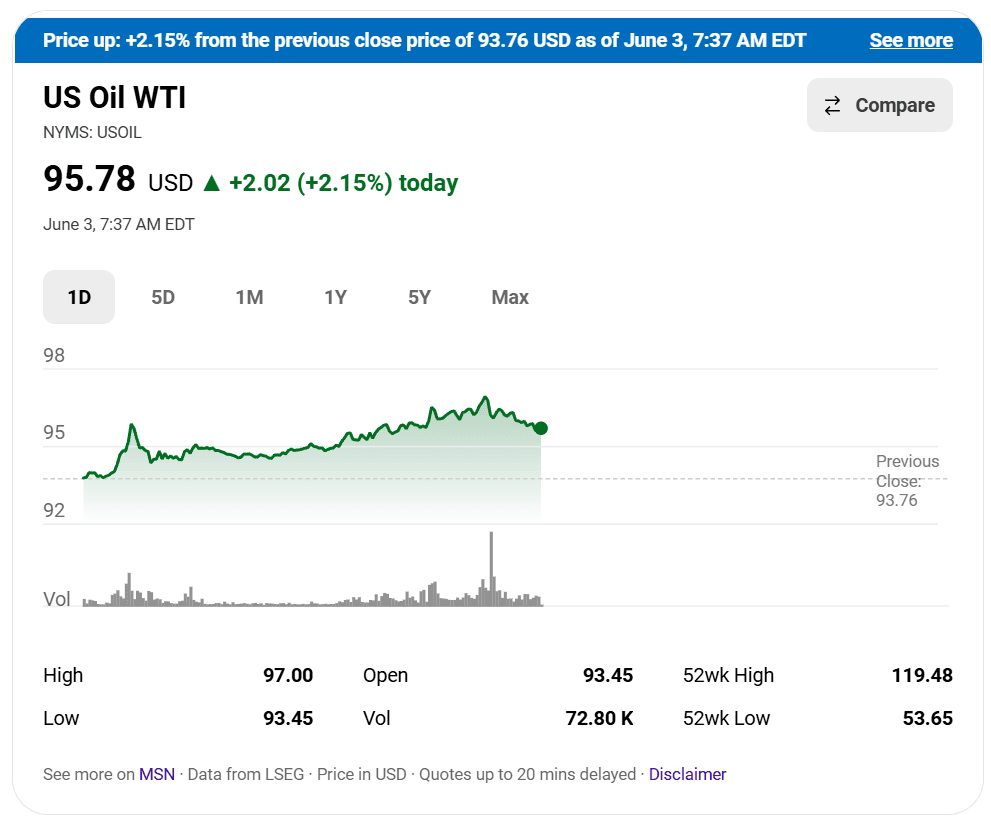
Over the past several weeks, investors had gradually become more optimistic that diplomatic efforts could reduce the risk of a broader regional conflict.
That optimism helped push oil lower from its earlier highs.
Today's developments challenged that view.
Instead of seeing evidence of de-escalation, traders were forced to consider the possibility that geopolitical risks may remain a feature of the market throughout the summer.
This sudden shift is the core driver behind why oil prices near $100 again returned to headlines.
As a result, buyers returned to crude oil futures, pushing prices closer to the psychologically important $100 level.
To understand oil prices near $100 again, it's important to understand what happened during May.
When the conflict first intensified earlier this year, traders immediately priced in the possibility of supply disruptions across the Middle East.
That fear helped drive Brent crude above $120 per barrel at one stage.
However, markets later began removing some of that geopolitical premium.
Why?
Because despite the conflict, global oil supplies continued to flow.
The worst-case scenarios that traders initially feared — including a major interruption to exports or a prolonged closure of critical shipping routes — did not materialize.
As a result, many investors reduced bullish positions, causing oil prices to retreat.
The market effectively moved from:
"A major supply crisis is coming."
to
"The conflict is serious, but oil exports are still flowing."
Today's rally shows that traders are no longer fully comfortable with that second assumption.
The structural driver behind oil prices near $100 again remains the strait of hormuz.
Roughly one-fifth of global oil consumption passes through this narrow waterway, making it one of the most strategically important energy corridors in the world.
Markets do not need an actual disruption to occur for prices to rise.
The possibility of disruption alone can increase oil prices because traders must account for the risk.
That is exactly what appears to be happening now.
As tensions rise, investors are once again adding a geopolitical risk premium to crude oil prices.
Read more:
Why Donald Trump Warns Oman Against Interfering In US-Iran Talks
Trump Signals Willingness To End Iran War
The latest move is not just an oil story.
It is an inflation story.
It is a central bank story.
And it is increasingly becoming a currency market story.
Higher oil prices can contribute to rising transportation and energy costs, potentially complicating inflation trends that many central banks have been trying to bring under control.
If energy prices continue climbing, markets may need to reassess expectations for future interest rate decisions.
This is why forex traders track oil prices near $100 again alongside CPI, interest rates, and risk sentiment, not just energy charts.
Every major move in oil now has the potential to influence broader market sentiment.
The importance of $100 is largely psychological.
It represents a level that governments, businesses, investors, and consumers all recognize.
Crossing above it can quickly generate headlines, influence inflation expectations, and alter market sentiment.
For that reason, traders are watching whether Brent can establish a sustained move above the threshold or whether the latest rally fades as previous spikes have.
Read more:
How To Trade Forex During High Volatility In 2026
Safe Haven Assets During Geopolitical Crises
The return of oil prices near $100 again is not about a supply crisis already happenin, it is about markets adjusting expectations for what could happen next.
It is the result of markets reassessing risk.
Over the past month, investors gradually priced in the possibility that tensions could ease and that energy supplies would remain largely unaffected.
Today's developments have forced traders to reconsider that assumption.
The key question is no longer whether conflict exists.
The key question is whether that conflict begins affecting oil flows, shipping routes, or regional stability in a way that changes the global supply outlook.
Until markets have a clearer answer, volatility is likely to remain the defining feature of crude oil trading.
If you want to stay ahead of these kinds of moves and break them down in real time with other traders, join our community here: FX Axe Community of Traders.
Disclaimer: This article is for informational and educational purposes only and does not constitute financial, investment, or trading advice.

