

There aren't many things in the world that can be worth less than nothing on Monday and become something countries are prepared to fight wars, redesign economies and compromise foreign policy to obtain a few years later. Welcome to oil. Back in April 2020, something happened in financial markets that still sounds completely ridiculous even when you understand it: the price of the May West Texas Intermediate crude oil futures contract went negative. Not cheap, not $5, not 50 cents, but minus $37.63 a barrel. For one extraordinary day, if you were contractually obliged to take delivery of certain American crude oil, the market was effectively prepared to pay you to take it away. Six years later we are looking at the opposite end of the telescope, with Brent above $110 as the Iran war and disruption around the Strait of Hormuz squeeze global supply. It is an extraordinary round trip, and one that illustrates why I think oil might be the most fascinating major market in the world.
Currencies are fascinating, equities are fascinating, gold has spent several thousand years persuading humanity that shiny yellow metal is an appropriate place to hide during an apocalypse, and Bitcoin somehow persuaded us to assign enormous value to something nobody can put in a wheelbarrow. But oil is different because it is financial, political and physical all at once. You can trade it on a screen in London, New York or Dubai, but eventually somebody somewhere has to put the actual black stuff in a tank, pump it down a pipeline, load it onto a ship, refine it into something useful and deliver it to somebody who wants to burn it. You can model demand, study charts and trade futures to your heart's content, but eventually reality intrudes. There has to be some oil, it has to be somewhere useful, and somebody needs to be able to get it from A to B. When any part of that chain goes wrong, things get interesting remarkably quickly.
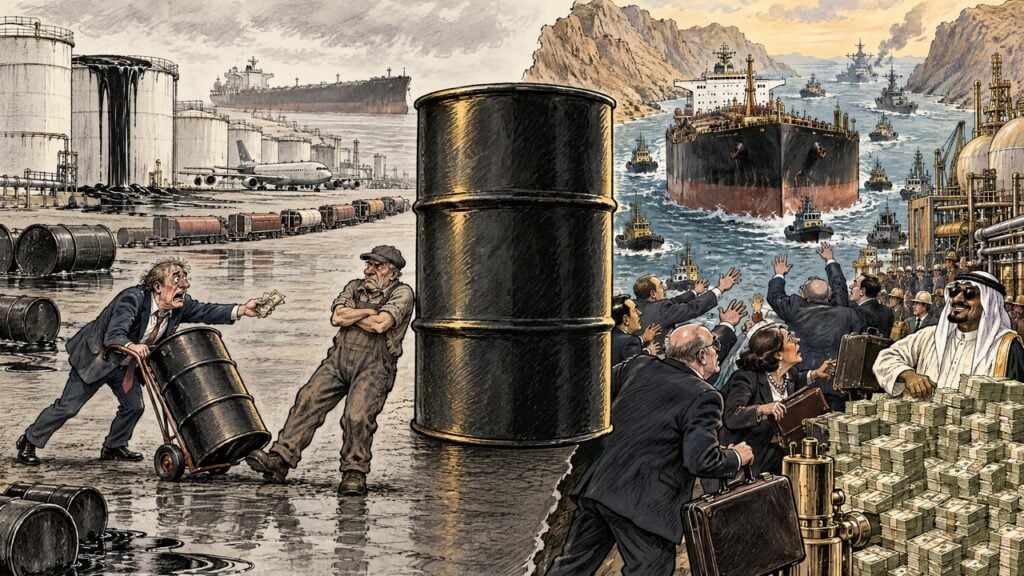
We've covered the great negative-oil episode before because it remains one of the strangest days in modern market history. On 20 April 2020, the May WTI futures contract opened at $17.73 and eventually settled at minus $37.63. Intraday it traded as low as minus $40.32. It was the first time since the WTI contract began trading in 1983 that its price had fallen below zero. The obvious question is how on earth a barrel of oil can be worth minus anything, because this didn't mean you could pull into a petrol station in Texas, fill the Range Rover and have the cashier hand you $80 and a Twix. The answer lies in the wonderful collision between financial markets and physical reality.
Covid had effectively switched enormous parts of the global economy off. Aeroplanes weren't flying, cars weren't driving, factories weren't producing and demand for petroleum collapsed at extraordinary speed while producers continued pumping oil out of the ground. The stuff had to go somewhere, and the crucial American storage hub at Cushing, Oklahoma, was rapidly running out of available capacity. This mattered because WTI futures aren't simply numbers dancing around on Bloomberg. The standard NYMEX contract represents 1,000 barrels of oil and is physically settled. If you hold the relevant contract into delivery, somebody can actually expect you to take the oil. Suddenly traders who had absolutely no desire to own 1,000 physical barrels of crude were approaching expiry while storage space was disappearing.
Imagine buying a sofa online because you think somebody else will buy it from you for more money tomorrow, only to discover that nobody wants the sofa, the delivery lorry is outside and your house is already completely full of sofas. At some point you stop asking how much somebody will pay you for the sofa and start asking how much you need to pay somebody to take the bloody thing away. That, in very simplified terms, is how oil became worth less than zero. The CFTC later identified the collapse in demand, oversupply, storage concerns and deteriorating liquidity around the expiring contract among the factors behind that historic move. It remains one of the greatest lessons markets have ever provided in the difference between trading something on a screen and actually owning the underlying thing.
Fast-forward to 2026 and nobody is desperately trying to give the oil away. Now the problem is getting enough of it to where it needs to go. The war involving the United States, Israel and Iran has returned the Strait of Hormuz to the centre of global markets. Hormuz is one of those geographic locations traders suddenly become experts on approximately twelve minutes after something explodes nearby. It is a narrow stretch of water connecting the Persian Gulf with the Arabian Sea through which an enormous quantity of the world's petroleum normally passes. Before the war, roughly 17 million barrels a day were moving through the Strait, and although traffic has recovered significantly from the initial disruption, flows remain below their pre-war level.
This matters because there isn't a convenient second Strait of Hormuz sitting next door in case this one is busy. Saudi Arabia and the UAE have some alternative pipeline capacity, but geography still matters enormously. Saudi, Emirati, Iraqi, Kuwaiti and Qatari energy exports are deeply connected to this relatively tiny piece of water, which means a military confrontation thousands of miles from most Western consumers can very quickly become an inflation problem at their local petrol station. A shipping lane becomes an economic indicator; a missile strike becomes an input into an interest-rate forecast. That is oil in a nutshell.
Which brings us to Donald Trump, who at a rally in Georgia at the weekend acknowledged the rather awkward political reality of rising fuel prices. He imagined the headlines saying that President Trump was boasting about the money being made while Americans were “suffering at the pump”, before responding in wonderfully Trumpian fashion: “I don't give a damn. I'm gonna say it. We're making a freaking fortune.”
And in one narrow sense, he has a point. America is one of the world's great energy producers, and higher international oil prices can be extremely good news for American producers and refiners. An industry analysis cited by Business Insider found that 38 US oil producers and refiners collectively increased year-on-year revenue by around $140 billion. That is revenue rather than profit, an important distinction, but it illustrates the extraordinary transfer taking place. If the international price of oil rises, companies producing enormous quantities of American oil can sell that product for more money. Texas, Oklahoma and Louisiana do not necessarily look at $110-plus Brent in quite the same way as somebody filling the family car in Pennsylvania.
The difficulty with saying “we're making a freaking fortune” is deciding who exactly we are. American motorists aren't making a freaking fortune. US regular gasoline has risen sharply since before the Iran war and diesel has risen even more dramatically. Higher oil therefore produces winners and losers inside the same economy. The producer celebrates while the consumer swears at the petrol pump, and the politician has to explain why an enormous increase in energy-sector revenues should make the family spending substantially more to drive to work feel better about things.
That would be politically awkward enough if the story stopped at petrol. Unfortunately, it doesn't.
When oil prices rise, the obvious effect is transport, but that's merely where oil introduces itself. The lorry delivering your supermarket food uses diesel. The ship bringing goods across the Pacific burns fuel. The aircraft carrying passengers and freight burns jet fuel. Farmers use diesel in tractors and machinery, construction equipment runs on fuel, mining consumes enormous quantities of energy, fishing boats use it and delivery vans use it. Then there are petrochemicals, with oil and natural-gas feedstocks appearing in plastics, synthetic fibres, paints, solvents, cosmetics, pharmaceuticals, packaging, detergents, fertilisers and countless industrial products. Even businesses that apparently have nothing whatsoever to do with petroleum often discover oil sitting several layers down their supply chain.
Oil is like glitter after a children's party: once it gets into the economy, you find the bloody stuff everywhere. Suppose diesel rises sharply. A haulage company doesn't simply decide to absorb that increase indefinitely out of the goodness of its heart; eventually it tries to pass some of the cost on. The supermarket pays more for transport, the food producer pays more for distribution, the farmer pays more to operate machinery, packaging may become more expensive and refrigerated transport costs more. Eventually you walk into a shop, pick up a tomato and wonder why the tomato has suddenly become expensive. The tomato hasn't discovered capitalism. The oil price has simply travelled through the supply chain.
This is one of the reasons people sometimes underestimate energy inflation. We see the enormous number displayed outside the petrol station and think that's the story, but the pump is really only where the story becomes most visible. Oil doesn't merely increase the price of driving your car. It can increase the cost of producing, transporting, packaging and selling the things you put inside it.
This is where oil moves from commodity story to macroeconomic story. A sustained rise in energy prices can increase inflation while simultaneously reducing economic growth. Consumers spend more on fuel and energy, leaving less money available for restaurants, clothes, holidays and everything else. Businesses face higher input costs and either pass them on to customers or absorb them through lower margins. Airlines, haulage firms, manufacturers and retailers all start recalculating numbers that looked perfectly sensible when crude was $70.
Central banks then inherit a particularly unpleasant problem. If energy prices are pushing inflation higher, cutting interest rates becomes harder, but if expensive energy is simultaneously weakening economic growth, keeping rates high becomes more painful. In the nastiest version, you get weak growth combined with persistent inflation: stagflation. Central bankers enjoy stagflation in roughly the same way golfers enjoy discovering their ball is behind a tree. There are options, certainly, but none of them is particularly appealing.
And this is where a move in oil begins travelling through other financial markets. Higher energy prices can alter inflation expectations, which alter interest-rate expectations, which affect government bond yields, currencies, company valuations and ultimately equities. An airline and an oil producer can look at precisely the same oil chart and see completely different futures. Saudi Arabia and an energy-importing developing economy can look at $110 crude and see completely different national budgets. The barrel hasn't changed; only which side of it you're standing on has.
This is where the recent Economist leader becomes particularly interesting. Trump has agreed with Vladimir Putin for Russia to export 2.2 million barrels of diesel to the United States, with the possibility of more to follow. The apparent economic logic is straightforward: America has expensive diesel, Russia has diesel, so bring some across and relieve pressure on the market. The geopolitical logic is rather more uncomfortable. Russia is still fighting Ukraine, Western countries have spent years using energy sanctions as a way of applying economic pressure to Moscow, and Trump recently signed legislation providing for tough sanctions against countries purchasing Russian energy. America arranging to buy Russian diesel therefore creates an obvious contradiction.
The Economist called the arrangement “hardly his finest hour” and pointed to what I think is the most extraordinary number in the entire story: America consumes roughly 2.2 million barrels of diesel every thirteen hours. In other words, the initial Russian agreement sounds enormous until you put it beside actual American consumption. It is a bit like solving a water shortage by announcing that Vladimir Putin has agreed to come round with a very large watering can. The geopolitical consequences could be significant while the physical quantity involved is consumed by the United States in barely half a day.
Yet the fact that Trump is prepared to contemplate the arrangement tells us something important about oil. Politicians fear expensive fuel, because unlike many other economic pressures, voters see it constantly and understand it immediately. Most people couldn't tell you today's price of copper, wheat futures, natural gas or a tonne of iron ore, but they know when petrol has gone up because the price is displayed in enormous illuminated numbers beside the road several times during their journey to work.
Imagine if supermarkets had a thirty-foot illuminated sign outside announcing BUTTER: UP 37% SINCE CHRISTMAS. Politicians would become surprisingly interested in cows. Petrol has that visibility built into it, and in America, where driving is fundamental to everyday life and vehicles tend not to be shy about consuming fuel, it becomes extraordinarily politically sensitive. Trump can celebrate America's energy companies making a fortune, but the voter standing beside a petrol pump isn't looking at Exxon's revenue statement. He's looking at the number on his credit-card receipt.
For all the geopolitics, though, the underlying economics of oil remain wonderfully simple: supply and demand. In 2020 demand disappeared while supply kept coming, storage filled up and the price collapsed. In 2026 demand exists but war has constrained the ability to move supply efficiently through one of the world's most important energy corridors, so prices rise. The underlying principle could fit on the first page of a GCSE economics textbook; the complications require several intelligence agencies, OPEC and occasionally an aircraft carrier.
That combination is what makes oil trading so fascinating. You're not merely analysing production numbers. You're analysing inventories, shipping, refinery capacity, economic growth, weather, currencies, sanctions, wars, pipelines, elections and diplomacy. A wheat trader needs to know the weather. An oil trader occasionally needs to know whether Iran is about to close a shipping lane.
Then there is OPEC and its wider OPEC+ grouping, effectively a collection of some of the world's largest producers attempting to manage supply. Saudi Arabia remains the heavyweight while Russia is central to OPEC+. When prices become too low, producers can restrict output; when prices become painfully high, they can increase it, at least in theory. But spare capacity isn't infinite, members don't always comply perfectly with quotas, different producers have different fiscal needs and increasing production somewhere else doesn't necessarily solve a transport bottleneck in the Persian Gulf. The market is therefore constantly pricing not only what is happening but what governments might decide to do about what is happening, which is why a few sentences from Riyadh, Washington, Tehran or Moscow can move billions of dollars in seconds.
This is perhaps the most important thing to understand about the oil market. When you see Brent above $110, don't simply read it as “oil is expensive”. Think about where that number travels next. It travels into fuel prices, shipping costs, airline margins, food prices, manufacturing costs, inflation expectations, interest-rate expectations, consumer spending, corporate margins, government budgets, trade balances, currencies, bond yields and elections.
For Saudi Arabia, higher oil can mean enormous additional revenue. For an oil-importing developing economy, it can create serious pressure on the current account and currency. For an airline, it can destroy margins. For an American shale producer, it can transform profitability. For a central banker, it can wreck an inflation forecast. For a government approaching an election, it can become a very immediate political problem. One barrel produces dozens of consequences, and because energy sits so close to the foundations of the global economy, those consequences rarely remain confined to the energy market.
Oil is also unusual because economics and geopolitics are almost impossible to separate. If Apple shares rise 20%, nobody invades somewhere to make them cheaper. If Bitcoin falls 30%, the US Navy doesn't reposition an aircraft carrier. Oil is different because access to energy is fundamental to modern economies and modern militaries. That is why the history of oil is inseparable from the history of geopolitics: the 1973 Arab oil embargo, the Iranian Revolution, the Iran-Iraq War, Saddam Hussein's invasion of Kuwait, the Gulf War, Russia's invasion of Ukraine and now the conflict with Iran. Wars move oil, but oil also shapes wars because countries need fuel to fight them, economies need affordable energy to survive them and governments know that controlling supply provides extraordinary leverage.
Which is why I keep coming back to those two numbers: minus $37.63 and more than $110. Same commodity, six years apart. At one extreme, humanity temporarily stopped moving and couldn't find anywhere to put its oil. At the other, humanity is once again fighting wars around the routes used to move it. There may be no better illustration of how markets actually work because price isn't simply an abstract number generated by a screen. It is information. It is the point at which scarcity, abundance, fear, logistics, politics, speculation and physical reality collide.
Oil can tell you whether factories are running, whether people are travelling, whether China is growing, whether Saudi Arabia is opening the taps, whether somebody has enough storage in Oklahoma and whether something has gone badly wrong in the Strait of Hormuz. It can make an American president boast that his country is making a “freaking fortune” while American motorists simultaneously complain about how much poorer it is making them. It can make buying Russian diesel look politically conceivable despite years of sanctions, and it can force central bankers to reconsider interest-rate decisions without a single thing changing in the domestic economy they actually control.
That is why I think oil remains one of the most fascinating markets in the world. It is simultaneously a commodity, an inflation gauge, a geopolitical weapon, an industrial input, a transport cost, a political headache and a financial asset. Very few markets give you a clearer view of how the real world and the financial world actually connect.
Six years ago, traders were paying people to take oil off their hands. Today governments are worrying about how to keep enough of it moving through a narrow stretch of water beside Iran. Tomorrow it could be somewhere completely different. That's oil.
Keep your Axe sharp. And always remember: the price at the pump is only where the oil story becomes visible.
Max
Join the FX Axe newsletter and stay one chop ahead.

