

There are very few occasions when two of my favourite things in the world collide in a way that can legitimately be described as research, so I intend to enjoy this one. I love rugby. I love red wine. I am also a committed supporter of what has become known amongst our group as the Mega Blend™.
The Mega Blend™ has its origins, rather appropriately, on a golf trip to Scotland. We had several very nice bottles of red wine in front of us and, for reasons that presumably seemed entirely logical after a few glasses, decided they might be even better if we mixed them together. Whether we actually improved upon the work of several professional winemakers is perhaps open to debate. We certainly thought we had. The results, as I remember them, were superb, although admittedly we were both the creators and increasingly enthusiastic judges.
Either way, the Mega Blend™ was born. It has since entered our lexicon and become an important part of group wine drinking: the point at which several perfectly good individual wines are combined in the belief that their respective strengths might produce something even better. Occasionally this is oenology. Occasionally it is six blokes on a golf trip pouring expensive red wine into the same glass. The distinction is largely one of marketing.
And, rather wonderfully, that brings us to Brendan Venter.
The former Springbok centre and one of rugby’s more interesting thinkers recently returned to Saracens and, for a brief and glorious period, somehow managed to get wine into his job description. There was a slightly mischievous administrative reason for this. Venter had no great enthusiasm for fulfilling all the media obligations normally expected of a senior rugby figure, Saracens found themselves in trouble over those obligations and his role emerged as “head of rugby culture and wine consultant”. Premiership Rugby subsequently poured that particular bottle down the sink and Saracens have now formally clarified that he is Head of Culture and Technical Director, with Joe Shaw remaining Head Coach.
I think this is rather a shame. Rugby already has enough Directors of Rugby, Heads of Performance, Technical Directors and Elite Development Managers to staff a medium-sized accountancy firm. What it desperately needs is more wine consultants. Venter even suggested inviting rugby journalists to StoneX Stadium for a wine tasting, where he would apparently be perfectly happy to answer their questions over a glass of wine. This seems an enormous improvement on the existing arrangement. If we must listen to someone explain that the boys “fronted up physically” and will “take the learnings into next week”, there is absolutely no reason everyone involved shouldn’t be drinking a decent Beaujolais (incidentally my dog’s middle name) while they do it.
There is a serious point underneath the joke, though, because wine is actually a rather good way of thinking about rugby. The best wine is not necessarily made from the single greatest grape any more than the best rugby team is made by finding the 15 greatest rugby players and giving them matching shirts. Both depend on the blend.
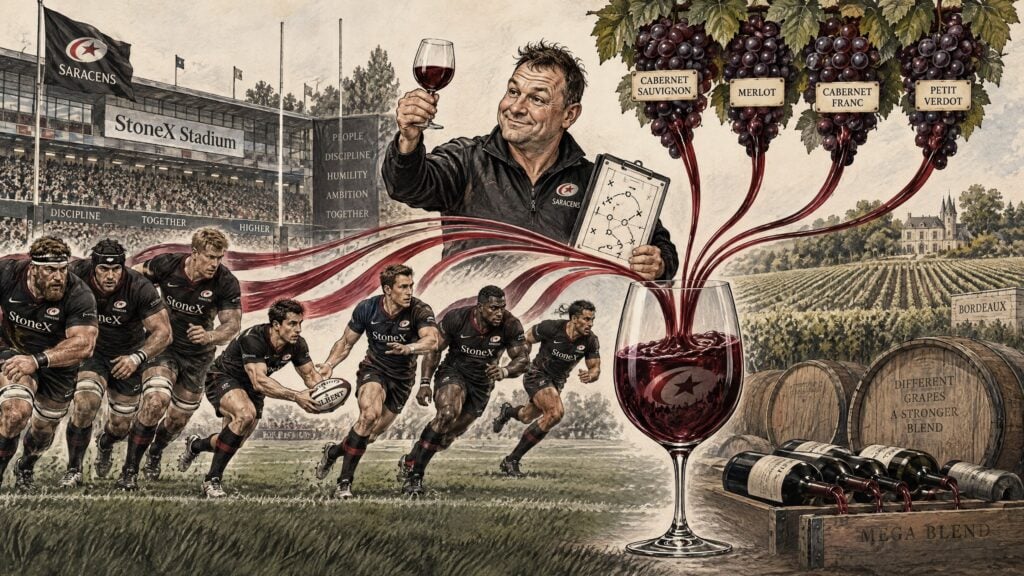
A blend works because different grapes bring different things. Cabernet Sauvignon might give you structure, tannin and backbone. Merlot can bring softness and fruit. Cabernet Franc contributes something different again, while Petit Verdot can add colour, spice and a bit of aggression. Individually they have their own characteristics; put together properly and the resulting wine can become considerably more interesting than any one of them would have been alone.
The proportions matter enormously. Too much of one and the whole thing becomes unbalanced. The winemaker’s job isn’t simply to identify the “best” grape and fill the bottle with it. It is to understand what each component contributes and how it interacts with everything around it.
This is also, incidentally, the intellectual foundation of the Mega Blend™, although I doubt our original Scottish experiment involved quite as much discussion of tannins, acidity and structure. We simply knew we had several good things and suspected that combining them might create one excellent thing. The fact that this is also the basic philosophy behind Bordeaux blending merely proves that we were pioneers rather than slightly pissed golfers.
Rugby is perhaps the greatest team-sport version of exactly the same problem because the physical requirements are almost comically contradictory. Imagine trying to invent rugby from scratch and explaining the recruitment brief to somebody who had never seen it. First, we need some extremely heavy men. Then we need several extremely tall men. After that we need some much smaller men who can run extremely quickly. We also require a few extraordinarily mobile large men, one person who can think clearly while enormous people are attempting to drive him into the turf, and ideally somebody at the back who can see what everybody else is doing.
It sounds less like building a sports team and more like assembling the cast of a particularly violent travelling circus. Yet that variety is exactly what makes rugby so wonderful.
Start with the front row. You need enormous strength and stability because somebody has to hold up a scrum while approximately 900 kilograms of humanity attempts to drive through it. Your props are the Cabernet Sauvignon of the operation: structure, weight and the reassuring sense that the entire thing isn’t about to collapse.
Your hooker needs much of that same physicality but also mobility and the rather unfair additional requirement of throwing a ball accurately between two rows of enormous men while thousands of people watch. Then come the locks: tall, powerful, athletic enough to get around the field but sufficiently enormous to provide weight in the scrum and become human cranes at the lineout. You wouldn’t design a lock and a scrum-half from the same blueprint unless the architect had been drinking considerably more wine than we did in Scotland.
Then we get to the back row, where the blend becomes particularly interesting. You need mobility, work rate, strength over the ball, carrying ability and usually at least one person who appears to regard personal safety as an irritating bureaucratic restriction. A brilliant back row demonstrates the principle perfectly because three individually outstanding players can still be the wrong combination. If all three want to do exactly the same job, something is missing. You need balance.
At nine you traditionally have someone smaller, quicker and louder, whose principal purpose appears to be arriving at every breakdown before everyone else and explaining to the referee why he is wrong. Scrum-halves are essentially terriers with mortgages.
At ten you need something entirely different. The fly-half has to see the field, understand space, control territory and make decisions while very large people are attempting to fold him into an unusual shape. Physical courage matters, obviously, but so does intelligence. He is part rugby player, part chess player and occasionally part air-traffic controller.
Then come the centres. At twelve, I have always rather liked somebody capable of straightening the attack by running directly through another human being. And ideally they were born in the Pacific Islands. There is something pleasingly uncomplicated about it. At thirteen you often want a slightly different mixture: power, pace, defensive judgement, handling and the ability to recognise where space is developing before everyone else notices it.
Your wings need speed because eventually somebody has to stop all the strategic sophistication and simply run like fuck. And at fifteen you need perhaps the ultimate reader of the game: somebody capable of seeing the picture from behind everyone else, covering kicks, counterattacking, organising defence and making sensible decisions when the ball descends from approximately the height of a commercial aircraft.
Put those requirements next to each other and it becomes obvious why rugby is such a fascinating exercise in construction. There is no single physical ideal. There isn’t even a single intellectual ideal. The sport requires deliberately different people to perform deliberately different jobs in pursuit of exactly the same objective.
That is a blend.
Professional rugby complicates matters further because you aren’t actually building a team of 15 anymore. You are building a squad. Players get injured. Some lose form. Internationals disappear. Weather changes. Opposition changes. A European knockout game may require something entirely different from a wet Friday night in Manchester. Your bench needs to alter the match rather than simply provide fresh legs for people who have become tired.
This is where recruitment becomes much more interesting than simply asking who the best available player is. If you already possess two enormous ball-carrying centres, perhaps buying a third isn’t quite as useful as finding someone who can distribute. If your back row contains three brilliant breakdown specialists but nobody who can carry effectively in heavy traffic, you haven’t assembled three great players; you’ve created an unbalanced wine.
You’ve put Cabernet in the Cabernet.
Nobody wants that. Actually, somebody probably does. Wine people can be extremely strange.
But the broader point is that talent and composition are not the same thing. A squad needs enough variety that coaches can change the blend depending on the occasion. Sometimes you want something elegant and sophisticated. Sometimes you need something enormous that goes extremely well with red meat.
That is the Mega Blend™ principle again. You aren’t merely mixing things together for the sake of it. You are identifying what is missing and adding it.
This is part of what makes Venter’s return to Saracens interesting. He isn’t some random former player brought back to wave a clipboard around and occasionally say something inspirational. He was enormously influential in creating the culture that helped transform Saracens during his first spell, and he remained connected with the club afterwards. His current remit covers culture, standards and development across the organisation rather than simply what happens for 80 minutes on a Saturday.
Culture itself is a blend. It isn’t a motivational slogan painted above a doorway. It is what happens when nobody particularly feels like training, when a player isn’t selected, when the team loses, when the referee makes a dreadful decision or when the bloke next to you makes a mistake.
The best teams don’t necessarily contain the 15 best individual players in the competition. They contain players whose abilities fit together, who understand what everyone else is trying to do and who trust one another enough to perform their own role rather than constantly trying to perform somebody else’s.
That is why simply buying stars doesn’t guarantee sporting success. Football has demonstrated this repeatedly with teams assembled at enormous expense that somehow look like 11 very talented strangers waiting for an Uber. Rugby is even less forgiving because so much of the sport depends upon coordinated physical actions. A scrum containing eight magnificent individuals who aren’t operating together is simply eight men being pushed backwards simultaneously.
Saracens have historically been particularly good at understanding this. Their great sides had enormous physicality, certainly, but also decision-makers, kickers, defensive organisers, leaders and players prepared to perform fairly unglamorous roles because the structure required them.
A Mega Blend™.
There is a rather obvious business and markets lesson here, although I promise not to ruin a perfectly good discussion about rugby and wine by becoming too earnest. We have a strange obsession with finding the “best” thing: the best stock, the best employee, the best investment, the best player. But the thing that performs best individually isn’t necessarily the thing that improves the overall portfolio, team or business.
If your investment portfolio already contains enormous exposure to American technology companies, buying another American technology company because you think it is wonderful might increase expected returns, but it may also simply give you more of something you already possess. The same applies to businesses. Hire ten people who all think in exactly the same way and you may have assembled an exceptionally talented echo chamber.
Diversification isn’t about deliberately adding rubbish. Brendan Venter isn’t going to select a prop who can’t scrum because “we needed a bit of variety”. A winemaker doesn’t add vinegar to a Bordeaux because the Cabernet was becoming a little dominant. The objective is to combine different strengths that complement one another.
And that, perhaps, is what blending really means. Not compromise. Composition.
It is also why our original Mega Blend™ may have contained more wisdom than we realised. We weren’t trying to rescue bad wine. Quite the opposite. We had several very nice wines and decided that the obvious thing to do was interfere with them. The fact that the results were superb has naturally been remembered far more clearly than any evidence to the contrary.
There is another reason I’m watching Saracens this season.
Now, I should make this extremely clear. This is not betting advice. I am not recommending that anybody gamble on sport, nobody should bet money they aren’t completely comfortable losing, and this is simply me sharing a personal view about a rugby team I find interesting.
With all of that thoroughly sensible adult supervision out of the way, I have seen Saracens at around 7/1 to win the Premiership.
And I rather like it.
Not because 7/1 means they will win. Obviously it doesn’t. Sport has an irritating habit of ignoring spreadsheets, predictions and people who announce confidently that something represents “value”. Saracens could quite easily make that observation look idiotic by Christmas. And, all this being said, they lost at home yesterday to Sale.
I like the idea because I think the ingredients are interesting. There is established quality, experience, young talent and now a man back inside the organisation who understands the culture that helped make Saracens successful in the first place. Whether Venter can help recreate the blend is another question entirely. Rugby teams, like wines, occasionally look wonderful on the label and turn out to be disappointing once opened.
But that uncertainty is rather the point.
Wine is chemistry, agriculture, weather, judgement and ultimately taste. Rugby is strength, speed, skill, intelligence, personality and ultimately performance. In both cases you can have wonderful individual ingredients and still make something fairly ordinary.
The magic is getting the proportions right.
So perhaps Brendan Venter’s fleeting career as Saracens’ wine consultant wasn’t quite as ridiculous as it first appeared. Building a rugby team and making a decent red are surprisingly similar occupations. You need structure without rigidity, power without overwhelming everything else, subtlety where it matters and enough different characteristics that the finished product becomes more than the sum of its ingredients.
And if it doesn’t quite work, there is always the Mega Blend™.
Add a little more Cabernet, bring on a replacement prop and see what happens.
Keep your Axe sharp. And never underestimate the importance of a decent blend.
Max
Join the FX Axe newsletter and stay one chop ahead.

