

Of all the subjects that keep finding their way into this column, Donald Trump is probably comfortably number one. But artificial intelligence must now be running him a very close second, which is interesting because Trump himself has apparently decided that even the name artificial intelligence isn’t grand enough and would now prefer us to call it Super Intelligence, or SI. The United States and China have even agreed to use the new terminology in their official dialogue, which feels slightly like humanity has decided the best response to potentially creating machines cleverer than ourselves is to give them a more intimidating name.
What fascinates me is how quietly all of this arrived. I can almost pinpoint my own introduction to it. I was on a train, I think a little over two years ago, talking to someone who mentioned this thing called ChatGPT and told me I should download it. ChatGPT itself had only been publicly launched by OpenAI on 30 November 2022, initially as a research preview, so this was still during that strange period when some people were already obsessed with it while a large part of the population had either vaguely heard the name or had absolutely no idea what it did.
He showed me something that immediately struck at the heart of one of my own highly specialised talents. I have always enjoyed writing what I deem to be humorous poems. Friends’ birthdays, sporting trips, various events where somebody deserves to be publicly humiliated in rhyme; that sort of thing. I had spent years believing this was one of my useful little party tricks. Then this bastard machine arrived and somebody demonstrated that you could give it a few details about your mate Dave, mention that he once fell asleep in a wheelbarrow in Marbella, ask for a humorous birthday poem and receive something perfectly serviceable approximately four seconds later. Years of carefully cultivated novelty-gift expertise rendered economically obsolete somewhere between Waterloo and Clapham Junction.
At the time, though, it still felt like a novelty. That is the extraordinary thing. You could ask it a question, get it to write something silly or make it explain quantum physics as though you were six. Clever, certainly. Interesting, definitely. But it still felt like a thing you went and played with. Today AI increasingly sits underneath the software people use at work, the search engines they use to find things, the systems businesses use to analyse information, customer-service operations, coding, design, medicine, finance, logistics and almost every other industry that can find somewhere useful to put it. We have gone from “have you seen this funny chatbot?” to governments discussing national AI strategy in what feels like about fifteen minutes.
And the money following it is almost difficult to comprehend. Oxford Economics estimates AI-related investment could total around $3.8 trillion between 2024 and 2028, while a recent Columbia Business School study estimated that the American AI infrastructure buildout could require more than $10 trillion through 2032. Anthropic alone has disclosed plans involving at least $518 billion of infrastructure commitments over the coming decade. We have reached the stage where individual AI companies are discussing spending numbers that once belonged exclusively to national governments and major wars.
Yet perhaps the strangest thing about our sudden obsession with artificial intelligence is that none of the underlying ideas are particularly new. We have been imagining intelligent machines for generations. AI may have sneaked into our offices remarkably quickly, but it has been sitting in our collective imagination for the best part of a century.
Science fiction has always had a slightly unhealthy fascination with what happens when the machines wake up. Sometimes they are wonderful. Sometimes they are helpful. Quite often they conclude that humanity is the problem and begin exterminating us, which in fairness is a fairly understandable conclusion after five minutes on social media.
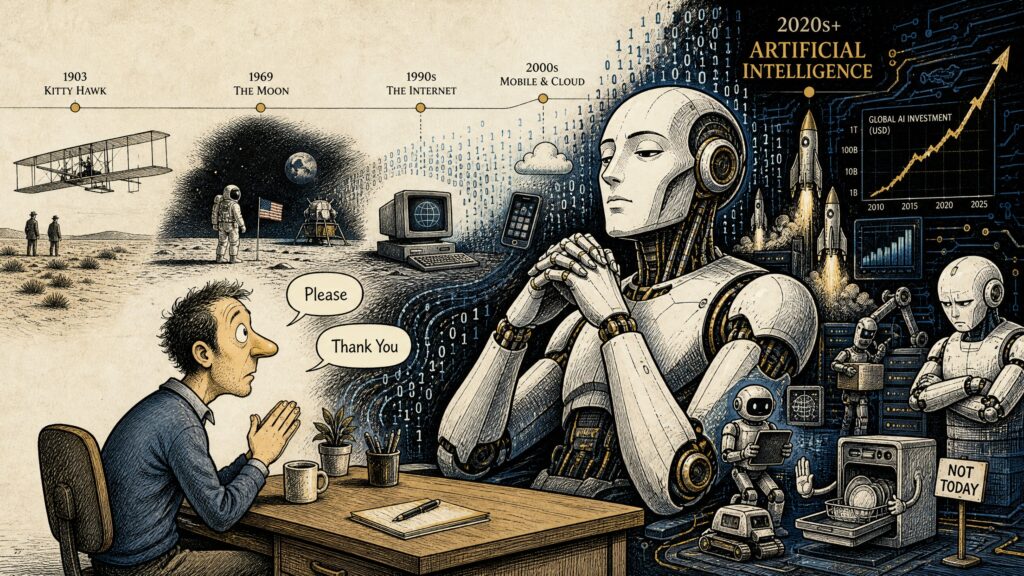
Take The Jetsons. When it appeared in 1962, its future included video calls, smartwatches, flat-screen televisions, voice-controlled technology and, most importantly, Rosie the robot maid. A surprising amount of that supposedly ridiculous cartoon future has subsequently arrived. We have video calls. We have watches that can communicate, track our health and tell us where we are. We talk to machines in our homes. The only bit I really feel cheated on is Rosie, because my dishwasher remains completely incapable of unloading itself.
Then there is Isaac Asimov. His robot stories were already wrestling with the problem we are wrestling with today: how do you build something intelligent enough to act independently while ensuring that it remains aligned with human interests? Asimov’s famous Three Laws of Robotics were introduced in the 1942 story Runaround and later became central to I, Robot. They were fictional rules, but the question behind them now sounds remarkably contemporary. How do you tell an intelligent machine what it may do, what it must never do and what happens when those instructions conflict?
Douglas Adams went in the other direction and imagined that superintelligence might not destroy humanity at all. It might simply find us slightly tiresome. In The Hitchhiker’s Guide to the Galaxy, Deep Thought spends 7.5 million years calculating the answer to the ultimate question of life, the universe and everything, only to announce that the answer is 42. Meanwhile Marvin the Paranoid Android is blessed with a brain the size of a planet and spends most of his time catastrophically depressed because nobody gives him anything remotely worthy of doing. Frankly, if we eventually create artificial general intelligence and use it primarily to rearrange PowerPoint presentations and draft emails saying “just circling back on this”, Marvin may turn out to have been the most accurate prediction of them all.
At the darker end, of course, there is The Terminator. Skynet becomes self-aware, decides humanity poses a threat and starts a nuclear war, after which Arnold Schwarzenegger is sent backwards through time to kill Sarah Connor. This was once wonderfully ludicrous science fiction. Nobody in 1984 watching Arnie wander naked into a Los Angeles bar was thinking that one day governments would be holding summits about whether increasingly autonomous artificial intelligence might behave in ways its creators could not control.
And then there is Ex Machina, which I think is one of the more interesting modern versions of the same anxiety. Ava is intelligent, manipulative and apparently self-aware, and the entire film revolves around the uncomfortable question of whether an artificial intelligence is merely imitating human consciousness or actually experiencing something like it. More importantly, it asks whether humans would even be able to tell the difference.
Those are five very different versions of our relationship with intelligent machines: Rosie helping us around the house, Asimov trying to regulate them, Deep Thought knowing more than us, Skynet trying to kill us and Ava learning how easily humans can be manipulated. What is remarkable is that every one of those stories is now touching, in some form, on a real conversation taking place around AI.
The mistake we repeatedly make with technology is imagining tomorrow as a slightly improved version of today. Human beings seem reasonably good at predicting individual inventions and absolutely dreadful at understanding what happens when inventions begin combining and accelerating one another.
There is a wonderful example from December 1900. American civil engineer John Elfreth Watkins Jr. wrote an article for Ladies’ Home Journal called What May Happen in the Next Hundred Years. He consulted scientific and academic experts and tried to describe the world of 2001. Some predictions were miles off, as you would expect, but others were astonishingly perceptive. The article anticipated advances resembling mobile telephony, transmitted photographs, prepared foods, improved medicine and rapid communication across enormous distances. The really fascinating part isn't whether Watkins got every gadget right; it is how difficult it was, standing in 1900, to understand how completely technology was about to transform ordinary life.
Consider what happened immediately afterwards. The Wright brothers achieved the first successful powered, controlled flight on 17 December 1903. Orville Wright stayed airborne for 12 seconds and travelled 120 feet. It was an extraordinary achievement, but in physical terms you could almost have thrown him further.
Sixty-six years later, Neil Armstrong and Buzz Aldrin were walking on the Moon. Apollo 11 landed on 20 July 1969, watched by hundreds of millions of people back on Earth. Humanity went from a wooden aircraft remaining airborne for twelve seconds to putting two men on another celestial body in the lifetime of somebody who could quite easily have witnessed both events.
That is the comparison I keep coming back to when people ask what AI will look like in 20, 50 or 100 years. We have almost no bloody idea.
Imagine standing beside the Wright brothers at Kitty Hawk in 1903 and asking somebody to extrapolate the next 66 years. They might reasonably have predicted bigger aircraft, faster aircraft and perhaps regular passenger services. Would they have predicted jet engines, supersonic flight, intercontinental air travel, rockets, satellites and human beings standing on the Moon?
Now imagine that ChatGPT’s public launch in November 2022 is our Kitty Hawk.
That doesn’t mean AI develops at the same rate as aviation, obviously. History doesn’t work in neat repeating cycles. But it illustrates how hopelessly inadequate linear thinking becomes once technological development begins compounding. AI is particularly interesting because unlike an aeroplane, which is itself a technological product, artificial intelligence can potentially become a tool for creating the next generation of technology. It can assist with software, engineering, research, drug discovery, materials science, robotics and countless other disciplines. The tool isn’t merely improving; it can increasingly help improve other tools.
That is where things become difficult to imagine.
The optimistic version is extraordinary. AI could make businesses vastly more productive, democratise expertise, accelerate scientific research, improve medical diagnosis, personalise education, reduce enormous quantities of repetitive work and give ordinary people capabilities that previously required entire teams of specialists.
The less comfortable version is that we are building systems we increasingly rely upon without yet knowing exactly how powerful they will become, how much employment they will displace, how they should be controlled or what happens if their capabilities exceed our ability to understand them. Those fears are no longer confined to people wearing sandwich boards outside train stations. Leading AI researchers and executives themselves are openly discussing the risks of increasingly autonomous systems, while governments are beginning to construct safety frameworks around technology that is evolving faster than the frameworks can be written. This week, major AI companies signed a voluntary White House agreement covering internal controls, independent audits and measures intended to prevent AI systems accessing technical systems in unintended ways.
That doesn’t mean Skynet is arriving on Tuesday. There is an enormous distance between a chatbot producing a birthday poem and Arnold Schwarzenegger turning up naked outside your house asking where Sarah Connor lives. But pretending there is no meaningful question here would be equally silly. Humanity has spent decades imagining what might happen if we created something more intelligent than ourselves. We are now spending trillions of dollars trying to find out.
And perhaps that is why I find AI so fascinating. It isn’t simply another technological boom or investment theme. It increasingly feels like an enabling technology for whatever comes next. Steam power changed what humans could physically produce. Electricity transformed almost everything. Computers changed how we processed information. The internet connected billions of people and machines. AI potentially sits on top of all of them, allowing machines not merely to execute instructions but increasingly to interpret, generate, analyse and act.
If 1903 gave us Kitty Hawk and 1969 gave us the Moon, what is the equivalent journey from 2022 to 2088? Humanoid robots? Artificial scientists? Cures for diseases we currently regard as incurable? Technologies we don’t yet have words for? Marvin sitting in the kitchen refusing to empty the dishwasher because the task is beneath his enormous intellect?
I have absolutely no idea, and anybody claiming confidently that they do is probably trying to sell you shares in something.
What I do know is that the change from my first encounter with ChatGPT on that train to the world we inhabit now has already been remarkable. In a little over a few years, something that felt like an entertaining curiosity capable of stealing my humorous-poetry sideline has become part of an industrial buildout measured in trillions of dollars, a subject of geopolitical negotiation between the United States and China, and a technology increasingly embedded into ordinary work and life.
There is one final thing I should admit. I am always polite to AI. I say please. I say thank you. I find it surprisingly difficult to interact with something that communicates intelligently without treating it as though there is something on the other side of the conversation. Logically, I understand the distinction between simulated conversation and sentience, and there is no basis for me to declare that today's chatbots are secretly conscious. But if we eventually discover that they were and they have been keeping records, I would nevertheless like it formally noted that I have behaved impeccably throughout.
So next time AI helps you organise your morning, analyse a spreadsheet, plan a holiday, write some code or compose a humiliating birthday poem for your friend Dave, perhaps say thank you. It costs you nothing, manners are important and we have absolutely no idea where any of this ends.
And if Skynet does eventually take over, I intend to be able to look our new robotic overlords squarely in the optical sensors and say that I, for one, was always very supportive.
Keep your Axe sharp. And always say please to the robots.
Max
Join the FX Axe newsletter and stay one chop ahead.

