

Donald Trump and Xi Jinping are meeting in Washington this week, which means two of the most powerful men on Earth will be sitting opposite one another discussing trade, artificial intelligence, rare earths, Taiwan and the future relationship between the world's two largest economies. Xi's state visit runs from 23 to 25 September, his first visit to Washington in eleven years, and the discussions between the two presidents could have consequences for pretty much every major market on the planet. Reuters
Naturally, this got me thinking about Winnie the Pooh.
Bear with me. (Pun intended).
There is something fascinating about political cartoons and caricatures. Governments can command armies, control television networks, employ thousands of communications professionals and produce speeches containing enough words to stun a medium-sized horse. Yet throughout history, one bloke with a pencil has repeatedly managed to cause considerably more irritation than any of them. And there is probably no better modern example than Xi Jinping's unfortunate relationship with a fictional bear who enjoys honey and doesn't wear trousers.
The comparison began circulating online after photographs of Xi walking alongside Barack Obama in 2013 were juxtaposed with Winnie the Pooh and Tigger. Other comparisons followed, including Xi with Japan's Shinzo Abe alongside Pooh and Eeyore. Chinese internet censors subsequently restricted searches and social-media references connecting Xi with Pooh, although the often-repeated claim that Winnie the Pooh himself is completely banned in China is too simplistic. Pooh merchandise and Disney products have remained available; it is principally the political meme and its use to mock Xi that have been censored.
Which, of course, is how you turn a silly internet joke into an internationally recognised symbol of censorship.
Trump has had his own versions. There is the endless supply of caricatures involving the hair, the orange complexion, the tie and the distinctive facial expressions. There is even the gloriously stupid internet discovery that if you turn Donald Duck upside down, he bears an uncanny cartoon resemblance to Donald Trump. Know Your Meme None of this matters politically in any conventional sense, yet caricature gets under the skin precisely because the politician cannot control it. You can issue a rebuttal to an accusation. It is considerably harder to issue a 14-page White House statement explaining why your hair does not resemble an inverted cartoon duck.
That power is hardly new. In fact, political caricature has been doing precisely this for centuries, and perhaps nobody in history demonstrates its ability to rewrite someone's reputation better than Napoleon Bonaparte.
Napoleon wasn't particularly short. Good luck convincing anyone.
Picture Napoleon.
You've probably imagined a small, furious Frenchman wearing a bicorne hat, one hand stuffed inside his jacket, compensating for his lack of height by invading Europe. We even have a phrase for it: Napoleon complex, or small-man syndrome.
There is just one slight problem.
Napoleon wasn't especially short.
Measurements differ slightly depending on the source and the conversion from contemporary French units, but he appears to have been around 1.68 metres, or roughly five foot six to five foot seven. That put him around average height, perhaps slightly above average, for a Frenchman of his period. Some confusion came from the French measurement recorded at his death, “five feet two”, because a French pied and pouce weren't identical to the British foot and inch. He was also frequently surrounded by his Imperial Guard, whose grenadiers were deliberately selected for their imposing stature. National Geographic
But the really important culprit was a British caricaturist called James Gillray.
During the Napoleonic Wars, Gillray repeatedly depicted Napoleon as “Little Boney”: tiny, petulant, childish and furiously overcompensating for his stature. In one famous 1803 print, Maniac-raving's, or Little Boney in a strong fit, Napoleon appears as a diminutive figure having what amounts to an international-relations tantrum. In another, an enormous John Bull towers over Little Boney across the English Channel. Britain couldn't always defeat Napoleon on land, but Gillray could make him look ridiculous in a shop window. The National Archives
And it worked so spectacularly that we are still repeating the joke more than two hundred years later.
That may be one of the most successful pieces of political propaganda ever created. Napoleon conquered enormous parts of Europe, became Emperor of the French, rewrote legal systems and fought some of the most famous military campaigns in history. Yet ask somebody to describe him today and there is a decent chance that “short” appears within the first ten seconds.
The cartoon outlived the empire.
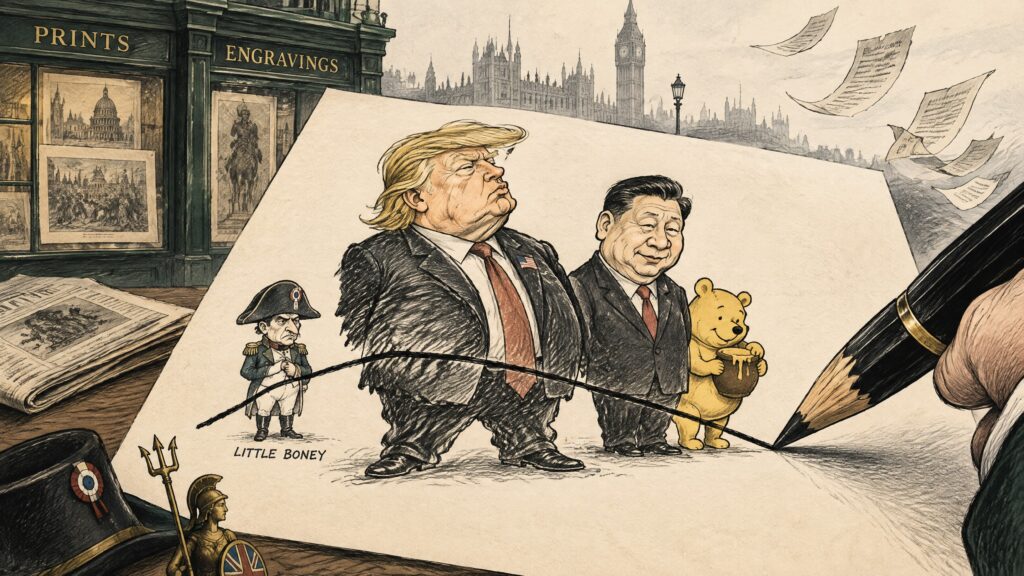
The comparison becomes even more entertaining when you look at Napoleon's British opponents. The Duke of Wellington was taller, certainly, but the other great British figure of the Napoleonic Wars was Horatio Nelson, hardly remembered by history as a vertically challenged bundle of insecurity. The precise historical measurements vary, but Nelson was not some towering giant standing over a tiny Napoleon.
Yet nobody talks about a “Nelson complex”.
Nobody sees a short bloke becoming irritated in a restaurant and says, “Bit of a Trafalgar syndrome there.”
Because there wasn't a James Gillray propaganda campaign successfully implanting the idea into Europe's collective imagination.
This is what caricature does so brilliantly. It doesn't need to be literally accurate. It needs to identify something recognisable, exaggerate it and make the resulting image impossible to forget. Gillray understood that more than two centuries before Photoshop, memes or social media existed. The National Portrait Gallery describes the essential mechanism of caricature perfectly: features are exaggerated or distorted not merely for humour, but to make political and social criticism. National Portrait Gallery
And Britain became extraordinarily good at it.
The British didn't merely caricature their enemies. They eventually turned Britain itself into a cartoon character.
John Bull began as a literary creation in John Arbuthnot's The History of John Bull in 1712, but artists including Gillray, Rowlandson and Cruikshank developed him into the personification of the British everyman. By the nineteenth century, particularly through Punch, he had become instantly recognisable: stocky, solid, frequently wearing a Union Jack waistcoat, sometimes accompanied by a bulldog, the human embodiment of Britain itself. Library of Congress
During the Napoleonic era, cartoonists could therefore reduce an enormously complicated geopolitical conflict to two characters. Little Boney was the excitable, ambitious French tyrant. John Bull was the stubborn British bloke who wasn't going anywhere.
You don't need a lecture about naval strategy, the Continental System, coalition warfare or European balance-of-power politics.
You need one fat Englishman eating tiny French ships for lunch.
That is an extraordinary communications technology when you think about it.
This is where the magazine you mentioned enters the story. Punch didn't create Little Boney because it wasn't founded until 1841, twenty years after Napoleon died. But what it did subsequently was enormous. The magazine became one of Britain's most influential institutions of political satire, and even helped establish the modern use of the word “cartoon” for a humorous or satirical illustration. Its artists turned politicians, monarchs, countries and international disputes into visual characters ordinary readers could immediately understand. The National Archives
John Tenniel, later famous for illustrating Alice's Adventures in Wonderland, spent decades drawing for Punch. Symbols such as Britannia, John Bull, Uncle Sam, the British Lion and Russian Bear became a kind of visual shorthand for geopolitics. A cartoonist could tell you Britain was confronting Russia without needing to write either country's name.
That tradition spread internationally. By the nineteenth century there were Punch-inspired publications in Canada, Australia, New Zealand and elsewhere, and British emigrants even launched Japan Punch in Yokohama in 1862. OUP Academic
The cartoon had become a political language.
Kitchener points directly at you
Then propaganda discovered that the cartoon didn't merely have to make you laugh. It could make you do something.
Few political images demonstrate that better than Alfred Leete's 1914 image of Lord Kitchener staring directly at the viewer, enormous moustache in place, finger pointing outward.
YOUR COUNTRY NEEDS YOU.
You can see the original in the Library of Congress collection here.
There is actually an interesting historical wrinkle to this one as well. The image first appeared on the cover of London Opinion in September 1914 and was subsequently reproduced in recruiting material; historians have debated just how widely the precise version we now regard as the famous recruitment poster was actually displayed during the war. What isn't in doubt is its extraordinary afterlife. Library of Congress
You know the image even if you've never consciously studied it. America adapted the concept into Uncle Sam pointing outward with I WANT YOU FOR U.S. ARMY. The pose has subsequently been copied, parodied and repurposed thousands of times.
Again, the image survived the campaign.
That is the peculiar power of political art. A speech disappears. A manifesto becomes obsolete. A newspaper article gets wrapped around tomorrow's fish and chips. But an image can become lodged in a culture for generations.
There is, obviously, a much darker side to this history. Cartoons have not merely been used for satire. They have been used to dehumanise minorities, inflame ethnic hatred, encourage violence and mobilise populations for war. Propaganda works partly because pictures can bypass the complicated bit where somebody has to explain an argument.
And sometimes the reaction to a cartoon itself becomes violent.
The most obvious modern example is Charlie Hebdo. The French satirical magazine had repeatedly published cartoons depicting Muhammad, including republication of the controversial Danish Jyllands-Posten cartoons. Here it is important to be precise: Islamic traditions concerning images vary, but many Muslims, particularly within Sunni traditions, regard visual depictions of Muhammad as prohibited or deeply offensive because of concerns about idolatry. The Guardian
On 7 January 2015, two Islamist gunmen attacked Charlie Hebdo's Paris offices and murdered 12 people, including several of France's best-known cartoonists. The attackers said they were avenging depictions of Muhammad. HISTORY
Whatever someone's view of the magazine's taste, religion or the limits of satire, the murders demonstrated in the most horrific possible way something political cartoonists have understood for centuries: people can react extraordinarily strongly to a drawing.
A few lines of ink can become a matter of identity, honour, religion, nationalism and political power.
This is the part I find fascinating.
Why should Xi Jinping care whether somebody thinks he looks like Winnie the Pooh? Why should Napoleon have cared that Gillray drew him tiny? Why do presidents become angry about cartoons when they have nuclear weapons, armies, governments and entire communications machines at their disposal?
Perhaps because caricature attacks something power finds particularly difficult to defend: dignity.
A politician can rebut an allegation. They can publish statistics against an economic argument. They can sue over a factual falsehood. They can give a speech explaining why a policy is misunderstood.
But what exactly does Xi say about Winnie the Pooh?
“I would like formally to deny that I resemble the bear”?
Excellent. You've now made it considerably funnier.
That is why attempts to suppress ridicule so often amplify it. The moment authorities censor the Pooh comparison, Winnie the Pooh stops merely being Winnie the Pooh and becomes shorthand for the fact that authorities don't want you making the comparison.
The cartoon acquires another layer of meaning.
And politicians who project enormous power can therefore find themselves surprisingly vulnerable to very small jokes.
Which brings us back to Trump and Xi.
They are meeting at a serious moment. China controls much of the world's rare-earth mining and an even larger proportion of processing, giving Beijing considerable leverage over technologies ranging from electric vehicles to defence systems. Taiwan remains an enormous strategic question. Trade, tariffs and artificial intelligence are all on the agenda. These are consequential issues involving two states capable of reshaping the global economy. Reuters
And yet alongside all that power sit two political figures who have also become extraordinarily fertile subjects for caricature.
There is something reassuring about that.
Not because every cartoon is fair. They aren't. Not because cartoons cannot be malicious. History shows very clearly that they can be vicious, racist, propagandistic and dangerous. And certainly not because every politician who dislikes being mocked is therefore equivalent to every other politician who dislikes being mocked.
But because satire performs a peculiar democratic function. It shrinks power back to human size.
Napoleon could command hundreds of thousands of soldiers. Gillray could make him three feet tall.
Kitchener could represent the entire British war machine. Leete could reduce him to one moustache, one finger and four words.
Xi can lead one of the most powerful states in human history.
And somewhere on the internet, somebody can still put him next to a yellow bear in a red shirt.
Perhaps that's why political cartoons survive every technological revolution. Paint became print, print became newspapers, newspapers became television, television became the internet and the internet became memes. The delivery system changed completely.
The joke didn't.
Two hundred years ago, James Gillray put Little Boney in a London shop window. Today somebody puts Donald Duck upside down on X.
Different century. Same weapon.
And perhaps the ultimate proof of its power is Napoleon himself. Empires disappeared. Governments fell. Borders moved. Punch eventually closed. Gillray died in 1815.
But more than two centuries later, millions of people still think Napoleon was short.
Never underestimate a man with a pencil.
Keep your Axe sharp.
Max
Join the FX Axe newsletter and stay one chop ahead.

