

There is something wonderfully human about the need to be right. Not merely to think you’re right, incidentally. That’s easy. I’m right about dozens of things every morning-just ask my wife. Actually, please don’t. The really satisfying bit is finding somebody who thinks you’re wrong and forcing them to attach some sort of consequence to it. For those of us who have spent years around trading, this is hardly an unfamiliar concept. A market is ultimately just an organised disagreement: I think something is worth more, you think it’s worth less, I buy, you sell, and somewhere between the two of us appears a price.
Prediction markets take that beautifully simple principle and apply it to almost everything else. Will the Fed cut rates? Will a particular candidate win an election? Will a war end before a certain date? Will a film win an Oscar? Will somebody score a goal? Will a particular person become the next Pope? If somebody believes the answer is yes and somebody else believes the answer is no, then congratulations: we potentially have a market.
That is essentially the idea behind Polymarket, the prediction-market business founded by Shayne Coplan, which has become one of the more fascinating financial companies of the past few years. The basic concept is wonderfully straightforward. If you think something is going to happen, and somebody somewhere in the world is prepared to take the other side, there is a price at which the two of you can trade. A contract trading at 70 cents broadly implies that the market is assigning around a 70 per cent probability to the event occurring. It’s trading stripped back to its most primitive form: I think this will happen; you don’t. Right then. How much?
And while Polymarket feels extremely modern — crypto infrastructure, smartphones, algorithms and people trading the probability of geopolitical events while sitting on the lavatory — the instinct behind it is centuries old.
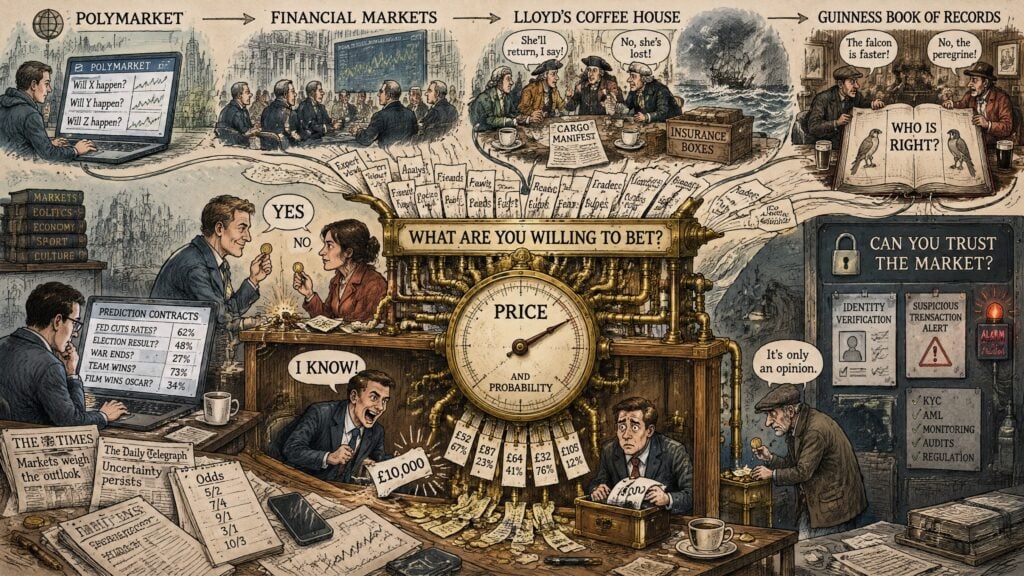
One of my favourite examples has nothing whatsoever to do with financial markets. In 1951, Sir Hugh Beaver, managing director of the Guinness Brewery, was at a shooting party in County Wexford when an argument broke out over which was Europe’s fastest game bird. Beaver and his companions couldn’t find a definitive answer in any reference book, and a few years later he realised something rather clever: pubs across Britain and Ireland must be filled every evening with people having exactly these sorts of pointless disputes.
And so the Guinness Book of Records was born. Norris and Ross McWhirter were brought in to compile it, the first edition appeared in 1955, and an institution emerged from the simple realisation that human beings really enjoy proving one another wrong. Guinness World Records — the story of how the book began
Think about how beautifully simple the commercial insight was. It wasn’t enough for one man to insist that one bird was faster than another. There had to be an independent mechanism for resolving the argument. Seventy years later, Polymarket has essentially taken the Guinness Book of Records principle and added a wallet. Now you don’t merely get to prove Dave wrong; you can take his money as well.
The financial version goes back considerably further. In the late seventeenth century, Edward Lloyd ran a coffee house in London, which became a meeting place for shipowners, captains and merchants. Coffee houses in those days weren’t simply places where somebody charged you £5 for something involving oat milk and then asked for your name; they were important centres of information and commerce, and Lloyd’s became particularly well known for reliable intelligence about ships, cargoes and voyages. Lloyd’s — how Edward Lloyd’s coffee house helped create the modern insurance market
Imagine the problem the people sitting in that café were trying to solve. A ship is sailing across the Atlantic carrying an extremely valuable cargo. There are storms, pirates, navigational errors, disease and approximately four hundred other ways in which seventeenth-century maritime travel can ruin your week. The owner doesn’t want to bear the entire risk, while somebody else is willing to take some of that risk for a price.
And that price depends on probability. What ship is it? Who is the captain? Where is it sailing? What time of year? What cargo is aboard? What is the weather likely to do? What are the chances of the bloody thing actually coming back?
That, in essence, is underwriting. One person has a risk they don’t want entirely to bear; another person develops a view about the probability of an outcome and names a price for taking it. From those conversations eventually developed one of the world’s great insurance markets. Lloyd’s was already renting out tables — or “boxes” — where businessmen could sell insurance against ships failing to return, and by 1734 Lloyd’s List was publishing shipping intelligence about arrivals, departures, cargoes, foreign fleets and even where pirates were operating.
What I particularly love is that eventually the speculative instinct became a problem in itself. By 1769, professional underwriters were sufficiently fed up with Lloyd’s growing reputation for speculative wagers that they broke away and established a new Lloyd’s coffee house focused on proper insurance business. Lloyd’s own history records complaints about speculative insurance on people’s lives and government securities being used for what was then called “stock-jobbing”. Lloyd’s — speculative wagering and the creation of New Lloyd’s
Three hundred years later, we’re still arguing about precisely the same dividing line. When is pricing probability insurance? When is it investing? When is it trading? And when is it simply gambling with a more expensive vocabulary?
Polymarket would presumably prefer the answer to favour the middle two.
Whatever you call it, there is clearly demand. Prediction markets have grown at extraordinary speed, and Reuters Breakingviews recently suggested the sector could exceed $1 trillion in annual trading volume by 2030. Polymarket and Kalshi sit at the centre of that expansion, while more conventional financial businesses are increasingly moving into the space as well. Reuters — why prediction markets could become a trillion-dollar industry
I can completely understand why. If you’ve spent your life following geopolitics and think you understand elections better than pollsters, there’s a market. If you understand monetary policy and think the consensus is wrong about the Fed, there’s a market. If you’re obsessive about sport, entertainment, economics or technology, increasingly there is somewhere you can attach money to that conviction.
We’ve talked before in Max’s Daily Chop about the extraordinary financialisation of almost everything. Athletes, elections, cryptocurrencies, future events — we are increasingly able to trade opinions that twenty years ago would have remained arguments between friends. Polymarket might be the purest expression of that, because it effectively says that if two people can disagree about something and construct sufficiently clear rules for determining who was eventually right, there is potentially a market in it.
Unfortunately, once you allow people to attach money to almost anything, you also attract people who are extremely inventive about acquiring other people’s money.
This is where the latest investigation by The Wall Street Journal, republished in The Times, becomes rather less entertaining. According to the report, Polymarket’s rapid expansion in America was accompanied by serious problems involving fraud prevention, compliance and internal controls. The Times — Polymarket’s rush to grow left a door wide open for fraudsters
In February, criminals allegedly used stolen debit cards to fund accounts, with attempted thefts totalling at least $10 million. During the attack, Polymarket’s payment processor was reportedly flagging more than 80 per cent of deposits as fraudulent. That distinction is important: this does not mean 80 per cent of Polymarket’s business was fraudulent. It refers to deposits being screened during a specific fraud attack. But it remains an extraordinary number. If more than four out of every five people walking through your front door are setting off the burglar alarm, you should probably have a word with yourself about the company you are keeping.
The Journal reports that internal concerns were raised about compliance while management remained intensely focused on growth, and that another security flaw in July led to account takeovers and losses for nearly 500 users. Polymarket disputes aspects of the reporting, denies wrongdoing and says it has strengthened its fraud-prevention systems and brought in experienced compliance personnel. Those qualifications matter, but so does the broader question the episode raises: growth at what cost?
Silicon Valley spent years worshipping at the altar of growth. Get users. Get scale. Capture the market. Worry about profitability later and regulation somewhere after that. If necessary, apologise in front of Congress once you’re already worth $50 billion. Sometimes this produces extraordinary companies; sometimes it produces WeWork. And occasionally it produces a business where the compliance department appears to be running behind the sales department shouting, “Could everybody please slow down for five bloody minutes?”
Polymarket’s difficulty is particularly interesting because trust is ultimately part of the product. A prediction market only works if participants believe the market itself is legitimate. They need confidence that their money is secure, that contracts will be resolved correctly, that participants aren’t manipulating outcomes and that somebody with privileged information isn’t quietly hoovering up everyone else’s money.
This is exactly the reason Lloyd’s evolved from coffee-house speculation into an institution governed by underwriting standards, rules and reputation. Markets require disagreement, but they also require trust. Without the second, the first becomes meaningless.
Prediction markets also create a particularly strange version of insider trading. Suppose you’re trading a stock and secretly know tomorrow’s earnings before everybody else. We understand the problem. But what happens if you’re trading whether a political event will occur and you work inside the government deciding whether that event occurs? Or you’re betting on whether a company will make an announcement while being involved in making the announcement? The very thing that makes prediction markets valuable — the possibility that somebody knows something everybody else hasn’t appreciated — becomes rather problematic when somebody actually does know something everybody else doesn’t.
This isn’t merely hypothetical. In May, the US House Committee on Oversight opened an investigation into potential insider trading on prediction-market platforms and requested information from both Polymarket and Kalshi about identity verification, geographic restrictions and the systems they use to identify suspicious activity. That is an investigation into the risks and controls around the platforms, not a finding that Polymarket itself engaged in insider trading, but it demonstrates how complicated this becomes once serious money starts moving through these markets. US House Oversight Committee — investigation into insider trading on prediction markets
The contradiction is wonderful. Prediction markets work because somebody might have a better view than everyone else. Prediction markets become problematic when somebody has a better view because they are sitting in the room where the decision is being made.
Try writing the regulatory framework around that.
This is where Polymarket becomes much more interesting than simply another clever startup. If prediction markets continue developing into a serious financial asset class, they have to solve precisely the same problem that Lloyd’s encountered centuries ago: how do you take the perfectly natural human desire to speculate on uncertain events and turn it into a market that people can actually trust?
The regulatory environment matters enormously here, particularly in America, where prediction markets sit awkwardly between finance, derivatives regulation and gambling laws. There are also obvious political sensitivities when markets allow people to trade on elections, government decisions and geopolitical events. Those issues become even more important when businesses in the sector have investors or advisers with political connections. The answer cannot simply be that a particular administration happens to be relaxed about the industry, because administrations change, regulators change, courts intervene and legislation changes. If prediction markets really are heading towards a trillion dollars of annual trading, the valuable regulatory framework is the one that survives whoever happens to occupy the White House.
And that brings us to the IPO question. If Polymarket eventually does come to the public markets, what exactly would investors be buying? A technology company? A crypto business? A betting company? An exchange? A financial-data company? Perhaps all of them, because the really powerful thing about prediction markets isn’t necessarily the wager itself. It’s the information created by the wager.
Ask 1,000 people whether something will happen and you’ll get opinions. Force those same 1,000 people to put their own money behind those opinions and suddenly you have something rather more interesting. Markets aren’t magically correct; crowds can be stupid, traders can herd, prices can be manipulated and participants can have terrible information. But money has a wonderful way of concentrating the mind. Saying “I’m absolutely certain” is free. Putting £10,000 behind it tends to introduce a little intellectual humility.
That principle is why bookmakers exist, why insurance exists and why financial markets exist. In a strange way, it is also why the Guinness Book of Records exists. We really, really like knowing who is right.
Strip away the apps, cryptocurrencies, venture capital and enormous valuations and Polymarket is facilitating something people have been doing for centuries. Two people disagree about what happens next and eventually somebody asks the most financially important question in human history: how much are you willing to bet on it?
Edward Lloyd would recognise that immediately. So would Sir Hugh Beaver. So would every trader who has ever stared at a chart and concluded that the entire market is wrong and they alone have spotted something everybody else has missed. Sometimes they’re right. Sometimes they discover, rather expensively, why the entire market was on the other side.
Polymarket’s great opportunity is that it has built an extraordinarily efficient machine for putting prices on human conviction. Its great challenge is proving that the machine itself can be trusted, because there is a wonderful contradiction at the centre of the entire prediction-market industry: the business depends completely on uncertainty, while the integrity of the market absolutely cannot.
And if Polymarket eventually does arrive on the stock exchange at an enormous valuation, investors will find themselves facing one final prediction market: is Polymarket itself worth the money?
At least we’ll know where to place the bet.
Keep your Axe sharp.
Max

