

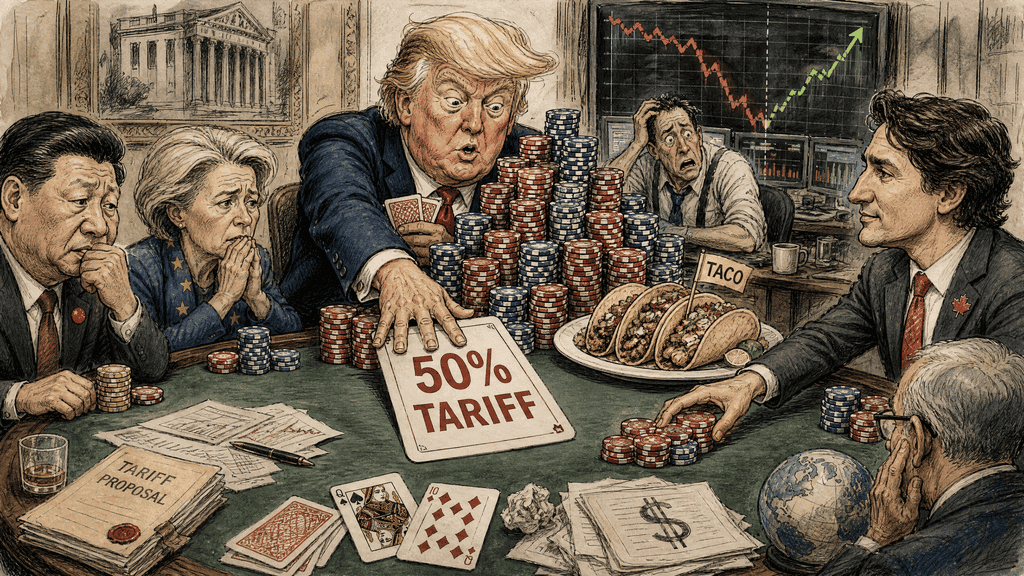
It is Tuesday, Donald Trump is threatening somebody with an enormous tariff, and Wall Street has somehow managed to turn American foreign policy into Mexican street food.
Welcome to TACO Tuesday.
For the uninitiated, TACO stands for “Trump Always Chickens Out”, a phrase coined by Financial Times columnist Robert Armstrong in May 2025 after investors noticed a rather useful pattern. Trump would announce something terrifying — enormous tariffs on China, Europe or whoever had annoyed him before breakfast — markets would fall, negotiations would begin, Trump would soften or postpone the threat, and markets would bounce. Eventually traders started buying the panic rather than fearing it. (Financial Times)
Trump, unsurprisingly, hates the nickname. When a reporter asked him about it, he called it a “nasty question” and insisted that reducing or postponing tariffs wasn't chickening out; it was negotiation. (The Guardian). It also must represent at least half of his weekly nutrition.
Which is probably why the nickname has survived.
But beneath the excellent acronym is a genuinely interesting question for traders. Is Trump actually somebody who repeatedly chickens out, or are we misunderstanding the negotiating strategy entirely? Because there is another interpretation: Trump doesn't threaten something because he necessarily intends to do it. He threatens the most extreme thing imaginable because he wants to move the starting point of the negotiation.
And if that sounds familiar, it's because he has been doing it for about fifty years.
To understand Trump's negotiating style, you have to go back to 1970s New York and a man called Roy Cohn.
Cohn was not a cuddly mentor figure dispensing wisdom out of his dojo. He had been Joseph McCarthy's chief counsel during the Red Scare, became one of New York's most notorious lawyers and fixers, and developed an approach to conflict which could broadly be summarised as: if somebody punches you, respond by driving a bulldozer through their house. And wife.
Trump met him in 1973 while the Trump family business was facing a federal housing discrimination case. Cohn's advice was not to quietly negotiate. The Trump organisation counter-sued the government for $100 million. That claim was dismissed, while the original discrimination case was eventually settled without an admission of guilt. Contemporary and academic accounts of their relationship describe Cohn as enormously influential in developing Trump's instinct to counterattack rather than concede. (MIT Negotiation Journal)
There is an extraordinary consistency between that young property developer and the president we watch today.
Attack first. Set the demand somewhere towards the moon. Never concede that you have conceded. If you eventually settle halfway between where everybody started and where you threatened to go, announce that you have achieved one of the greatest victories in human history.
Cohn provided much of the aggression. Another Trump adviser, veteran real-estate lawyer George Ross, supplied considerably more of the mechanics of deal-making. Ross spent decades negotiating Trump deals and became one of his senior advisers.
And, to be fair to Trump, there were genuine successes.
The transformation of Manhattan's decrepit Commodore Hotel into the Grand Hyatt was the deal that really established his reputation. New York was in dreadful financial condition, the area around Grand Central was struggling and the project was considered risky. Trump nevertheless assembled Hyatt, lenders and government support, including an extraordinary 40-year tax abatement worth roughly $60 million at the time. The renovated hotel opened in 1980 and became an important part of the subsequent revival around Grand Central. (Los Angeles Times)
It was bold, complicated and extremely effective.
It also benefited from political connections and one of the most generous tax arrangements imaginable. Of course.
Welcome to the Donald Trump business story. Even the clean examples tend to arrive with an asterisk of filth.
The difficulty with treating Trump as some sort of negotiating Yoda is that the wider business record is considerably more complicated than the mythology.
Trump Tower was a major success. The Grand Hyatt worked. His decision to push into Manhattan rather than remain focused on his father's outer-borough property business was ambitious and ultimately enormously valuable. Perhaps his greatest commercial achievement was turning Donald Trump himself into an asset. Long after individual property ventures struggled, the Trump name could be licensed onto buildings, golf courses and products around the world.
But there was also the Plaza Hotel, Trump Shuttle and the Atlantic City casinos. The Taj Mahal opened in 1990 financed heavily with expensive debt and entered Chapter 11 bankruptcy protection the following year. Trump's casino businesses went through repeated restructurings, while his personal debt reached roughly $900 million, forcing the sale or surrender of assets including his airline and yacht. (Los Angeles Times)
So perhaps the useful lesson isn't that Trump has always been an astonishing negotiator.
It's that Trump has always been astonishingly willing to bet.
And that is slightly different.
The easiest way I can describe Trump's negotiating style is poker.
Imagine sitting down at a table against somebody who isn't necessarily better at poker than you are. In fact, you're fairly sure you understand probability better, you've played more carefully and his strategy appears to involve repeatedly shouting that he has the best cards anybody has ever seen.
There is just one problem.
He has ninety per cent of the chips.
Trump's America is the world's largest economy, controls the world's dominant reserve currency, possesses enormous military power and sits at the centre of the global financial system. When the United States threatens a 50% tariff on one of your industries, you cannot simply reply, “Fine, we'll take our business elsewhere” in the way you might respond to an unreasonable plumber.
That asymmetry gives Trump tremendous negotiating power.
He can go all-in far more comfortably because everybody around the table knows that if the bluff unexpectedly becomes real, the damage is not evenly distributed.
And that brings us to Canada.
The past week has provided almost a laboratory experiment in Trump negotiation.
The United States and Canada appeared tantalisingly close to a deal that would actually have reduced existing tariffs. The proposal under discussion would have lowered the top-line US tariff on Canadian cars and light trucks from 25% to 15%, while steel and aluminium tariffs would have fallen from 50% to 25%. Then negotiations collapsed on Friday over several outstanding issues, including treatment of medium and heavy-duty trucks. (Reuters)
On Saturday, 50% US tariffs consequently took effect on around $20 billion of Canadian goods. Canada announced that it would retaliate dollar-for-dollar from September 8. (RV Industry Association)
Then, on Monday, Trump escalated again. He threatened to increase tariffs on all Canadian-made cars, trucks, automotive parts and steel to 50% from January 1, 2027. Automotive shares fell, while industry executives warned about the effect on extraordinarily integrated North American supply chains. (Reuters)
So much for always chickening out.
Or perhaps not.
Because the January deadline creates precisely what Trump likes most: another negotiation.
Even executives speaking to Reuters questioned whether the threatened 50% auto tariffs would ultimately materialise, noting both Trump's previous unfulfilled tariff threats and the months remaining before implementation. Some interpreted the announcement as an attempt to force Canada back to the negotiating table. (Reuters)
The threat is enormous. The pain would be real. But there is time between now and implementation for Canada to move, Washington to move, both to move and everybody eventually to announce that the other side moved more.
This is why TACO is useful as a market observation but dangerous as an investment law.
We've seen the same sequence outside trade.
In 2017, Trump called North Korean leader Kim Jong-un “Little Rocket Man”, threatened North Korea with “fire and fury”, and engaged in rhetoric which at times sounded less like international diplomacy than two men being removed from a pub.
And then, remarkably, they met.
The June 2018 Singapore summit was the first meeting between a sitting US president and a North Korean leader. The two signed a declaration committing themselves to new US-North Korean relations and working towards the denuclearisation of the Korean Peninsula.
If you're making the case for Trump's negotiating method, this is one of your strongest examples. Extreme pressure was followed by direct engagement that few conventional presidents would even have attempted.
But you cannot simply stop the story there.
The negotiations ultimately stalled. North Korea did not denuclearise and continued expanding its nuclear programme. Just last week, South Korea's defence minister estimated that Pyongyang may now possess 80 to 120 nuclear warheads, while Trump is once again talking about meeting Kim later this year. (Reuters)
So did the strategy work?
For immediate de-escalation, you can make a reasonable argument that it did.
For the stated strategic objective of denuclearising North Korea, clearly it didn't.
Both of those things can be true at once, which is rather inconvenient for political slogans, but rather convenient for the partisan radicals that plague the world.
The bigger problem for Trump is that negotiation tactics lose power when everybody understands them.
The first time someone bangs a revolver onto the negotiating table, people become extremely attentive.
By the fifteenth time, somebody asks whether it is loaded.
That is essentially what happened with the TACO trade. Markets began recognising that Trump's maximum-threat opening position was not necessarily his final position. Investors increasingly stopped asking only, “What has Trump just announced?” and started asking the considerably more useful question: “What is actually going to happen?”
The Financial Times noted that this expectation of eventual retreat helped drive the extraordinary US market recovery after the initial tariff shock. But it also warned against complacency: even after the retreats, US tariff levels remained historically high and the policy uncertainty itself carried economic costs. (Financial Times)
And once everyone knows the magician has a rabbit in his jacket, the appearance of a rabbit becomes slightly less impressive.
This is where I think “Trump Always Chickens Out” oversimplifies something much more useful for traders.
Trump doesn't always chicken out.
Sometimes he follows through. Canada has just discovered that.
China provides another useful example. Trump's first administration imposed sweeping tariffs and eventually reached the Phase One trade agreement in January 2020. The agreement contained commitments covering intellectual property, technology transfer, agriculture, financial services and enormous additional Chinese purchases of American goods and services.
That sounds like a negotiating victory.
The subsequent record is less flattering. In 2025, the US Trade Representative concluded that China appeared not to have lived up to numerous Phase One commitments and estimated that its purchases fell more than $217 billion short of the promised total. (US Trade Representative)
Again, both things can be true. Trump used tariffs to force China into an agreement previous administrations had not achieved. China then failed to deliver much of what the agreement promised.
Winning the negotiation and winning the outcome are not necessarily the same thing.
Yes.
But probably not in the simplistic sense.
The lesson isn't “Trump threatens tariffs, therefore buy stocks because he'll definitely reverse them”. Canada has just demonstrated why that could become an extremely expensive assumption. The useful lesson is that markets increasingly understand Trump's negotiating grammar: maximum demand, maximum publicity and maximum pressure. Watch the reaction. Negotiate. Then describe whatever happens next as victory.
It is recognisably the Roy Cohn playbook translated from Manhattan property disputes into global economics.
Sometimes it produces genuine results. Sometimes it produces agreements that look rather less impressive once the details arrive. Sometimes it creates enormous uncertainty. And occasionally somebody calls the bluff and discovers there was, in fact, a tariff behind it.
For traders, that means the opportunity is increasingly not in reacting first, but in distinguishing the opening bid from the probable destination.
Trump may not be the world's greatest poker player.
He simply has entered the tournament with more chips than almost everybody else combined.
The trouble is that when the man with all the chips goes all-in often enough, eventually somebody is going to call him.
And this TACO Tuesday, Canada just did.
Keep your Axe sharp.
And perhaps don't order the chicken just yet.
Max
Want more of The Daily Chop?
Sharp market stories, trading takes and financial madness straight to your inbox.

