

I’m sure most of us saw the video on social media last week. A Tesla Roadster suddenly launches itself into the air, spins around like somebody has accidentally pressed the wrong button on a PlayStation controller, rights itself and lands again. I certainly saw it, and I think most of us had roughly the same reaction: AI. Obviously AI. Look at the bloody thing. Why is it spinning? Why would a car need to do that? What possible journey requires you to drive to Waitrose, perform a mid-air barrel roll and then continue towards the underground car park?
Except it turns out it wasn't AI. Elon Musk has actually built it. Tesla unveiled its long-delayed new Roadster at a SpaceX facility in Texas, where the car accelerated, launched itself into the air, rotated in mid-flight and landed back on its wheels. The trick comes from a SpaceX-derived system of ultra-high-pressure compressed air and directional thrusters around the car. One of the engineers involved has now written about the project for The Times, and the details somehow make the video seem even more ridiculous rather than less.
Internally, the project was apparently known as MEDE: Most Epic Demo Ever, which is wonderfully Elon Musk. Most companies have project names like Project Horizon or Strategic Mobility Platform 2030. Elon appears to have gathered some engineers together and said, essentially, “Can we make the car jump over another car and do a fucking backflip?” And they did.
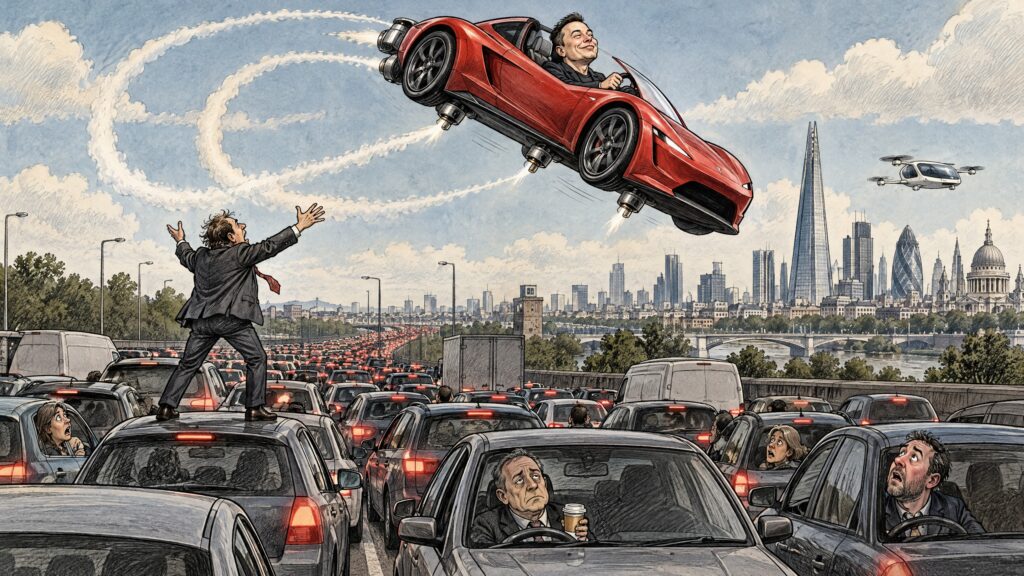
This is where I have a small complaint. I've been promised flying cars for most of my life, and this isn't quite what I had in mind. Back to the Future Part II promised us a DeLorean soaring elegantly over Hill Valley. Blade Runner gave us Spinners cruising between skyscrapers. The Fifth Element had Bruce Willis driving a flying taxi through three-dimensional New York traffic. The Jetsons essentially treated personal aviation as the school run. And long before all of them, Chitty Chitty Bang Bang had already solved the problem rather beautifully: car gets stuck in traffic, wings come out, car flies over traffic.
That's what I want. That is the entire point of a flying car. I'm not particularly interested in driving down the M1 and suddenly doing a somersault over Birmingham. Sorry what am I talking about, that’s exactly what I’d do. Though ideally I would be doing that in a slightly more serene and controlled manner than appeared on social media.
Tesla's Roadster can't really do that, at least not yet. What Tesla has demonstrated is better described as an extraordinarily powerful car capable of launching itself into the air and controlling itself while airborne. The system uses compressed air fired through multiple thrusters positioned around the vehicle. According to the engineer's account in The Times, the system can produce more than eight tonnes of thrust, while the car can accelerate from 0–60mph in around 0.81 seconds and generate more than 2G in corners.
Eight tonnes of thrust in a car is an objectively ridiculous sentence. And 0–60 in 0.81 seconds is less acceleration than an attempt to leave your internal organs behind at the traffic lights. The demonstration version was remotely controlled because experimental ultra-high-pressure air tanks introduce fairly obvious safety considerations. Tesla itself isn't pretending this is sensible family motoring, and production is currently expected in 2028 after what can politely be described as quite a few previous promised arrival dates.
So no, this isn't yet the flying car Hollywood promised us. But it is a car that flies, and that's sufficiently absurd that I think we should take a moment to appreciate it.
Flying cars occupy a strangely permanent place in our idea of “the future”. We don't imagine the future arriving with a slightly more efficient dishwasher. Nobody watched Blade Runner and thought, “Goodness, I hope kitchen extraction improves.” We want robots, holograms, space travel, teleportation, hoverboards and flying cars. The particularly amusing thing is that several of the cinematic futures in which flying cars were supposed to exist have already happened. Back to the Future Part II was set in 2015. Blade Runner was set in 2019. We have passed both of them, and instead of flying cars 2015 gave us the Apple Watch while 2019 gave us increasingly aggressive arguments on Twitter.
It has always been one of those technologies that appears perpetually about twenty years away. The reason is fairly obvious: cars and aircraft have fundamentally contradictory jobs. A good car wants to remain firmly attached to the road. A good aircraft has rather different ambitions. Add the weight of batteries, safety systems, propulsion, aviation regulation and the inconvenient possibility that an engine failure now results not in waiting for roadside assistance but in arriving through somebody's conservatory, and the problem becomes rather more complicated.
Yet people keep trying because the attraction is irresistible, and Tesla isn't even alone. Companies are working on everything from electric vertical-take-off aircraft to vehicles much closer to the science-fiction definition of a flying car. Alef Aeronautics, for example, is developing a road-going electric vehicle intended to take off vertically and fly above traffic. Its prototype has demonstrated low-altitude flight, although that remains a very long way from proving that thousands of us are about to commute through the sky.
So apparently my plan to leapfrog the Birmingham is technically achievable. It will simply cost an enormous amount of money and require the aviation authorities to become considerably more relaxed about idiots.
The Tesla version is fascinating for another reason: it makes almost no commercial sense, and that may be precisely the point. The Roadster isn't going to replace the Model Y. It isn't going to transform Tesla's margins. It isn't going to become the family car of choice for somebody comparing boot space and wondering whether a Labrador fits comfortably behind the rear seats. This is a halo product, and halo products are allowed to be ridiculous.
Imagine you're a 24-year-old engineering genius deciding whether you want to work at BMW, Mercedes, Toyota or Tesla. BMW says, “We're developing a new seat-folding mechanism that will increase rear luggage capacity by seven per cent.” Tesla says, “Would you like to make a car jump over another car?” There is an economic value to ridiculousness.
Companies need things that demonstrate capability rather than necessarily generating enormous direct profits. Formula One works partly like this for manufacturers. Supercars work like this. Concept cars have done it for decades. Space missions do it for nations. The Roadster tells engineers, customers and investors something about Tesla's self-image: we are still the company prepared to attempt the stupid thing.
That image may be particularly valuable now. Tesla no longer has the electric-car playground largely to itself. Chinese manufacturers have become technically excellent extraordinarily quickly, established carmakers have caught up in important areas, Tesla's older models have aged and the company increasingly has to prove that it remains a technology business rather than simply another enormous car manufacturer. So what does Musk do? He makes the Roadster fly. It's difficult to accuse somebody of becoming boring while their sports car is upside down in mid-air.
What I particularly enjoyed about the engineer's account is how much actual engineering sits underneath what looks like a social-media stunt. The project combines automotive engineering with SpaceX-style thinking. The thrusters use extremely high-pressure compressed air rather than combustion rockets, with nozzles controlling the forces acting on the vehicle. Aerodynamics, propulsion, vehicle dynamics and control software all have to work together quickly enough to prevent Most Epic Demo Ever becoming Most Expensive Insurance Claim Ever.
This is something Musk's companies have repeatedly understood rather well: absurd objectives can force useful innovation. SpaceX saying “let's reuse rockets” sounded ridiculous until reusable rockets started landing vertically. Catching a returning Super Heavy booster with giant mechanical arms sounded like something invented after several bottles of wine, and then they did it. There is an important distinction between promising absurd things and delivering them, of course, and Musk's timelines have often had only a casual acquaintance with calendars. The second-generation Roadster itself was unveiled in 2017 and was at one stage supposed to arrive around 2020. We are now talking about 2028. Elon Time remains a unit of measurement only loosely related to Earth Time.
But there is something admirable about aiming for something sufficiently ridiculous that even partial success produces something interesting. Most corporate innovation is necessarily boring. Better batteries, cheaper manufacturing, improved software architecture and more efficient supply chains are how enormous businesses actually make money. Every now and then, however, somebody needs to ask whether the car can jump.
There is actually a useful business lesson buried underneath the barrel roll. Not every project needs to be judged entirely on the revenue it directly produces. Some products create attention. Some attract talent. Some establish technological credibility. Some generate intellectual property that subsequently finds its way into more mundane products. Some simply remind people why the company interested them in the first place.
The Roadster is probably all of those things. If millions of people watch a Tesla unexpectedly leap into the air and think, “How the fuck did they do that?”, it has achieved something an advertising campaign costing hundreds of millions might struggle to replicate. Ferrari doesn't need every car to maximise practicality. Rolex doesn't need to tell the time more accurately than your phone. SpaceX didn't launch Musk's original Roadster into space in 2018 because interplanetary used-car delivery represented an underserved market. Sometimes spectacle is part of the product.
And that is where Musk remains unusually good. He understands that technology isn't only about capability; it is also about imagination. People need to want the future before somebody can sell it to them. You can dislike the man, question the timelines, worry about Tesla's valuation or think half his promises are bonkers, but he remains exceptionally good at making engineering look exciting. Even from within what is surely the weirdest body shape of all time.
I reserve the right to be disappointed, though, because we've waited long enough. I don't want a car that can briefly become airborne while performing an extremely expensive gymnastics routine. I want the full thing. I want Doc Brown. I want Blade Runner. I want Bruce Willis's taxi from The Fifth Element. Frankly, I'll take Chitty Chitty Bang Bang. Ian Fleming came up with that in a children's book in the 1960s: car approaches traffic jam, wings appear, traffic jam ceases to be your problem. More than sixty years later, Silicon Valley is still unnecessarily complicating the brief.
There is something wonderfully human about that. We have artificial intelligence that can write software. We can land reusable rockets. We can edit genes. We have put telescopes in space capable of seeing galaxies whose light began travelling towards us billions of years before human beings existed. And still, one of the great dreams of technological civilisation is essentially: can I please just fly over this fucking traffic?
Tesla hasn't quite solved that. But a car launched itself into the air, spun around and landed again, and when I first saw the footage I assumed it was fake. It wasn't. Perhaps that's the most exciting thing about it: the line between the ridiculous things we were promised by science fiction and the ridiculous things engineers can actually build is getting increasingly difficult to see.
The flying car isn't here yet, certainly not the one I was promised. But for a few seconds over Texas, it bloody well looked like it was.
Keep your Axe sharp. And where we're going, apparently we still need roads — just not all the time.
Max
Join the FX Axe newsletter and stay one chop ahead.

