

In my life outside trading, educating and keeping an eye on the markets, I love to cook. In fact, it's probably my favourite way of switching my brain off from them. I cook all the time, I'll have a go at pretty much any cuisine and I am perfectly happy spending an unreasonable amount of an afternoon experimenting with something that the rest of the family will ultimately consume in about eleven minutes.
There is, however, one culinary principle on which I have become completely inflexible: if a dish is fundamentally based around tomatoes, buy the best bloody tomatoes you can find.
You can economise elsewhere. You don't need branded salt. Your dried oregano does not need to have been personally harvested from a hillside in Sicily by a woman called Nonna Maria. There is absolutely no reason to spend £14 on olive oil if you're subsequently going to use it to fry an onion. But if you're making a Bolognese, chilli, tomato soup, arrabbiata, lasagne, gazpacho or anything else in which the tomato is doing the heavy lifting, do not save 70p on the principal ingredient.
And the best tinned tomatoes, in my completely unsolicited opinion, are Mutti.
It's not even close.
I've tried the expensive supermarket ones. I've tried the fancy Italian ones with labels suggesting the tomatoes were individually counselled before entering the tin. I've tried Cirio, Napolina and various beautifully packaged alternatives that cost enough to make you wonder whether the tin comes with a small shareholding in the farm.
Mutti are better.
I should make clear at this point that Mutti has not paid me a penny to say this. FX Axe has no commercial relationship with Mutti whatsoever and this remains the fiercely independent tomato journalism you've presumably come to expect from us.
However, if anyone at Mutti is reading, my principles are not completely inflexible.
Call me.
Before we get onto business, I have one other piece of entirely unsolicited culinary advice.
If you're making Bolognese, don't add sugar to the tomatoes. A small splash of balsamic vinegar does a much better job of bringing out their natural sweetness and gives the sauce considerably more depth without simply making it sweeter. You don't need expensive balsamic either. Save the 25-year-old Modena stuff for something where anyone can actually taste it. Supermarket balsamic is absolutely fine.
Let the tomatoes do the talking.
And if you think I'm labouring this point, there is a reason. The extraordinary thing about Mutti is that Francesco Mutti has spent more than thirty years building an €800 million business around essentially the same argument.
Mutti began in Parma in 1899, when brothers Marcellino and Callisto Mutti started processing tomatoes. The company has remained in the family ever since and is now run by Francesco Mutti, the fourth generation, who took control from his father in 1994. (The Times)
What Francesco inherited was not exactly Unilever.
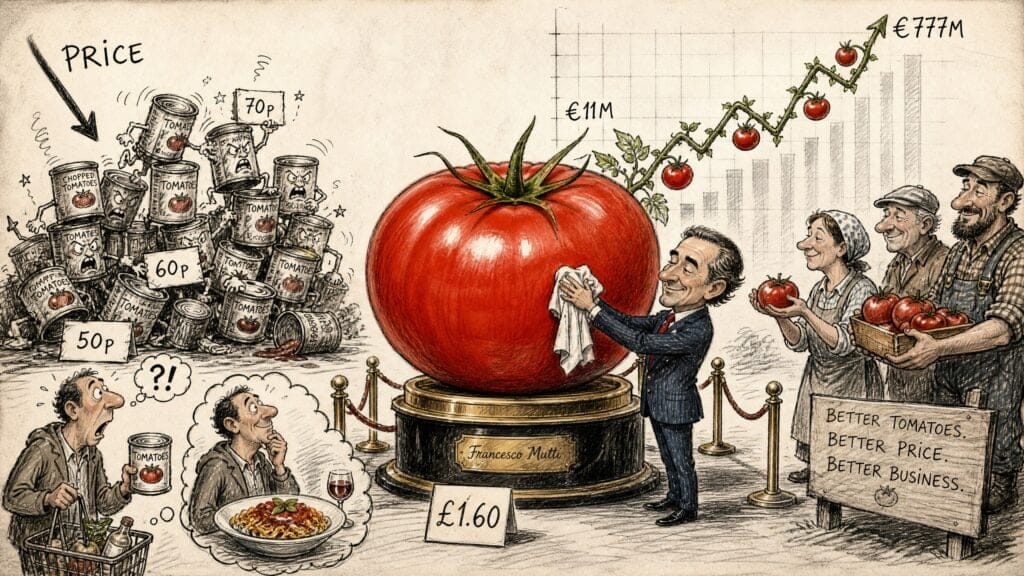
Mutti had about 25 employees and annual revenues of roughly €11 million. It was, in Francesco's own description, a quiet, conservative company operating in an industry where supermarkets increasingly regarded processed tomatoes as a commodity. Everyone sold essentially the same red stuff in essentially the same metal cylinder, and the obvious way to compete was on price. (Forbes / Harvard Business School)
Francesco Mutti decided to do almost exactly the opposite.
He got rid of side businesses in cheese and cattle and concentrated the company almost entirely on tomatoes. He invested in production, technology and relationships with growers. Most importantly, rather than trying to buy tomatoes as cheaply as possible and then fight competitors for tiny margins, Mutti started paying farmers more for better produce. (Forbes / Harvard Business School)
That's the bit I love.
Imagine presenting that strategy to the board.
“We operate in an intensely price-sensitive commodity market.”
“Right.”
“Our competitors are fighting to reduce costs.”
“Right.”
“So we're going to pay more for the raw material.”
There would presumably have been a short silence.
But that was the trade.
Thirty-odd years later, the quiet little €11 million tomato processor has become the European leader in tomato products. Mutti reported €777 million of revenue in 2025, up 10.6% in a year, with exports accounting for 60% of the business. It processed more than 725,000 tonnes of tomatoes last year and is now sold around the world. (Mutti – 2025 Financial Results)
And Britain, rather wonderfully, has fallen for it.
Mutti only really began pushing seriously into the UK in 2020. Yet by early this year it had overtaken Napolina to become Britain's biggest non-supermarket tomato brand, taking nearly 11% of the market in the relevant category. This is despite a tin of Mutti costing around £1.60, compared with roughly 50p for a supermarket own-brand equivalent. (The Guardian)
Think about what that means from a business perspective.
Mutti has entered one of the world's most competitive grocery markets selling one of the most commoditised products imaginable, charged roughly three times the cheapest alternative and gained market share.
There isn't a revolutionary patent involved. Nobody has discovered Tomato 2.0.
They're just better tomatoes.
And this is where tomatoes unexpectedly become interesting to investors.
If you sell something that customers regard as identical to everything else, there are only so many ways to compete. Usually you end up fighting over price. Margins shrink, somebody gets bigger, somebody gets cheaper and eventually everybody is working extremely hard to make almost no money.
Financial markets aren't entirely different.
There are thousands of traders looking at the same charts, receiving the same economic data and reacting to the same central banks. There are thousands of investment funds buying the same securities and thousands of companies selling products that, at first glance, look interchangeable.
The interesting question is always: where is the edge?
Francesco Mutti found his in quality.
Not “quality” as something written on the side of a packet beneath a picture of an Italian flag. Actual quality, embedded through the supply chain. Mutti works with around 1,000 Italian farming families, processes its crop during an intense roughly 70-day harvest and has spent decades rewarding growers for producing better tomatoes. (The Guardian)
The company has also repeatedly invested in production when it could have taken the easier route of harvesting profits. It spent more than €20 million expanding capacity ahead of its record 2025 processing season and has another €42 million investment programme planned for 2026 as part of a wider five-year programme. (Mutti – 2025 Financial Results)
That's not terribly glamorous.
Neither is risk management.
Unfortunately, boring things done consistently have an irritating habit of working.
There is another part of the Mutti story that I think is particularly relevant to trading and investing: they know exactly what they are.
Francesco didn't take over a tomato company and decide what it really needed was a blockchain division, an electric scooter business and an AI-powered subscription service.
He sold the cows.
He sold the cheese.
He concentrated on tomatoes.
Even Mutti's innovations have largely been about finding better ways of selling the same fundamental product. In 1951 the company introduced tomato concentrate in an aluminium tube — at the time a packaging format associated with toothpaste — so consumers could use some and keep the rest fresh. In the 1970s it pioneered its finely chopped polpa. (Mutti – Sustainability Report)
It's a useful reminder that innovation doesn't necessarily mean completely reinventing yourself. Sometimes it means becoming exceptionally good at the thing you already do.
Traders are particularly vulnerable to forgetting this. You spend two years learning FX, finally develop a strategy that appears to work and then discover somebody on YouTube making 40% a week trading cocoa futures from his bedroom.
Suddenly you're a commodities trader.
Three weeks later you've bought some crypto.
By Christmas you're explaining uranium miners to your wife.
There is enormous value in knowing your market.
Perhaps the cleverest thing Mutti has achieved is persuading people that a tin of tomatoes shouldn't necessarily be cheap.
For years, British supermarkets trained us to regard tinned tomatoes as a basic pantry product. They're tomatoes. They're in a tin. Fifty pence. Job done.
Mutti effectively asked consumers to think about the category differently. If you're spending £15 or £20 making dinner, why compromise the whole thing to save £1 on the ingredient that determines what most of it tastes like?
Once framed like that, £1.60 suddenly doesn't seem expensive at all.
That is pricing power, and investors should adore it.
The greatest businesses aren't necessarily the ones that can produce something most cheaply. They're often the ones that can persuade customers that their version is meaningfully better and therefore deserves a premium.
Apple does it with phones. Ferrari does it with cars. Hermès does it with handbags.
Mutti does it with chopped tomatoes.
Admittedly, nobody has yet queued overnight outside Harrods for the latest limited-edition passata, but give them time.
The Times interview also makes clear that selling the world's finest tinned tomatoes doesn't exempt you from the world outside Parma. Mutti's business is unusually exposed to weather because its entire Italian tomato crop has to be harvested and processed during a short summer window. Climate change means hotter temperatures, water stress and increasingly unpredictable harvests, while energy costs can hit the business particularly hard during its intensive processing season. (The Times)
There are geopolitical risks too. Francesco Mutti has previously complained about cheap Chinese tomato concentrate entering Europe, arguing that European producers face tougher environmental and labour standards while competing against imports produced at substantially lower cost. (Financial Times)
Which is another reminder that even a beautifully simple business is never actually simple.
Weather. Energy. Labour. Trade policy. Supply chains. Consumer spending. Currency movements.
Suddenly our tin of tomatoes looks remarkably like a Bloomberg terminal.
I don't want to stretch the tomato metaphor until it resembles something served at a very disappointing gastropub, because this isn't really an article about how tomatoes can teach us the secrets of the stock market.
It's about something more straightforward.
Mutti spent more than a century building expertise in an extremely narrow field, and then Francesco Mutti took that expertise and made a very deliberate bet. Instead of competing harder on price, he competed harder on quality. Instead of diversifying away from his core business, he concentrated on it. Instead of extracting as much profit as possible from suppliers, he paid the best ones more. And instead of assuming consumers would always choose the cheapest tin, he trusted that enough of them could taste the difference.
€11 million became €777 million.
There is a lesson in that whether you're running a company, investing in one or trading currencies.
You don't need to be good at everything. You don't need to take every trade, chase every new market or know something about every asset class. You need to find the area where you genuinely have an edge, understand it better than most people, invest in that edge and then have the discipline to keep improving it.
Francesco Mutti's edge happened to be tomatoes.
And having conducted extensive independent research involving Bolognese, chilli, soup and a frankly unreasonable amount of pasta, I'm prepared to confirm that the thesis remains intact.
So this weekend, try it yourself. Make something tomato-heavy twice. Use the cheap tin in one and Mutti in the other.
Then tell me there isn't a difference.
And Mutti, if you're reading this, I remain entirely independent.
But available.
Keep your Axe sharp.
And your tomatoes expensive.
Max
Want more of The Daily Chop?
Sharp market stories, trading takes and financial madness straight to your inbox.

