

There is an old rule in politics that anything you say about somebody else will eventually be found, printed out and handed back to you at the least convenient possible moment. This is particularly dangerous for Donald Trump because Donald Trump has spent the best part of 15 years leaving behind an archaeological record of opinions about almost everything. Somewhere on the internet there is usually an earlier version of Trump explaining, often in capital letters, precisely why the thing currently happening is a disaster, a disgrace or evidence that whoever is responsible for it is hopeless.
And so we arrive at the United States budget deficit, which is currently producing the sort of number that requires quite a lot of zeroes and ideally a large drink. According to the latest figures reported by the Wall Street Journal, based on Congressional Budget Office estimates, the US federal government ran a deficit of $1.993 trillion in the 2026 financial year, up 12 per cent from the previous year and the largest annual shortfall since 2021. Government spending reached about $7.4 trillion against revenue of roughly $5.4 trillion, leaving Washington spending almost $2 trillion more than it collected. The deficit is expected to exceed 6 per cent of GDP, while annual interest costs on the national debt have climbed beyond $1.1 trillion. Wall Street Journal: US Budget Deficit Jumps to Nearly $2 Trillion
It is worth correcting one thing before we start throwing rocks around the greenhouse: this is not the largest US budget deficit in history. The pandemic produced much bigger nominal deficits, including more than $3 trillion in 2020, when governments around the world effectively turned themselves into enormous emergency cheque books. What makes the current figure so striking is that America isn't presently in anything resembling that economic emergency. The economy is growing, unemployment isn't at crisis levels and there is no Covid-style shutdown requiring Washington to keep large parts of the country alive by bank transfer. America has somehow managed to produce the sort of deficit normally associated with an economic house fire while the house is, broadly speaking, still standing. Congressional Budget Office: 2026 Budget and Economic Outlook
This would be concerning under any president. Under Donald Trump, however, it also has the unfortunate quality of being extremely funny, because if there is one subject upon which Donald Trump has historically expressed strong opinions, apart from Donald Trump, it is other presidents borrowing too much money.
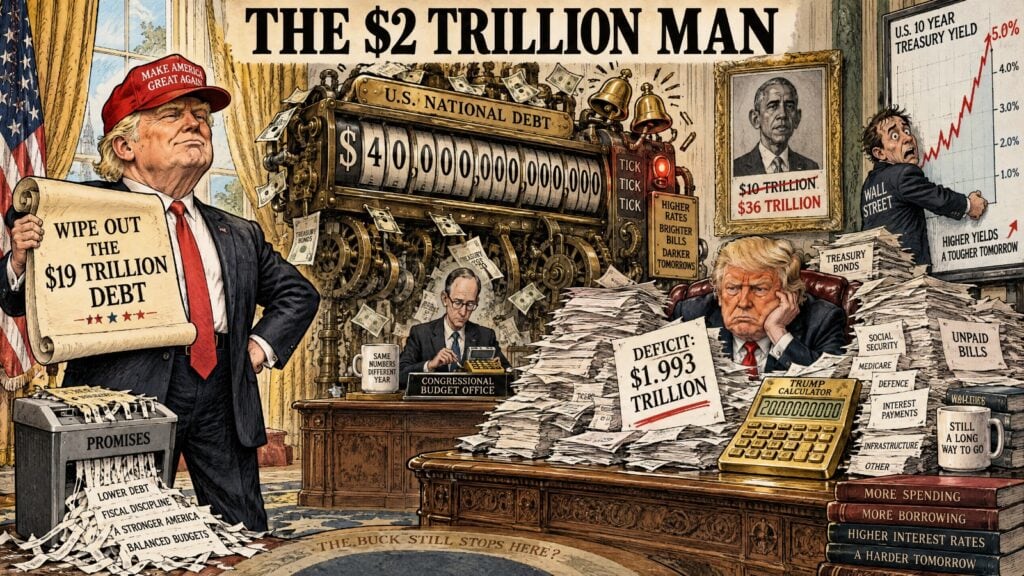
Trump spent years attacking Barack Obama over America's debt. This wasn't an obscure policy position buried on page 84 of a manifesto that nobody read. Debt was part of his political repertoire. When he ran for president in 2016, America owed roughly $19 trillion and Trump didn't merely promise to improve the situation. In an interview with Bob Woodward and Robert Costa, he said he believed he could get rid of the entire thing “over a period of eight years”, principally through better trade deals and economic growth. The Washington Post's fact-checking operation subsequently pointed out the fairly substantial mathematical difficulty involved: before paying off $19 trillion of existing debt, the government would first have to stop adding new deficits to it. Washington Post: Trump's $19 trillion debt pledge
Trump nevertheless kept returning to the subject. Once in office, he stood before Congress in February 2017 and complained that the Obama administration had added more new debt than nearly all previous presidents combined. That wasn't a stray remark from the campaign trail; it was in his first joint address to Congress as president, presented as part of the economic mess he said his administration had inherited. White House archive: Trump's 2017 address to Congress
The rhetoric continued even as the debt increased during his first administration. In July 2018, Trump told Sean Hannity that once his tax changes really kicked in, America would start paying down its then $21 trillion debt “like it’s water”. Days later, he argued that tariff revenues would allow the government to begin paying down large amounts of the debt accumulated under Obama. By 2019, when a reporter pointed out that the debt had already climbed from just under $20 trillion when Trump entered office to more than $22 trillion, Trump returned to his criticism of Obama before arguing that economic growth would ultimately solve the problem. Washington Post: Trump's record on the national debt White House archive: Trump questioned about rising debt in 2019
By 2020, Trump was still saying debt mattered “very much”, although his explanation had evolved. He argued that military rebuilding had been necessary and that extraordinarily low interest rates made America's debt easier to carry, before once again blaming the scale of inherited borrowing and promising that growth and trade deals would eventually improve the position. That is a perfectly legitimate argument to make. It is simply rather more nuanced than the standard Trump had previously applied to the other bloke. White House archive: Trump on the national debt in 2020
This is where the story becomes less about one enormous number and more about an old political habit: fiscal rectitude is considerably easier when someone else is president.
There is an important distinction here because politicians have a habit of using “deficit” and “debt” as though they are interchangeable, normally selecting whichever produces the more terrifying number. The deficit is the difference between what the federal government spends and collects during a particular year. The national debt is, broadly speaking, the accumulated result of years of borrowing.
Think of America as a man with an enormous credit-card balance who is still spending considerably more every month than his salary. The $40 trillion debt is what is already sitting on the statement. The roughly $2 trillion annual deficit is the fact that he is still wandering around the shopping centre.
The slightly alarming part is that the credit-card company has also increased the interest rate.
US government debt has now exceeded $40 trillion, while annual interest costs are around $1 trillion or more. Reuters recently calculated that roughly 20 per cent of federal tax revenue is being swallowed by debt servicing. That means approximately one dollar in every five Washington collects in tax is already spoken for before anyone starts discussing roads, schools, aircraft carriers, border security, healthcare or whatever else Congress would quite like to spend money on. Reuters: Washington confronts rising bond yields and debt costs
This is why interest rates matter so much. For years, enormous government debts were surprisingly easy to ignore because borrowing was extraordinarily cheap. If somebody lends you a fortune at almost no interest, you can become remarkably relaxed about owing them a fortune. When the interest rate rises, the personality of the debt changes rather quickly.
The US government continually refinances maturing debt while issuing new bonds to fund fresh deficits. If investors demand higher yields, the interest bill increases. That additional interest becomes government spending, which can enlarge future deficits, which requires more borrowing, which itself creates additional interest expense. It is a hamster wheel, except the hamster has somehow acquired a Bloomberg terminal and a $40 trillion overdraft. Reuters analysis of US borrowing and Treasury yields
This is also why comparing today's deficit with the pandemic years needs some care. In 2020, the US government ran a deficit above $3 trillion, but it did so while facing an extraordinary economic emergency. Businesses were closed, unemployment exploded and Washington deliberately borrowed vast sums to support households and companies through a once-in-a-century disruption. You can argue about individual policies, but the reason for the fiscal explosion wasn't particularly mysterious.
The current position is much stranger. The Congressional Budget Office entered this year already projecting a deficit of about $1.9 trillion for 2026 while simultaneously forecasting stronger economic growth during the year. The final estimate has come in at $1.993 trillion. In other words, this isn't principally the result of an economy collapsing and tax receipts disappearing down a hole. America is running an enormous structural deficit while its economy continues to expand. Congressional Budget Office: Budget and Economic Outlook 2026–2036
Normally governments use the good years to repair some of the damage from the bad ones. You borrow during recessions, wars and emergencies, then improve the public finances when employment is strong and the economy is growing. America appears increasingly to have developed a different system in which it borrows heavily during emergencies and then celebrates the return to normality by continuing to borrow heavily.
It is the fiscal equivalent of using the emergency credit card for the weekly shop because, technically, nobody has cancelled it yet.
This is where we have to interrupt the jokes with something annoyingly important: America’s fiscal problem is not solely Donald Trump’s creation. It wasn’t solely Barack Obama’s or Joe Biden’s either. The federal budget contains enormous structural commitments, particularly Social Security and Medicare, whose costs rise as the population ages. Congress determines taxation and spending. Republican and Democratic administrations have both added substantially to the debt, and American voters have repeatedly demonstrated an impressive enthusiasm for lower taxes and generous government programmes provided nobody asks them to choose between the two.
The arithmetic is actually horribly simple. If America wants to stabilise its debt over the long term, it ultimately needs some combination of lower spending, higher revenue and stronger economic growth. Each option is popular until translated into English. “Lower spending” means identifying actual things people currently receive and taking them away. “Higher revenue” means taxes. “Stronger growth” is wonderful but cannot simply be ordered from Amazon.
The current Trump administration and Republican-controlled Congress have pursued spending reductions in some areas while extending tax cuts and increasing expenditure elsewhere. According to the current Wall Street Journal account, reductions affecting clean-energy tax breaks, healthcare subsidies and food assistance have not been sufficient to prevent the overall deficit rising, while tariff revenues have also failed to provide the fiscal transformation once promised. Interest costs alone accounted for more than half of the year’s increase in the deficit. Wall Street Journal: breakdown of the 2026 deficit
So this is not an argument that Trump personally found $1.993 trillion behind the sofa and accidentally spent it. It is an argument about the standard he chose to apply to presidents before him and the standard now required when the same arithmetic appears underneath his own administration.
That is the really interesting comparison. If Trump had spent the Obama years arguing that deficits were complicated, that presidents didn’t control every dollar Congress spent, that structural entitlement programmes mattered and that borrowing sometimes made sense depending upon the economic circumstances, there wouldn’t be much irony here. Those are all perfectly defensible positions.
But that wasn’t the sales pitch.
The sales pitch was that America’s enormous debt reflected political incompetence and bad deals, and that a brilliant businessman could fix it. His 2016 campaign included a promise to eliminate the then $19 trillion national debt within eight years, alongside proposals to cut government spending and use stronger economic growth to increase revenues. The Washington Post’s contemporary catalogue of his campaign promises records the debt pledge alongside his promise to reduce the budget through negotiation and spending restraint. Washington Post: Trump’s 2016 campaign promises
Then came the presidency and reality behaved rather rudely. The debt kept rising. Trump’s explanation increasingly incorporated the same complications that confront every president: military spending was necessary, inherited obligations mattered, growth would take time, low interest rates made borrowing manageable and future trade agreements would eventually help. In isolation, none of those arguments is ridiculous. The amusing bit is that Barack Obama could presumably have used several of them too.
The numbers, unfortunately, have no sense of humour and even less party loyalty. Treasury bonds do not know whether the president is Republican or Democrat. They don’t watch Fox News or MSNBC. They don’t care who won Pennsylvania. Investors lend the US government money and ask what return they require for doing so.
Arithmetic is terribly woke like that.
The deficit isn’t merely a Washington argument involving politicians standing behind lecterns pointing at enormous numbers. The United States sits at the centre of the global financial system, and Treasury securities are part of the foundations underneath it. Their yields influence mortgage rates, company borrowing costs, equity valuations, currencies and the return investors demand for owning almost every other financial asset.
That is why we spend so much time in the FX Axe education material talking about yields and interest rates. When Washington needs to borrow enormous sums, it issues Treasury securities. Investors have to be persuaded to buy them. If those investors become more concerned about inflation, deficits or the sheer quantity of debt coming to market, they can demand higher yields. Those higher yields then ripple outward through the financial system. Reuters reported this week that Washington is already confronting long-term yields near two-decade highs while servicing more than $40 trillion of debt. Reuters: what rising US bond yields mean for Washington
Higher Treasury yields can support the dollar because dollar-denominated assets become relatively more attractive. They can simultaneously pressure equities because future corporate earnings are being discounted at a higher rate, while companies themselves face more expensive borrowing. They can hit mortgages, commercial property and government finances. Suddenly the federal deficit isn’t an abstract political number anymore. It is sitting inside the price of money.
And this is where the whole story becomes rather more serious than an amusing collection of old Trump quotes. The larger America’s debt becomes, the more sensitive the government’s finances become to the rate of interest it must pay. A $40 trillion debt burden and higher-for-longer interest rates are a rather different proposition from a $20 trillion debt burden financed in a near-zero-rate world.
Perhaps the most revealing thing about America’s debt problem is that almost everybody agrees it is unsustainable right up until somebody suggests doing something that would actually reduce it. Cut Social Security? Absolutely not. Medicare? Certainly not. Raise taxes? Best of luck. Defence? The world has inconveniently refused to become less dangerous. Cut everything else? Fine, provided the government doesn’t cut the particular programme, tax break or subsidy that benefits whoever is currently answering the question.
This is not uniquely a Trump problem. It is an American political problem and, increasingly, one shared across much of the developed world. Governments have spent decades discovering that promising things is electorally rewarding and sending people the invoice somewhat less so.
Trump simply makes an unusually entertaining case study because he spent so long presenting the answer as if it were principally a question of competence. In 2016, America owed about $19 trillion and candidate Trump said he could eliminate that debt within eight years. In 2017, President Trump stood before Congress and condemned the debt accumulated under Obama. In 2018, he said America would soon start paying its debt down “like it’s water”. By 2020, with the debt still rising, he was explaining why military spending, inherited obligations, interest rates and future economic growth all needed to be taken into account. Washington Post: Trump’s eight-year debt promise White House archive: Trump’s 2017 address to Congress White House archive: Trump’s 2020 debt comments
And now America has passed $40 trillion of national debt and has just recorded another annual deficit of almost $2 trillion. None of that proves that every Trump economic policy is wrong, just as the debt accumulated under previous administrations did not prove that every policy they pursued was wrong. Presidents inherit economies, commitments and legislation they did not create, while Congress holds enormous power over the public finances.
It does, however, demonstrate something markets teach people rather brutally sooner or later: arithmetic doesn’t care about branding. You can call the previous administration incompetent. You can promise that better deals will transform the finances. You can insist that growth will solve the problem and tariffs will start paying down the debt. Eventually, somebody from the Congressional Budget Office turns up with a calculator.
And $1,993,000,000,000 is quite a lot for the calculator to display.
Perhaps the most formidable critic of Donald Trump’s current fiscal record, therefore, isn’t a Democrat, an economist or some troublesome bond trader in New York. It is Donald Trump circa 2016, who had some extremely strong opinions about presidents who allowed America’s debt to keep rising.
It would be fascinating to hear what he thinks of the bloke currently in charge.
Keep your Axe sharp. And always save your old tweets.
Max
Join the FX Axe newsletter and stay one chop ahead.

