

One of the recurring difficulties when writing about Donald Trump is that occasionally you come across a sentence which sounds as though it has been deliberately constructed by his critics to make him look bad, only to discover that it is simply a factual description of events.
Here is today’s example.
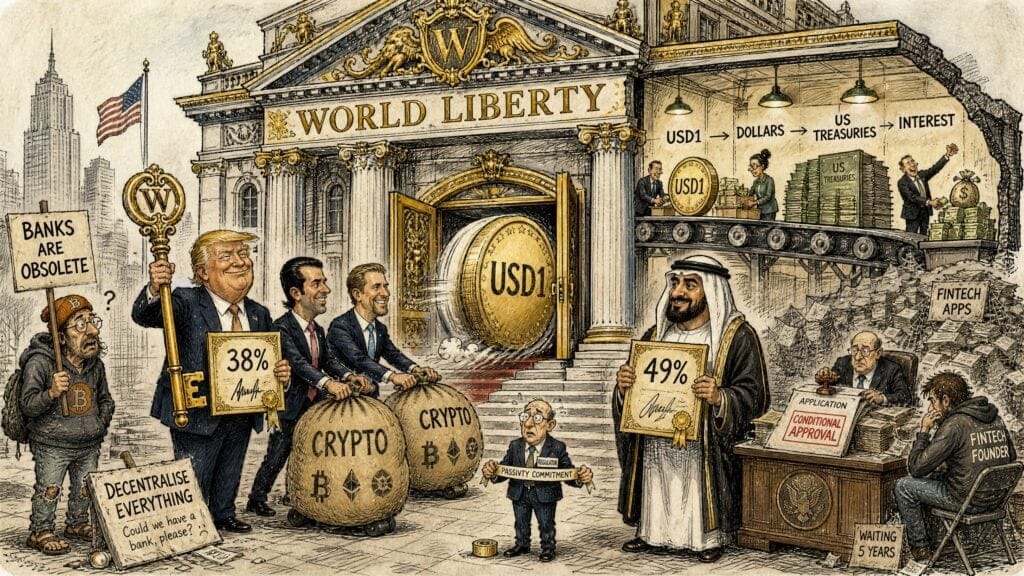
The family of the sitting President of the United States is preparing to become a major owner of a federally chartered crypto bank, alongside the national security adviser of the United Arab Emirates.
There really isn’t a great deal of garnish required.
The business is World Liberty Financial, the Trump family’s crypto venture. Earlier this month America’s Office of the Comptroller of the Currency gave preliminary conditional approval for its subsidiary, World Liberty Trust Company, to operate as a national trust bank. It will principally issue, redeem and safeguard USD1, World Liberty’s dollar-backed stablecoin, which has grown into a multibillion-dollar asset. The Times — Trump Family’s New Crypto Bank Is Backed by Abu Dhabi Sheikh
And according to reporting first published by The Wall Street Journal and carried by The Times, an entity connected to Sheikh Tahnoon bin Zayed al Nahyan and his co-investors owns 49% of the bank’s holding company. A Trump-family-affiliated entity owns another 38%.
Tahnoon is not simply a wealthy Emirati gentleman who happens to enjoy crypto. He is the brother of the UAE president, the country’s national security adviser, deputy ruler of Abu Dhabi and one of the most powerful men in the Gulf.
Which does rather make opening a joint bank with the American president’s family sound less like an episode of Dragons’ Den and more like the sort of thing that, until recently, would have required an extremely long meeting with the ethics department.
If the name World Liberty Financial sounds familiar, it should. We have been here before.
Donald Trump and his family launched themselves into cryptocurrency around the 2024 election and have since demonstrated a frankly breathtaking ability to monetise the intersection between politics, celebrity and digital assets. World Liberty sold governance tokens; Trump launched the $TRUMP meme coin; Melania Trump launched her own token; Trump’s sons became involved with crypto businesses; and the family’s financial interests spread into everything from bitcoin mining to publicly traded crypto vehicles.
Reuters calculated in June that the Trump family had made an estimated $2.3 billion from four principal crypto ventures between mid-2024 and April 2026, while outside investors in those ventures had collectively suffered losses of a similar magnitude at the prices Reuters examined. World Liberty alone generated more than $1.4 billion for the Trumps, according to the Reuters analysis, while the $TRUMP meme coin generated an estimated $616 million. Reuters investigation — Parsing the Trumps’ crypto profits and investors’ losses
That is quite a business model.
Forbes subsequently calculated that Donald Trump took in about $2.4 billion during 2025, compared with roughly $760 million in 2024. Around $1.4 billion of that year-on-year increase came from cryptocurrency, according to its analysis of his disclosures, securities filings, bond documents and other records. Forbes — Trump Is Making Three Times As Much in the White House As He Did in Business
Having spent much of his earlier political career dismissing crypto as something “based on thin air”, Trump has undergone what may be one of history’s more financially rewarding ideological conversions.
Sell the revolution.
Buy the assets.
The relationship with Sheikh Tahnoon makes all of this considerably more interesting.
A Tahnoon-linked investment vehicle reportedly agreed to put $500 million into World Liberty Financial for a 49% stake shortly before Trump returned to office. The arrangement subsequently attracted scrutiny from US senators because Tahnoon’s sprawling interests also extend into strategically sensitive areas including artificial intelligence.
That timing and overlap matter because the Trump administration has simultaneously been dealing with the UAE on access to advanced American AI technology. Democratic senators Elizabeth Warren and Andy Kim consequently asked the US Treasury to initiate a national-security review of the investment through the Committee on Foreign Investment in the United States. Reuters — Senators seek CFIUS probe of UAE stake in Trump family crypto company
There is no established evidence that Tahnoon’s investment purchased a particular US government decision. That is important. Foreign investors are allowed to invest in American companies, presidential relatives are allowed to conduct business, and correlation remains stubbornly different from proof of causation.
But politics is not conducted in a laboratory, and the circumstances create some fairly obvious questions.
Maybe everything is entirely proper.
But if you were designing a hypothetical examination question entitled “Explain the concept of a potential conflict of interest”, you probably wouldn’t need to make the scenario much more complicated.
This is what makes the latest development different.
World Liberty was originally marketed around the wonderfully crypto-sounding idea of decentralised finance: removing traditional intermediaries and allowing people to transact through blockchain technology.
It has now evolved sufficiently that it would quite like a federally chartered bank.
There is something rather beautiful about that journey. Banks are obsolete, decentralise everything and free yourself from the financial establishment — followed, several billion dollars later, by:
The proposed World Liberty Trust Company is not a conventional high-street bank. You won’t be popping into the Lake America branch to deposit your salary or asking Eric Trump for a mortgage. Its purpose is primarily to manage USD1, the stablecoin World Liberty launched last year, including issuance, redemption and custody.
But a federal charter matters. It gives the enterprise regulatory standing and potentially allows it to integrate much more deeply into the American financial system.
Reuters Breakingviews highlighted the extraordinary regulatory position this creates. World Liberty has received provisional approval despite the obvious political conflicts surrounding the Trump family connection, while other fintech applicants with extensive financial-sector experience have faced an extremely demanding regulatory process. Reuters Breakingviews — Trumps laugh all the way to the bank charter
Regulators have attempted to build safeguards around the arrangement. Significant shareholders, including representatives of both the Trump and Tahnoon interests, have reportedly made “passivity commitments” designed to prevent them from influencing the bank’s management.
Which is reassuring.
Although “the president’s family owns 38% but promises not to interfere” is not a sentence I remember from It’s a Wonderful Life.
USD1 is where this becomes especially fascinating.
A stablecoin is essentially a digital token designed to remain worth one US dollar, normally backed by assets such as cash and short-term Treasury securities. The business can be enormously lucrative at scale because the issuer receives actual dollars, invests the backing assets and earns the interest while token holders continue holding the digital dollars.
In other words, if billions of USD1 are circulating and the reserves are invested in US government debt, somebody is earning the yield.
World Liberty’s stablecoin has already become a major crypto asset, and its growth has been helped by relationships in the Gulf. The entire episode neatly demonstrates why cryptocurrency has become such a perfect business for the Trump era: politics, financial regulation, sovereign wealth, international diplomacy and private profit all occupy roughly the same few square metres.
The overlap is becoming increasingly difficult to miss. In February, Eric Trump and Donald Trump Jr hosted the World Liberty Forum at Mar-a-Lago. Guests included some of the most powerful people in American finance alongside federal officials and lawmakers. Goldman Sachs chief executive David Solomon, Nasdaq chief Adena Friedman and New York Stock Exchange president Lynn Martin were among the announced speakers. Reuters — Wall Street chiefs join Trump sons’ World Liberty Forum at Mar-a-Lago
Again, individually none of this proves corruption.
Collectively, it is certainly unusual.
Crypto is also only part of the broader story.
Trump’s traditional international licensing business has come roaring back since his return to political power. According to Forbes, his foreign licensing operation generated $61 million in 2025, an astonishing 900% increase from 2023.
And where did more of that money come from than anywhere else?
The United Arab Emirates.
Trump collected around $23 million from UAE deals, compared with $10 million from India, $9 million from Saudi Arabia and $5 million apiece from Qatar, Romania and Vietnam. Forbes — Trump’s Foreign Licensing Business Grew 900% As He Returned to Power
There is a rather important historical comparison here. During Trump’s first presidency, his organisation promised not to enter new foreign deals. Whatever you thought of the arrangement, there was at least an acknowledgement that having the President of the United States simultaneously expanding his private business empire overseas presented an ethical problem.
That restraint has largely disappeared in the second term.
Forbes has documented a rapid expansion of overseas Trump-branded developments since his political comeback, particularly across the Middle East. Forbes — How Trump Used the Presidency to Expand His Global Empire
Again, none of those figures alone proves impropriety. The White House has repeatedly said there are no conflicts of interest and that Trump’s sons handle the businesses.
But they create an arrangement rarely encountered in modern democracies: foreign governments, sovereign-linked investors and businesspeople negotiating with the American government can simultaneously inhabit a world in which enormous sums of money can flow into businesses attached to the president and his family.
Even if every decision is taken perfectly independently, the appearance problem is not exactly subtle.
The standard defence is that Trump does not personally manage these businesses day to day and that his sons operate them independently.
That would be considerably more persuasive if the businesses weren’t repeatedly monetising Donald Trump.
The $TRUMP coin does not derive its commercial value from Eric’s detailed knowledge of distributed-ledger architecture. World Liberty did not suddenly attract hundreds of millions of dollars because Barron had discovered an overlooked inefficiency in decentralised lending.
The economic asset is proximity to Trump.
That is why this is fundamentally different from a president having an ordinary diversified investment portfolio. If a president owns shares in Microsoft, Microsoft does not become dramatically more valuable because a foreign government wants access to him personally.
A token with his name on it rather obviously can.
That distinction matters.
There is another side to the Trump crypto boom that shouldn't disappear amid the enormous numbers.
Reuters’ investigation found that while the family made an estimated $2.3 billion from the four crypto ventures it examined, outside investors had collectively lost approximately the same amount at the measurement point. The family, Reuters found, had generally put comparatively little of its own capital at risk.
The $TRUMP meme coin alone generated an estimated $616 million for the Trump family, according to Reuters, while investors had suffered more than $700 million in losses. World Liberty investors were estimated to have sustained hundreds of millions more, although the company disputes treating governance-token movements in the same way as conventional investment gains and losses. Reuters — Parsing the Trumps’ crypto profits and investors’ losses
That caveat is fair.
But there is something extraordinary about a presidency during which members of the public can buy the president’s crypto token, foreign officials can invest hundreds of millions in his family’s crypto company, federal regulators can approve that company for a banking charter and the administration can simultaneously determine the regulatory framework governing the entire industry.
Whatever your politics, that is new territory.
Very much so.
The serious crypto story here isn't $TRUMP or whether somebody paid too much for a digital token bearing the president’s name. It is stablecoins moving into the plumbing of global finance.
World Liberty wants USD1 to become part of that plumbing. If stablecoins continue growing, their issuers could become significant holders of US Treasuries, major participants in international dollar payments and competitors to parts of the traditional banking system.
That is a genuine economic story, and there are legitimate arguments on both sides about whether dollar stablecoins ultimately strengthen American financial dominance or create new systemic risks.
It would simply be considerably easier to have that debate if the president’s family weren't simultaneously positioned to make an enormous amount of money if his preferred side wins.
America has had rich presidents before. Washington owned enormous amounts of land. Kennedy came from extraordinary wealth. Roosevelt was born into it. Modern presidents have written books, given speeches and made fortunes after leaving office.
The unusual thing about Trump is not that he is wealthy.
It is the almost complete collapse of the distance between political power and commercial opportunity while he is exercising that power.
During the second term, crypto policy has changed dramatically. Trump-associated crypto businesses have generated enormous revenues. Foreign licensing income has surged 900% from 2023. A UAE royal serving as his country's national security adviser has invested hundreds of millions in the family crypto venture. That venture has now received conditional approval from an agency inside Trump’s own administration to operate a federally chartered trust bank.
Perhaps every individual decision survives scrutiny.
But stand far enough back and the picture is still remarkable.
A decade ago, American politics spent weeks debating whether a foreign government booking rooms at a Trump hotel might violate constitutional norms.
In 2026, an Abu Dhabi sheikh can reportedly own 49% of the holding company behind the president's family crypto bank and the reaction is increasingly:
Yes, but which one?
That may be the most Trumpian achievement of all. Not merely making extraordinary sums of money while president, but expanding the scale of the enterprise so rapidly that yesterday's scandal begins to look almost quaint.
The man who promised to run America like a business may have delivered on that promise rather more literally than anybody expected.
And business, it turns out, is booming.
Keep your Axe sharp.
And perhaps check who owns the bank.
Max
Want more of The Daily Chop?
Sharp market stories, trading takes and financial madness straight to your inbox.

