

There is a peculiar form of financial masochism familiar to anyone who has ever traded. You make a bad call, watch the position move determinedly in precisely the opposite direction to the one you predicted, close it at a loss and then spend the rest of the afternoon wondering how somebody apparently incapable of getting even a whiff of direction as to what EUR/USD will do between breakfast and lunch is nevertheless allowed to operate heavy machinery or indeed, breed.
So, for anyone currently staring mournfully at a red number on their trading account, I have some reassuring news: people have been getting markets spectacularly wrong for centuries. Not stupid people either. Generals, millionaires, entrepreneurs and, in one particularly satisfying case, quite possibly the cleverest man who ever lived.
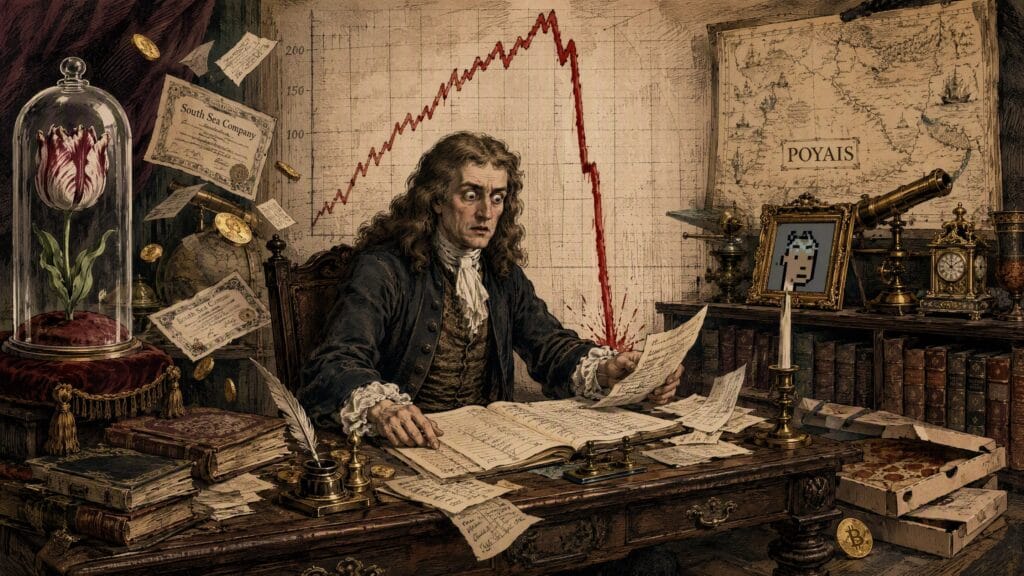
Welcome to Max's Daily Chop-today a brief run down of both people getting absolutely mumba’d by the market, and my top 3 historic horror trades.
But before we travel back a few centuries, consider something rather more recent.
From $623,000 to… considerably less
In 2021, Logan Paul bought an NFT from the 0N1 Force collection for around $623,000. It was a sort of pixelated character called Bumblebee, because apparently there was a brief period in human civilisation when sentences like that could contain the words “$623,000” without anyone immediately calling an ambulance.
Then the NFT market collapsed.
A claim subsequently went viral that Paul’s $623,000 picture was worth just $10. That wasn’t quite fair. Contemporary estimates from DappRadar put its value nearer $9,000, although that still represented a loss of roughly 98.5%. (CoinMarketCap)
Whether you like Logan Paul or would rather spend an evening trapped in a lift with a recorder ensemble, he is extraordinarily good at understanding popular attention. He has built businesses and an enormous audience largely by knowing what people will be interested in next.
And he still bought near the top.
That matters, because markets aren’t simply exercises in identifying whether something is “good”. They’re exercises in understanding what everybody else thinks it is worth, what everybody else might think tomorrow and, crucially, when they might suddenly stop thinking it.
The reverse is eye gougingly more painful.
On 22 May 2010, programmer Laszlo Hanyecz made the first widely recognised commercial Bitcoin purchase, paying 10,000 BTC for two Papa John’s pizzas. The Bitcoin was worth roughly $41 at the time. (Guinness World Records)
At Bitcoin’s later six-figure highs, those coins would have been worth comfortably more than a billion dollars.
Two pizzas.
You’d hope they were quite nice. Which of course they weren’t, because they were bought from Papa John’s.
Hanyecz has repeatedly said he doesn’t regret it, which is a lie, though to be fair somebody actually had to use Bitcoin for it to become useful. But his story and Paul’s sit rather beautifully at opposite ends of the same problem. One man disposed of an asset before anybody knew how valuable it might become; another bought an asset when everybody appeared convinced it could only become more valuable.
Neither knew what happened next.
Neither do we.
And we certainly aren’t the first generation to discover this.
So let’s cast our minds back through the misty haze of time to Max’s favourite financial fuck-ups. (The alliteration there too tempting to pass by)
Of all the great financial frauds and unimaginative names, Gregor MacGregor’s deserves recognition for sheer ambition.
MacGregor was a Scottish soldier and adventurer who had fought in Latin America. In the early 1820s, with British investors fascinated by the opportunities emerging from the newly independent nations of Central and South America, MacGregor returned to Britain with an absolutely magnificent investment proposition.
He had a country.
It was called Poyais, on the Mosquito Coast (surely alarm bells here already-those bitey bastards don’t put me in mind of prosperous relaxation) of Central America, and MacGregor claimed to be its “Cazique”, or ruler. There was fertile land, commercial opportunity and a wonderful new society waiting to be built. He sold Poyaisian bonds and land certificates. There were official documents. There was even Poyaisian currency.
There was only one minor administrative difficulty.
Poyais didn’t exist.
Well, in the vein of absolute accuracy, the physical location did exist. What wasn’t there was the prosperous country MacGregor had described. The British Museum rather delicately describes the destination as, “at best an uninhabitable swamp and, at worst, an invention of MacGregor’s imagination.” (British Museum)
Around 250 settlers sailed there in 1822 and 1823. They arrived expecting a functioning colony and instead found wilderness. Disease and starvation followed; historical accounts suggest at least 180 of them died. Worse, or if you’re a fan of our plucky Scottish conman, somewhat impressively, a second ship of hopeful settlers arrived after the first group had already discovered the catastrophe, while further vessels had to be intercepted. (Wikipedia)
MacGregor hadn’t merely sold people a bad investment. He had persuaded families to liquidate their lives and physically move to a paradise colony that existed entirely in his own head.
But this wasn’t simply mass stupidity. It worked because MacGregor attached his story to one of the great investment narratives of his age: a newly opening world, fortunes being made overseas and opportunities unavailable to previous generations.
In modern language, Poyais had excellent thematic exposure.
The asset was unfortunately a toilet swamp.
Travel backwards again to the Netherlands in the 1630s and we arrive at perhaps history’s most famous speculative frenzy: Tulip Mania.
Tulips had become fashionable luxury objects, and rare varieties commanded extraordinary prices. Then something very familiar happened. People stopped buying tulips principally because they wanted tulips and started buying them because they believed somebody else would shortly pay more for them.
At the manic end of the market was the spectacular Semper Augustus. Reports put its value at 5,500 guilders in 1633, with a quoted price of 10,000 guilders by early 1637. For context, 10,000 guilders was enough to buy one of the grandest houses on an Amsterdam canal. Another variety, Admirael de Man, reportedly went from 15 guilders to 175 in only a few months: an increase of more than 1,000%. (Reserve Bank of Australia)
There is legitimate historical debate about how widespread Tulip Mania really was, and some of the more lurid stories have been embellished over the centuries. But the underlying speculative boom was real. By February 1637 buyers suddenly stopped appearing, and the extraordinary market unravelled. (Cairn Droit)
The fascinating bit isn’t that seventeenth-century Dutchmen were uniquely gullible.
It’s that they sound remarkably modern.
Scarcity. Status. Explosive recent returns. Everybody talking about the same asset. People buying because other people were buying. A persuasive argument that this time the price "genuinely made sense".
Change “tulip bulb” to whichever asset is currently dominating your social-media feed and the basic machinery requires surprisingly little alteration.
And then we come to my favourite.
In 1720 Britain became obsessed with the South Sea Company.
The company had been established in 1711 and was granted valuable trading rights connected with Spanish America. Eventually it became deeply involved in restructuring British government debt, exchanging that debt for company shares. The promised commercial riches never materialised on anything like the scale imagined, but the story was magnificent, the political connections were impressive and the share price kept rising. (Newton and the Mint)
And rising.
South Sea stock went from roughly £128 in January 1720 to around £1,000 at its summer peak — approaching an eightfold increase in a matter of months. Then confidence cracked. By the end of September it was around £200–£300, ruining thousands of investors along the way. (Wikipedia)
Among them was Sir Isaac Newton.
Just consider the CV for a moment.
Newton formulated the laws of motion and universal gravitation. He transformed mathematics and optics. He helped invent calculus. He explained, with extraordinary precision, how objects move through the universe.
And he got FOMO.
The particularly wonderful part is that Newton initially appears to have played the trade brilliantly. He invested, watched the shares rise, sold and banked a substantial profit.
Then the shares kept rising without him.
Anyone who has ever traded knows exactly where this is going.
Newton watched other people continuing to make money, reconsidered his admirable caution and piled back in close to the top. When the bubble burst, the traditional estimate is that he lost around £20,000, often translated into several million pounds in modern purchasing power. More recent historical work suggests the precise figure is difficult to establish, but confirms that his losses were substantial. (Newton and the Mint)
Newton is subsequently reported to have observed that he could calculate the motions of heavenly bodies, but not “the madness of people”. The exact wording has probably evolved in the retelling, but the anecdote itself can be traced back to the eighteenth century. (Wikiquote)
And there, I think, is the lesson for every trader.
You aren’t supposed to know everything
Markets have better technology now. We have Bloomberg terminals, economic calendars, algorithmic execution, live central-bank commentary and approximately nine million people on X confidently explaining what the dollar is going to do next.
What we haven’t upgraded is the human being operating all of it.
Greed still feels like opportunity when everybody else is getting rich. Fear still feels like rational analysis when everybody else is selling. FOMO persuaded Isaac Newton to chase a stock in 1720 and it persuades people to chase candles on a screen three centuries later.
That doesn’t mean analysis is pointless. Quite the opposite. It means process matters more than pretending you can predict everything.
A good trader isn’t somebody who never takes a loss. Such a person either doesn’t exist or is shortly going to sell you a course-you won't believe trading tip number 7. A good trader controls the size of the losses, understands why a trade was taken, learns when the thesis was wrong and, most importantly, survives to take the next one.
So next time USD/JPY suddenly tears through the level you were absolutely certain would hold, don’t conclude that you’re uniquely hopeless.
Logan Paul mistimed NFTs. Someone once spent 10,000 Bitcoin to have an appalling supper. Dutch merchants speculated on flowers. Hundreds of Britons invested in a country that wasn’t there.
And Isaac bloody Newton sold for a profit, watched everybody else getting richer, bought back at the top and lost a fortune.
You will get trades wrong.
The trick is making sure no single one matters enough to end the journey.
Keep your head, stick to your system, manage the risk - and keep your Axe sharp.
Max
Want more of The Daily Chop?
Sharp market stories, trading takes and financial madness straight to your inbox.

