

Now look, I am not one of those intensely boring people who cannot separate their work from the rest of their life. You know the sort. The lawyer who sees a contractual dispute every time someone lends him a lawnmower. The estate agent who cannot walk past a perfectly pleasant family home without telling you what it would achieve per square foot. The trainspotter who, actually, probably doesn't have this problem because I’m not entirely sure trainspotting has a professional version. Perhaps railway engineering. Either way, you know what I mean. Some people allow one particular interest to seep into absolutely everything until a perfectly innocent Sunday lunch somehow becomes a seminar.
I am not one of those people.
I can already sense you detecting a fairly substantial but approaching here. There may even be people reading this who think I am exactly one of those people. We don't like those people, however, and their opinions are not to be trusted.
There is also a reasonable defence available to me. I am currently writing a blog every day, which means some degree of percolation between normal life and Max's Daily Chop is probably inevitable. I can't spend the morning thinking about something interesting and then sit down at a keyboard and pretend it didn't happen. And this week my wife and I have been looking at schools for our young daughter, which has unexpectedly got me thinking about trading, investment strategies, algorithms and, eventually, brokers.
I realise that sentence has not exactly helped my case.
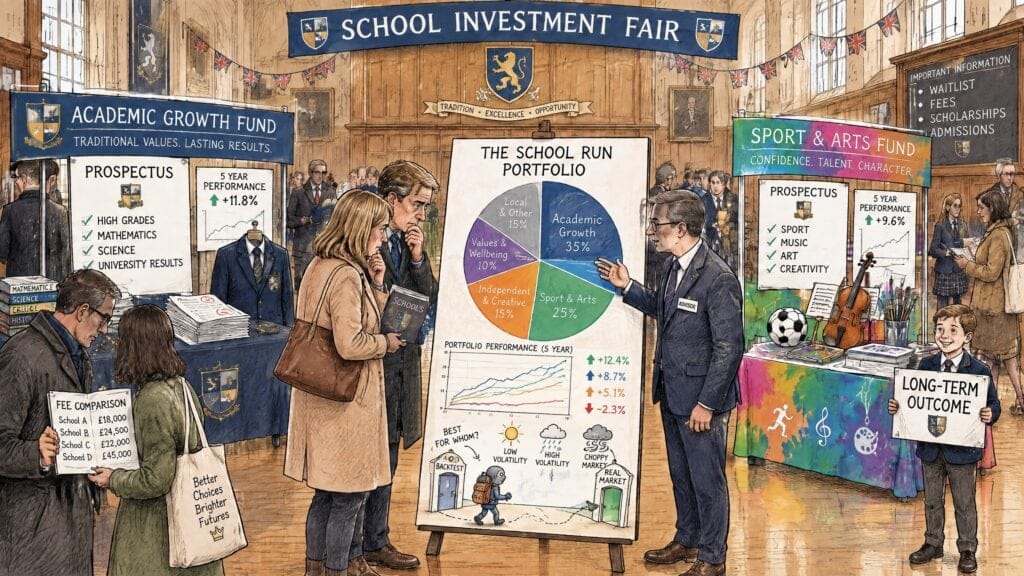
Choosing a school for your child is an extraordinary decision because you are effectively making an enormous long-term allocation based on a remarkably small amount of data. Our daughter is still very young. We know quite a lot about her as a person, obviously, but almost nothing about the person she will eventually become. We can see little things beginning to emerge: the books she wants read repeatedly, the animals she loves, colours she gravitates towards, nursery rhymes she inexplicably wants to hear for the 4,000th time and sports she seems more interested in watching than others.
Curiously, she seems particularly interested in cricket, rugby and history. Absolutely no idea where that's come from.
Trading too, obviously.
But we don't yet know whether she'll be highly academic, wonderfully artistic, obsessed with sport, brilliant at music or discover at sixteen that her life's great passion is something neither of us has even considered. Perhaps we'll spend years confidently assuming she's academically inclined only to discover that, when confronted with mathematics, she couldn't calculate the change from a tenner if the shopkeeper handed her the receipt. Meanwhile she turns out to be able to paint like Hockney or cover 100 metres before I've managed to start the stopwatch.
And yet right now we're being asked to make a decision that will help shape all of those things.
That is what got me thinking about markets, because underneath all the emotion involved in choosing a school is something traders encounter constantly: you have to make the best decision you can using information that is necessarily incomplete.
Imagine two schools. School A has phenomenal academic results, traditional teaching, exceptional mathematics and science departments and sends half its pupils off to excellent universities. School B has perfectly respectable academics but an extraordinary arts department, magnificent sports facilities and a philosophy built around developing individual interests. Which is the better school?
There isn't an answer.
There is only the better school for the child.
That is remarkably similar to choosing a broker or constructing a trading strategy. There is no universally perfect broker because traders want different things. Someone making a handful of long-term equity investments has completely different requirements from somebody trading FX intraday. Execution speed might be absolutely critical to one and almost irrelevant to another. Asset range, spreads, leverage, regulation, platform, research and customer support all matter differently depending on what you're actually trying to achieve.
The same is true when building an algorithm or strategy. You begin with the information available to you. You establish the objective, look at historical data, identify patterns, test assumptions and decide what conditions you want the strategy to operate within. Eventually you reach a point where you have to press the button.
Then reality turns up.
This is something I think people misunderstand constantly, not just in trading but in life. We tend to judge the quality of a decision by what happened afterwards. If it worked, clever decision. If it failed, stupid decision. But that is hopelessly simplistic because a good decision and a good outcome are not the same thing.
Suppose we choose a school after months of research. We've visited it, spoken to teachers, looked at results, understood its ethos, considered our daughter's personality and concluded that it is the best environment for her. Five years later it turns out not to suit her. Does that mean the original decision was bad? Not necessarily. We may have made the correct decision based on everything we could reasonably have known at the time. The information simply changed.
Markets are full of exactly the same problem. You can analyse a company properly, understand its balance sheet, assess its competitive position, buy it at what appears to be a sensible valuation and then watch something completely unforeseen destroy the investment case. A government changes regulation. A competitor invents something better. Management changes. A war starts. A pandemic arrives. The fact that the investment eventually lost money doesn't automatically mean the original analysis was idiotic.
Conversely, you can make a catastrophically stupid decision and make a fortune. People do it every day. Buying an asset you don't understand because a bloke called CryptoDave1987 told you it was going to the moon remains a terrible investment process even if, by sheer chance, CryptoDave turns out to be right.
Outcome matters. But process matters too.
The more difficult question comes afterwards. At what point do you admit that a perfectly sensible original decision is no longer working?
If our daughter eventually turns out to be a superb sportswoman attending a school that treats physical education as something to occupy children while the maths teachers have lunch, we would have to reconsider. That wouldn't mean the school had suddenly become bad. It might remain an outstanding school. It simply might no longer be the right school for her.
That distinction is enormously important in trading. People become emotionally attached to positions because changing them feels like admitting they were wrong. They bought the share at £10, therefore they will keep explaining why it is worth £10 while watching it pass £8, £6 and eventually £3. The original thesis becomes almost irrelevant because the objective quietly changes from making money to proving that Past Me wasn't an idiot.
A strategy can be excellent and still stop working. A broker can be excellent and cease to suit the way you trade. A company can be excellent and become too expensive. A school can be excellent and be completely wrong for your child. Quality and suitability are related, but they are not interchangeable.
The intelligent response isn't blind loyalty and it isn't constant tinkering. It is periodically asking whether the original assumptions still hold.
This is where the school comparison becomes even more interesting. We could theoretically choose exactly the right school on paper. Its academic approach suits her, its sports and arts provision match her interests, the teachers are excellent and everything appears perfect. Then she arrives and struggles socially. Perhaps she finds making friends difficult. Perhaps the particular group she falls in with isn't good for her. Perhaps something about the environment simply doesn't allow her to thrive.
Now the underlying institution hasn't necessarily changed at all, but the environment in which our strategy is operating has.
Trading algorithms have the same problem. A strategy designed in a low-volatility environment may behave completely differently when volatility explodes. A trend-following system can look brilliant while markets are moving strongly in one direction and dreadful when they become choppy. A strategy built around low interest rates may suddenly discover that 5% rates have rewritten the economics underneath it. Nothing necessarily went wrong with the original model; the environment changed.
That doesn't automatically mean abandoning it. Sometimes the correct decision is to do absolutely nothing.
There is an obvious danger here, because adaptation can very quickly become interference. If our daughter comes home one afternoon aged seven and announces that she hates school because someone stole her purple pencil, moving her immediately to another establishment would probably constitute an overreaction. Children have difficult weeks. Schools have difficult terms. Friendships change. You have to give decisions enough time to work.
Markets are no different. If you change your strategy every time it experiences a losing week, you don't really have a strategy. You have a nervous twitch with a trading account.
This is why the distinction between noise and information matters so much. A temporary drawdown doesn't necessarily invalidate a model any more than one miserable week invalidates a school. But repeated evidence that the assumptions underpinning your decision are wrong should eventually force you to reconsider. The challenge is giving a strategy enough time to prove itself without becoming so emotionally committed to it that you ignore evidence when it fails.
That balance between conviction and flexibility is probably one of the hardest things to get right. Too little conviction and you abandon good decisions before they have time to work. Too much and stubbornness starts masquerading as discipline.
Research improves the odds. It doesn't remove uncertainty.
I think this is ultimately what struck me while looking around schools. As parents, we naturally want to find the answer. We want enough prospectuses, conversations, visits, results tables and observations eventually to reveal the objectively correct decision. But there probably isn't one. There is simply a decision made with the best information available today, followed by years of observing whether reality continues to support it.
That is much closer to investing than I would perhaps like to admit.
Research matters enormously because it improves the probability of making a sensible decision. Due diligence matters. Understanding what you're buying matters. Knowing your objectives matters. Choosing a broker that suits the way you trade matters. Testing a strategy properly matters. But none of those things grants you access to the future.
The best you can do is construct something robust enough to cope with uncertainty and flexible enough to change when the evidence changes. In investing, that means knowing why you bought something before you buy it. In trading, it means understanding the conditions in which your strategy is supposed to work. In choosing a school, I suppose it means knowing what you're trying to provide for your child rather than becoming mesmerised by league tables, facilities or somebody proudly pointing at a Latin motto carved above the entrance.
And then you watch.
Not obsessively. Not every five minutes. Not changing everything because of every wobble. You allow the original decision time to work while remaining prepared to alter it if the evidence becomes strong enough.
Perhaps that's the biggest lesson. There is no point designing the theoretically perfect strategy if the person using it cannot live with it. A trading system that produces magnificent long-term returns but requires you to tolerate 50% drawdowns is useless if you know perfectly well you'll panic and sell at minus 25%. The mathematics may be excellent. The fit is terrible.
Education must work in much the same way. The school with the highest grades isn't automatically the best school. The most prestigious name isn't automatically the best choice. The best environment is the one in which the particular child standing in front of you has the greatest chance of becoming whatever version of themselves eventually emerges.
We don't know what that will be yet. That's simultaneously the terrifying and rather wonderful bit.
So we'll do the research. We'll look at the schools, understand their strengths, consider their weaknesses and make the most robust decision we can from the information available. Then we'll stick with it long enough to give it a proper chance, while keeping our eyes open to what the data — in this case, our daughter — tells us along the way.
And if in ten years' time she turns out to hate cricket, rugby and history and wants to become a conceptual artist specialising in interpretive dance, I'll accept that the model required recalibration.
Although obviously I'll be checking whether her mother interfered with the data.
Keep your Axe sharp. And never confuse a good strategy with one you're too stubborn to change.
Max
Join the FX Axe newsletter and stay one chop ahead.

