

On Good Friday, 18 April 1930, the BBC sat down to deliver its evening news bulletin and encountered a problem that now sounds almost unimaginably exotic.
There wasn’t any news.
Not not much news. Not a slow news day in which somebody had to find a photograph of a slightly unusual vegetable or send a reporter to interview Britain’s oldest tortoise. The BBC simply announced: “There is no news.” It then played piano music instead. This apparently lasted for about 15 minutes, after which normal programming resumed.
I find this absolutely wonderful. Imagine trying it today. “Good evening. Nothing much happened. Here’s some Chopin.” Sky News would have an aneurysm. Somewhere on X, somebody would immediately conclude that the absence of news was being suppressed by the government. Within 20 minutes there would be a YouTube video entitled WHAT THEY DON’T WANT YOU TO KNOW ABOUT THE PIANO, and by bedtime somebody would have discovered that the pianist’s cousin once attended a conference funded by George Soros.
We have travelled an extraordinary distance in less than a century. News used to be something you waited for. Events happened, journalists discovered them, newspapers printed them, vans drove those newspapers around the country and the following morning you found out what had happened yesterday. Now I can know that Donald Trump has said something peculiar whilst shitting his underpants again (allegedly, sigh) in Washington while he is, in all probability, still saying it. And requiring an urgent 15 minute personal meeting with Natalie Harp.
And for markets, that transformation has been even more profound. Information used to arrive. Now it attacks.
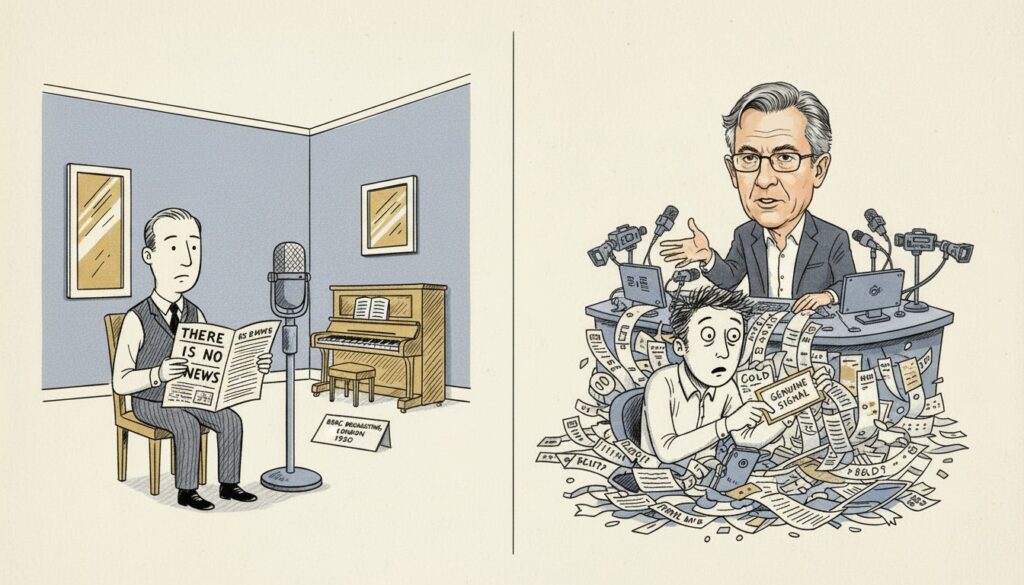
The development of news is really the story of collapsing time. Newspapers shortened the distance between an event and the public knowing about it. The telegraph shortened it again. Radio made information effectively immediate. Television added pictures. Satellite broadcasting made the whole thing global. Then came 24-hour news, the internet, smartphones, social media and finally the algorithm, at which point humanity solved the problem of not knowing what was happening by creating the entirely different problem of never being able to stop knowing what was happening.
Think about the sheer quantity of information that reaches an ordinary person now. Wars, earthquakes, football scores, celebrity divorces, election results, interest-rate decisions, company announcements, deaths, births, scandals, weather warnings and footage of a Labrador refusing to get out of a swimming pool are all delivered through the same rectangular piece of glass in your pocket.
Nothing has to wait.
And we have become so accustomed to this that the alternative feels almost absurd. There are adults alive today who remember watching the evening news specifically because that was when you discovered what had happened. If you missed it, you waited. A football match abroad might finish and you wouldn't necessarily know the score immediately. A politician could give a speech without several million people analysing individual sentences before he had reached the end of it.
Markets once had the same friction. Prices travelled comparatively slowly. Information advantages could exist because one person simply knew something before somebody else.
Now Jerome Powell can move trillions of dollars by changing an adjective.
The Federal Reserve releases a statement and within fractions of a second computers are parsing the language, comparing it with the previous statement and trading on the differences. By the time a human trader has finished reading the first paragraph, somebody's algorithm has already decided whether “somewhat elevated” is more hawkish than “moderately elevated”, bought $200 million of something and gone home for a tiny electronic lunch.
This is progress. Well, probably.
There is a fairly obvious assumption that more information must make us better informed. I’m increasingly unconvinced.
The problem is no longer access. Almost everybody with a smartphone has access to an amount of information that would have been inconceivable even 30 years ago. The problem is deciding what deserves attention, what is reliable, what matters and what is complete bollocks.
Worse, we increasingly don't even choose the information ourselves.
We choose the first piece, the algorithm chooses what comes next.
Spend an evening watching videos explaining why Donald Trump is wonderful and your feed will soon conclude that you would like some more Donald Trump being wonderful. Watch videos explaining why Donald Trump is terrible and, remarkably, your phone discovers an inexhaustible supply of Donald Trump being terrible. The same thing happens with politics, vaccines, wars, football teams, diets, investments and almost everything else about which human beings are capable of developing an unnecessarily strong opinion.
This doesn't require some sinister bloke sitting inside YouTube deciding to radicalise your uncle. It is largely the consequence of a much simpler commercial objective: platforms want you to keep watching. Giving people material they find interesting tends to accomplish that rather well.
The result is extraordinary. Two intelligent people can spend an entire day “following the news” and emerge that evening with almost completely different versions of what happened.
This is where the information revolution becomes particularly relevant to trading. The edge used to be getting information. Increasingly, the edge is filtering information.
Everybody knows when US CPI is released. Everybody can see non-farm payrolls. Everybody can watch the Federal Reserve. Everybody knows when oil moves 5 per cent. Everybody has economic calendars, charts, alerts, podcasts, X feeds, financial television and some bloke on YouTube explaining why gold is definitely going to $10,000, normally shortly before asking you to subscribe to his course.
The difficulty isn't finding a view, it's finding a reason to ignore 99 per cent of them.
Piers Morgan is an interesting character in this story because his career has essentially travelled through the history of modern media.
He began in newspapers, became editor of the News of the World at 29, then edited the Daily Mirror from 1995 until 2004. He moved into television, including Britain’s Got Talent, Good Morning Britain and his CNN interview programme in America, then launched Piers Morgan Uncensored with Rupert Murdoch's TalkTV.
And then something rather interesting happened.
The television programme became, increasingly, an internet programme.
Morgan left News UK at the beginning of 2025 and took control of the Uncensored brand through his own Wake Up Productions. The YouTube-led operation has subsequently developed into a broader digital media business spanning politics, interviews, history, sport and other programming. In June this year it raised $27 million, in a round led by Raine Ventures and Antenna Group and backed by investors including Elisabeth Murdoch and Simon and David Reuben. The fundraising valued the company at around $145 million.
That is quite a journey.
A man who once required Rupert Murdoch to give him a newspaper and then a television channel can now, effectively, own the printing press, television station and distribution network himself.
You don't have to like Morgan to recognise that he understands media. He is abrasive, opinionated and has accumulated enough controversies over his career to fill a small regional library. But he is also bright, well informed, argumentative and exceptionally good at understanding what produces attention. His programme regularly brings together people who profoundly disagree with one another and then, rather unsurprisingly, they disagree with one another.
Sometimes very loudly.
Morgan himself has said he believes traditional media could effectively be dead within a decade. That may be rather dramatic, but he is putting a considerable amount of his own business behind the theory. Uncensored has more than four million YouTube subscribers and is being expanded from one personality-led show into a network of digital programmes.
The fascinating part isn't really Piers Morgan.
It is what Piers Morgan no longer needs.
That brings us to Earl Spencer.
Charles Spencer has recently published Swan Song: Diana, My Sister, a new book about Diana. Among its claims was an allegation connecting Morgan to the publication of notorious covert photographs of Diana exercising at a gym in 1993.
There was a rather significant problem with this.
Morgan wasn't editor of the Daily Mirror in 1993.
The photographs were first published by the Sunday Mirror on 7 November 1993. At the time, Morgan was working for the Mirror's great rival, The Sun. He did not become editor of the Daily Mirror until October 1995, nearly two years later. Spencer subsequently acknowledged that his assumption was wrong, apologised to Morgan and said the error would be corrected in future editions.
Spencer stands by other disputed elements of his account, including his description of a telephone conversation with Morgan after Diana's death, and one demonstrated factual error obviously does not establish that everything else in a book is false. That distinction matters.
But look at what happened from a media perspective.
A major publisher released a book containing a damaging claim about Piers Morgan. Piers Morgan did not need to write a letter to the editor.
He did not need to telephone the BBC and hope somebody invited him onto Newsnight. He did not need another newspaper to decide his response deserved publication.
He turned on his own cameras.
On Piers Morgan Uncensored, he produced the dates, pointed out that he was working for a rival newspaper when the photographs appeared, attacked Spencer's account and asked the obvious question: if such a basic fact involving him was wrong, what confidence should readers place in other disputed claims in the book? Morgan also threatened legal action against Spencer and publisher Penguin Random House.
Within hours, the story had changed.
Morgan was still the subject of allegations in Spencer's book, but he had also become one of the principal distributors of the story about those allegations.
That is new. And enormously powerful.
This may be one of the strangest consequences of modern media.
Bad news used to be something public figures tried to suppress. Now, if you have sufficient reach, bad news can become content.
Morgan took an accusation against himself and converted it into a programme. The programme became clips. The clips travelled across X, YouTube and other platforms. Other newspapers reported Morgan's response. Television broadcasters interviewed him about the response. Spencer apologised for the specific error, which generated another round of stories, which gave Morgan another opportunity to respond.
The attack fed the machine.
That does not mean Morgan somehow “won” every substantive argument around Spencer's book. Some claims remain contested and should be described as such. But in communications terms he achieved something much more interesting: he seized control of part of the distribution.
Thirty years ago, the owner of the printing press possessed enormous power. Today, the person with four million subscribers may possess rather a lot of it too.
Morgan's business being valued at around $145 million suddenly makes more sense. Investors aren't merely valuing a television programme.
They're valuing attention.
This is also why media businesses increasingly look so different from the newspapers and television companies that preceded them.
A newspaper required printing presses, journalists, offices, distribution networks, vans, shops and enormous physical infrastructure. A television station required licences, studios, transmitters and access to scarce broadcasting spectrum.
A modern media company can begin with a camera, microphones and an audience.
Obviously producing high-quality journalism still costs money, and the idea that a bloke with a webcam is automatically equivalent to Reuters is nonsense. Reporting requires journalists, lawyers, editors, researchers and people prepared to stand somewhere unpleasant while everybody else sensibly stays at home.
But distribution has been democratised to an astonishing degree.
That is the real revolution.
Piers Morgan can publish globally without owning a television transmitter. Joe Rogan can speak for three hours and reach an audience larger than many traditional broadcasters. A Ukrainian civilian can upload footage of a missile strike before an international news crew has reached the location. A chief executive can bypass journalists and announce something directly on X. Donald Trump can communicate directly with tens of millions of people through his own social channels.
And every one of us can theoretically become part of the news network.
Which sounds marvellous until you remember that quite a lot of us are idiots.
The financial world is simply the most concentrated version of this transformation.
Markets have always been information-processing machines. Prices move because expectations change, and expectations change because information arrives.
What has changed is the velocity and volume.
A trader in London can now simultaneously watch Treasury yields, oil, gold, currencies, equity futures, Bloomberg headlines, CNBC, an economic calendar and 14 people on X shouting contradictory interpretations of the same Federal Reserve speech.
That feels like an informational advantage.
Sometimes it is.
Sometimes it is simply 19 televisions in a betting shop.
The important distinction is between information and signal. Information is everything. Signal is the tiny part that actually changes the probability of an outcome.
That is why more information does not automatically produce better traders. Quite often it produces more opportunities to change your mind.
A perfectly sensible trading thesis can now be destroyed because somebody with a blue tick and a photograph of a Lamborghini posts that an unnamed “source close to the situation” says something completely different. Twenty minutes later it turns out the source was another bloke with a blue tick and a different Lamborghini.
The problem isn't scarcity anymore.
It is discipline.
Which takes us back to the BBC in 1930.
“There is no news.”
What an extraordinary sentence.
Today there is always news. If nothing significant has happened, somebody will find something insignificant and make it significant. If nothing new has happened, we will analyse something old from another angle. If nothing has happened at all, somebody will speculate about what might happen, somebody else will become angry about the speculation and a third person will produce a reaction video to the anger. I’m talking about Piers Morgan for fucks sake.
Then the algorithm will decide which version you are most likely to enjoy.
That has made the world more informed, more immediate and, in many ways, more democratic. Gatekeepers have lost some of their power. People can challenge inaccurate reporting instantly. Voices previously excluded from traditional media can build enormous audiences of their own. Information can travel from one side of the planet to the other before a newspaper editor has finished deciding what the headline should be.
But there is a price.
We have gone from information scarcity to attention scarcity.
The valuable skill is no longer simply knowing things. It is knowing which things deserve to be known.
For journalists, that means verification. For audiences, it means deliberately seeking information that might contradict what they already believe. For traders, it means distinguishing the headline that changes the fundamental picture from the 400 headlines that merely make your phone vibrate.
And for Piers Morgan, apparently, it means discovering that if somebody writes something damaging about you in a book, you can turn the resulting row into several million views and add it to the business currently valued at $145 million.
That may be the most 2026 business model imaginable.
In 1930, the BBC could tell Britain there was no news and play the piano.
In 2026, everybody owns a newsroom, everybody has an opinion and nobody ever shuts up.
I'm not entirely convinced we've improved on the piano.
Keep your Axe sharp. And for God's sake, check the source.
Max
Join the FX Axe newsletter and stay one chop ahead.

