

Regular readers may remember that last week I made quite a point of saying that I am not one of those people who relates absolutely everything that happens in their personal life back to work. I believe I used the example of the lawyer who cannot lend you his lawnmower without wondering whether the arrangement constitutes a binding contract, or the estate agent who walks into somebody’s kitchen and immediately starts calculating price per square foot. We don’t like those people. Their opinions are not to be trusted. I then proceeded to write an entire article comparing choosing a school for my daughter with building an investment strategy.
Still, I thought the underlying point remained intact. It was an isolated incident, a momentary lapse. I remained perfectly capable of walking around in the real world without looking at absolutely everything through the prism of markets, strategies, probabilities and risk. That confidence has lasted approximately a week, because I would now like to tell you about my tadpoles.
A few days ago I was walking the dog near our house. There is a pond nearby and we’ve had quite a lot of rain recently, enough that the water had overflowed its normal boundaries and was running across part of the walkway. As I came past, I noticed several tadpoles being swept along with it. They were basically being washed out of the pond and across the path, which did not appear to offer particularly encouraging long-term prospects for any of them.
Now, I wasn’t carrying specialist amphibian-rescue equipment. I was walking a dog. I therefore had dog poo bags, and this is how, entirely unexpectedly, I found myself crouching beside a flooded pond attempting to rescue tadpoles with one. David Attenborough has probably worked with more sophisticated equipment, but you use what you’ve got.
I managed to scoop up a couple with some pond water and brought them home. The original intention was extremely modest. I have a young daughter, and I thought it might be rather nice for her to watch them develop. We’d keep them for a little while, watch the extraordinary process by which a tiny swimming comma gradually acquires legs and becomes a frog, and then release them back into precisely the pond they came from. Lovely, educational and, most importantly, contained. Two tadpoles. That was the strategy.
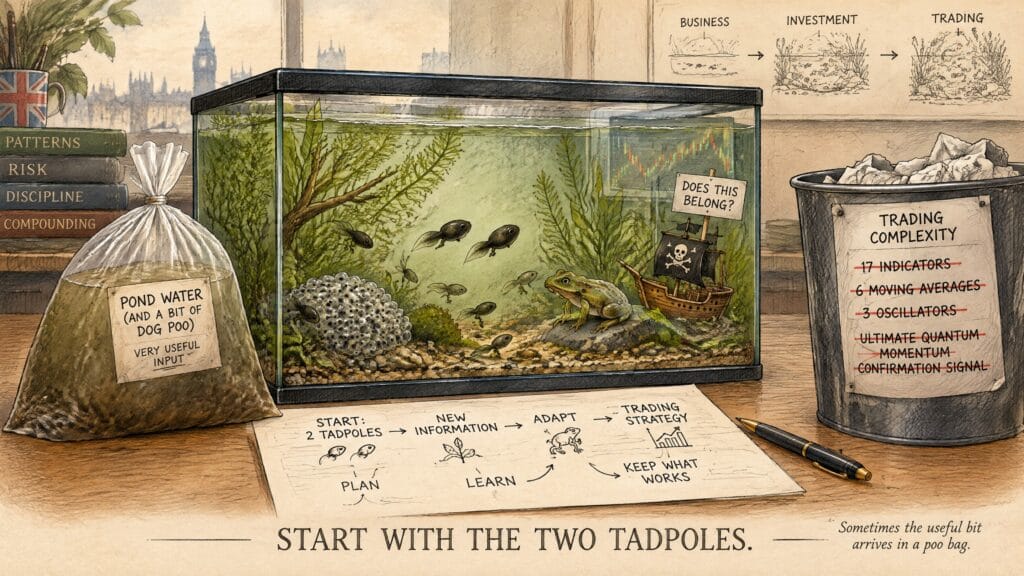
Initially, they were living in one of our kitchen containers, which very quickly began to feel slightly inadequate, so I bought a small fish tank. This was obviously better: more room, better visibility for my daughter and presumably a significant improvement in the tadpoles’ standard of living. But once you have a tank, a tank containing nothing except water and two tadpoles looks rather bleak. They needed somewhere to hide and something resembling their natural environment, so I added some aquatic plants and bits from the pond. Excellent. We now had an ecosystem.
Except there wasn’t quite enough water. This was easy enough to solve. ChatGPT, which has apparently added amphibian husbandry to the increasingly bizarre list of things I ask it about, had sensibly suggested that if the tadpoles came from the pond, the safest option was to use more water from the same pond rather than suddenly dumping them into chlorinated tap water. So back I went.
Once again, I had no bucket. Once again, I did have poo bags, and having established that these make surprisingly effective emergency water carriers, I filled two of them with pond water and took them home. The water was extremely murky. We’ve had all the rain, the pond is full of silt, and you could see virtually nothing inside the bags. It didn’t matter. I wasn’t collecting anything this time. I already had my two tadpoles. I just needed the water.
I poured it into the tank and apparently I now had about ten tadpoles.
They had been completely invisible in the muddy water. Some were tiny, some considerably larger, and one was already well advanced towards becoming a frog, with legs developing and that slightly peculiar intermediate appearance where evolution seems to have got halfway through the job and gone off for lunch. My carefully controlled two-tadpole biological experiment had therefore increased its population by roughly 400 per cent in the time it took me to pour two poo bags into a fish tank.
My daughter, meanwhile, thought this was absolutely magnificent. She now checks them in the morning and wants to see them when she gets back from school. We can identify the different stages they’re at, watch the larger ones changing and compare them with the tiny ones. What started as a fairly simple idea had accidentally become much more interesting precisely because it had stopped going according to plan. And I had become surprisingly fond of them myself.
Then this morning things escalated again.
I went to look at the tank and attached to the plants are what appear to be little clusters of eggs or spawn. I have absolutely no idea how this has happened. I began this exercise with two tadpoles that I rescued from almost certain death using a dog poo bag. I then accidentally acquired another eight because I couldn’t see through some muddy water. And now, unless I am completely misidentifying something in the tank, we appear to have moved backwards through the amphibian production process and acquired the beginning of another generation.
At this rate, by next Thursday I will presumably own a wetland.
What I particularly love about it is that the tank now contains almost the entire progression at once. There are tiny tadpoles near the beginning of development, larger ones somewhere in the middle and one particularly advanced chap who looks as though he is already mentally choosing which part of the pond he’d like to live in once we release him. And somewhere among them is potentially the next batch. What began as two tadpoles has become a miniature ecosystem, which is precisely the point at which I realised I had done it again. Bloody hell. This is a strategy.
Think about almost anything you’ve ever built successfully, whether it’s a business, an investment portfolio, a trading system, a career or frankly your life. You normally begin with something fairly simple. There is a problem you want to solve, so you build something that solves it. Then you notice that if you add one small thing, it works slightly better. Fine. That improvement creates another opportunity you hadn’t anticipated, so you add that. Something else arrives accidentally. It turns out to be useful, so you keep it. The new thing interacts with the old thing and creates another possibility that wasn’t in the original plan. Before long, you look down and realise your two tadpoles have become an ecosystem.
This is how businesses develop all the time. A company begins by selling one product to one type of customer. Customers start using it for something the founders hadn’t anticipated, the company notices, builds a feature around that behaviour and suddenly the secondary use becomes more important than the original product.
It happens in markets too. You might begin with an extremely simple strategy: I trade this instrument, under these circumstances, using these signals. Then you discover that the strategy behaves differently during periods of high volatility, so you incorporate volatility. You realise performance changes around particular economic announcements, so you adapt around those. Perhaps you discover that something originally intended as an entry signal is actually more useful as a risk filter. The strategy develops, and if you’re doing it properly, you’re not simply bolting random things onto it. You’re watching what happens, learning from the environment and allowing useful information to change what you do.
There is an obvious problem with this, because complexity isn’t automatically improvement. If I went back to the pond tomorrow and added three fish, a crab, half a kilogram of gravel, a plastic pirate ship, some seaweed I found on the beach and a decorative miniature SpongeBob, I wouldn’t have created a more sophisticated ecosystem. I’d have ruined the tank.
Strategies can suffer exactly the same fate. Anyone who has spent enough time around trading will have seen systems that began with one perfectly sensible idea and gradually accumulated seventeen indicators, six moving averages, three oscillators, a Fibonacci retracement and something called the Ultimate Quantum Momentum Confirmation Signal that somebody found on YouTube. Every individual addition probably had an explanation. Collectively, nobody has the faintest idea what the thing is doing anymore.
Businesses do it as well. Products acquire features because one customer asked for them. Management structures acquire layers because somebody once had a problem. Processes are added to fix processes that were themselves added to fix earlier processes. Eventually the organisation has become incredibly sophisticated at doing things nobody remembers needing to do. That isn’t evolution. That’s clutter.
The interesting question is therefore not simply how we improve the system, but what has the system taught us that deserves to become part of it? My accidental extra tadpoles belong in the tank because they’re part of exactly the same environment. The plants belong there because they improve that environment. More pond water belongs there because the animals need it. The plastic pirate ship probably doesn’t, although my daughter may disagree.
The part of this little experiment I find most interesting is that almost everything that has made it better was unplanned. The two original tadpoles were planned, if scooping something off a flooded path with a poo bag can reasonably be described as planning. The other eight weren’t. The different stages of development weren’t. Whatever is now attached to the plants certainly wasn’t.
But those unexpected elements have made the whole thing considerably more interesting for my daughter because she isn’t simply watching two tadpoles get bigger. She’s watching a system. Different creatures are at different stages, the environment changes, one develops legs while another is still tiny, and the plants aren’t merely decoration but part of the habitat. That is much closer to how useful strategies develop in the real world.
We have an understandable obsession with plans. Business plans, investment plans, trading plans, five-year plans, forecasts, models and targets. We quite rightly want to know where we’re going and how we intend to get there. But a plan is built using the information you possess before you begin. Once you begin, you acquire new information, and refusing to use it because it wasn’t in the original plan isn’t discipline. It’s stubbornness.
There is an important difference between abandoning your strategy every time something unexpected happens and allowing your strategy to learn. We talked about this in the school article last week: if you change your trading system after every losing week, you haven’t got an adaptive strategy, you’ve got a nervous twitch with a trading account. But the opposite extreme is just as ridiculous. If reality repeatedly tells you something and you refuse to incorporate it because “that wasn’t the plan”, eventually reality wins. Reality is irritatingly good at that.
Perhaps that’s the bit I like most. The original idea still matters. Without the two tadpoles, there is no tank. Without the tank, there are no plants. Without needing more water, there is no second trip to the pond. Without the muddy water, there aren’t another eight tadpoles. Without all of that, my daughter isn’t standing there every morning examining this strange little world and learning something about how animals develop.
You need the simple strategy first. You need to know what problem you’re solving, what you’re trying to achieve and roughly what success should look like. That gives you something to build around, but you also need enough humility to accept that the finished version may look nothing like the thing you imagined at the beginning.
Some of the best businesses in the world ended up making their money from things that weren’t central to the original idea. Some of the best investors have changed their approach as markets changed and their own knowledge improved. Some of the best trading systems evolve because the person running them notices something the original model didn’t. You don’t throw away the original thesis casually; you allow it to develop. And occasionally something useful arrives in a poo bag.
I have no idea how this experiment ends. Hopefully, over the next few weeks, the larger tadpoles become froglets, we return them safely to the pond they came from and my daughter gets to watch the complete transformation. Then the smaller ones follow. If the mysterious new additions really are eggs and they develop too, apparently I have committed myself to this process for rather longer than originally anticipated.
That wasn’t the plan, but that’s rather the point. Most worthwhile things don’t develop in a straight line from intention to outcome. You start with an idea. You build the smallest version that works. You observe it, improve the environment around it and see what happens. Unexpected things appear. Some belong and some don’t. You keep what strengthens the system, remove what doesn’t and gradually what you have stops looking like the thing you originally designed. It starts behaving like an ecosystem.
So yes, after confidently announcing last week that I don’t turn every event in my personal life into some tedious analogy about trading, I have now managed to derive an investment philosophy from rescuing tadpoles in a dog poo bag. I accept that the evidence against me is beginning to mount.
Tomorrow morning my daughter and I will go and inspect our increasingly complicated amphibian empire. We’ll see what’s changed overnight, whether the big one has developed any further and whether the mysterious eggs on the plants are actually what I think they are. If there’s suddenly a frog sitting there looking back at me, we’ll adapt the strategy again.
Perhaps that is the lesson. Start with a plan, build around what works, pay attention to what appears unexpectedly and don’t become so attached to the original strategy that you fail to notice you’ve built something better. Just remember that at some point, you still have to release the frogs. Otherwise you’ve not built an ecosystem; you’ve accidentally opened a zoo.
Keep your Axe sharp. And always check what’s in the poo bag.
Max
Join the FX Axe newsletter and stay one chop ahead.

