

Look, I'm a rugby union man. My immaculately manicured hands and delicate facial features aren't necessarily something that needs to be demonstrated on the hard, stony fields of northern England, where rugby league appears to have been specifically designed for men called Gaz who regard having several functioning teeth as an unnecessary affectation of the middle classes.
I grew up with union. I played it, I watch far too much of it, and I remain capable of spending an unreasonable amount of time discussing whether somebody entered a breakdown from precisely the correct angle while every normal person in the room gradually moves away from me. League has always been the other code: thirteen players, six tackles, barely a scrum worth the name and a rather refreshing attitude that if you've been tackled, perhaps you could just get up and get on with it rather than lying underneath six forwards while a Frenchman with a whistle conducts a lengthy archaeological investigation into what happened.
But I like rugby league. I like it a lot, actually. It is fast, brutal, skilful and wonderfully uncomplicated in places where union occasionally seems determined to make itself impenetrable to new audiences. And with the Rugby League World Cup in full flow, I'm watching it properly, because the international game is getting interesting.
Australia are inevitably the big beast. They are the number-one favourites because Australia and rugby league go together rather like the All Blacks and union, Brazil and football, or the English cricket team and making me unnecessarily nervous at all times. The depth of the Australian game is absurd. The NRL produces enormous, technically excellent athletes almost industrially, and Australia have spent decades treating international rugby league trophies as items that occasionally need to be lent to other countries before being returned.
That is why England's 30–12 defeat to Tonga matters. Losing to Tonga would once have been viewed as a catastrophe. Now you look at the Tongan team and, frankly, look at some of the fucking Tongans. These aren't enthusiastic amateurs who have arrived with a flag and a protein based packed lunch. They are enormous, highly skilled professional rugby players drawn heavily from the same NRL system producing Australia's stars. Tonga, Samoa and the wider Pacific nations have transformed international league because heritage eligibility has allowed extraordinary players to represent countries that previously couldn't assemble that sort of depth. Suddenly Australia are still favourites, but the path towards another trophy contains considerably more very large Pacific Islanders than it used to.
England have serious quality too. Herbie Farnworth is one of those athletes who makes professional sport look slightly unfair. He's enormous, fast, skilful and capable of running into defenders with the sort of enthusiasm most of us reserve for walking through an automatic door. There is plenty to like about England, despite the Tonga result, and that's partly why I'm looking forward to the tournament. I don't need rugby league to replace rugby union in my affections. I can enjoy something outside my natural sporting home without having to convert to it.
And actually, rugby union worked that out years ago.
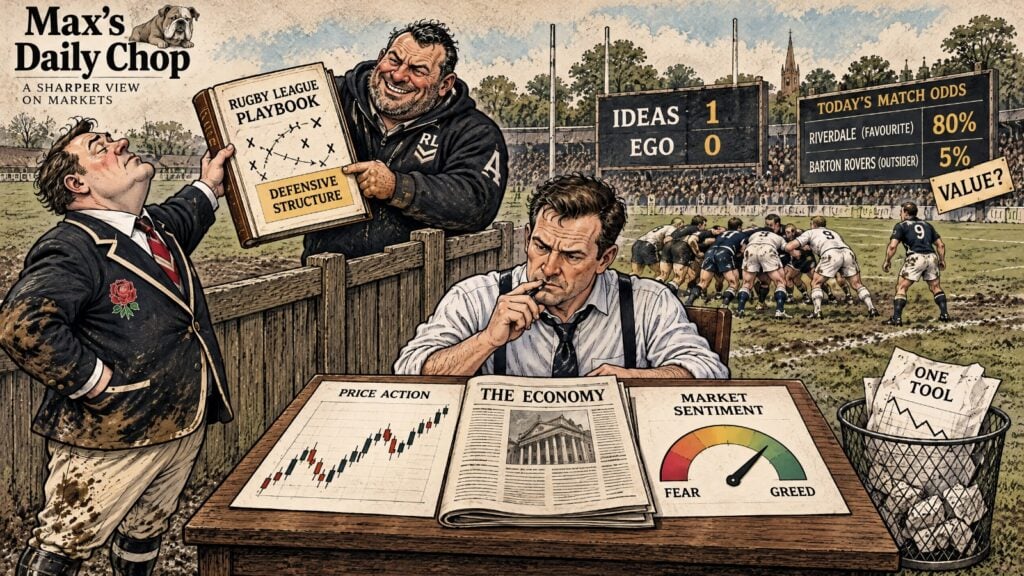
When union became professional in 1995, it discovered fairly quickly that rugby league had spent decades becoming extremely good at several things union suddenly needed to understand. The response, eventually, was admirably pragmatic: steal them.
Defence is the obvious example. League had developed sophisticated systems for organising thirteen men against repeated attacking phases in open space. Connected defensive lines, aggressive line speed, numbering systems, inside pressure, communication, decisions about when to slide and when to shoot: these were problems league coaches had spent years solving. Union had traditionally spent rather more time concentrating on set pieces, territory and what happened when everybody piled on top of the ball.
Professionalism changed that. Players became bigger, fitter and faster, attacking structures improved and suddenly union needed proper defensive systems. Instead of pretending it already had all the answers, it went shopping next door.
Phil Larder came from rugby league and became an important part of Clive Woodward's England operation, culminating in the 2003 World Cup. Shaun Edwards went from being one of the great rugby league players to becoming arguably the most famous defensive coach in rugby union, transforming Wasps, Wales and then France. Andy Farrell captained Great Britain in league before crossing codes, becoming an elite union coach and eventually leading Ireland.
It wasn't only defence. League's influence can be seen in attacking shapes, handling under pressure, short passing between forwards, running lines and the way modern union teams manipulate defensive structures. Union didn't become league. It simply recognised that the people next door were exceptionally good at certain things and asked what it could learn from them.
That distinction is important. Taking an idea from somebody else doesn't mean accepting everything they believe.
You can still think a rugby league scrum is essentially six large men leaning against another six large men while everyone politely waits for the actual rugby to resume. You can still prefer lineouts, rucks and the tactical complexity of union. You can still believe your own game is better and simultaneously acknowledge that somebody else has solved a particular problem better than you have.
That is intellectual openness, and it is something traders could do with considerably more of.
Or a fundamental trader. Or a macro trader. Or a price-action trader. Or whatever other little box you've decided you belong in.
Trading is remarkably tribal. Technical traders sometimes talk about fundamentals as though knowing what an interest rate is represents an unfortunate distraction from the purity of the chart. Fundamental traders can talk about technical analysis as though drawing a support line automatically qualifies somebody for admission to an astrological society. Price-action traders think indicators are unnecessary. Indicator traders sometimes produce charts that look as though they're attempting to launch Apollo 11. Macro traders are discussing Japanese bond yields and global capital flows while somebody scalping EUR/USD is wondering whether any of this is likely to matter before he finishes his coffee.
The mistake is assuming one of them has to be right and everybody else has to be wrong.
You can be a fundamentally driven trader and use technical analysis to improve your entry. You can trade predominantly from charts and still know that non-farm payrolls are being released in twelve minutes. You can understand the macroeconomic argument for a currency moving higher while recognising that everybody else understands it too and the trade is already hopelessly crowded. You can use sentiment, positioning, price action, support and resistance, volatility, momentum, economic data and whatever else helps you make a better decision without being required to swear allegiance to any of them.
Steal what works.
That is what rugby union did. It didn't hold an existential conference to decide whether employing a league defensive coach meant abandoning its identity. It found people with expertise it didn't have and used it.
Traders should think exactly the same way.
We all have a natural inclination towards the things that make sense to us. Some people love numbers. Some like charts. Some want to understand the economic story behind every move. Others couldn't care less why something is moving as long as they can identify the movement early enough to trade it.
That's fine. Your natural style matters because you need to understand and trust the way you make decisions. The problem comes when preference turns into dogma.
Imagine a rugby union coach saying, “I'm a union man, therefore I refuse to learn anything from rugby league.” He wouldn't sound principled. He'd sound like an idiot. If Shaun Edwards can make your defence better, you employ Shaun Edwards. Which, ironically the RFU refuse to do-he’s off to Argentina now.
Yet traders do the equivalent constantly. They dismiss entire schools of thought because they aren't “their style”. Somebody who trades technically ignores economic data that could explain why the market is behaving unusually. Somebody who trades fundamentals refuses to acknowledge that an obvious technical level is attracting enormous flows. Somebody convinced by a long-term macro thesis keeps buying into falling momentum because eventually the market must recognise that he is right.
Maybe it will.
It can bankrupt you while you're waiting.
The better approach is to understand your core competency while remaining interested in everybody else's. You don't need to use every tool. In fact, trying to use everything simultaneously will probably leave you paralysed, staring at 17 contradictory indicators while the trade you were considering disappears without you.
But you should understand what those other tools are telling you.
A rugby team doesn't need thirteen fly-halves. It does need the fly-half to understand what the forwards are trying to achieve.
This becomes particularly useful when thinking about Australia at the World Cup. Australia can simultaneously be the team I think is most likely to win and a terrible bet.
Those statements aren't contradictory.
Suppose Australia have a 60 per cent chance of winning the tournament. They are clearly favourites. But if the odds available effectively imply an 80 per cent chance, the price is unattractive. Conversely, suppose England have only a 15 per cent chance of winning but the market price implies five per cent. England could theoretically be the better value despite being substantially less likely to win the trophy.
This is one of the most important distinctions in trading and investing: being right about the outcome is not enough. You also need to be right about the price.
A magnificent company can be a terrible investment if you pay an absurd valuation for it. A struggling company can become an excellent investment if everybody else has become excessively pessimistic. The dollar can be fundamentally strong and still be a bad trade if the entire market is already long dollars. Oil can obviously benefit from war and still be a dreadful place to buy if the price already assumes half the Middle East is about to be set on fire.
You aren't trading reality in isolation. You're trading the difference between reality and expectations.
That is another reason to expose yourself to different ways of thinking. The technical trader may spot something the economist misses. The macro trader may understand why a beautiful chart setup is about to be driven through a wall by a central-bank announcement. The sentiment trader may recognise that everybody is already positioned for the supposedly obvious outcome.
Each discipline sees part of the pitch.
The best traders learn to look around.
England's defeat to Tonga offers another lesson because both sport and markets encourage an incredibly dangerous habit: allowing the most recent result to rewrite everything you thought you knew.
England lose 30–12 and suddenly they're rubbish. Australia scrape past New Zealand 24–22 and perhaps Australia aren't so unbeatable after all. One late pass sticks, one kick bounces differently or one enormous Tongan runs over somebody rather than being tackled two metres short, and an entire week's analysis changes.
But the underlying players haven't suddenly become different people.
New information matters. Of course it does. England losing heavily to Tonga should affect how you assess England. The mistake is assuming the latest information is the only information.
Markets are appalling for this. One inflation number arrives slightly above expectations and interest rates are apparently staying high forever. One weak employment report appears and suddenly we're discussing emergency rate cuts. A company misses quarterly earnings by a few percentage points and billions disappear from its market value before the chief executive has finished the conference call.
Then everyone calms down.
A good coach asks whether a defeat revealed a structural weakness or whether the team simply played badly. A good trader should do the same thing with a losing strategy. Has the environment changed? Has volatility changed? Has your edge disappeared? Did you execute badly? Or did something with a positive probability of failure simply fail?
You cannot learn anything useful unless you're willing to look beyond the result.
There is an important qualification to all this. Being open-minded doesn't mean copying everything you see.
Rugby union couldn't simply take a rugby league defensive system and transplant it unchanged. The sports are different. Union has fifteen players, rucks, mauls, lineouts, contested possession and different spaces to defend. The principle had to be adapted.
Trading strategies are exactly the same. Somebody might show you an extraordinary system for scalping gold on a one-minute chart. Fantastic. Does it suit your temperament? Can you execute it? Does it work when spreads widen? Does it work in different volatility regimes? Does it still work after transaction costs? Does it work outside the three-month backtest somebody selected because that was the period when it looked brilliant?
Take the principle, test it and adapt it.
Don't photocopy the playbook.
And don't assume that because something works for somebody else it has to work for you.
The point of intellectual openness isn't to become a magpie collecting every shiny strategy on the internet. It is to become curious enough to ask whether somebody outside your natural way of thinking knows something useful.
That is what I increasingly like about modern rugby. The old boundaries are becoming less important. Union steals league defence. League studies union kicking. Rugby studies American football tackling and analytics. Football clubs employ specialist throw-in coaches. Formula One looks at cycling aerodynamics. Elite sport has become one enormous intellectual burglary because everybody has finally realised that ideas don't care which changing room they came from.
Business works like this too. Most successful companies aren't built entirely from ideas nobody has ever had before. They take existing technologies, systems and behaviours and combine them better. Innovation is often less about inventing something from nothing than noticing something useful somewhere else.
Trading should be no different.
Have a core philosophy. Know what you're good at. Understand your preferred time horizon, risk tolerance and decision-making style. But don't build walls around it.
Read the fundamental argument even if you're a technician. Look at the chart even if you're a macro trader. Understand sentiment. Understand positioning. Learn what options markets are implying. Look at volatility. Listen to people you disagree with. Especially listen to people you disagree with when they're intelligent.
You don't have to become them.
You just need to be willing to steal their best idea.
That is ultimately why I'm looking forward to the Rugby League World Cup. I'll be watching as a rugby union man, probably still quietly judging the scrums and wondering why nobody has formed a maul for an hour. I'll support England. I'll admire Herbie Farnworth. I'll look at some of the Tongans and remain extremely grateful that my immaculately manicured hands and delicate facial features never required me to tackle one of them on a freezing field somewhere outside Wigan.
And I'll probably expect Australia to win.
But I'll also watch what league does well, because my preferred version of rugby doesn't need to be the only version from which I can learn something. In fact, one of the reasons rugby union improved so dramatically after professionalism was precisely because it became less precious about that distinction.
There's a useful lesson there far beyond rugby.
Know your game, but study everybody else's. Have a strategy, but don't worship it. Develop expertise, but don't allow expertise to become a closed mind. The best idea available to you may come from somebody whose entire approach you normally disagree with.
Take it anyway.
Rugby union did.
And it became better.
Keep your Axe sharp. And never be too proud to steal a good playbook.
Max
Join the FX Axe newsletter and stay one chop ahead.

