

I started writing this article earlier in the week, after watching Katie Zacharia's first performance as White House press secretary and wondering how somebody apparently so spectacularly uncomfortable speaking to the press had managed to become White House press secretary. Her inaugural briefing on Tuesday lasted approximately 14 minutes. She spent much of it reading slowly from prepared notes, looking down repeatedly and delivering the sort of performance that suggested somebody had accidentally entered the White House briefing room while looking for the toilets and decided it would be more embarrassing to leave. She took three questions, all from broadly Trump-friendly outlets, before bringing proceedings to a fairly merciful conclusion. At one point she began talking about her family and attempted to thank her husband. Unfortunately, what actually came out was: “my president — excuse me, my husband.” Which, to be fair, may be the most Trump-administration Freudian slip imaginable.
I should declare an interest here. Of course, presenting is incredibly difficult. Reading from an autocue while trying to sound as though you aren't reading from an autocue is incredibly difficult. Anyone that does so should be revered with quivering respect, they are the mighty warriors of yore. Talking into a camera while somebody is waving at you from behind it, another person is counting down in your ear and your brain is simultaneously attempting to remember whether the next sentence contains the word “stagflation” is a peculiar and, lets be honest, remarkable skill… Well is it? Surely not if your employed as press secretary to the most widely watched office in the world.
There are certain jobs where “public speaking makes me nervous” represents a fairly significant occupational disadvantage. Lifeguard if you can't swim. Pilot if you're frightened of heights. Sommelier if you hate wine. And perhaps spokesperson for the President of the United States if standing behind a lectern and speaking to journalists causes your operating system to begin installing updates. So I started wondering how somebody reaches one of the most visible communications positions on Earth without anybody apparently establishing whether they're particularly good at communicating. Then I woke up this morning and discovered that Donald Trump had apparently wondered exactly the same thing.
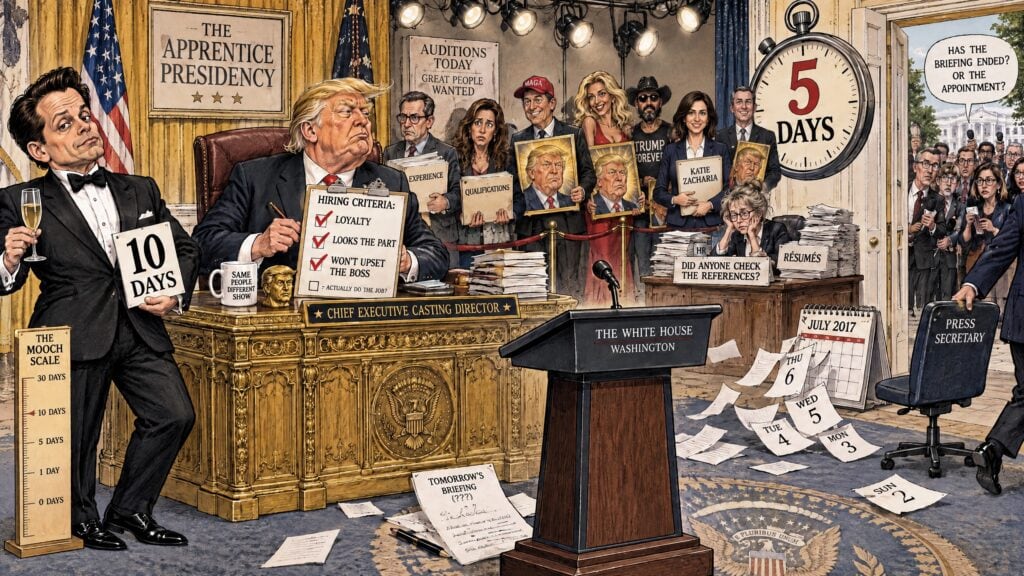
Katie Zacharia was announced as Trump's new White House press secretary last Friday. By the following Friday, Trump was standing outside the White House explaining that he'd had a conversation with her. “I said, Katie, is this for you?” He said she'd been treated very roughly by the media, thought even Sean Hannity had been rather tough on her and had apparently advised her: “Honestly, if I were you, I'd reconsider.” Then came the line every employee dreams of hearing from the President of the United States five days after starting a new job: “Maybe it's not for her.” She was subsequently confirmed as leaving the position.
Five days is quite an achievement because the Trump administration already has an unofficial unit for measuring catastrophically short political careers. Anthony Scaramucci famously served as Trump's White House communications director for ten days in 2017, a period so gloriously brief that a Scaramucci, or a Mooch, subsequently became a joke unit of political time. Katie Zacharia has therefore managed approximately half a Mooch. At this rate future White House appointments may have to be measured in lettuces.
The comparison is slightly unfair to Scaramucci because, underneath all the comedy surrounding his White House implosion, the Mooch is actually a remarkably accomplished bloke. He has a degree in economics from Tufts, a law degree from Harvard, built a successful career on Wall Street, founded SkyBridge Capital, wrote several books and now co-hosts The Rest Is Politics: US alongside Katty Kay. I listen to him reasonably regularly and he's interesting, informed, self-deprecating and surprisingly thoughtful about his brief encounter with the Trump machine. Whatever you think of his politics, nobody could reasonably argue that Anthony Scaramucci somehow wandered into the White House because he looked good standing behind Donald Trump. He was qualified. He was also fired after ten days. Zacharia lasted five. Inflation really is everywhere.
Unfortunately for Zacharia, the briefing wasn't even the strangest part of her week. When Trump announced her appointment he described her as an attorney. Zacharia herself had repeatedly used the language of being a lawyer during media appearances, she has a law degree from Pepperdine and had previously worked at a major law firm in Beijing. There was, however, a fairly substantial administrative wrinkle: she hadn't passed the California bar. When reporters started asking where she had actually passed the bar, the answer became confused. Eventually, during an interview with Sean Hannity, she acknowledged that she had failed the California bar exam in 2011 and never retaken it.
Now, failing the bar doesn't make somebody stupid. The California bar is famously difficult and plenty of extremely clever people have failed it. Nor does having a law degree without practising law invalidate everything somebody subsequently does with their life. But if the President of the United States announces you to the world as an attorney, and you have repeatedly presented yourself publicly as a lawyer, it would be useful if somebody in the recruitment process had established whether you had ever actually qualified to practise law. Particularly when the job you are being recruited for involves standing in front of a room full of journalists whose entire professional purpose is finding awkward things you would prefer they didn't find.
And this is where Zacharia herself stops being particularly interesting and the system around her becomes fascinating. Donald Trump did not inherit Katie Zacharia from some enormous government bureaucracy. Reporting suggests Trump personally selected her, surprising members of his own senior staff, and that the appointment was made without the usual internal process. So this wasn't somebody promoted beyond their competence by an HR department after twenty years of quietly collecting service awards. The President chose her. That immediately raises a much more interesting question about Trump as a manager: what qualities does he actually value in the people around him?
There is an increasingly obvious answer, and it is loyalty. Research into Trump's second-term staffing has repeatedly identified personal loyalty as an unusually important characteristic in appointments. That isn't necessarily irrational. Every leader wants people they can trust. CEOs don't deliberately appoint executives who despise them, football managers prefer players who believe in the system, and if I'm building a company I would rather not discover during the Monday morning meeting that my commercial director has started a WhatsApp group called “Get Max Fired”. Loyalty is valuable. The problem begins when loyalty stops being one qualification among several and starts replacing the others.
This is something we've already touched on in these pages with Natalie Harp, Trump's extraordinarily devoted aide and carrier of what is, of course, DEFINITELY NOT A NAPPY BAG, despite looking remarkably like a bag in which one could transport a fairly comprehensive selection of nappies. Harp has become famous for printing articles and handing them to Trump, earning the nickname “the human printer”. Her proximity to him is extraordinary. She follows him around, supplies him with information and appears to enjoy a level of personal access that most presidential advisers could only dream about. Perhaps she's brilliant at it. I have absolutely no idea. But she fits a wider Trump pattern in which personal devotion and being saccharinely pretty appears to carry enormous currency.
This isn't unique to Trump. Every powerful person develops a court. CEOs acquire people who laugh slightly too enthusiastically at their jokes. Football managers acquire assistants who have somehow worked with them at six different clubs. Kings had courtiers. Roman emperors had favourites. Rupert Murdoch has presumably never had to make his own cup of tea since about 1957. The danger is what psychologists and management consultants have been warning about forever: if the boss increasingly rewards agreement, eventually the boss stops receiving information and starts receiving applause.
Trump's particular personality makes that tendency especially interesting because he appears to place enormous value on public loyalty. People who praise him extravagantly can move surprisingly quickly into his orbit, while people who criticise him can move equally quickly out of it. When that becomes part of an organisation's culture, recruitment changes. The question gradually stops being “Is this the best person for the job?” and becomes “Does this person understand the boss?” Those are not remotely the same question.
There is another uncomfortable feature of Trump's political world that is impossible not to notice: presentation matters enormously to him. Trump came from television. He understands casting, pictures and the fact that politics is partly theatre. He has repeatedly commented on people's appearance, their television performance and whether somebody “looks the part”. His administration and wider political orbit have consequently included a striking number of television personalities, influencers, commentators and extremely camera-ready loyalists.
There is obviously nothing wrong with being attractive, and being an attractive woman tells you precisely nothing about intelligence or competence. Plenty of Trump's female appointees are accomplished professionals, so simply dismissing them all as blonde bimbos would be both unfair and lazy. The more interesting question is whether, in Trump's world, casting has occasionally been confused with recruitment. Television asks whether somebody looks right in the shot. Government has to ask whether they can do the bloody job. Sometimes those questions produce exactly the same candidate; sometimes they very much don't. Katie Zacharia's extraordinary week looked rather like what happens when the casting process reaches the podium before the competence test catches up.
That matters because organisations eventually become reflections of what their leaders reward. If the fastest route to promotion is disagreeing intelligently with the boss, you eventually produce a culture full of people willing to challenge assumptions. If the fastest route is telling the boss that every idea is magnificent, you eventually produce a room full of people waiting for somebody else to mention that the building is on fire. Markets work exactly the same way. If you surround yourself exclusively with analysts, commentators and Twitter accounts that already agree with your position, you haven't conducted research; you've assembled a support group.
The same principle applies rather more consequentially to presidents. If my mate tells me my terrible business idea is brilliant, I might lose some money. If everybody around the President of the United States tells him his terrible idea is brilliant, several aircraft carriers may eventually become involved. That is why competence matters, disagreement matters and awkward people matter. Sometimes the person in the room who annoys you is the most valuable person in it.
There is something almost magnificent about the speed with which the Zacharia episode resolved itself. On Friday she was announced as White House press secretary. By Tuesday she was standing behind the lectern accidentally referring to the President as her husband. Then came the questions about whether the lawyer was actually a lawyer, followed by Sean Hannity interviewing her, and within days the President who had appointed her was publicly wondering whether the whole White House press secretary thing was really her scene. Somewhere Anthony Scaramucci presumably raised a glass.
The White House itself had described Zacharia's first appearance as a “commanding inaugural press briefing”. Days later the man she was supposedly commanding the press on behalf of was essentially saying: perhaps communications isn't for you. That might be my favourite part of the whole episode, because it captures something about Trump’s “politics” that increasingly fascinates me: the distance between the official description of reality and reality itself can now survive approximately 72 hours before somebody quietly deletes the press release.
Everything is historic. Everything is tremendous. Every appointment is brilliant. Every speech is extraordinary. Every new member of the team is the finest person ever to occupy the position, right up until the moment they aren't. And we have somehow reached an era in which events that would once have been considered spectacularly embarrassing barely survive a news cycle. A White House press secretary can arrive, stumble through one briefing, become embroiled in questions about whether she possesses the professional qualification people were told she possessed, and disappear again before most of the public has learnt her name. Then everyone simply moves on because by lunchtime something even more ridiculous has happened.
That may actually be the most interesting part of the story. Trump has made politics so relentlessly absurd that our embarrassment threshold has moved. Something extraordinary happens on Monday, something more extraordinary happens on Wednesday, and by Friday we've forgotten both because somebody has announced something completely insane on Truth Social. Yet organisations still obey fairly boring old rules. Recruit badly and you get bad recruits. Reward loyalty above competence and eventually competence leaves the building. Surround yourself with people who tell you how magnificent you are and eventually somebody will tell you your new clothes look wonderful while you're standing in the street with your small toadstool shaped (according to Stormy Daniels) cock out. Hans Christian Andersen really has been doing a lot of work for this column recently.
Katie Zacharia isn't ultimately the interesting part of this story. She took an enormously difficult job, discovered almost immediately that she wasn't suited to it and is now out. There is actually something refreshingly efficient about that. The interesting part is the person who put her there, because if somebody is obviously wrong for one of the most visible jobs in government, the important question isn't simply why she was so bad. It is why the person doing the hiring thought she would be good.
Five days later, Donald Trump apparently had his answer: “Maybe it's not for her.” Perhaps somebody should have asked before giving her the job.
Keep your Axe sharp. And always check the CV before announcing your lawyer.
Max
Join the FX Axe newsletter and stay one chop ahead.

